June 12, 2026
Why Carbonatite Geology Is the Silent Engine Behind the World's Critical Mineral Renaissance
Most investors tracking the critical minerals space focus on commodity prices, permitting timelines, or geopolitical risk. Far fewer pause to consider the geological architecture that actually determines whether a mining project can generate multiple revenue streams simultaneously. Carbonatite-hosted deposits represent one of the most structurally complex and commercially compelling ore systems on Earth, precisely because they concentrate multiple critical minerals within a single, often near-surface mineralised body. Understanding that architecture is the starting point for interpreting what the St George Araxá niobium and rare earth flotation results actually mean for the project's development trajectory.
When big ASX news breaks, our subscribers know first
The Araxá Carbonatite: A Geological System Unlike Most Critical Mineral Deposits
The Araxá region of Minas Gerais, Brazil, is not simply a mining district. It is arguably the most economically significant carbonatite complex on the planet when measured by the concentration of critical mineral value within a geographically compact area. The dominant operating niobium facility in the world is located here, a fact that establishes the geological pedigree of Araxá-style pyrochlore mineralisation beyond any reasonable dispute.
What makes carbonatite-hosted systems particularly unusual is their internal layering. The weathering profile above the unaltered carbonatite rock creates distinct horizontal zones with different mineralogical characteristics:
- The orange saprolite horizon sits at the top of the weathering profile, representing the most accessible and typically the lowest-density ore type, but one that responds well to conventional flotation
- Beneath this lies the brown saprolite layer, which carries a higher concentration of pyrochlore niobium mineralisation but requires more intensive processing
- Deeper still sits a phosphate-rich apatite zone, which adds yet another potential commodity to the system
This vertical stratification means that early-stage mining in Araxá-style deposits typically accesses orange saprolite first, offering lower strip ratios and reduced capital intensity during the initial years of production. The flotation testwork now completed by St George Mining used exactly this ore type, which is critical context for interpreting the results' commercial relevance.
Furthermore, a key distinction of carbonatite-hosted pyrochlore deposits versus hard rock niobium mineralisation is that the saprolitic weathering profile dramatically reduces comminution energy requirements. This translates directly into lower processing costs per tonne, a factor that materially improves project economics before a single revenue dollar is counted.
Decoding the St George Araxá Niobium and Rare Earth Flotation Results
The Niobium Circuit: First-Pass Performance Against Commercial Benchmarks
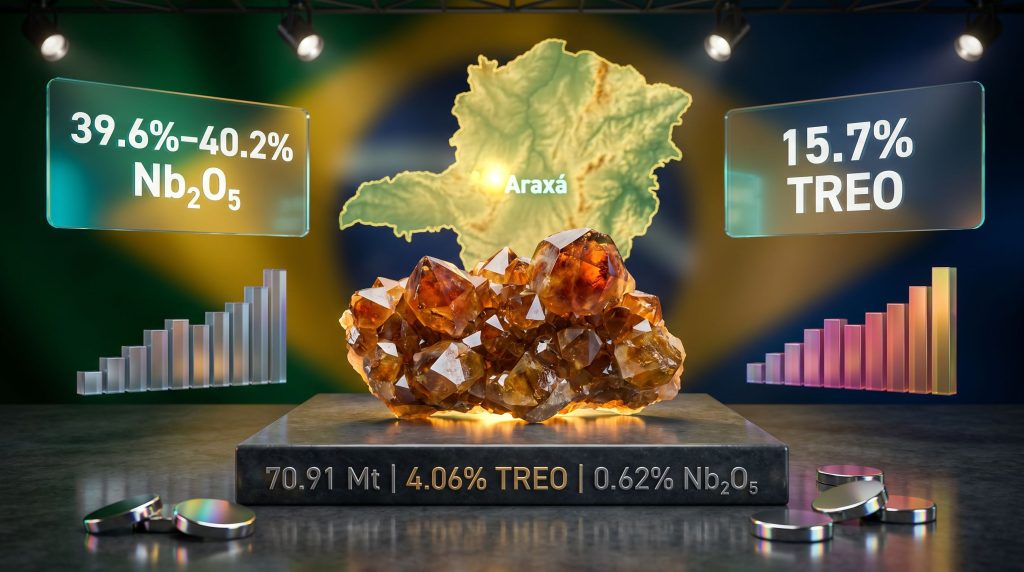
The flotation program conducted at CIT-SENAI in Belo Horizonte produced niobium concentrate grades of 39.6% to 40.2% Nb₂O₅ in the initial open-circuit evaluation. When a preceding magnetic separation step was incorporated, the combined niobium recovery across both unit operations reached approximately 50.9% Nb₂O₅ in Test 13. Standalone flotation recovery reached 54.3%.
To contextualise these numbers, it helps to understand where they sit within the established processing range for Araxá-style pyrochlore operations:
| Performance Metric | St George Araxá (Initial Open-Circuit) | Commercial Araxá-Style Pyrochlore Range |
|---|---|---|
| Flotation Concentrate Grade | 39.6%–40.2% Nb₂O₅ | 40%–50% Nb₂O₅ |
| Combined Mag Sep + Flotation Recovery | ~50.9% | 40%–60% |
| Standalone Flotation Recovery | 54.3% | 40%–60% |
| Post-Refining Grade (Pyrometallurgical) | Not yet tested | 50%–60% Nb₂O₅ |
| Post-Refining Recovery | Not yet tested | ~95% |
These results land squarely within the operating envelope of existing commercial niobium producers using the same ore type in the same geological district. That alignment on a first open-circuit pass is a materially positive signal. Commercial flotation circuits incorporate recycled middlings streams that open-circuit testing deliberately excludes, meaning the numbers above represent a conservative floor rather than a ceiling.
One technical nuance worth understanding: elevated lead oxide (PbO) content is a recognised characteristic of Araxá-style pyrochlore mineralisation. This is not an unexpected contaminant unique to St George's ore body. It is a known feature of the district's mineralisation, and existing Brazilian niobium operations have established processing protocols to manage it. Downstream refining studies, planned as the next phase of work, will assess specific impurity removal pathways and evaluate ferroniobium processing options tailored to the Araxá Central ore characteristics.
The Rare Earth Circuit: Reverse Flotation From Niobium Tailings
The rare earth component of the St George Araxá niobium and rare earth flotation results introduces a conceptually important processing innovation. Rather than treating rare earth recovery as a separate feed processing challenge, the team applied reverse flotation to the tailings stream produced by the niobium flotation circuit.
Reverse flotation is a technique most closely associated with iron ore processing, where silica gangue minerals are selectively floated away from the iron-bearing fraction using targeted reagent chemistry. Here, the same principle was applied to the niobium flotation tailings, floating silica minerals to produce a rare earth-enriched non-floating product.
The mass balance from this initial test reveals a nuanced distribution of rare earth minerals across the circuit:
| Rare Earth Distribution | Proportion |
|---|---|
| Reporting to niobium flotation concentrate | ~59.7% |
| Recovered to silica flotation tailings (RE concentrate) | ~33.2% |
| Lost to silica concentrate | ~7.1% |
| Overall open-circuit RE recovery | ~82% |
The figure that demands attention here is not the 33.2% direct recovery to the rare earth product stream in isolation. It is the ~82% overall rare earth recovery that remains within potentially recoverable positions across the circuit. The majority of rare earths currently reporting to the niobium concentrate (~59.7%) are expected to be redirectable to a rare earth product stream through locked-cycle processing, where intermediate streams are recycled back through the circuit rather than lost to tailings.
The rare earth concentrate produced graded 15.7% TREO, compared to a feed grade of 9.8% TREO, representing a 1.6-fold upgrade factor in a single flotation step. This is a commercially meaningful starting point for a concentrate that has not yet been optimised. According to reporting on the Araxá project's strong beneficiation outcomes, these early-stage results have drawn considerable industry attention.
What's Inside the Rare Earth Concentrate: The NdPr Factor
Not all rare earth concentrates are created equal. The economic value of a mixed rare earth product is heavily influenced by the proportion of neodymium (Nd) and praseodymium (Pr) it contains, since these two elements are the primary inputs for NdFeB permanent magnets used in EV traction motors and wind turbine generators. A rare earth concentrate dominated by lanthanum and cerium, which are abundant and structurally oversupplied, carries a fraction of the market value of one enriched in NdPr.
The Araxá rare earth concentrate contains:
| Rare Earth Component | Grade / Concentration | Primary Market Application |
|---|---|---|
| Neodymium Oxide (Nd₂O₃) | 2.18% | NdFeB permanent magnets (EV motors, wind turbines) |
| Praseodymium Oxide (Pr₆O₁₁) | 0.66% | NdFeB magnets (NdPr alloy feedstock) |
| Heavy Rare Earth Oxides (HREO) | ~1,037 ppm (yttrium-dominant) | Specialty alloys, phosphors, defense applications |
| Samarium Oxide (Sm₂O₃) | ~600 ppm | Samarium-cobalt magnets for defense and high-temp applications |
The presence of samarium at approximately 600 ppm is a detail that often escapes mainstream coverage. Samarium-cobalt (SmCo) magnets are specifically used in applications requiring high-temperature performance and resistance to demagnetisation, particularly within defence-critical minerals supply chains and aerospace systems. While NdPr commands the largest share of commercial rare earth supply chains by volume, samarium occupies a specialty niche with considerably less production globally and significant procurement interest from defence-critical minerals procurement agencies.
The combination of NdPr at commercial grades alongside samarium and heavy rare earth oxides positions the Araxá rare earth concentrate as a multi-application product, not a single-market commodity. That distinction has meaningful implications for offtake negotiations and pricing.
The Resource Foundation: Scale and Grade in Global Context
The metallurgical results sit on top of a defined mineral resource of 70.91 million tonnes grading 4.06% TREO and 0.62% Nb₂O₅. The simultaneous presence of world-scale grades for both commodities within a single defined resource is a structural characteristic that separates Araxá from the overwhelming majority of critical mineral projects globally, most of which are optimised around a single product.
| Resource Parameter | Value |
|---|---|
| Total Defined Tonnage | 70.91 million tonnes |
| Average TREO Grade | 4.06% |
| Average Nb₂O₅ Grade | 0.62% |
| Primary Ore Type Tested | Orange saprolite (near-surface) |
| Project Location | Araxá, Minas Gerais, Brazil |
A grade of 4.06% TREO is exceptional by global rare earth standards, where producing operations in Australia and China often process ore at grades well below 1% TREO in beneficiation plants designed specifically for rare earth recovery. Combined with a niobium grade that is commercially viable at standalone levels, the resource profile reflects a genuinely dual-commodity system rather than a primary ore with trace amounts of a secondary element.
Why the Dual-Commodity Architecture Changes the Investment Calculus
Single-commodity critical mineral projects carry an inherent concentration risk tied to the price cycle of one element. Dual-commodity projects, particularly those producing materials from different market segments with uncorrelated pricing drivers, create a natural hedging mechanism within the project's revenue model. Indeed, the broader surge in critical minerals demand underscores why this dual-commodity positioning is increasingly valued by institutional investors.
Niobium and rare earth elements serve fundamentally different industrial functions:
- Niobium is consumed primarily in high-strength low-alloy (HSLA) steel production, which is structural in nature and tied to construction, automotive manufacturing, and infrastructure spending cycles
- Rare earth elements (specifically NdPr) are consumed in permanent magnet production for electrification technologies, a demand curve driven by EV adoption rates and renewable energy deployment
These two demand drivers are largely independent of each other. A slowdown in construction activity affecting niobium steel demand does not necessarily correlate with a decline in EV motor production consuming NdPr. This structural independence between the two revenue streams is a genuine risk-management feature that strengthens the project's investment thesis relative to single-product peers.
The global niobium supply chain is currently one of the most concentrated of any critical mineral. The vast majority of global ferroniobium production originates from a single operating complex in the same Minas Gerais region, creating a supply concentration that has driven industrial consumers and procurement agencies to actively seek alternative sources. A second meaningful niobium production hub in Araxá, even at a fraction of the dominant operation's scale, would represent supply chain diversification that buyers have been structurally unable to access for decades.
Development Roadmap: What Comes After the Flotation Results
The initial flotation testwork represents the first gate in a multi-stage metallurgical development program. The sequence of work planned is structured to systematically close the gap between open-circuit bench-scale results and commercial plant performance:
| Development Phase | Primary Activity | Target Timing |
|---|---|---|
| Phase 1 (Completed) | Open-circuit flotation testwork (Nb + RE) | June 2026 |
| Phase 2 (Underway) | Locked-cycle and recycle circuit optimisation | Current |
| Phase 3 | Pilot plant study | July 2026 |
| Phase 4 | Large-scale pilot plant operational | Late Q4 2026 |
Each phase serves a distinct purpose in de-risking the processing flowsheet:
- Locked-cycle testing recycles intermediate flotation streams (middlings) back into the circuit, simulating continuous commercial plant behaviour and expected to produce higher recoveries than open-circuit benchmarks
- Closed-circuit evaluation tests the interaction between the niobium and rare earth flotation stages under continuous operating conditions, particularly important for understanding how rare earths currently reporting to the niobium concentrate can be redirected
- Downstream refining studies assess pyrometallurgical upgrading of niobium concentrates to ferroniobium specification and evaluate hydrometallurgical rare earth separation pathways
- Pilot plant operation generates bulk sample data at scale to underpin a future feasibility study process and provide the engineering confidence needed for capital cost estimation
The progression from open-circuit bench testing to pilot plant within a calendar year is an aggressive but not unusual pace for a project with strong early metallurgical indicators and an experienced technical team in place.
The next major ASX story will hit our subscribers first
The Technical Team Advantage: Local Knowledge in a Specialist District
One underappreciated aspect of the Araxá metallurgical program is the composition of the team executing it. The joint Brazilian and Australian technical group brings direct operational experience from existing niobium processing facilities within the Araxá district itself. This is not generic flotation expertise transplanted from a different mineral system. It is domain-specific process knowledge developed within the exact geological and mineralogical context being tested.
That distinction matters for several practical reasons:
- Reagent selection for pyrochlore flotation is highly mineralogy-specific. Teams with Araxá operating experience carry institutional knowledge about which reagent suites work in this ore type, reducing trial-and-error iterations in the optimisation program
- Understanding how PbO and other impurities behave in the Araxá flotation circuit requires prior exposure to the same mineralisation, not just textbook knowledge of niobium processing
- CIT-SENAI's role as the testing laboratory adds institutional credibility. As one of Brazil's foremost applied industrial research and technology centres, its involvement signals that the testwork methodology and reporting meet rigorous scientific standards
Furthermore, Proactive Investors noted that the encouraging niobium and rare earth beneficiation results represent a meaningful milestone in validating the Araxá processing concept.
Frequently Asked Questions: Understanding the Flotation Results
What is open-circuit flotation testwork and how does it differ from commercial plant performance?
Open-circuit testwork evaluates each flotation stage independently, without recycling intermediate streams back through the process. It is a deliberately conservative methodology used at early stages of process development to establish baseline performance. In a commercial plant, these intermediate streams are continuously recycled, which typically improves both grades and recoveries substantially compared to open-circuit results.
Why does 82% overall rare earth recovery matter if only 33.2% reports directly to the rare earth concentrate?
The 82% figure represents the total rare earth content remaining in recoverable positions across the circuit, including the ~59.7% currently co-reporting with the niobium concentrate. In locked-cycle testing, the recycling of intermediate streams is expected to redirect a significant proportion of those rare earths to the dedicated rare earth product stream, substantially increasing the final product recovery above what the initial open-circuit test alone suggests.
What does a 15.7% TREO concentrate grade mean in practical terms?
A 15.7% TREO grade in a flotation concentrate represents a meaningful enrichment of rare earth minerals from the 9.8% TREO feed material, achieving a 1.6-fold upgrade in a single processing step. While this is not yet a final separated rare earth product, it provides a commercially concentrated feed material that downstream hydrometallurgical processing can upgrade further into individual rare earth oxides or alloys.
How significant is samarium in the Araxá rare earth concentrate?
At approximately 600 ppm, samarium is present at concentrations relevant to specialty magnet applications. Samarium-cobalt magnets are used in defence systems, aerospace components, and high-temperature industrial applications where NdFeB magnets underperform. The samarium content adds a defence-relevant dimension to the concentrate's market positioning that goes beyond the primary NdPr magnet market narrative.
Key Signals From the Initial Flotation Program
The St George Araxá niobium and rare earth flotation results, interpreted within their proper methodological context, communicate several important things about the project's development status:
- Niobium concentrate grades of 39.6%–40.2% Nb₂O₅ align with commercial Araxá-style pyrochlore operations from the first open-circuit pass, validating the processing concept without requiring optimisation
- An 82% overall rare earth recovery in open-circuit conditions, with the bulk of the rare earth content in recoverable positions, provides a strong foundation for the locked-cycle optimisation program currently underway
- The NdPr content within the rare earth concentrate directly targets the highest-demand segment of the rare earth market, aligning the project's output with EV and renewable energy supply chains
- Samarium content at meaningful concentrations adds a defence-relevant dimension to the product profile that is frequently overlooked in generic rare earth project coverage
- The near-surface orange saprolite ore type used in this testwork reflects the material most likely to be processed in the first years of any future operation, giving the results operational relevance beyond laboratory scale
- The development timeline targeting a large-scale pilot plant by late Q4 2026 positions the project to generate bankable feasibility-grade metallurgical data within a compressed timeframe
Disclaimer: This article is intended for informational purposes only and does not constitute financial advice or an investment recommendation. Forward-looking statements regarding development timelines, metallurgical performance, and project outcomes involve inherent uncertainty. Actual results may differ materially from those anticipated. Readers should conduct their own due diligence before making investment decisions.
Want to Discover the Next Major Critical Mineral Opportunity Before the Market Does?
Discovery Alert's proprietary Discovery IQ model scans ASX announcements in real time, instantly identifying significant mineral discoveries across niobium, rare earths, and more than 30 other commodities — turning complex geological data into actionable investment insights for both short-term traders and long-term investors. Explore how historic mineral discoveries have generated extraordinary returns on Discovery Alert's dedicated discoveries page, and begin your 14-day free trial today to position yourself ahead of the market.