May 13, 2026
When Boron Became a Bottleneck: Understanding the Industrial Stakes Behind 5E's Offtake Milestone
Critical mineral supply chains rarely fail loudly. They tighten gradually, through years of underinvestment, concentrated sourcing, and deferred domestic capacity development, until industrial buyers find themselves competing for supply that was once treated as a commodity afterthought. Boron is now moving through exactly this sequence, and the dynamics reshaping its supply landscape are directly relevant to understanding why the 5E Advanced Materials boric acid offtake deal carries commercial weight that extends well beyond a single non-binding agreement.
Boron's invisibility to most investors is itself a market asymmetry worth understanding. Unlike lithium or cobalt, which have attracted intensive coverage tied to battery demand, boron has quietly underpinned some of the most technically demanding manufacturing sectors in the modern economy. LCD glass production, fiberglass insulation, ceramic glazes, agricultural micronutrients, and flame-retardant formulations all depend on reliable boric acid supply. More recently, boron's function in neodymium-iron-boron (NdFeB) permanent magnets has drawn it into the centre of clean energy and defence manufacturing debates.
When the US Government added boron to its 2025 Critical Minerals List, it formalised what industrial buyers had been experiencing operationally for some time: the domestic supply of this mineral is structurally inadequate relative to growing critical minerals demand, and import dependence from Turkish and South American producers carries geopolitical and logistical risks that long-term buyers can no longer absorb quietly.
When big ASX news breaks, our subscribers know first
The Supply Architecture That Created the Deficit
How Decades of Import Reliance Became a Strategic Vulnerability
Turkey holds an estimated 70% of the world's known boron reserves, with Rio Tinto's Borax operations in California historically representing the most significant domestic US production presence. As US industrial demand for boron-containing products expanded across construction materials, electronics, and agriculture, the sourcing model became progressively more concentrated rather than diversified.
This concentration created a specific type of supply risk that is distinct from price volatility. It is availability risk: the possibility that long lead times, geopolitical disruptions, shipping bottlenecks, or simply the production prioritisation decisions of a handful of foreign suppliers could leave US manufacturers unable to secure boric acid on terms consistent with their production requirements.
The conditions that make boric acid supply particularly sensitive include:
- Geographic concentration: The majority of global production originates from a small number of mines in Turkey and, to a lesser extent, Argentina and Chile.
- Limited domestic substitution: There are very few active or near-production boric acid sources within the United States capable of supplying industrial-scale volumes.
- Application criticality: Many end uses, including LCD glass manufacturing, cannot easily substitute alternative compounds without significant process re-engineering.
- Quality barriers: Industrial buyers in technically demanding sectors maintain strict qualification requirements, meaning new suppliers cannot simply enter the market without extensive product trials.
Furthermore, the US boric acid market has moved into a supply deficit condition, with both domestic and international buyers reporting difficulty securing reliable long-term supply commitments. This structural gap is the commercial context in which the 5E Advanced Materials boric acid offtake deal must be understood.
What the 5E Advanced Materials Boric Acid Offtake Deal Actually Represents
Heads of Agreement: The Instrument and Its Limitations
A Heads of Agreement, or HoA, occupies a specific and well-defined position in the commercialisation process for mining projects. It is a document that records mutual intent to negotiate toward a binding supply contract, but it is not itself that contract. Volumes are typically indicative rather than committed. Pricing may be referenced but is rarely locked. The counterparty can exit.
In the case of the 5E Advanced Materials boric acid offtake deal, the customer identity has not been disclosed, which is standard practice in pre-financing commercial negotiations where industrial buyers prefer to manage competitive sensitivity. According to Morningstar, the structure of the current agreement includes the following parameters:
- Term: 10 years, covering boric acid supply from the Fort Cady project in Southern California
- Status: Non-binding Heads of Agreement
- Customer: A domestic US industrial buyer, unnamed at this stage
- Volumes and pricing: Undisclosed
- Source project: Fort Cady, designated Critical Infrastructure by the US Department of Homeland Security
Even with those caveats, there is a technical signal embedded in the deal that should not be dismissed. A domestic industrial customer willing to enter HoA negotiations for a 10-year supply arrangement has, at minimum, concluded that 5E's boric acid product is capable of meeting their technical specifications. That conclusion does not happen without prior qualification work.
The Product Qualification Layer That Preceded the HoA
This is the part of the deal that has received less attention than the commercial headline. Before any industrial buyer will negotiate even a non-binding long-term supply agreement, they need to establish that the supplier's product can actually perform in their manufacturing process. For boric acid, the qualification parameters that matter to industrial end users include:
- Impurity profiles (trace elements that can affect downstream product quality)
- Moisture content (critical for handling, storage, and process consistency)
- Particle size distribution (affects dissolution rates, mixing behaviour, and flowability)
- Flowability and bulk density (logistics and handling compatibility)
5E completed a 20-tonne commercial-scale product trial with a major US LCD glass manufacturer, satisfying all of these parameters. LCD glass manufacturing represents one of the most technically exacting boric acid applications because borosilicate glass requires extremely consistent feedstock chemistry. Passing this trial at commercial rather than laboratory scale is a meaningful qualification outcome, and it is what opened the pathway for offtake negotiation.
Fort Cady: The Resource Foundation Beneath the Commercial Story
Key Project Metrics
| Milestone | Detail |
|---|---|
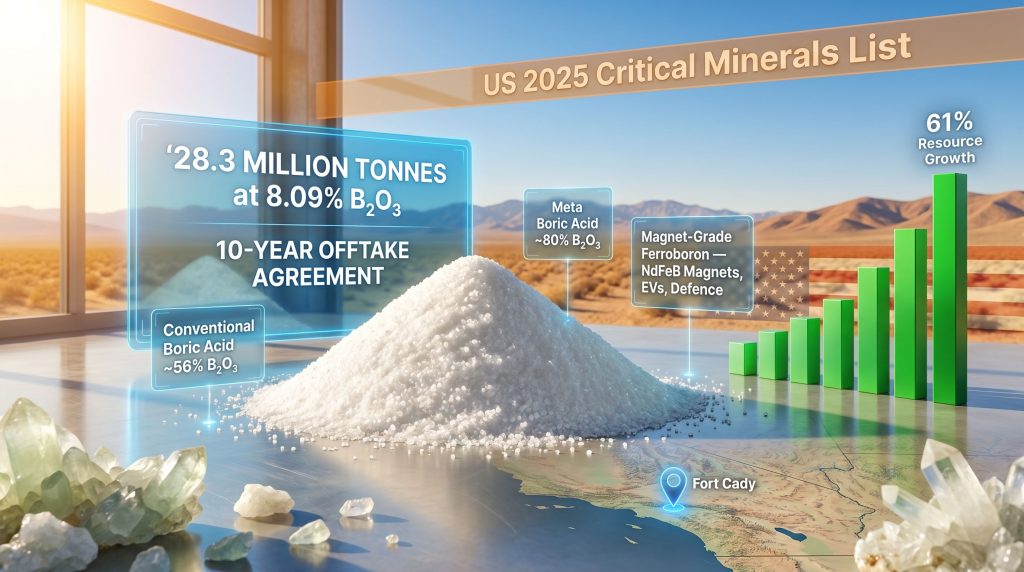
| Resource Base | 28.3 million tonnes at 8.09% B₂O₃ (measured and indicated) |
| Resource Growth | 61% increase in measured and indicated boric acid resources |
| Product Qualification | 20-tonne commercial trial passed with a major US LCD glass manufacturer |
| Trial Standards Met | Impurity profiles, moisture content, particle size distribution, flowability, logistics |
| Project Location | Fort Cady, Southern California |
| Critical Infrastructure Status | Designated by US Department of Homeland Security |
| Critical Mineral Status | Listed on US Government 2025 Critical Minerals List |
Fort Cady's resource grade of 8.09% B₂O₃ across 28.3 million measured and indicated tonnes positions it as a material boron resource by any global benchmark. The 61% resource growth recorded in the most recent update is not a marginal revision; it represents a substantive expansion of the project's production potential and economic foundation. For project finance teams assessing Fort Cady, the resource base provides the tonnage confidence needed to underwrite a long-duration supply agreement.
The Southern California location also carries infrastructure advantages. Proximity to existing industrial users, established logistics corridors, and a US domestic customer base that is actively seeking supply security all contribute to a commercial positioning that more remote projects could not replicate.
The Customer Roadshow: From Market Interest to Commercial Documentation
The 5E Advanced Materials boric acid offtake deal did not emerge in isolation. The company conducted a structured customer engagement programme comprising 12 meetings with industrial buyers, generating multiple requests for proposals in the process. Management has indicated its intention to execute additional offtake agreements in the near term.
This commercial pipeline depth matters because a single non-binding HoA, while significant, is not sufficient to close a project financing facility. The existence of multiple RFPs and the stated likelihood of further agreements suggests that Fort Cady has genuine market traction across more than one buyer relationship, which is the condition lenders need to see before they will advance credit.
In project finance, an offtake agreement functions as the commercial bridge connecting resource definition to debt mobilisation. A non-binding HoA is the opening move that signals a viable buyer-seller relationship exists. What converts that signal into a financeable position is a binding agreement with disclosed volumes and pricing.
Beyond Boric Acid: The Higher-Margin Products the Market Has Not Priced
Meta Boric Acid: A Proprietary Product With Patent Protection in Progress
Conventional granular boric acid, the bulk commodity that dominates global trade, contains approximately 56% B₂O₃ equivalent by mass. That grade is sufficient for most agricultural, ceramic, and fiberglass applications, but it falls short of what certain advanced manufacturing processes require.
5E has developed a proprietary meta boric acid product with approximately 80% B₂O₃ equivalent content, representing a meaningful step-up in concentration and therefore in value per tonne. A provisional patent application has been filed, and customer samples are currently moving through qualification programmes.
The commercial significance of this is straightforward. A higher-purity boron compound commands pricing premiums that can be substantially above bulk boric acid benchmarks. Applications demanding elevated B₂O₃ concentrations include advanced glass formulations, specialty ceramics, and certain chemical processes where water content and impurity levels are tightly controlled.
Magnet-Grade Ferroboron: The Intersection of Boron and the Permanent Magnet Supply Chain
The second product development running parallel to the commercial offtake story is both more technically complex and potentially more strategically significant. Ferroboron is a boron-iron alloy that serves as the boron feedstock in NdFeB permanent magnet production. These magnets are the enabling technology for electric vehicle drive motors, wind turbine generators, industrial automation systems, and a range of defence platform components.
The global NdFeB magnet supply chain is substantially concentrated in China. Chinese producers control a dominant share of both magnet manufacturing and the upstream processing that feeds into it. In recent periods, export control measures applied to rare earth materials and related alloys have intensified concerns, particularly given the vulnerabilities already documented within the rare earth supply chain at a global level.
Ferroboron sits at a specific and underappreciated node in this supply chain. While most policy discussion focuses on the rare earth elements in NdFeB magnets, the boron component is equally non-negotiable from a metallurgical standpoint. Magnet-grade ferroboron specifications are demanding: purity requirements are high, trace element tolerances are tight, and achieving consistent specification at commercial scale requires process development that goes well beyond simply producing industrial boric acid.
Comparative Product Value Stack
| Product | B₂O₃ Content | Market Application | Strategic Value |
|---|---|---|---|
| Conventional Granular Boric Acid | ~56% B₂O₃ | Glass, ceramics, agriculture | Established, commodity-adjacent |
| Meta Boric Acid (5E Proprietary) | ~80% B₂O₃ | Specialty industrial, advanced materials | Premium-priced, patent-protected |
| Magnet-Grade Ferroboron | High-purity boron alloy | NdFeB permanent magnets, defence, EVs | Strategic critical mineral, highest value-add |
If 5E transitions from a boric acid producer into a vertically integrated advanced boron materials supplier, the revenue mix, margin profile, and strategic positioning of the company all shift materially. That transition is not yet accomplished, but the product development pathway being pursued makes it a plausible long-term scenario worth monitoring.
The Financing Gap: What Still Has to Happen Before Fort Cady Can Be Built
Bankability Improvement vs. Bankability Proof
Project finance is a discipline built on cash flow certainty. Lenders extending capital to build a mine need to know, with legal enforceability, that there are buyers for the output at prices that generate sufficient revenue to service debt. A non-binding HoA advances the bankability narrative but does not complete it.
The distinction between bankability improvement and bankability proof is important for investors assessing the current stage of 5E's commercial development. The company has improved its bankability position meaningfully by completing a commercial product trial, conducting a structured customer roadshow, and executing its first 10-year offtake HoA. However, the financing conversations that result in a closed debt facility require a binding agreement with disclosed volumes and pricing as their commercial anchor.
Consequently, 5E has disclosed that it is in active discussions regarding project financing pathways, including government-facilitated options. No financing facility has been announced as closed. Models for strategic mineral financing via government-backed instruments have precedent in the current policy environment, which may provide a viable pathway for Fort Cady.
Three Commercial Triggers Investors Should Monitor Over the Next 6 to 9 Months
-
Binding Offtake Execution: Does the current HoA convert to a binding supply agreement with disclosed commercial terms? This is the single most important near-term catalyst for financing advancement and represents the clearest milestone for reassessing the investment position.
-
Meta Boric Acid and Ferroboron Sample Qualification: Do the pilot-scale product samples for the proprietary meta boric acid and magnet-grade ferroboron programmes complete customer qualification and generate formal purchase interest? Positive outcomes here expand the commercial pipeline and the potential revenue mix.
-
Financing Package Announcement: Does a project finance facility, government-facilitated loan, or strategic partnership close before the balance sheet requires another equity capital raise? The sequencing between commercial milestones and capital needs is the risk variable that will most directly determine shareholder outcomes.
Disclaimer: The above represents analytical framework applied to publicly disclosed information and does not constitute financial advice. Investors should conduct their own due diligence and assess their personal risk tolerance before making investment decisions.
The next major ASX story will hit our subscribers first
Boron's Growing Role in the Clean Energy and Defence Technology Stack
Applications Beyond the Commodity Baseline
One of the less widely understood dimensions of the boron supply story is the breadth of emerging applications that are adding demand vectors beyond the established industrial base. In addition to existing uses, these include:
- Next-generation battery electrolytes: Boron-containing compounds including lithium bis(oxalato)borate (LiBOB) are under active investigation as electrolyte additives and components in solid-state battery architectures.
- Boron neutron capture therapy (BNCT): A form of targeted radiotherapy for certain cancer types that requires boron-10 enriched compounds, with value per unit orders of magnitude higher than industrial applications.
- Defence materials: Boron carbide is one of the lightest structural ceramics used in body armour and vehicle protection systems, with boron-containing compounds also appearing in propellant formulations.
- Nuclear applications: Boron's neutron absorption properties make it a control material in nuclear reactor designs, including advanced small modular reactor (SMR) concepts currently under development.
Each of these demand vectors is additive to the existing industrial base. Collectively, they support a structural demand growth trajectory for boron that is likely to outpace any near-term expansion of domestic US supply capacity. This broader context also reinforces the importance of how critical minerals trade policy evolves in relation to boron-containing products.
Frequently Asked Questions: 5E Advanced Materials Boric Acid Offtake Deal
What is the 5E Advanced Materials boric acid offtake deal?
5E Advanced Materials (ASX: 5EA) has signed a non-binding Heads of Agreement for a 10-year boric acid supply arrangement with an unnamed domestic US industrial customer. The agreement covers supply from the Fort Cady boric acid project in Southern California and represents the company's first formal commercial offtake milestone.
Is the offtake agreement binding?
No. The current agreement is structured as a non-binding Heads of Agreement. While it demonstrates commercial intent and confirms product qualification by an industrial end user, it does not constitute a legally binding supply contract. A subsequent binding offtake agreement with disclosed volumes and pricing would represent a materially more significant commercial and financing milestone.
What is Fort Cady?
Fort Cady is 5E Advanced Materials' primary boron development project, located in Southern California. The project holds a measured and indicated boric acid resource of 28.3 million tonnes at 8.09% B₂O₃ and has been designated Critical Infrastructure by the US Department of Homeland Security. The project has also benefited from boron's inclusion on the US Government's 2025 Critical Minerals List.
What is meta boric acid and why does it matter for 5E?
Meta boric acid is a higher-concentration boron compound with approximately 80% B₂O₃ equivalent content, compared to roughly 56% in conventional granular boric acid. 5E has filed a provisional patent for its proprietary meta boric acid product and is advancing customer sample qualification. Successful commercialisation would introduce a premium-priced product line into the company's revenue mix.
What is ferroboron and why is it strategically important?
Ferroboron is a boron-iron alloy used as a critical feedstock in the production of NdFeB permanent magnets, which are found in electric vehicle motors, wind turbines, and defence systems. 5E has initiated a magnet-grade ferroboron development programme. Success in achieving commercial-scale production would position the company within a strategically critical and higher-value segment of the boron supply chain. Furthermore, progress in US critical minerals production policy may provide additional tailwinds for domestic ferroboron development.
What are the key risks for investors?
The primary risks include the non-binding nature of the current offtake agreement, the absence of a closed project financing facility, the potential need for additional equity capital before Fort Cady reaches production, execution risk associated with the meta boric acid and ferroboron development programmes, and the technical and timeline uncertainties inherent in taking a development-stage mining project to first production.
The Investment Thesis: A Direction Established, a Destination Still Ahead
What the HoA Changes and What It Does Not
The 5E Advanced Materials boric acid offtake deal marks a genuine inflection in the company's commercial story. For years, Fort Cady existed primarily as a resource narrative: a large, well-defined boron deposit in a country with a growing supply deficit and a policy framework increasingly aligned with domestic critical mineral production. What was missing was customer evidence — the demonstrated willingness of an industrial buyer to enter a long-term supply relationship.
That evidence now exists, at the non-binding stage, but it exists. The 20-tonne commercial trial result, the 12-customer roadshow, the multiple requests for proposals, and the executed HoA collectively represent a commercial foundation that did not exist 12 months ago.
What the HoA does not change is the fundamental gap between current status and a funded, producing operation. The balance sheet remains a risk. The binding offtake remains outstanding. The project financing remains unclosed. For investors assessing position sizing, the honest framing is that the thesis has moved forward without being de-risked to the level that warrants uncritical conviction.
The US boric acid supply deficit, the critical minerals policy landscape, the proprietary product development pipeline, and the demonstrated commercial engagement across 12 industrial buyers all point in the same direction. However, pointing in a direction is different from arriving. The next binding offtake is the moment that meaningfully resets the risk-reward calculation.
Until then, this is a development-stage critical minerals story with improving commercial evidence, real remaining execution risk, and a product suite that, if fully commercialised, addresses a supply gap that neither the US market nor its industrial buyers can afford to leave unfilled.
Readers seeking additional context on the commercial development pathway for US critical mineral projects may find related analysis at Stocks Down Under, which covers ASX-listed resource and materials companies navigating similar qualification-to-revenue trajectories. This article is general in nature and does not constitute financial advice. Always conduct independent research before making investment decisions.
Want to Know When the Next Critical Mineral Discovery Hits the ASX?
Discovery Alert's proprietary Discovery IQ model scans ASX announcements in real time, instantly identifying significant mineral discoveries across boron, rare earths, and more than 30 other commodities — translating complex data into actionable investment insights the moment they emerge. Explore historic examples of major mineral discoveries and their market returns, then begin your 14-day free trial to position yourself ahead of the broader market.