
May 13, 2026
The Accounting Anomaly That Could Redefine U.S. Fiscal Strategy
When monetary systems approach breaking points, governments rarely announce their intentions in advance. History shows that the most consequential monetary policy shifts arrive suddenly, without warning, and with consequences that fall disproportionately on those who were unprepared. Understanding the structural conditions that precede such events is therefore far more valuable than waiting for official confirmation that one is imminent.
Few potential monetary policy shifts carry more structural weight than a Fort Knox gold revaluation. The arithmetic alone is staggering. Yet beyond the headline numbers lies a deeper story involving sovereign accounting anomalies, decades of deferred audits, sovereign gold movements, and a fiscal crisis of a scale that has no modern peacetime parallel.
When big ASX news breaks, our subscribers know first
Why U.S. Gold Is Officially Worth Almost Nothing
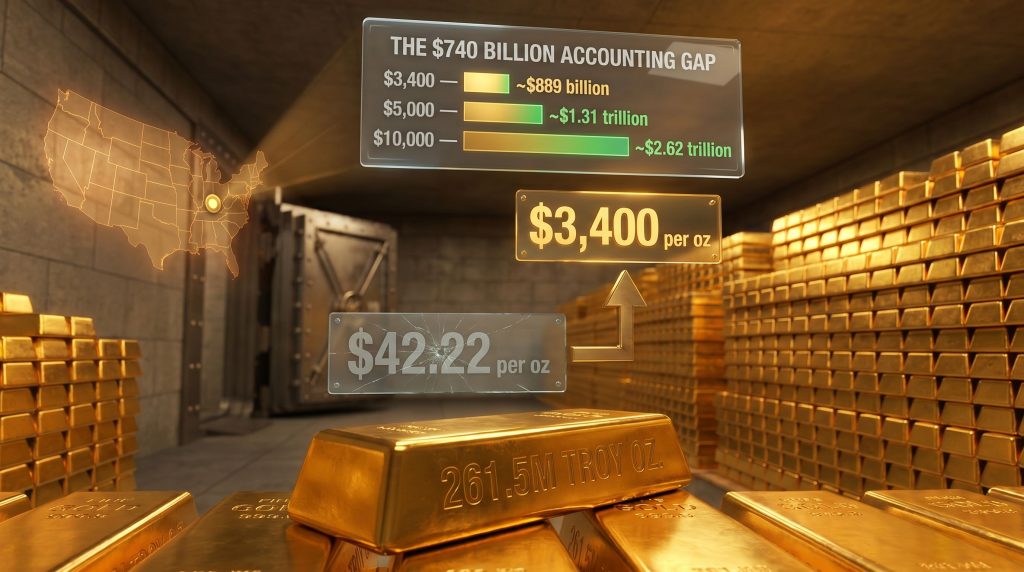
The U.S. Treasury continues to record its gold holdings at $42.22 per troy ounce, a statutory figure that has not been updated since 1973. With gold trading well above $3,000 per ounce in 2025, this creates one of the most significant unrealised asset discrepancies in the history of sovereign balance sheet accounting.
The United States holds approximately 261.5 million troy ounces of gold, with the majority stored at Fort Knox, Kentucky, and additional holdings at the West Point Mint and the Denver Mint. At the 1973 book rate, the entire holding is recorded at roughly $11 billion on the government's official accounts. As Forbes reports, the Treasury is effectively sitting on a $750 billion gold hoard officially valued at just $11 billion.
The gap between that figure and current market reality is not marginal. It represents hundreds of billions of dollars in unrecognised asset value, frozen in time by a statutory pricing mechanism that was never updated when the U.S. formally abandoned the gold standard.
Understanding the Statutory Pricing Freeze
The 1973 price freeze was a byproduct of the collapse of the Bretton Woods system, under which major currencies had been pegged to the U.S. dollar at a fixed rate, and the dollar itself had been convertible into gold at $35 per ounce. The Nixon gold shock of 1971 suspended gold convertibility, and as the Bretton Woods framework dissolved, the official gold price was adjusted incrementally before being set at $42.22 per ounce through legislation in 1973.
That figure has remained unchanged ever since. It is not a market price. It is a statutory relic, embedded in the U.S. Code under Title 31, Section 5116, and it bears no relationship to any real-world transaction price for physical gold.
The result is an accounting structure where the U.S. government holds the largest gold reserve of any nation on Earth, yet officially recognises almost none of its contemporary market value on its balance sheet.
What Is a Gold Revaluation Account?
Critically, the mechanism for correcting this imbalance already exists within the U.S. government's accounting framework. A Gold Revaluation Account (GRA) is an established instrument on the Treasury's balance sheet specifically designed to capture profits arising from changes in the official gold price.
This is not a theoretical construct. It is a functioning accounting structure that has been used before, as detailed throughout gold revaluation history. Activating it would involve retiring gold certificates currently issued at the 1973 statutory rate and replacing them with new certificates reflecting an updated official price. The difference between the old and new certificate values would flow through the Gold Revaluation Account, producing an immediate improvement in the government's net asset position.
No new currency would technically need to be printed. No new bonds would need to be issued. No new taxes would need to be collected. The balance sheet improvement would arise purely from recognising the difference between historical cost accounting and current market reality.
How a Fort Knox Gold Revaluation Would Actually Work
The mechanics of sovereign gold revaluation follow a structured sequence that has been executed in various forms by multiple nations throughout monetary history. Understanding this process clarifies why the audit question is inseparable from the revaluation question.
A credible revaluation would require the following steps:
- Audit and Physical Verification: Independently confirm the existence, quantity, and purity of gold held in each U.S. repository through comprehensive metallurgical testing and third-party auditing.
- Legislative or Executive Authorisation: Establish a new official gold price through Treasury authority or an act of Congress, replacing the current $42.22 statutory figure.
- Certificate Retirement: Retire existing gold certificates held by the Federal Reserve, which are currently valued at the 1973 statutory rate.
- New Certificate Issuance: Issue updated certificates reflecting the revised official valuation, creating an immediate change in the recognised asset value on government books.
- Balance Sheet Recognition: Record the resulting surplus through the Gold Revaluation Account, instantaneously improving the government's net asset position by the full amount of the price adjustment multiplied by total ounces held.
The critical insight here, and one that is frequently missed in mainstream commentary, is that you cannot credibly complete step two without first completing step one. A revaluation of gold that cannot be independently verified carries no credibility with international markets, foreign central banks, or domestic institutional investors. The logical sequencing demands an audit before any revaluation can be taken seriously.
What Different Revaluation Prices Would Mean for U.S. Finances
The fiscal mathematics across various revaluation scenarios are revealing:
| Official Gold Price (per oz) | Implied Total U.S. Reserve Value | Net Gain vs. Current Book Value |
|---|---|---|
| $3,400 (approximate spot) | ~$889 billion | ~$878 billion |
| $5,000 | ~$1.31 trillion | ~$1.30 trillion |
| $10,000 | ~$2.62 trillion | ~$2.61 trillion |
| $15,000 | ~$3.92 trillion | ~$3.91 trillion |
| ~$150,000 (theoretical debt parity) | ~$39.2 trillion | Full debt offset scenario |
The $150,000 per ounce figure represents a mathematically possible but economically extreme theoretical ceiling where revaluation proceeds would fully offset total U.S. national debt. Most credible policy discussions focus on the $3,400 to $15,000 range, where the fiscal benefits are substantial but the economic disruption risks remain more containable.
Potential Applications for Revaluation Proceeds
| Application | Estimated Scale | Policy Context |
|---|---|---|
| Sovereign Wealth Fund Seed Capital | $500B to $700B | National investment infrastructure |
| Strategic Reserve Asset Diversification | Partial allocation | Digital and alternative asset exposure |
| National Debt Reduction | Partial offset | Near-term interest payment relief |
| Balance Sheet Strengthening | Full revaluation amount | Treasury credibility and reserve adequacy |
| Non-inflationary Economic Stimulus | Variable | Domestic growth without bond issuance |
Historical Precedent: What Past Revaluations Reveal
For those who characterise Fort Knox gold revaluation as a fringe theory, the historical record offers a direct counter-argument. The United States has executed sovereign gold revaluations before, and the playbook is well-documented.
The Roosevelt Precedent (1933 to 1934)
Executive Order 6102, signed by President Franklin D. Roosevelt on April 5, 1933, required American citizens to surrender gold bullion, gold coins, and gold certificates to Federal Reserve banks at the prevailing official price of $20.67 per troy ounce. Penalties for non-compliance included fines and imprisonment.
Following the collection period, the Gold Reserve Act of 1934 raised the official gold price to $35 per ounce, a revaluation of approximately 69%. Citizens who had surrendered their gold received fiat currency at the lower rate and subsequently watched the purchasing power of that currency erode as the revaluation took effect. The wealth transfer was immediate and irreversible for those who had complied.
Critically, the original executive order explicitly exempted rare and collectible coins from the mandatory surrender requirement. This legal distinction meant that holders of numismatic gold coins retained their gold through the confiscation period and consequently benefited from the full price adjustment that followed.
This historical precedent carries a direct and underappreciated lesson: the form in which gold is held, specifically whether it falls within or outside the scope of any regulatory action, can determine whether a holder benefits from or is disadvantaged by a revaluation event. The legal distinctions embedded in historical precedent suggest that not all gold ownership structures carry equivalent protection under future policy scenarios.
The 1973 Revaluation
The U.S. raised the official gold price from approximately $38 to $42.22 per ounce in 1973, producing an effective dollar devaluation of roughly 10% overnight. This remains the last time the United States officially adjusted its gold book value and established the statutory figure that remains on the books today.
The dollar impact was immediate. Holders of dollar-denominated assets absorbed a real-terms loss in international purchasing power within a single trading session, while holders of physical gold saw their assets revalued upward.
International Case Studies
The pattern of sovereign gold revaluation extends well beyond U.S. borders. Multiple nations have used gold revaluation as a balance sheet management tool during periods of monetary restructuring, currency integration, and fiscal stress. Countries including Germany during post-reunification monetary restructuring, Italy during European monetary integration, and South Africa during post-transition monetary modernisation each used revaluation mechanisms to improve their sovereign balance sheet positions.
Furthermore, the significance of institutional research documenting these international episodes is not incidental. Academic and central bank research into foreign revaluation precedents is historically a precursor to domestic policy consideration, representing the modelling phase that precedes policy implementation.
The Fort Knox Audit Problem
No dimension of the Fort Knox gold revaluation debate is more foundational than the audit question, yet it is frequently treated as a secondary concern. It is not. It is the primary prerequisite.
A 70-Year Verification Gap
The last substantive audit of Fort Knox gold reserves was conducted approximately 70 years ago. A 1974 event that brought journalists to the facility allowed observers to view less than 6% of total holdings, with no independent metallurgical testing, no assaying, and no third-party verification of the gold's composition or purity. The U.S. public has been asked to accept, on the government's word alone, that 261.5 million troy ounces of gold remain fully intact in federal vaults.
Legislation introduced in the U.S. Senate in late 2025 by Senator Mike Lee called for the first comprehensive, independent audit of U.S. gold reserves. The bill attracted significant bipartisan attention precisely because the absence of independent verification represents a credibility risk that extends far beyond domestic fiscal policy into international monetary confidence.
Why the Audit Must Come Before the Revaluation
The sequencing logic is straightforward:
- A revaluation announcement without prior audit verification would carry zero credibility with international currency markets
- Foreign central banks holding dollar reserves would have no basis for confidence in the claimed asset backing
- The risk of a credibility collapse would be far more damaging than any balance sheet benefit from the revaluation itself
- Audit first, then revalue is not just logical. It is the only sequence that preserves dollar confidence during the transition
Three Scenarios an Audit Could Produce
| Scenario | Gold Status | Likely Market Impact |
|---|---|---|
| Full Verification | All 261.5M oz confirmed and independently tested | Revaluation credibility maximised; gold price surge |
| Partial Shortfall | Significant discrepancy identified | Severe dollar confidence crisis; extreme gold price spike |
| Accounting Irregularities | Evidence of leasing, encumbrances, or swaps | Systemic financial shock; potential monetary reset pressure |
The third scenario is the least discussed but arguably the most significant. Gold lease arrangements, in which central banks lend gold to bullion banks in exchange for interest payments, are a known feature of institutional gold markets. If U.S. gold reserves are subject to undisclosed lease or swap arrangements, the effective ownership of those ounces would be more complicated than official records suggest. An audit revealing such arrangements would fundamentally alter the revaluation calculus.
Macroeconomic Risks of Revaluation at Scale
A Fort Knox gold revaluation would not be a consequence-free accounting exercise. The macroeconomic transmission risks are real and deserve rigorous analysis rather than dismissal.
The Inflation Transmission Question
While no new currency is technically created through a gold certificate revaluation, critics have characterised the mechanism as functionally equivalent to backdoor monetary expansion. The government's effective spending capacity expands by the full amount of the balance sheet improvement, and if those proceeds are deployed into the broader economy, the inflationary downstream effects could be substantial.
A revaluation generating $500 billion to $750 billion in balance sheet improvement would represent one of the largest single fiscal events in U.S. peacetime history. The inflationary implications depend heavily on:
- The pace of proceeds deployment into the real economy
- Whether the Federal Reserve offsets the expansion through contractionary policy
- The degree to which international confidence in the dollar holds or deteriorates
- Whether foreign holders of dollar-denominated assets respond by reducing their exposure
Dollar Devaluation Dynamics
Every historical gold revaluation has correlated with meaningful currency devaluation. The 1934 episode produced an immediate erosion of dollar purchasing power. The 1973 adjustment delivered a roughly 10% overnight devaluation. A 2025-era revaluation at spot prices would represent an adjustment of approximately 8,000% from the current book rate, a scale that has no modern peacetime parallel and whose dollar impact cannot be reliably modelled from historical precedent alone.
The De-Dollarisation Amplification Risk
The U.S. dollar's status as the global reserve currency rests substantially on confidence in U.S. fiscal management and the stability of dollar-denominated assets. A revaluation announcement, particularly one following an audit that reveals discrepancies, could accelerate the de-dollarisation trend already observable in foreign central bank behaviour.
Central bank gold demand has been shifting significantly, with foreign central banks systematically increasing gold allocations while reducing U.S. Treasury holdings over recent years. This structural shift in reserve asset preferences predates the current revaluation discussion but creates a more fragile context for any major dollar policy change.
The next major ASX story will hit our subscribers first
Sovereign Gold Flows as a Forward Indicator
One of the most underanalysed dimensions of the Fort Knox gold revaluation debate is what sovereign gold movements reveal about institutional positioning.
Over the past decade, multiple nations including Germany, the Netherlands, Hungary, and Poland have repatriated gold reserves from foreign custodians, primarily the Federal Reserve Bank of New York and the Bank of England, back to domestic vaults. The stated rationale has typically emphasised domestic security and sovereign control.
However, viewed through the lens of revaluation history, a different logic emerges. Nations that hold their gold within their own sovereign vaults prior to a revaluation event capture the full benefit of the price adjustment on their own balance sheets. Nations whose gold sits in foreign custody at the time of a revaluation announcement face logistical, legal, and political complications in accessing that value.
The pattern of repatriation therefore mirrors the historical behaviour of informed institutional actors who understand that gold must be in your possession before a revaluation, not after. The post-announcement scramble for physical gold consistently produces dramatically higher acquisition costs and severely constrained physical availability.
This dynamic applies at both the sovereign and individual level. Historical revaluation episodes share a consistent structural feature: the announcement arrives without advance public notice. Governments do not pre-announce revaluations because doing so would allow foreign nations and institutional investors to position ahead of the event, defeating the fiscal and monetary policy purpose. The only viable positioning window is before the announcement, not after it.
The Fiscal Pressure Building Beneath the Surface
Understanding why Fort Knox gold revaluation is being discussed with increasing seriousness requires understanding the fiscal context that makes it relevant.
U.S. national debt has surpassed $36 trillion as of mid-2025, with annual interest payments having crossed the $1 trillion threshold for the first time in American history. At the current debt trajectory, servicing costs are projected to consume an ever-growing share of federal revenue, progressively crowding out discretionary spending, defence investment, and infrastructure development.
The conventional fiscal toolkit for addressing this pressure includes:
- Raising taxes (politically constrained)
- Cutting spending (politically constrained)
- Issuing more debt (self-reinforcing and confidence-eroding)
- Monetary inflation through Federal Reserve balance sheet expansion (inflationary and politically exposed)
Gold revaluation represents a fifth pathway: recognising existing asset value that is already physically present but artificially suppressed by a 52-year-old statutory pricing freeze. It requires no new taxation, no new bond issuance, no direct money printing in the conventional sense, and no congressional spending approval in the same sense as discretionary appropriations.
A revaluation at spot prices alone would generate approximately $740 billion in balance sheet improvement, equivalent to roughly two years of current annual interest payments. A revaluation to $10,000 per ounce would produce approximately $2.6 trillion in recognised asset value, sufficient to meaningfully restructure the near-term debt servicing profile. For additional context on how this intersects with broader monetary architecture, consider the wider role of gold in the monetary system and what revaluation could signal for international reserve frameworks.
Reading the Policy Signals Carefully
Official government communication on sensitive monetary policy topics must be interpreted carefully, particularly when the policy under discussion would lose much of its effectiveness if disclosed in advance.
Treasury Secretary Scott Bessent publicly stated in March 2025 that no gold revaluation was currently planned. That statement is on record. However, Bessent has separately articulated a policy objective centred on monetising the asset side of the U.S. balance sheet, a framing that structurally describes exactly what a gold revaluation would accomplish. These two positions are not necessarily contradictory. A policy can be under active consideration without being formally confirmed as imminent.
The broader policy signal landscape includes several data points that warrant attention:
- Central bank research on international gold revaluation precedents published in 2025
- Legislative activity in the Senate demanding a comprehensive Fort Knox audit
- Continued public commentary from President Trump about visiting Fort Knox to verify the gold
- Unexplained gold flows from London and Swiss vaults into U.S. repositories since late 2024
- Systematic foreign central bank gold accumulation at a pace not seen in decades
Furthermore, record gold ETF inflows in 2025 reflect a broader institutional repositioning that reinforces these signals. No single data point constitutes confirmation, but the convergence of institutional research activity, legislative proposals, sovereign gold movements, and fiscal pressure creates a context that is qualitatively different from previous periods when revaluation was purely theoretical.
Frequently Asked Questions: Fort Knox Gold Revaluation
What is the current official U.S. gold reserve valuation?
The U.S. Treasury officially records its gold at $42.22 per troy ounce, a statutory price last updated in 1973. Applied to approximately 261.5 million troy ounces, this produces a total book value of roughly $11 billion, bearing no relationship to current market prices.
Has the U.S. executed a gold revaluation before?
Yes. The most significant domestic precedent was the 1933 to 1934 Roosevelt revaluation, in which the official price was raised from $20.67 to $35 per ounce following a mandatory gold surrender programme. A smaller adjustment in 1973 set the current statutory rate of $42.22 per ounce.
Would a revaluation cause inflation?
Economists are divided. While no new currency is technically created, the effective expansion of the government's balance sheet capacity could have meaningful inflationary downstream effects if the proceeds are deployed into the broader economy. The scale and pace of deployment would determine the magnitude of the inflationary impact. Analysts at SBC Gold have examined these dynamics in detail, noting that the sequencing of deployment is as consequential as the revaluation itself.
Why hasn't Fort Knox been independently audited?
The last substantive audit occurred approximately 70 years ago. A 1974 media visit covered less than 6% of total holdings with no metallurgical testing. Senator Mike Lee introduced comprehensive audit legislation in late 2025, citing the credibility gap this creates in any revaluation discussion.
Are all forms of gold ownership treated equally in a revaluation?
Not historically. The Roosevelt-era confiscation explicitly exempted rare and collectible numismatic coins from mandatory surrender requirements. Whether equivalent exemptions would apply under any future regulatory framework would depend entirely on the specific legislative language enacted. This legal distinction has historically carried significant financial consequences for gold holders.
What would happen to gold prices after a revaluation announcement?
Based on historical precedent, a revaluation announcement would likely trigger an immediate and sharp increase in gold prices, a surge in physical gold demand, constrained physical supply availability, and potential dollar devaluation. The magnitude would depend on the revaluation price point and the credibility of the accompanying audit verification.
Synthesising the Evidence: Where Does This Actually Stand?
| Dimension | Status | Signal Strength |
|---|---|---|
| Gold Revaluation Account exists on U.S. balance sheet | Confirmed accounting structure | High |
| Last comprehensive Fort Knox audit | Approximately 70 years ago | High |
| Senate audit legislation introduced (late 2025) | Senator Mike Lee bill filed | High |
| Central bank research on international revaluations (2025) | Published institutional research | High |
| Treasury monetisation policy objective stated | Bessent public statements | Medium |
| Official confirmation of active revaluation planning | Denied by Bessent (March 2025) | Low |
| Sovereign gold repatriation trend | Widespread and confirmed | High |
| U.S. debt servicing exceeding $1 trillion annually | Confirmed fiscal data | High |
| Unexplained gold flows into U.S. vaults (late 2024 onwards) | Documented, motivations unclear | Medium |
The weight of institutional, legislative, sovereign, and fiscal evidence suggests that Fort Knox gold revaluation has progressed well beyond fringe monetary theory into active policy consideration. The audit question remains the near-term catalyst that would confirm or complicate any forward movement.
What history consistently demonstrates is that those who position themselves in physical gold before a revaluation event capture its full benefit, while those who attempt to acquire gold after an announcement face dramatically higher costs, constrained availability, and compressed purchasing power. The pattern has repeated itself across multiple monetary epochs and multiple sovereign jurisdictions. Whether or not a U.S. revaluation occurs in the near term, that historical dynamic remains the most instructive framework for understanding why sovereign gold movements deserve far more analytical attention than they typically receive in mainstream financial commentary.
Disclaimer: This article is provided for educational and informational purposes only. It does not constitute financial, investment, or legal advice. All figures relating to gold prices, debt levels, and fiscal projections are drawn from publicly available sources and historical records. Readers should conduct their own research and consult qualified financial professionals before making any investment decisions. Forward-looking statements and scenario analyses are speculative in nature and do not constitute predictions of future outcomes.
Want To Position Ahead of the Next Major Mineral Discovery?
Discovery Alert's proprietary Discovery IQ model delivers real-time alerts the moment significant ASX mineral discoveries are announced, transforming complex data across 30+ commodities into clear, actionable insights for both short-term traders and long-term investors — explore historic discovery returns to understand the scale of opportunity, then begin your 14-day free trial at Discovery Alert to secure your market-leading edge before the next major announcement arrives.