
July 22, 2026
The Geography of a Disrupted Energy World: How Capital Is Flowing Away From the Gulf
Energy markets have spent decades building their architecture around a single geographic assumption: that Persian Gulf crude would flow freely through a narrow waterway just 21 nautical miles wide at its tightest point. That assumption is now being stress-tested in real time, and the consequences are reshaping where capital moves, which companies benefit, and what post-Hormuz oilfield services stocks look like on the other side of the crisis.
The Strait of Hormuz carries approximately 20 to 21 percent of globally traded oil every single day. No alternative pipeline network exists with the capacity to absorb that volume in a meaningful timeframe. Saudi Arabia's East-West pipeline to the Red Sea and the UAE's Abu Dhabi Crude Oil Pipeline to Fujairah provide partial relief, but their combined throughput falls well short of replacing full Hormuz transit capacity. The Gulf's landlocked producers, including Saudi Arabia, Kuwait, Iraq, Qatar, and the UAE, are essentially captive to this single maritime corridor.
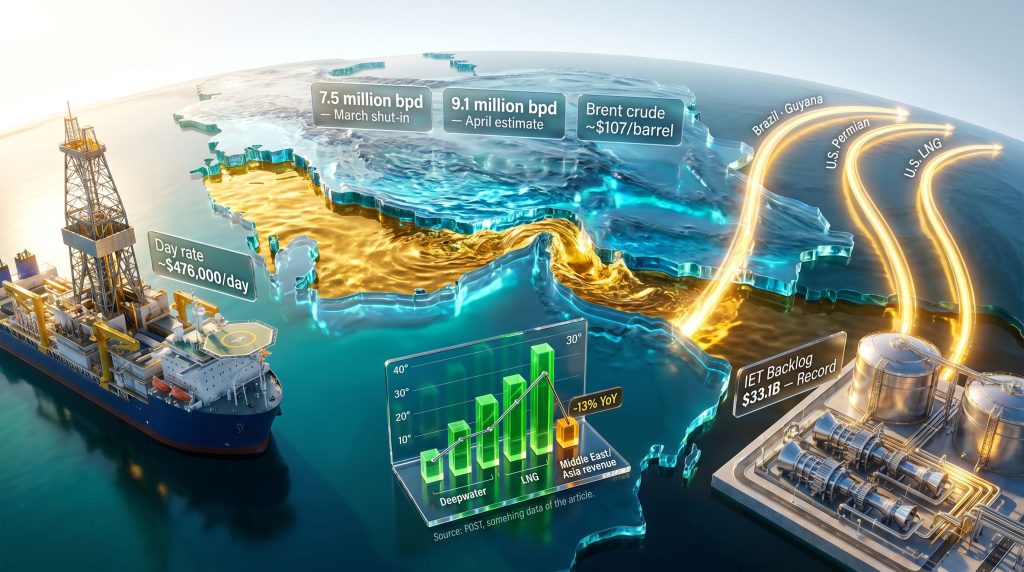
The oil price shock has produced striking numbers. The EIA's Short-Term Energy Outlook documents the scale of the damage, with regional production shut-ins reaching approximately 7.5 million barrels per day in March, rising to an estimated 9.1 million barrels per day by April. OPEC market influence has been severely tested, with aggregate output falling to levels not seen in more than 26 years, according to Reuters survey data. Saudi Aramco's leadership has characterised the cumulative supply loss as approximately 100 million barrels for every week the disruption persists. Brent crude has settled near the $107 to $108 per barrel range, a structural repricing rather than a speculative overshoot.
This is not simply a price event. It is a fundamental reallocation of upstream capital that will determine where oilfield services companies deploy equipment, personnel, and technology for years beyond the immediate conflict.
When big ASX news breaks, our subscribers know first
Where Upstream Capital Is Already Redirecting
The oilfield services industry spent the decade following 2015 reorienting its forward strategy around the Gulf Cooperation Council. Saudi Aramco's multi-billion-dollar expansion programs, ADNOC's Abu Dhabi offshore infrastructure buildout, and QatarEnergy's North Field development represented the single largest concentration of international OFS contract value outside North America. Major service providers built revenue projections, technology investment cycles, and personnel deployment pipelines around continued GCC growth.
Almost overnight, those contracts went dark. Force majeure declarations swept through Qatar. Offshore operations across the Persian Gulf were suspended. SLB demobilized crews. The question the sector is now answering is where the work goes instead, and the answer is already visible across four geographies.
Brazil's Santos Basin is the most structurally significant redirect. Petrobras's deepwater development commitments are multi-decade infrastructure programs that operate independently of Gulf geopolitics. Contract extensions with major drillship operators now run through 2030, and the production ambitions of Brazil's national oil company have not been revised downward by a single barrel because of events in the Persian Gulf.
Guyana's Stabroek Block represents the most consequential non-OPEC deepwater growth asset in the world. ExxonMobil's flagship program is targeting production above 1 million barrels per day in 2026, with the Uaru project online and the Whiptail development advancing behind it. This is a program requiring continuous drillship deployment and subsea infrastructure investment regardless of where Brent trades on any given morning.
The U.S. Permian Basin is beginning to respond to the price signal, though with the hesitation characteristic of operators who remember sub-$60 oil from earlier in the year. Diamondback Energy, the Permian's third-largest producer, has reversed its capital discipline framework and is adding both drilling rigs and fracturing crews. ConocoPhillips raised capital expenditure guidance. Continental Resources reversed a previously announced 20 percent spending cut. The Dallas Federal Reserve's energy survey tempers the optimism somewhat, showing a meaningful segment of E&P executives remaining cautious about committing to sustained capital increases when price volatility has been so extreme.
U.S. LNG export infrastructure is experiencing accelerated development driven by European and Asian importers who lost access to Qatari supply. Furthermore, the LNG supply outlook suggests each new terminal represents a significant demand event for gas turbines, centrifugal compressors, and associated engineering services.
Post-Hormuz Oilfield Services Stocks: The Structural Business Model Divide
Why the Long-Cycle vs Short-Cycle Distinction Matters Now
Understanding which post-Hormuz oilfield services stocks carry the most compelling investment thesis requires grasping a fundamental structural distinction within the sector. OFS companies divide broadly into two categories with very different risk and return profiles in the current environment.
| Characteristic | Long-Cycle Providers | Short-Cycle Providers |
|---|---|---|
| Revenue visibility | 3 to 10 years via contracted backlog | Weeks to months |
| Primary exposure | Deepwater, LNG infrastructure, subsea | North American shale completions |
| Commodity price sensitivity | Low | High |
| Asset intensity | Capital-intensive (drillships, turbines) | Moderate (frac fleets, pumping equipment) |
| Speed of demand response | Years | Weeks |
This distinction matters enormously right now. Long-cycle providers are largely insulated from a rapid Hormuz normalisation scenario because their revenue is locked into multi-year contracts. Short-cycle providers capture faster upside when the price signal is strong but face rapid revenue compression if prices fall.
Deepwater Drilling: Structural Scarcity at the Worst Possible Moment for Buyers
The offshore drilling market contains a supply constraint that cannot be resolved quickly, and that constraint is now intersecting with peak demand.
Building a high-specification ultra-deepwater drillship takes approximately three years and requires capital outlays exceeding $500 million per vessel. Following the oil price collapse of 2014 through 2016, the industry stopped ordering new vessels entirely. Dozens of mid-water rigs were scrapped. Companies built around older assets went bankrupt. The fleet of capable deepwater drilling assets shrank dramatically and remained depleted through the slow recovery that followed.
The consequence is that there are now very few rigs capable of drilling in deep water at precisely the moment when deepwater plays in Brazil and Guyana have become the most strategically important new sources of supply in the world. The broader geopolitical risk landscape has only intensified this structural scarcity dynamic.
How Is Transocean Positioned?
Transocean (NYSE: RIG) sits at the centre of this structural scarcity story. The company operates 20 ultra-deepwater floaters and 7 harsh-environment rigs, and that fleet is essentially fully committed. Q1 2026 contract drilling revenue reached $1.08 billion, up 19 percent year over year. Average daily revenue hit $476,000, the highest level recorded in over a decade. Adjusted EBITDA margin exceeded 40 percent.
Since the quarter ended, Transocean added $1.6 billion in new backlog at a weighted average day rate of approximately $410,000, taking total backlog to $7.1 billion. The Petrobras contract extensions are particularly revealing of the long-cycle demand dynamic:
- The Deepwater Corcovado extended for 1,156 days through November 2030
- The Deepwater Orion locked in a three-year extension
- The Deepwater Aquila added one year
- The Transocean Barents secured a three-year contract with Vår Energi in Norway
The honest assessment requires acknowledging the gap between the operational story and the financial one. Net income was $71 million on $1.08 billion in revenue, and while free cash flow reached $136 million and the company retired $358 million in Deepwater Titan notes in March, the income statement still looks modest relative to the revenue base. The investment thesis rests on the backlog, the day rate trajectory, and the structural scarcity of the assets, not the current income statement. For further context on oilfield services stocks built for this environment, the structural drivers remain consistent across the sector.
LNG Infrastructure: The Long-Cycle Paradox That Baker Hughes Is Winning
There is a counterintuitive dynamic playing out in the LNG equipment market that contains one of the more important insights available to investors analysing the post-Hormuz landscape.
Qatar cannot currently ship LNG because the Strait of Hormuz is closed. QatarEnergy has declared force majeure on export contracts with buyers across Europe and Asia. Yet simultaneously, QatarEnergy recently awarded a major equipment contract for the North Field West project encompassing six Frame 9 gas turbines, 12 centrifugal compressors, and dual mega-trains totalling 16 MTPA of capacity.
The explanation is that long-cycle energy infrastructure investment is made on 20 to 30 year economic models, not on the basis of current spot prices or near-term transit disruptions. The North Field West project will not be operational for years. Consequently, the crisis that is shutting down near-term LNG exports is simultaneously accelerating the infrastructure investment that will supply global markets for the next several decades.
Baker Hughes (NYSE: BKR) is positioned to benefit from both sides of this dynamic. The company has been deliberately repositioning itself from a conventional OFS business into an energy technology platform, with its Industrial and Energy Technology segment now the dominant driver of portfolio value.
Q1 2026 results demonstrated the strength of this repositioning. Revenue reached $6.59 billion, beating consensus estimates by approximately $260 million. The IET segment generated $4.9 billion in orders, its third consecutive quarter above $4 billion, producing a record IET backlog of $33.1 billion. Total company orders rose 26 percent year over year.
Beyond the Qatar award, Baker Hughes secured a contract to supply gas compression and power generation equipment for an 8.4 MTPA LNG export terminal off Texas, the precise type of U.S. supply capacity that European and Asian importers who lost Qatari supply access are now urgently pursuing. Full-year guidance stands at $27.1 billion in revenue with EPS of $2.47. The traditional Oilfield Services and Equipment segment declined 7 percent due to Middle East disruptions. However, the market largely ignored it.
The North American Completions Trade: Halliburton and Liberty Energy
Hydraulic fracturing operates on a fundamentally different timeline than deepwater or LNG infrastructure. Operators can move from a drilling decision to first production within months, not years. The bottleneck is fracturing capacity, and one company controls more of that capacity in North America than any other.
Halliburton (NYSE: HAL) reported Q1 2026 revenue of $5.4 billion, flat year over year, with net income more than doubling to $461 million and EPS of $0.55 beating estimates. North America revenue dipped 4 percent to $2.1 billion, reflecting two years of pricing pressure. Management indicated that completion calendar availability for Q2 2026 had essentially disappeared, with the company fielding increasing inbound interest in spot work as Permian operators reverse their capital restraint. The Middle East drag on Q1 EPS was characterised by management as representing only two to three cents, a marginal impact relative to the North American upside now developing.
Liberty Energy (NYSE: LBRT) offers the most concentrated North American exposure on the list. The company has zero international business, total focus on shale completions, and Q1 2026 results that significantly outperformed expectations. Revenue of $1.02 billion rose 4 percent year over year, and EPS of $0.06 dramatically exceeded a consensus that had modelled a loss of $0.13. The stock gained nearly 10 percent on the earnings release.
Liberty's competitive differentiation rests on proprietary technology rather than scale alone. The StimCommander platform automates rate and pressure control across frac fleets in real time, while the Forge cloud-based optimisation system aggregates performance data to improve efficiency continuously across operations. Three consecutive quarters of beating subdued expectations suggests this approach is generating measurable value even as pricing pressure continues.
The company also executed a notable balance sheet move in Q1, issuing $1.3 billion in zero-coupon convertible notes and ending the quarter with $699 million in cash. Management has signalled that power generation represents the next strategic growth leg, and the capital to pursue it is now in place.
Liberty represents the highest-beta expression of the North American completions recovery thesis. If the Permian reactivation accelerates, there is no other name in the sector that captures that upside more directly. If oil prices fall sharply on a rapid Hormuz resolution, there is also no name that absorbs the downside more fully.
The next major ASX story will hit our subscribers first
SLB: The Technology Moat That the Gulf Exposure Obscures
SLB (NYSE: SLB) presents the most complex interpretation challenge of the major post-Hormuz oilfield services stocks because the headline Q1 numbers are genuinely weak while the underlying structural position is genuinely strong.
Middle East and Asia revenue fell 13 percent year over year and 17 percent sequentially. The company demobilised in Qatar following force majeure declarations, withdrew crews from Iraq, and suspended offshore operations across multiple countries. EPS declined from $0.58 to $0.50. Free cash flow turned marginally negative.
What the headline numbers obscure, however, is the character of SLB's core technology business. The company does not simply drill wells. It provides the reservoir characterisation technology that makes subsurface formations readable, and the production systems that optimise hydrocarbon recovery once a well is producing. In deepwater environments, where infrastructure commitments run for decades and well performance has enormous economic consequences, that technology capability commands a structural premium.
The Production Systems segment, covering equipment for long-cycle deepwater wells, grew 23 percent year over year in Q1. The integration of ChampionX added artificial lift and chemical injection capabilities to the portfolio, contributing both revenue diversification and margin resilience. SLB management noted that commodity prices in a post-conflict environment tend to remain structurally elevated above pre-conflict levels because lost supply capacity requires years to rebuild, a dynamic that underpins the multi-year deepwater investment cycle in Brazil and Guyana.
Investment Risk Framework: Scenario-Specific Vulnerabilities
No analysis of post-Hormuz oilfield services stocks is complete without a structured assessment of the specific risk factors that could alter the thesis under each resolution scenario. In addition, understanding the broader oil market disruption context is essential for framing these risks accurately.
| Risk Factor | Segment Most Exposed | Segment Most Insulated |
|---|---|---|
| Rapid Hormuz normalisation | North American completions (LBRT, HAL) | Deepwater drilling, LNG infrastructure |
| Debt and balance sheet stress | Offshore drilling (legacy liabilities) | Technology-diversified OFS platforms |
| Operator capital discipline hesitation | Pressure pumping and completions | Long-cycle infrastructure providers |
| Geographic concentration | Pure-play North America operators | Globally diversified OFS platforms |
What Happens Under Rapid Normalisation?
Risk 1: Rapid Normalisation presents the most acute near-term threat to the short-cycle names. A diplomatic resolution restoring Hormuz transit would compress oil prices quickly, triggering immediate activity reductions among North American shale operators. Long-cycle deepwater and LNG infrastructure names would be largely insulated by contracted backlogs. Furthermore, energy stocks respond differently across the sector depending on their exposure profile, making this distinction critical for portfolio construction.
What About Debt and Operator Psychology?
Risk 2: Debt Load in Capital-Intensive Segments requires careful attention in the offshore drilling context. Ultra-deepwater companies carry substantial legacy liabilities from the 2014 to 2020 downcycle. Elevated day rates and strong backlogs improve refinancing collateral, but the income statement gap relative to revenue remains a structural vulnerability.
Risk 3: Operator Psychology in North America is quantified but not resolved by the Dallas Federal Reserve energy survey data. Operators who spent years defending capital return frameworks to institutional shareholders face genuine pressure not to abandon those frameworks at the first sign of higher prices. The memory of $57 oil from earlier in 2026 is recent and visceral for many E&P executive teams.
Risk 4: Pure-Play Geographic Concentration creates asymmetric exposure for companies with no international business or long-cycle backlog. The same geographic concentration that maximises upside in a sustained high-price environment maximises downside if the scenario reverses faster than expected.
This article is for informational and educational purposes only and does not constitute financial advice. Investing in energy sector equities involves significant risks, including commodity price volatility, geopolitical uncertainty, and company-specific financial risk. Past performance and current market conditions are not reliable indicators of future results. Readers should conduct independent research and consult qualified financial advisors before making investment decisions.
Want to Know Which ASX Resource Discoveries Could Deliver the Next Major Return?
While global energy capital scrambles to reprice risk across deepwater, LNG, and shale completions, Discovery Alert's proprietary Discovery IQ model scans ASX announcements in real time, instantly identifying significant mineral discoveries before the broader market reacts — explore historic examples of what major discoveries have returned to understand the opportunity, then begin your 14-day free trial at Discovery Alert to position yourself ahead of the next transformative find.