May 13, 2026
The Anode Processing Bottleneck Nobody Talks About
Battery supply chain conversations tend to fixate on lithium, cobalt, and nickel. Yet the single largest material input by weight in a lithium-ion battery cell is graphite, and the processing infrastructure required to convert raw flake graphite into battery-ready anode material remains one of the most concentrated and underinvested segments in the entire clean energy supply chain.
The critical minerals demand for anode-grade graphite is accelerating rapidly, yet the processing bottleneck receives comparatively little attention. Spheronized purified graphite (SPG) and its coated derivative (CSPG) are the active materials loaded into battery anodes. Without them, no lithium-ion cell can be manufactured, regardless of how much lithium or nickel is available. The challenge is that transforming mined graphite concentrate into anode-grade material requires a highly specialised multi-stage process involving micronisation, spheronisation, thermal purification to greater than 99.95% carbon purity, and carbon coating.
This capability currently sits overwhelmingly within one country's industrial base. The global graphite shortage is, in large part, a processing capacity shortage rather than a raw material shortage. China accounts for the vast majority of global graphite anode processing capacity, leaving battery manufacturers across Japan, South Korea, Europe, and North America acutely exposed to a single point of supply chain failure.
Against this backdrop, every new ex-China anode processing facility that reaches a binding investment commitment represents a structurally meaningful event for the global battery supply chain, not merely a corporate milestone. The approval of a Final Investment Decision (FID) for the NextSource UAE battery anode facility in Abu Dhabi's Industrial City is precisely that kind of event.
When big ASX news breaks, our subscribers know first
What the FID Actually Means and Why It Matters
An FID is the formal threshold at which a project transitions from planning into irreversible capital commitment. It is the point at which boards accept that costs will be incurred, contracts will be signed, and equipment will be ordered. For project finance purposes, it is also the trigger that activates construction-phase lending and enables procurement of long-lead items with multi-month manufacturing timelines.
TSX-listed NextSource Materials approved the FID for Phase 1 of its UAE battery anode facility in May 2026, following the successful completion of Front-End Engineering Design (FEED) conducted under the oversight of Stantec, one of the world's largest engineering consultancies. The FEED outcome validated the economic assumptions and engineering configuration established in the company's October 2025 feasibility study, providing the board with independent technical confirmation before committing capital.
FEED completion is a critical de-risking milestone in large infrastructure projects. When FEED outcomes align with prior feasibility assumptions, it signals that the project's cost estimates are reliable and that engineering risk is substantially reduced. For lenders and development finance institutions, this alignment is often a prerequisite for capital commitment.
The FID formally authorises NextSource to advance through the following pre-construction and mobilisation activities:
- Property agreement finalisation within Abu Dhabi's Industrial City
- Early works contract awards with specialist construction and engineering contractors
- Environmental and regulatory permitting progression within the UAE's industrial framework
- Long-lead equipment procurement, ordering specialised processing machinery with extended manufacturing timelines
- Equipment shipments from China and Mauritius, initiating international logistics for key processing systems
- Project personnel recruitment, including engineers, project managers, and operational staff
Project Fundamentals at a Glance
| Parameter | Detail |
|---|---|
| Developer | NextSource Materials (TSX-listed) |
| Facility Location | Industrial City of Abu Dhabi, UAE |
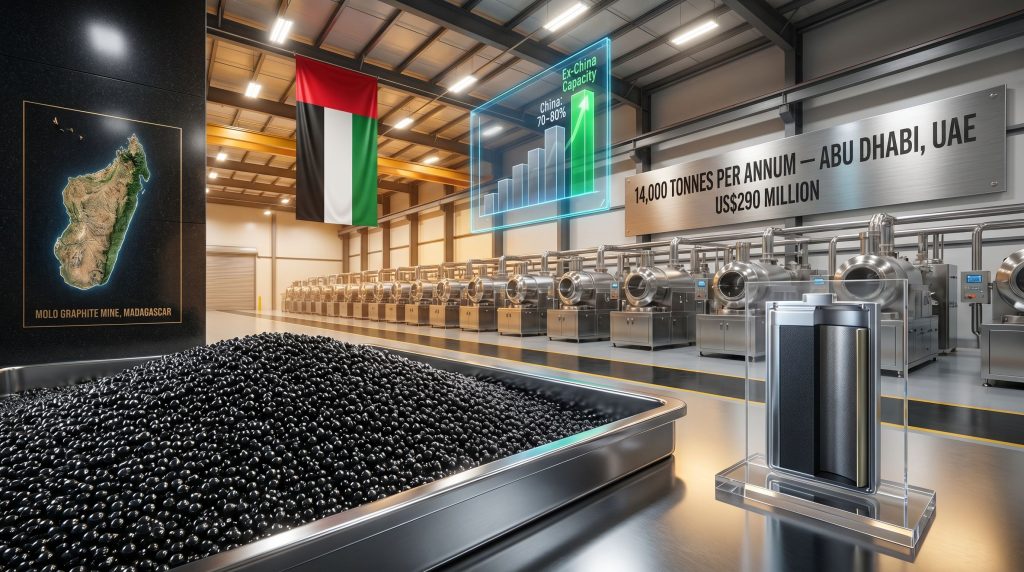
| Phase 1 Annual Capacity | 14,000 tonnes |
| Total Capital Investment | US$290 million |
| Primary Output | Spheronized Purified Graphite (SPG) and Coated SPG (CSPG) |
| Lead Engineering Consultant | Stantec |
| Primary Feedstock Source | Molo Graphite Mine, Madagascar |
| Secondary Feedstock | Third-party flake graphite suppliers as required |
| FID Approval Date | May 2026 |
| Baseline Feasibility Study | October 2025 |
Phase 1 targets 14,000 tonnes per annum of battery-grade anode material. The company has confirmed it is simultaneously planning Phase 2, targeting an additional 16,000 tonnes per annum, alongside a longer-term ambition to develop a distributed global network of battery anode facilities serving regional battery manufacturing clusters across Asia, North America, and Europe.
The Vertical Integration Thesis: From Madagascar to Abu Dhabi
One of the most strategically distinctive aspects of the NextSource model is its vertical integration from mine to anode facility. The company's Molo graphite mine in southern Madagascar serves as the primary upstream feedstock source for the UAE processing facility, creating a fully traceable, integrated supply chain from raw graphite extraction through to finished battery anode material.
This vertical integration matters for several interconnected reasons:
- Margin capture: Vertically integrated producers capture value at both the mining and processing stages rather than paying spot market prices for feedstock, which can erode processing margins significantly during periods of graphite price volatility
- Quality control: When a single entity controls both mining and processing, it can optimise flake graphite quality specifications at the mining stage to maximise anode processing efficiency and final product quality
- Supply traceability: Battery manufacturers and automotive OEMs are increasingly required under emerging battery passport regulations in the European Union to demonstrate full chain-of-custody for battery materials. Vertically integrated suppliers are inherently better positioned to meet these traceability requirements
- Feedstock security: Reliance on spot graphite markets exposes pure-play processors to supply interruptions, particularly relevant given China's dominance in graphite export markets
Madagascar's graphite deposits are recognised within the industry for producing large-flake, high-carbon-grade concentrate, characteristics that are particularly valuable in the spheronisation process where flake size and purity directly influence anode particle yield and electrochemical performance. Furthermore, third-party flake graphite suppliers will supplement Molo production where strategically appropriate, providing operational flexibility without compromising the core integrated model.
Why Abu Dhabi Was Chosen Over Alternative Jurisdictions
The selection of Abu Dhabi's Industrial City as the processing location reflects a sophisticated analysis of competing location factors including regulatory timelines, infrastructure availability, logistics connectivity, and geopolitical trade positioning.
Pre-Permitted Industrial Infrastructure
Operating within a designated pre-permitted industrial zone compresses the regulatory approval timeline dramatically compared to establishing greenfield industrial facilities in North America or Europe, where environmental assessment and permitting processes can extend project timelines by years. The Industrial City of Abu Dhabi provides an established framework within which manufacturing operations can be activated more rapidly, reducing the regulatory execution risk that has derailed or delayed comparable projects in other jurisdictions.
The availability of existing warehouse and industrial infrastructure within the zone transforms what would typically be a construction-intensive mobilisation into a more focused equipment installation and commissioning exercise, with meaningful implications for both capital deployment timelines and cost management.
Logistics Geometry
Abu Dhabi's position at the intersection of major East-West maritime trade routes provides efficient access to flake graphite imports from Madagascar and competitive shipping routes to battery manufacturing clusters in Japan, South Korea, China, Germany, and the emerging North American gigafactory belt. For battery manufacturers operating on just-in-time procurement models, proximity and logistics reliability are critical supplier selection criteria.
Trade Positioning
The UAE occupies a commercially neutral position in the shifting landscape of critical minerals trade. As battery supply chains in Japan, Europe, and North America actively seek to reduce dependence on Chinese-processed materials, a processing facility located outside both Chinese and Western jurisdictions offers offtake optionality that facilities based in any single geopolitical bloc cannot replicate. This positioning consequently enables NextSource to serve battery manufacturers across multiple regional markets without triggering trade policy complications.
NextSource president and CEO Hanré Rossouw described the UAE as continuing to offer a stable, strategically located, and highly supportive environment for advanced materials manufacturing, with the FID signalling the company's confidence in moving ahead while maintaining disciplined risk management.
The Japanese Consortium and Offtake Security
The financing architecture underpinning the FID decision reflects a layered, risk-mitigated capital structure that combines strategic equity, contracted revenue, and engagement with development finance institutions. The broader battery metals investment landscape is increasingly shaped by exactly this kind of institutional, government-backed financing model.
Strategic Equity: Hanwa and JOGMEC
| Partner | Role | Consortium Commitment |
|---|---|---|
| Hanwa Co. | Strategic equity investor | Part of US$30 million consortium |
| Japan Organization for Metals and Energy Security (JOGMEC) | Strategic equity investor | Part of US$30 million consortium |
Hanwa Co. is a major Japanese integrated trading and materials company with established expertise across metals, energy, and commodity supply chains. JOGMEC is the Japanese government-affiliated body specifically mandated to secure stable, long-term supplies of critical minerals for Japan's industrial economy.
The participation of JOGMEC alongside a commercial trading partner is a signal worth noting carefully. It reflects Japan's national strategic calculation that securing ex-China graphite anode processing capacity is a priority at the governmental level, not merely a commercial opportunity. Japan hosts some of the world's largest battery cell manufacturers and automotive OEMs with aggressive EV transition commitments, creating structural demand for reliable anode material supply that is insulated from Chinese export policy risk.
Offtake Certainty: Mitsubishi Chemical
Mitsubishi Chemical has contracted 9,000 tonnes per annum of Phase 1 capacity under a multi-year offtake agreement. This represents approximately 64% of Phase 1's total annual output committed to a single investment-grade counterparty before the facility has broken ground, a level of pre-contracted revenue that substantially de-risks the project's commercial case.
Advanced discussions are ongoing for the remaining approximately 5,000 tonnes of Phase 1 capacity and for the full 16,000 tonnes of Phase 2, suggesting that demand visibility for the project's full output profile is emerging earlier than is typical for projects of this scale and novelty.
The combination of strategic equity from a government-affiliated critical minerals body, long-term offtake from an investment-grade chemicals company, and parallel engagement with development finance institutions represents the emerging standard financing model for critical mineral infrastructure projects globally. Each element de-risks a different dimension of project execution, creating a structure that is more resilient than any single financing component alone.
NextSource has confirmed it is continuing constructive engagement with additional equity investors, commercial lenders, and development finance institutions (DFIs) to complete the project's broader financing structure.
The next major ASX story will hit our subscribers first
How the UAE BAF Compares to Other Ex-China Anode Projects
The global pipeline of ex-China battery anode processing projects is expanding but remains thin relative to projected demand growth. The NextSource UAE battery anode facility stands out within this competitive landscape for several reasons. In addition, shifts in the battery raw materials market are creating urgency for processing capacity to be established outside of China at pace.
| Project | Developer | Location | Planned Capacity | Status (as of May 2026) |
|---|---|---|---|---|
| UAE Battery Anode Facility (Phase 1) | NextSource Materials | Abu Dhabi, UAE | 14,000 tpa | FID approved |
| Vidalia Anode Material Facility | Syrah Resources | Louisiana, USA | ~11,250 tpa | Operational (partial ramp) |
| Matawinie Mine and Bécancour Facility | Nouveau Monde Graphite | Quebec, Canada | ~42,000 tpa (full build) | Development stage |
| Kellyton Graphite Facility | Westwater Resources | Alabama, USA | ~7,500 tpa (Phase 1) | Development stage |
Note: Capacity figures are indicative and based on publicly disclosed project parameters. The competitive landscape is evolving as critical mineral investment activity intensifies globally. This table should not be relied upon as investment guidance.
What differentiates the NextSource UAE position within this competitive set is the combination of pre-permitted infrastructure reducing regulatory execution risk, existing physical infrastructure compressing capital deployment timelines, geopolitical neutrality enabling multi-regional offtake without trade policy exposure, and Japanese institutional backing providing both capital and a direct channel into the Asia-Pacific battery supply chain.
Understanding the Battery Anode Manufacturing Process
For investors and industry observers less familiar with the technical dimensions of anode material production, understanding what a battery anode facility actually produces and why it commands premium pricing relative to raw graphite is essential context.
Raw flake graphite concentrate, typically assaying between 90% and 97% total graphitic carbon (TGC) when mined, undergoes the following transformation sequence:
- Micronisation: Flake graphite is milled to a controlled particle size distribution, typically targeting median particle sizes in the 15 to 20 micron range for standard battery anode applications
- Spheronisation: Milled particles are mechanically shaped into near-spherical morphology, which maximises packing density within battery anodes and optimises lithium-ion intercalation kinetics during charging and discharging
- Thermal purification: Spheronised particles are subjected to high-temperature treatment at temperatures exceeding 2,800 degrees Celsius to remove metallic and non-metallic impurities, achieving final purities typically above 99.95% TGC required by battery manufacturers
- Carbon coating: A thin amorphous carbon layer is deposited onto purified spherical particles, improving first-cycle coulombic efficiency and cycle life performance within battery cells
Each processing stage adds significant commercial value. Raw flake graphite concentrate may trade at several hundred dollars per tonne, while finished CSPG for battery applications commands prices multiples higher, reflecting the capital intensity, technical precision, and intellectual property embedded in the processing sequence. Furthermore, recycled graphite products are beginning to enter this value chain, though virgin processed graphite remains dominant.
Key Considerations for Investors and Industry Observers
The following section contains forward-looking observations and speculative analysis. It does not constitute financial advice. Readers should conduct their own due diligence before making any investment decisions.
Several dynamics make the NextSource UAE battery anode facility announcement worth monitoring carefully:
- FID as a valuation inflection point: Historically, resource and processing projects that achieve FID experience a re-rating by the market as execution risk shifts from being binary to being operational. The transition from development to construction phase typically compresses the discount applied to future cash flows in project valuations
- The Phase 2 pipeline: With only 64% of Phase 1 capacity contracted and Phase 2 discussions already underway, the revenue ceiling of the broader NextSource BAF network is substantially larger than Phase 1 alone implies. Investors attentive to optionality within project structures may find this phasing significant
- DFI engagement as a signal: Development finance institutions apply rigorous environmental, social, and governance (ESG) screening before committing capital. Active engagement with DFIs, as disclosed by NextSource, implies that the project's ESG risk profile has been assessed as acceptable by institutions with sophisticated due diligence frameworks
- Battery passport regulation: Emerging European Union battery regulations requiring full supply chain traceability will create structural advantages for vertically integrated producers with documented chain-of-custody from mine to finished anode material. This regulatory tailwind applies at the sector level, not specifically to this project
- Equipment origin diversification: The disclosure that equipment will be sourced from both China and Mauritius is a notable operational detail. It suggests that NextSource's processing technology architecture draws on Chinese manufacturing expertise for certain equipment categories whilst diversifying supply sources for others, a pragmatic approach to balancing cost efficiency with supply chain resilience
Frequently Asked Questions
What is a battery anode facility and why is it critical to EV manufacturing?
A battery anode facility converts raw flake graphite into coated spherical graphite particles that function as the active anode material in lithium-ion batteries. Graphite is the largest input material by weight in a lithium-ion cell, making anode processing facilities foundational infrastructure for electric vehicle production.
What is the total investment commitment for the NextSource UAE BAF?
The total capital investment across planned development phases is US$290 million.
How much of Phase 1 production capacity is already under offtake agreement?
Mitsubishi Chemical has contracted 9,000 tonnes per annum, representing approximately 64% of Phase 1's 14,000-tonne annual capacity under a multi-year agreement.
What does the FID approval authorise NextSource to begin doing?
The FID clears the company to finalise property agreements, award early works contracts, initiate long-lead equipment procurement, begin equipment shipments from China and Mauritius, progress environmental and permitting activities, and recruit project personnel.
Who are the key financial backers disclosed to date?
The Japanese consortium comprising Hanwa Co. and JOGMEC has proposed a strategic investment of US$30 million. Mitsubishi Chemical provides offtake-based revenue certainty. NextSource is also engaging additional equity investors, commercial lenders, and development finance institutions.
Why is Madagascar's Molo mine significant to this project?
The Molo graphite mine provides the primary feedstock for the UAE processing facility, forming the upstream foundation of NextSource's vertically integrated model. Madagascar's graphite is recognised for large-flake, high-carbon characteristics that are well-suited to battery anode processing requirements.
Want to Know Which ASX Graphite and Battery Materials Discoveries Are Emerging Right Now?
Discovery Alert's proprietary Discovery IQ model scans ASX announcements in real time, instantly identifying significant mineral discoveries across graphite, lithium, and the full spectrum of critical battery materials — turning complex data into actionable insights for investors at every level. Explore historic discoveries and their returns to understand the scale of opportunity, then begin your 14-day free trial at Discovery Alert to position yourself ahead of the market.