June 18, 2026
When Two Macro Storms Collide: Understanding the ASX Decline After Budget Day and the US CPI Shock
There are sessions on the Australian Securities Exchange that decline for obvious, isolated reasons. A single earnings miss. A commodity price drop. A surprise regulatory announcement. Then there are sessions shaped by the convergence of multiple independent pressure systems arriving simultaneously, each reinforcing the other in ways that make the combined outcome worse than either event would have produced alone. The trading session that opened on 13 May 2026 belongs firmly to the second category, and understanding why ASX heads lower after Budget Day and US CPI data is essential for investors navigating this environment.
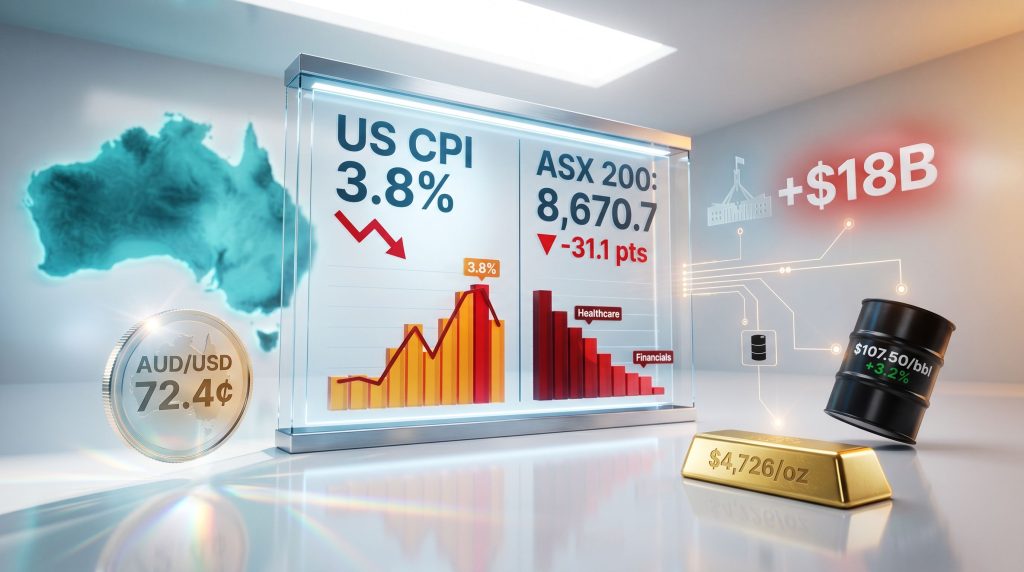
Two distinct macro forces landed within hours of each other: a federal budget committing to $18 billion in additional spending over the 2026-27 financial year, and a US inflation print showing the American Consumer Price Index had climbed to 3.8% annually in April, its highest reading in nearly three years. Neither event alone would have been catastrophic for Australian equities. Together, they created a compounding environment of uncertainty that forced investors to reassess both domestic monetary policy expectations and global rate trajectories at the same time.
Understanding why the ASX heads lower after Budget Day and US CPI data requires examining not just the numbers, but the transmission mechanisms that connect offshore policy signals to Australian equity valuations, and the specific tension that arises when a central bank and a government pull in opposite directions. Broader Australian share market performance context helps frame just how significant this dual-pressure session truly was.
When big ASX news breaks, our subscribers know first
The US Inflation Print: What 3.8% Actually Means for Global Rate Expectations
April's US CPI reading did not emerge from nowhere. A surge in petrol and grocery costs drove the 12-month rate to 3.8%, representing the most significant resurgence in American inflation since the US last exceeded the 4% threshold approximately three years earlier. Both the S&P 500 and the Nasdaq Composite fell into negative territory in direct response to the release, as reported by Market Index.
The market logic behind that reaction is mechanical and well-established:
- Higher-than-expected inflation reduces the probability of near-term Federal Reserve rate cuts
- Sustained elevated rates strengthen the US dollar as yield-seeking capital flows toward USD-denominated assets
- A stronger USD exerts downward pressure on the Australian dollar, which was trading at approximately US 72.4 cents at the time of the ASX open on 13 May
- A weaker AUD raises the domestic cost of imported goods, adding a secondary inflationary dimension to Australia's own economic outlook
- As import inflation risks rise, the Reserve Bank of Australia's capacity to cut rates narrows further
In effect, the US CPI release did not just affect American markets. It tightened the policy constraints facing the RBA by making the global rate environment more restrictive than markets had priced. Furthermore, the relationship between tariffs and investment markets had already been adding layers of complexity to investor positioning before this inflation data landed.
The transmission chain runs in one direction: US inflation rises, the Federal Reserve signals a hold for the foreseeable future, global capital reprices risk upward, and smaller developed economies like Australia absorb the consequences through currency weakness and delayed domestic rate relief.
The Federal Reserve's signalling that rates would hold steady for the foreseeable future was particularly significant for Australian equity valuations. Rate-sensitive sectors, including financials, real estate, and growth-oriented technology stocks, carry higher duration risk, meaning their valuations are disproportionately affected by upward revisions to long-run interest rate expectations.
The Australian Federal Budget: Fiscal Ambition in a High-Inflation Environment
The Albanese government's 2026-27 federal budget arrived with a characterisation of being its most ambitious fiscal programme, committing to $18 billion in additional expenditure. In most economic environments, a growth-oriented budget would be read positively by equity markets as a stimulus for corporate earnings and household spending. In the current environment, however, that interpretation is complicated by a critical variable: the Reserve Bank of Australia had already made its position clear.
RBA Governor Michele Bullock had explicitly called for a reduction in government spending prior to the budget, framing fiscal restraint as a necessary condition for the central bank's inflation management mandate to succeed. The budget's decision to move in the opposite direction created an immediate policy tension that markets were quick to price, with pre-budget nerves already evident in equity markets in the days leading up to the announcement.
Why Fiscal Expansion Complicates the Rate Outlook
| Factor | Pre-Budget Market Expectation | Post-Budget Reassessment |
|---|---|---|
| RBA rate cut timing | Possible in near term | Materially pushed out |
| Inflationary fiscal impulse | Moderate | Elevated by $18B commitment |
| Household cost-of-living pressure | Targeted relief | Broad-based; potentially stimulative |
| Policy coordination (fiscal + monetary) | Moderate tension | Active divergence |
When a central bank tightens monetary conditions while a government simultaneously expands fiscal spending, the two levers work against each other. This dynamic, broadly described as fiscal-monetary policy divergence, is historically associated with prolonged periods of elevated interest rates. Fiscal stimulus can sustain consumer demand and keep inflation elevated even as the central bank raises the cost of borrowing. The result is a longer rate cycle, which suppresses equity market returns by raising the discount rate applied to future earnings.
For ASX investors, the practical implication was straightforward: the combination of a fiscally expansionary domestic budget and a resurgent US inflation print materially reduced the probability of near-term RBA rate cuts, and that repricing was visible across multiple sectors in the opening session.
How Far Did the ASX Fall: Index and Sector Performance on 13 May 2026
The scale of the decline was measured but meaningful, with selling pressure distributed across the breadth of the market rather than concentrated in a single area.
Index-Level Performance
| Index | Level | Movement | Percentage Change |
|---|---|---|---|
| S&P/ASX 200 (prior close, 12 May) | 8,670.7 | -31.1 points | N/A |
| All Ordinaries | 8,909.6 | -32.8 points | -0.37% |
| S&P/ASX 100 | 7,252.2 | -25.0 points | -0.34% |
| S&P/ASX Small Ordinaries | 3,470.3 | -19.6 points | -0.56% |
The Small Ordinaries registering a larger percentage decline than large-cap indices is a characteristic signature of risk-off sessions. Smaller companies carry higher perceived vulnerability to credit conditions and interest rate sensitivity, so investors tend to rotate out of them more aggressively when the rate environment becomes more restrictive.
Pre-market futures had indicated an approximately 20-point drop at the open, suggesting the dual pressures were already priced into overnight positioning before Sydney trading began.
Healthcare: The Dominant Sector Drag
The healthcare sector bore an outsized share of the index decline, driven primarily by a significant company-specific event at one of the ASX's most heavily weighted healthcare constituents. A major impairment of approximately A$7 billion was flagged, accompanied by a downward revision to the full-year 2026 earnings outlook. The resulting share price movement sent the broader healthcare sector to levels not seen in over eight years, amplifying the index-level decline beyond what the macro backdrop alone would have produced.
This illustrates a critical dynamic in index-heavy markets: when a single large constituent experiences a company-specific shock on the same day as a broad macro-driven selloff, the index decline can exceed what the underlying economic conditions would ordinarily justify. The two events are independent, but their timing compounds the headline number.
Financials: Broad-Based Weakness Across the Big Four
Australia's major banks declined broadly, with the sector falling between 1.8% and 3.3% across the Big Four. The backdrop was particularly nuanced for Commonwealth Bank (ASX: CBA), which reported an unaudited quarterly cash profit of approximately $2.7 billion, supported by higher lending and deposit volumes through a period of multiple interest rate adjustments.
Despite solid underlying earnings, CBA described operating income as broadly flat during the quarter, a reflection of the margin compression that occurs when rate cycles are extended and competition for deposits intensifies. Markets interpreted the broader banking sector's performance through the lens of the new fiscal and inflation reality: if rate cuts are pushed further out, the compressed margin environment persists, and the valuation premium the sector had been building on anticipated rate relief narrows.
Consumer and Energy Sectors
Consumer discretionary and transport-linked stocks experienced notable selling pressure, consistent with a risk-off rotation that occurs when inflation expectations are revised upward. Energy producers, however, provided a partial offset, benefiting directly from Brent Crude's advance.
Commodity Markets: Oil Rises as Iron Ore and Natgas Retreat
The commodity picture on 13 May 2026 was notably mixed, with divergent price movements across the key resources that matter to ASX-listed companies.
Commodity Price Snapshot
| Commodity | Price | Movement | Key Driver |
|---|---|---|---|
| Brent Crude | US$107.50/bbl | +3.2% | Anticipated Trump-Xi Beijing meeting |
| Iron Ore (Singapore) | US$110.10/tonne | -1.5% | China demand uncertainty |
| Gold | US$4,726/oz | Broadly flat | Safe-haven demand offset by USD strength |
| US Natural Gas (futures) | ~US$2.83/GJ | -2.7% | Seasonal demand normalisation |
Brent Crude's advance to $107.50 per barrel was attributed to geopolitical speculation surrounding an anticipated meeting between US President Donald Trump and Chinese President Xi Jinping in Beijing. Resource markets often front-run significant bilateral meetings between the world's two largest economies, pricing in the possibility of trade-related commodity demand shifts before any concrete agreements are reached.
A rising oil price in an inflationary environment creates a structural paradox for equity investors. Energy producers gain directly from higher crude prices, but the broader economic system pays an elevated input cost that flows through to transport, manufacturing, and consumer goods pricing, sustaining inflationary pressure and reinforcing the case for sustained high interest rates.
Iron ore's retreat of 1.5% to $110.10 per tonne in Singapore reflected ongoing uncertainty about Chinese industrial demand, which remains the single most important variable for Australian bulk commodity exports. Understanding the longer-term iron ore demand prospects is consequently essential context for any ASX materials sector investor. Gold's broadly flat performance at $4,726 per ounce reflected the competing forces of safe-haven demand from risk-averse investors and USD strength from the inflation data, which tends to suppress gold's relative appeal as a non-yielding asset. The longer-run gold price forecast nonetheless remains a closely watched variable for resource-sector positioning.
Corporate Developments Operating on a Separate Track
Beyond the macro pressures, several ASX-listed companies announced developments that would ordinarily attract significant investor attention independently of broader market conditions.
Rare Earths Supply Chain: Arafura and Traxys
Arafura Rare Earths (ASX: ARU), backed by Gina Rinehart, formalised an Offtake Term Sheet with North American commodities group Traxys. Under the agreement, Traxys committed to supply 500 tonnes per annum of Neodymium-Praseodymium (NdPr) oxide and 7.5 tonnes per annum of Dysprosium-Terbium (DyTb) oxide annually.
This transaction carries significance beyond the deal size. NdPr oxide is the primary input material for permanent rare earth magnets used in electric vehicle motors and wind turbine generators. DyTb oxide is added to those magnets to maintain magnetic performance at high operating temperatures, a requirement for traction motors in electric drivetrains.
The decision by a North American offtake partner to formalise supply commitments with an Australian producer reflects the ongoing effort by Western supply chains to reduce dependence on Chinese rare earth processing. The broader critical minerals energy transition narrative underpins much of this strategic repositioning, which dominates global production at the refining and separation stage.
The rare earths market operates with pricing dynamics that are not widely understood outside specialist circles. NdPr is typically priced on a per-kilogram basis for oxide-equivalent material, and offtake agreements are often structured with floor pricing and ceiling mechanisms. A 500 tonne per annum commitment represents a meaningful volume anchor for project financing discussions.
Lithium Infrastructure: Develop Global's $274 Million Contract
Develop Global (ASX: DVP) secured a $274 million underground development and production contract at Core Lithium's (ASX: CXO) Finniss Lithium Project in the Northern Territory. Simultaneously, Develop terminated its existing agreement with Bellevue Gold (ASX: BGL) in the Western Australian Goldfields, signalling a deliberate reorientation of its contracting exposure toward lithium-linked infrastructure.
The scale of the Finniss contract reflects the capital intensity of underground hard rock mining, where development costs per metre of advance are substantially higher than open-pit equivalents. Underground lithium development requires specialised ground support systems, ventilation design, and ore handling logistics that differ meaningfully from the open-cut spodumene operations that characterise many of Australia's lithium projects.
Gold Sector Resource Update
Black Bear Minerals (ASX: BKB) updated its Independence project mineral resource estimate to 2.2 million ounces, a development that in a risk-on environment would typically attract meaningful positive attention. The resource update arrived in a session dominated by macro headwinds, however, limiting the market's capacity to focus on the underlying merit of the announcement.
The next major ASX story will hit our subscribers first
Australian Inflation Context: The Domestic Layer That Compounds Everything
The offshore macro pressures arrived against an already challenging domestic backdrop. Australian annual inflation had been tracking near a three-year high of approximately 3.7% as of March 2026, driven in part by transport cost rebounds following the sustained period of elevated global energy prices.
This creates a three-part constraint on the RBA's policy flexibility:
- Domestic inflation remains above target, limiting the central bank's justification for rate cuts
- Expansionary fiscal policy adds stimulus that risks sustaining demand-driven inflation for longer
- US inflation resurgence removes the external tailwind of a global rate-cutting cycle that would have eased financial conditions for Australian borrowers
Business confidence surveys from NAB indicated very low sentiment in the period, with many businesses absorbing cost increases internally rather than passing them fully to consumers. While this compression of corporate margins provides some demand-side relief from an inflation management perspective, it simultaneously reduces the earnings growth that equity market valuations depend upon.
What the Convergence Signals for ASX Positioning in the Months Ahead
The events of 13 May 2026 are not simply a one-session story. They reflect structural forces that will shape the investment landscape for Australian equities across the medium term.
Short-Term Pressures (0 to 3 Months)
- Rate cut expectations will continue to be repriced lower as long as US inflation remains elevated and domestic fiscal policy adds spending impulse
- Sector rotation away from rate-sensitive growth stocks toward resource and energy producers is likely to persist while oil prices remain above $100 per barrel
- Currency volatility will remain a live risk for internationally exposed ASX companies, with AUD/USD fluctuations driven primarily by US inflation data and Fed communications
Medium-Term Considerations (3 to 12 Months)
- The trajectory of US inflation is the single most important external variable for ASX performance across this horizon; a sustained return toward 2 to 2.5% would unlock global rate cut cycles and provide a meaningful equity tailwind
- Each domestic CPI print will be assessed through the lens of whether the budget's $18 billion spending commitment is adding to inflationary pressure, making the quarterly CPI release a critical market event
- Critical minerals supply chain developments, such as offtake agreements in rare earths and lithium infrastructure contracts, represent structural growth themes that operate with a degree of independence from short-term rate cycle dynamics
Distinguishing between cyclical headwinds and structural tailwinds is the essential analytical task for ASX investors in this environment. Rate uncertainty and currency pressure are cyclical by nature and will eventually resolve. The buildout of Western rare earth and critical mineral supply chains is a decade-long structural theme that creates compounding value regardless of where rates sit in any given quarter.
Key Takeaways: ASX Heads Lower After Budget Day and US CPI
| Factor | Key Detail | Market Impact |
|---|---|---|
| US CPI (April 2026) | 3.8% annual; highest in nearly 3 years | Negative: reduced Fed cut expectations |
| Australian Federal Budget (2026-27) | +$18B additional spending | Negative: inflationary fiscal impulse |
| RBA Policy Tension | Governor explicitly called for spending restraint | Negative: rate cut timeline extended |
| AUD/USD | ~US 72.4 cents at open | Negative: USD strength adds import inflation risk |
| Brent Crude | US$107.50/bbl, +3.2% | Mixed: energy sector positive, broader economy negative |
| Iron Ore (Singapore) | US$110.10/t, -1.5% | Negative for materials sector |
| Gold | US$4,726/oz, broadly flat | Neutral: safe-haven demand offset by USD strength |
| US Natural Gas Futures | ~US$2.83/GJ, -2.7% | Modest negative for energy segment |
| ASX 200 Prior Close (12 May) | 8,670.7 (-31.1 pts) | Bearish session established before 13 May open |
| Healthcare Sector Impairment | ~A$7B write-down flagged | Significant sector drag amplifying index decline |
| CBA Quarterly Cash Profit | ~$2.7 billion | Solid but broadly flat operating income |
| Arafura-Traxys Offtake | 500tpa NdPr + 7.5tpa DyTb | Structural rare earths supply chain positive |
| Develop Global Contract | $274M Finniss Lithium contract | Lithium infrastructure sector positive |
This article is intended for informational purposes only and does not constitute financial or investment advice. Past market performance and current economic conditions discussed here do not guarantee future outcomes. Readers should conduct their own research and consult a licensed financial adviser before making any investment decisions.
Want to Stay Ahead of Significant ASX Mineral Discoveries as They Happen?
While macro headwinds dominated this session, structural themes in critical minerals, rare earths, and lithium continue to generate compelling discovery opportunities on the ASX — and timing is everything. Discovery Alert's proprietary Discovery IQ model delivers real-time alerts the moment significant mineral discoveries are announced, turning complex data across 30-plus commodities into clear, actionable insights for both short-term traders and long-term investors; explore Discovery Alert's discoveries page to see the historic returns major ASX discoveries have delivered, and begin a 14-day free trial to position yourself ahead of the broader market.