May 13, 2026
Guatemala's Mining Sector Sits at a Genuine Crossroads for Global Capital
Across Latin America, the tension between resource extraction and Indigenous territorial rights has never been more commercially consequential. For decades, the mining industry operated under the implicit assumption that government permits, once issued, translated into operational certainty. That assumption is being systematically dismantled. Guatemala has become one of the most instructive case studies in the world for understanding how quickly a constructed, fully permitted mine can transform into a stranded asset, and conversely, how aggressively capital can flow into a jurisdiction when regulatory conditions align. Aura raises Era Dorada capex as Escobal restart remains uncertain in Guatemala, and these two simultaneously unfolding scenarios offer investors, geologists, and policy analysts a rare comparative framework for evaluating risk in a single country at a single moment in time.
When big ASX news breaks, our subscribers know first
What the Era Dorada Capital Escalation Actually Signals
When a mining company more than doubles its expansion capital commitment within a single revision cycle, the market tends to treat this as either a sign of extraordinary confidence or a red flag for cost discipline. In Aura Minerals' case, the April 2026 board approval for full construction at Era Dorada appears to reflect the former.
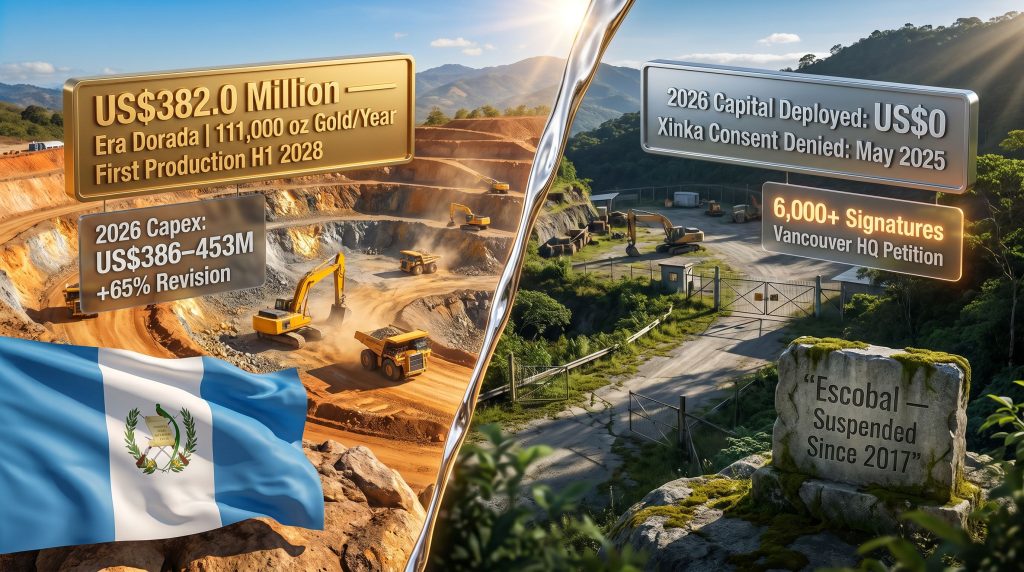
The total capital commitment for the project reached US$382.0 million, while 2026 annual capital expenditure guidance was revised upward to a range of US$386 to US$453 million, representing a 65% increase from prior guidance. The most dramatic shift occurred within the expansion capital line, which surged from a previous range of US$111 to US$130 million to US$262 to US$314 million, effectively more than doubling in a single reporting period.
What makes this escalation analytically interesting is what did not change. Sustaining capital held steady at US$105 to US$123 million, a deliberate signal that the underlying mine economics remain intact and that the additional spend represents growth acceleration rather than cost blowout. Exploration capital was maintained at US$19 to US$25 million, indicating that resource growth ambitions continue alongside active construction. Understanding mineral exploration importance helps contextualise why maintaining this budget line signals long-term confidence in the asset.
A 65% upward revision in annual capital expenditure guidance within a single reporting cycle is uncommon outside of compressed construction timelines or periods of sustained commodity price strength that justify front-loading investment risk.
Production Targets and Mine Life Economics
Era Dorada's production profile underpins the capital rationale. The project is designed to deliver an average of 111,000 ounces of gold per year during its first four years of commercial operation, with a projected mine life of 17 years. First production is targeted for the first half of 2028, establishing a construction window of approximately 24 months from the April 2026 board decision.
A 17-year mine life is a significant asset duration metric. In institutional capital planning, long-duration gold assets carry a distinct valuation premium because they allow operators to amortise infrastructure costs across an extended production base, reduce per-ounce capital intensity over time, and provide sufficient operating history to refinance project debt on favourable terms. Furthermore, definitive feasibility studies completed prior to these kinds of capital commitments are what give institutional investors the confidence to back large-scale construction decisions. For Aura Minerals, Era Dorada represents a generational asset in a jurisdiction where, at least for this specific project, permitting conditions have not emerged as a construction barrier.
Environmental Design as a Competitive Differentiator
One of the less-discussed aspects of Era Dorada's project design is its environmental architecture. The project incorporates 100% water reuse systems and includes commitments to deliver potable water infrastructure to surrounding communities. These are not incidental features. They represent a deliberate engineering response to the category of community concerns that have historically paralysed mining projects across Central America.
Water access and contamination risk sit at the centre of almost every major social licence dispute in the region. By designing closed-loop water management into the project from the outset, Aura Minerals has effectively addressed the most common environmental objection before it can gain community traction. Considering natural capital in mining is increasingly recognised as a best practice in modern project development, though it remains underutilised across the broader sector.
The Comparative Reality: Era Dorada Versus Escobal
To understand why Aura raises Era Dorada capex as Escobal restart remains uncertain in Guatemala matters beyond a single company announcement, the contrast between these two assets must be examined in structural terms.
| Metric | Era Dorada (Aura Minerals) | Escobal (Pan American Silver) |
|---|---|---|
| Project Status | Full construction approved | Indefinitely suspended |
| 2026 Capital Deployed | US$386-453 million | Nil (care and maintenance only) |
| Total Project Capex | US$382.0 million | Not applicable (pre-2017 construction) |
| Annual Production Target | 111,000 oz gold (first 4 years) | No production since 2017 |
| Projected Mine Life | 17 years | Undetermined |
| Expected First Production | H1 2028 | No timeline announced |
| Indigenous Consultation Status | Not a reported material barrier | Xinka consent formally denied May 2025 |
| Government Resolution Position | Approved and advancing | Consultation unresolved by MEM |
The contrast is stark. One asset is absorbing hundreds of millions of dollars in active capital deployment. The other is absorbing care-and-maintenance expenditure with no production revenue and no defined resolution pathway. Both exist within the same national regulatory jurisdiction.
How ILO Convention 169 Became the Defining Legal Variable at Escobal
The Escobal mine's suspension dates to 2017, when the Guatemalan Constitutional Court ordered the Ministry of Energy and Mines to conduct free, prior, and informed consent consultations with the Xinka Indigenous People before any consideration of operating licence reinstatement. The legal foundation for this ruling is ILO Convention 169, the International Labour Organization's framework treaty protecting the rights of Indigenous and tribal peoples over decisions affecting their territories.
Guatemala is a signatory to ILO Convention 169, and the Constitutional Court's application of the treaty created a legally binding procedural obligation that the government cannot simply bypass. This is a critically important distinction that investors sometimes misread. The consultation requirement is not a formality that can be satisfied through a series of community meetings. Under international legal interpretation of the Convention, the process must be:
- Free from coercion, pressure, or manipulation
- Prior to any decision being made, not conducted after the fact
- Informed through comprehensive sharing of project impacts, risks, and alternatives
- Conducted in good faith with the genuine possibility of the process resulting in consent not being granted
The structural question that remains legally contested is whether the Xinka Parliament's denial of consent constitutes an effective veto, or whether the Guatemalan government retains ultimate licensing authority notwithstanding the consultation outcome. Pan American Silver's publicly stated position is that it respects the consultation process while maintaining that final decision-making authority rests with the government, a stance that places the company in direct structural conflict with Indigenous communities who interpret the Convention as requiring their consent to be binding.
Seven Years of Process, One Formal Rejection
After nearly a decade of consultation proceedings, the Xinka Parliament formally denied consent for the Escobal mine's restart in May 2025. The community's objections centred on three interconnected concerns:
- Risks to watershed systems and downstream water security
- Threats to cultural heritage sites within and adjacent to the mining concession area
- The perceived incompatibility of industrial extraction with territorial integrity and long-term community governance
The Xinka leadership did not call for modified operating conditions or enhanced benefit-sharing arrangements. They called for permanent mine closure. This is not a negotiating position; it is a finalised institutional response following a seven-year deliberative process. Treating it as an opening bid in a commercial negotiation misreads the nature of the Xinka Parliament's authority and the cultural weight of the decision within the community's governance structure.
Civil Society Escalation and Reputational Calculus
In November 2025, Indigenous rights advocates delivered a petition bearing over 6,000 signatures to Pan American Silver's Vancouver corporate headquarters. The petition demanded that the company formally honour the Xinka Parliament's consent denial rather than defer to a potential government override.
This kind of international civil society engagement has become a material factor in how institutional investors evaluate ESG risk exposure. Pension funds and asset managers operating under responsible investment frameworks are increasingly required to assess whether portfolio companies face active Indigenous rights disputes. Consequently, the reputational consequences of being associated with a contested restart can affect both equity valuations and debt financing terms.
Three Scenarios for Escobal's Future
The Ministry of Energy and Mines has not announced a completion date for the consultation process, leaving Escobal in a state of regulatory limbo with no defined resolution pathway. Three plausible outcomes exist, each carrying materially different consequences:
Scenario A: Permanent Closure
The government accepts the Xinka Parliament's denial as effectively binding. Pan American Silver writes down the asset and exits Guatemala. The precedent effect would strengthen Indigenous consent rights in future Latin American mining consultation processes, potentially reshaping how projects across the region are designed and negotiated.
Scenario B: Contested Restart
The government overrides the consultation outcome, citing national economic interest and its own authority over mineral licensing. Legal challenges escalate through Guatemalan courts and potentially international arbitration mechanisms. Any operational restart occurs under sustained civil opposition, with elevated risk of production disruptions, supply chain complications, and ongoing reputational exposure.
Scenario C: Negotiated Conditional Framework
Structured dialogue between Pan American Silver, the Xinka Parliament, and the Ministry of Energy and Mines produces a conditional operating agreement. A restart becomes contingent on binding community benefit arrangements, environmental monitoring co-governance, and independent oversight mechanisms. The timeline remains multi-year; investor uncertainty persists throughout.
Each scenario produces a different asset valuation outcome for Pan American Silver and a different precedent signal for the broader Latin American mining investment community.
What the Escobal Impasse Reveals About Systemic Risk Architecture
Escobal is not simply a difficult project in a difficult country. It is a constructed, previously operational mine with existing infrastructure, established ore bodies, and a known production profile, now generating zero revenue after nearly a decade of suspension. From a pure asset economics perspective, this represents one of the more striking examples of how unresolved social licence disputes can convert productive capital into indefinitely dormant sunk cost.
The Escobal mine is located in the San Rafael Las Flores municipality of the Santa Rosa department in southeastern Guatemala. It is considered one of the world's largest primary silver mines by reserve base, which makes the indefinite suspension particularly significant for global silver supply considerations — especially given the growing importance of critical minerals and energy security in the global transition. The mine's ore grades were historically strong, with silver mineralisation occurring in a high-grade epithermal vein system, and the project had reached commercial production before the 2017 suspension order.
For investors conducting due diligence on Latin American mining assets, Escobal has become a reference case study in what the industry sometimes calls constructed asset stranding — a scenario where capital has already been deployed to build a functioning mine, but the mine cannot operate due to legal, social, or regulatory barriers rather than technical or geological limitations.
The next major ASX story will hit our subscribers first
Capital Allocation Psychology and the Investor Signal Problem
From an investor psychology perspective, the divergence between Era Dorada and Escobal creates a signal problem for Guatemala as a mining jurisdiction. On one hand, Aura Minerals' aggressive capital deployment demonstrates that Guatemala can attract and retain large-scale gold development investment when permitting conditions are clear. On the other hand, Escobal's indefinite suspension demonstrates that Guatemala's constitutional framework can effectively freeze a fully operational mine for nearly a decade without resolution.
These two realities coexist in the same regulatory environment, and how investors weight them depends heavily on where in the project development cycle their exposure sits. Indeed, mining permitting risks represent one of the most underappreciated variables in cross-border capital allocation decisions:
- Greenfield development investors may look at Era Dorada as evidence that Guatemala remains accessible for new project development with the right permitting foundation
- Brownfield and operating asset investors may treat Escobal as a warning about the durability of operating licences in jurisdictions where Indigenous consultation rights remain constitutionally embedded and unenforced at the government level
- ESG-focused institutional capital will increasingly require demonstrated social licence strategies before committing to either category in Guatemala
The water dimension runs through both projects as a thematic thread. Water governance has become a non-negotiable variable in Central American mining project design, and Era Dorada's closed-loop water systems reflect the industry's recognition that this is no longer a risk to be managed after community opposition emerges, but one to be designed out from the engineering phase forward.
Frequently Asked Questions
What is the Era Dorada project and who owns it?
Era Dorada is a gold mining development project in Guatemala owned by Aura Minerals. Following full board approval in April 2026, the project entered its construction phase with a total capital commitment of US$382.0 million and a target production start in the first half of 2028.
Why has the Escobal mine been suspended since 2017?
Guatemala's Constitutional Court ruled that the government must conduct free, prior, and informed consent consultations with the Xinka Indigenous People under ILO Convention 169 before the mine's operating licence could be considered for reinstatement. The Xinka Parliament formally denied consent in May 2025 following a seven-year process.
What is ILO Convention 169 and why does it matter for mining in Guatemala?
ILO Convention 169 is an international treaty protecting the rights of Indigenous and tribal peoples over decisions affecting their territories, including the right to free, prior, and informed consent. Guatemala's Constitutional Court has applied it as a legally binding constraint on the government's ability to unilaterally reinstate Escobal's operating licence.
How much is Aura Minerals investing in Era Dorada in 2026?
Revised 2026 capital expenditure guidance sits at US$386 to US$453 million, representing a 65% increase from prior guidance. Expansion capital alone more than doubled to US$262 to US$314 million following the April 2026 board decision for full construction.
What is Era Dorada's expected gold production?
The project targets an average of 111,000 ounces of gold per year during its first four years of operation, with a projected mine life of 17 years.
Has Pan American Silver provided a timeline for Escobal's restart?
No. Pan American Silver has not provided any restart timeline. The Ministry of Energy and Mines has also not announced when the consultation process will conclude, leaving the asset in a state of indefinite regulatory uncertainty.
Key Takeaways for Mining Investors Watching Guatemala
-
Capex velocity reflects social licence clarity: The contrast between Aura's US$386 to US$453 million 2026 deployment and Escobal's zero active capital spend demonstrates that social licence status is now a direct determinant of investment velocity, not a secondary consideration
-
ILO Convention 169 is a financial variable, not just a legal one: The Xinka Parliament's consent denial has effectively converted a fully constructed mine into a stranded asset, establishing a precedent with implications across Latin American jurisdictions where the Convention applies
-
Environmental design is increasingly a social licence instrument: Era Dorada's 100% water reuse commitment reflects a broader industry recognition that community water concerns must be addressed at the engineering stage, not after opposition crystallises
-
Guatemala's regulatory environment is bifurcated by project status: Approved projects with clear permitting foundations can attract and deploy capital aggressively; projects entangled in constitutional consultation obligations face indefinite suspension regardless of their physical construction status
-
The Escobal resolution will carry regional precedent weight: How Guatemala's government ultimately addresses the Xinka Parliament's denial will shape risk frameworks for mining investment across Central America for years
This article is intended for informational purposes only and does not constitute financial, legal, or investment advice. Forward-looking projections including production targets, capital expenditure ranges, and project timelines are subject to material risks and uncertainties. Readers should conduct independent due diligence before making investment decisions.
Want to Stay Ahead of Significant ASX Mineral Discoveries Before the Broader Market?
Discovery Alert's proprietary Discovery IQ model delivers real-time alerts on high-potential ASX mineral discoveries, turning complex data across more than 30 commodities into clear, actionable insights for both short-term traders and long-term investors — explore historic discoveries and their returns to understand the scale of opportunity, then begin your 14-day free trial to position yourself ahead of the market.