
May 13, 2026
When Geography Becomes Destiny: The Hidden Fragility of Gulf Aluminium
Few industrial sectors illustrate the concept of geographic concentration risk as vividly as primary aluminium production in the Middle East. For decades, Gulf producers have capitalised on cheap energy, modern smelting infrastructure, and proximity to key Asian and European markets to build a formidable share of global output. Yet this same geographic clustering creates a structural vulnerability that commodity markets have arguably underpriced for years. When a single maritime corridor closes, the consequences ripple through supply chains with immediate and measurable force.
The Aluminium Bahrain sales fall over Strait of Hormuz closure episode in early 2026 offers one of the most instructive case studies in modern commodity market disruption. What unfolded between February and May of that year was not a slow-moving theoretical risk scenario. It was a live stress test of how quickly a geographically exposed industrial producer can lose shipping access, absorb a physical attack on its facilities, scramble to reroute exports across 1,400 kilometres of overland terrain, and still report a 316% surge in net profit, all within a single quarter.
Understanding how these seemingly contradictory outcomes coexisted requires examining the mechanics of LME aluminium pricing, the operational flexibility of large-scale smelters, and the strategic logic that drove Alba to simultaneously manage a wartime logistics crisis while pursuing a European acquisition. Furthermore, the broader aluminum and alumina markets provide essential context for interpreting these dynamics.
When big ASX news breaks, our subscribers know first
The Strait of Hormuz and Why Aluminium Flows Through It
A Chokepoint Built Into the Production Geography
The Strait of Hormuz is approximately 33 kilometres wide at its narrowest navigable point and separates the Persian Gulf from the Gulf of Oman. Every tonne of aluminium produced in Bahrain, the UAE, and Qatar must transit this corridor to reach global markets unless an alternative overland or indirect maritime route is established.
This structural dependency exists because Gulf aluminium smelters were built to exploit regional energy advantages, not to optimise logistics resilience. Bahrain, for instance, has historically used cheap natural gas to power its smelting operations, giving producers like Alba a significant cost advantage over energy-intensive competitors in Europe and North America. The trade-off was always implicit: low-cost production in exchange for geographic exposure.
The Gulf region accounts for roughly 8 to 9% of global primary aluminium production, according to industry estimates. Alba alone operates an annual smelting capacity of 1.6 million tonnes per year, making it one of the largest single-site aluminium producers in the world. When the strait becomes inaccessible, that volume does not simply redirect itself overnight. Top aluminium companies operating in this region face compounded exposure as a result.
Why Smelters Cannot Simply Stop and Restart
A critical piece of industry knowledge that receives little attention in general financial coverage is the operational constraint of aluminium smelting. Unlike many manufacturing processes, electrolytic aluminium smelters cannot be switched off and restarted without significant cost and technical risk. The Hall-Héroult process, which uses molten cryolite baths maintained at approximately 960 degrees Celsius, requires continuous electrical current.
A cold shutdown risks permanent damage to the reduction cells, known as pots, and can require months and tens of millions of dollars to recommission. This means producers facing a logistics disruption face an uncomfortable choice: continue producing and stockpile inventory at cost, reduce capacity through selective cell shutdowns, or absorb higher transport costs through alternative routes.
Alba's decision to take 19% of capacity offline in mid-March 2026 by shutting down Lines 1, 2, and 3 reflects the outcome of this calculus, accepting some production loss while preserving the majority of operational continuity.
The irreversibility of smelter shutdowns is a key reason why aluminium producers tend to absorb short-term logistics cost increases rather than halt production. The cost of restarting a cold pot line frequently exceeds the losses from operating at negative short-term margins.
Q1 2026 Operations: What the Numbers Actually Reveal
Sales Volume Decline Masks a More Complex Picture
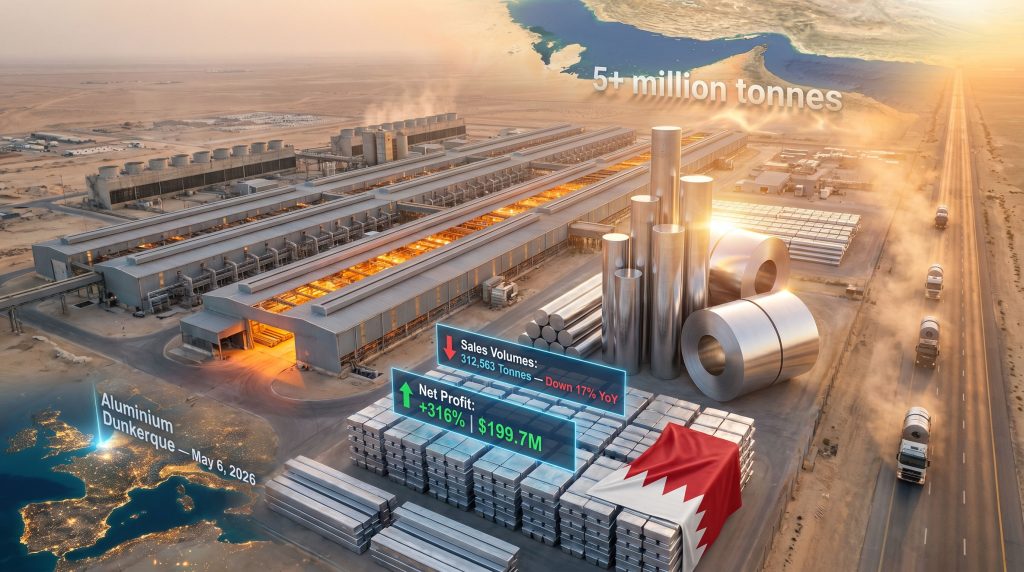
Alba reported a 17% year-on-year decline in sales volumes to 312,563 metric tonnes in the first quarter of 2026, against a net finished aluminium production figure of 339,734 tonnes, itself down 14% on the prior year. The gap between production and sales is instructive: the company produced more than it sold, meaning inventory was accumulating even as it managed logistics constraints.
The mid-March shutdown of 19% of capacity did not take full effect until late in the quarter, so the Q1 production figure still reflects a relatively high output level for most of January and February before disruptions intensified.
Key Q1 2026 Operational Metrics:
| Metric | Q1 2025 (Estimated) | Q1 2026 (Reported) | Change |
|---|---|---|---|
| Sales Volume | ~376,500 tonnes | 312,563 tonnes | -17% |
| Net Production | ~394,000 tonnes | 339,734 tonnes | -14% |
| Capacity Offline | Minimal | 19% (Lines 1, 2, 3) | Significant |
| Net Profit | Baseline | 75.3M BHD ($199.7M) | +316% |
Note: Q1 2025 sales volume is an estimate derived by applying the disclosed 17% decline rate to the Q1 2026 reported figure. Financial data sourced from Mining.com/Reuters, May 12, 2026.
The Raw Material Constraint That Nearly Stopped Everything
Arguably the most underreported aspect of Alba's Q1 2026 operational crisis was the alumina supply situation. Alumina (aluminium oxide) is the refined intermediate product derived from bauxite ore and is the essential feedstock for primary aluminium smelting. Without a continuous alumina supply, a smelter cannot produce metal regardless of its energy availability or labour capacity.
As of mid-March 2026, Alba held approximately one month of alumina stockpile and had not yet secured alternative supply routes through the Red Sea corridor. This represented an extremely narrow operational window. A one-month buffer is considered minimal in the industry; most large smelters prefer a buffer of two to three months to absorb supply chain disruptions.
The company responded by deploying what it described as diversified sourcing strategies and flexible logistics, using multiple regional ports and multimodal transport routes for raw material imports and metal exports. This language in the earnings release signals that the alumina supply crisis was resolved, though the specific sourcing arrangements secured were not disclosed in detail.
The Logistics Pivot: Rerouting 60% of Exports Overland
Jeddah as the Operational Lifeline
When the Strait of Hormuz became effectively impassable, Alba's primary alternative was to route aluminium exports through the Saudi port of Jeddah on the Red Sea. This required overland trucking of metal across approximately 1,400 kilometres (870 miles), from Bahrain through Saudi Arabia to the western seaboard port facility.
Alba confirmed it was routing up to 60% of its aluminium exports via Jeddah, with CEO Ali Al Baqali indicating that customer commitments were being maintained without significant transport cost escalation. That qualification is important: some cost increase was implicitly acknowledged, but the company characterised it as manageable relative to the scale of the operational disruption.
Why the Jeddah Route Works (and Its Limitations):
- Jeddah's King Abdulaziz Port is one of the largest ports on the Red Sea and is equipped to handle bulk commodity shipments including aluminium billets, slabs, and rolling slab
- The Red Sea itself remains open to shipping, providing access to European and Asian markets via the Suez Canal
- Overland trucking at scale across 1,400 km adds days to transit time and increases per-tonne logistics costs meaningfully
- The route requires cross-border coordination between Bahraini and Saudi authorities, as well as port capacity allocation in Jeddah
- Trucking capacity constraints can limit throughput during peak demand periods
The fact that Alba achieved this pivot within weeks of the Hormuz closure suggests both pre-existing relationships with Saudi logistics infrastructure and significant operational agility — capabilities that will likely be embedded more formally into its supply chain strategy going forward.
The Profit Paradox: How a 17% Volume Drop Produced a 316% Profit Surge
LME Prices and the Economics of Scarcity
The most counterintuitive element of Alba's Q1 2026 performance is the relationship between lower volumes and dramatically higher profits. This apparent paradox resolves clearly once the price environment is factored in. In addition, understanding aluminium tariff impacts is essential context, as trade policy had already tightened the global supply picture heading into the disruption.
Primary aluminium is predominantly sold on contracts linked to the London Metal Exchange (LME) cash price, often with a regional premium added for delivery location and product specification. When the Hormuz closure simultaneously reduced supply availability from the Gulf's 8 to 9% of global production, LME prices responded to the supply shock with significant upward movement.
Alba's net profit rose 316% year on year to 75.3 million Bahraini dinars ($199.7 million), with the company specifically attributing the result to higher aluminium prices. The BHD to USD exchange rate implied by the reported figures is consistent with the Bahraini dinar's historical peg to the US dollar at approximately 0.376.
This is the price-volume paradox in commodity markets: when a supply disruption is severe enough to move benchmark prices materially, the surviving producers who maintain partial output can earn more revenue per tonne than they did at full capacity in a lower-price environment. The producer suffers a volume penalty but collects a price premium that more than compensates.
What This Means for Commodity Market Investors
This dynamic carries important implications for investors evaluating commodity producers during periods of geopolitical disruption. The instinct to sell a producer that announces volume declines is understandable but can be incorrect when:
- The volume decline is caused by a supply-side shock that simultaneously affects competitors
- The price response to that supply shock is larger than the volume reduction
- The producer maintains sufficient operational continuity to benefit from elevated prices
- The producer's cost structure allows profitable operations even at reduced throughput
Alba demonstrated all four conditions in Q1 2026. Investors who sold the stock on the volume decline headline would have missed the profit surge driven by the underlying price mechanics.
Industry-Wide Disruption: Alba Was Not Alone
Emirates Global Aluminium and Qatar: Parallel Crises
Alba's operational challenges were part of a broader pattern of disruption affecting Gulf aluminium producers. Emirates Global Aluminium in the UAE experienced damage from missile and drone strikes and was compelled to reroute exports through Oman's Port of Sohar, a facility on the Gulf of Oman that sits outside the Hormuz closure zone. This mirrors broader concerns around China metals demand and the vulnerability of global supply chains to regional disruptions.
Industry-Wide Disruption Overview:
| Producer | Country | Primary Disruption | Mitigation Route |
|---|---|---|---|
| Aluminium Bahrain (Alba) | Bahrain | Capacity shutdown + smelter strike | Jeddah, Saudi Arabia (overland) |
| Emirates Global Aluminium | UAE | Missile/drone strike damage | Sohar, Oman |
| Qatar Aluminium | Qatar | Gas supply disruption | Under review |
| Hindalco Industries | India | Gas supply interruption | Extruded product sales suspended |
Source: Mining.com/Reuters, May 12, 2026. Note: Qatar and Hindalco details require independent verification beyond the primary source article.
The Cumulative Supply Impact
When multiple Gulf producers experience simultaneous disruptions, the collective effect on global aluminium availability becomes meaningful rather than marginal. The Gulf cluster's combined share of roughly 8 to 9% of global primary production sounds modest in isolation, but concentrated supply shocks of this magnitude are sufficient to move benchmark prices, particularly when they coincide with stable or growing demand in key consuming regions.
Furthermore, the broader implications for industrial metals — including parallels with green steel pricing dynamics — suggest that geopolitical disruption is increasingly repricing the risk premium embedded in commodity markets globally.
The next major ASX story will hit our subscribers first
Alba Buys Aluminium Dunkerque: A Strategic Bet on Geographic Diversification
The Acquisition Logic
On May 6, 2026, Alba signed a share purchase agreement to acquire Aluminium Dunkerque, a major European primary aluminium smelter, from U.S. fund AIP. Talks had been announced on March 2, 2026, meaning negotiations proceeded in parallel with the most acute phase of the logistics crisis.
The timing is not coincidental. An active conflict that had exposed Alba's dependence on a single maritime corridor simultaneously provided the strategic rationale for acquiring a production asset in a politically stable, geographically diversified location. Aluminium Dunkerque, located in northern France, provides Alba with:
- Production capacity outside the Middle East conflict zone
- Access to European customers without Gulf logistics dependency
- A platform for supplying European automotive and aerospace sectors
- Exposure to European carbon border adjustment mechanisms that may affect import competitiveness over time
What the Acquisition Signals About Alba's Long-Term Ambitions
The decision to pursue a major acquisition during an active wartime operational crisis signals a management posture that prioritises long-term strategic positioning over short-term operational conservatism. The 316% profit surge in Q1 2026 provided the financial foundation for this transaction, illustrating how elevated commodity prices can accelerate strategic optionality for producers.
From an investor perspective, the Dunkerque acquisition represents a meaningful change in Alba's risk profile. The company transitions from a single-country, single-corridor producer to a geographically diversified smelting group with assets on two continents. This diversification premium is likely to be reflected in valuation multiples over time as investors reassess concentration risk in the wake of the Hormuz disruption.
Frequently Asked Questions
Why did Aluminium Bahrain's sales fall in Q1 2026?
Alba's sales fell 17% year on year to 312,563 metric tonnes primarily because the closure of the Strait of Hormuz from late February 2026 severely disrupted the company's primary export route. The company subsequently shut down 19% of its production capacity in mid-March and later sustained a physical attack on its smelter facility.
How much production capacity was taken offline?
Lines 1, 2, and 3 of Alba's smelter complex were shut down in mid-March 2026, representing approximately 19% of the company's total production capacity. This decision was made in direct response to the Strait of Hormuz closure.
What alternative routes is Alba using?
Alba redirected up to 60% of aluminium exports through the Saudi port of Jeddah on the Red Sea, requiring overland trucking across approximately 1,400 kilometres from Bahrain through Saudi Arabia. The company also referenced multiple regional ports and multimodal transport routes in its earnings release.
How has the Hormuz closure affected global aluminium prices?
The closure contributed to a significant upward movement in LME aluminium prices by removing Gulf-origin supply from the market. Alba's 316% profit increase despite a 17% volume decline reflects the scale of the price response to the supply disruption.
What is the Aluminium Dunkerque acquisition?
On May 6, 2026, Alba signed a share purchase agreement to acquire Aluminium Dunkerque, a European primary aluminium smelter, from U.S. fund AIP. The deal was announced after talks began on March 2, 2026, and represents a significant geographic diversification move for the company.
How long has the Strait of Hormuz been effectively closed?
As of the May 12, 2026 reporting date, the strait had been effectively closed for approximately two and a half months following the outbreak of conflict in late February 2026. No formal closure declaration has been issued — a distinction with significant implications for insurance claims and force majeure determinations.
Which other aluminium producers have been affected?
Emirates Global Aluminium in the UAE sustained strike damage and rerouted exports through Oman's Sohar port. Qatar's aluminium sector faced gas supply disruptions, and India's Hindalco Industries suspended sales of extruded aluminium products as a result of the broader regional disruption.
Key Takeaways for Investors and Industry Observers
The Aluminium Bahrain sales fall over Strait of Hormuz closure episode delivers several durable lessons that extend well beyond this single company or conflict cycle:
- Concentration risk is real and quantifiable. A single maritime chokepoint controlling the export routes of an 8 to 9% global production cluster represents a systemic vulnerability that commodity markets had chronically undervalued in forward pricing
- The price-volume paradox rewards operational survivors. Producers who maintain partial output during supply disruptions can benefit dramatically from the price response, as Alba's 316% profit increase with a 17% volume decline demonstrates
- Logistics flexibility is a strategic asset, not just an operational consideration. Alba's ability to redirect 60% of exports through Jeddah within weeks reflects infrastructure relationships and contingency planning that will be studied across the industry
- Acquisitions during crises can be strategically rational. The Dunkerque deal illustrates that financial strength gained from elevated prices can accelerate geographic diversification at precisely the moment that diversification's value is most apparent
- Alumina supply security deserves more attention than it typically receives. The one-month stockpile warning in mid-March was the hidden operational risk that received far less coverage than production and sales figures, yet it represented the most acute near-term threat to continuity
Disclaimer: This article is intended for informational purposes only and does not constitute financial or investment advice. All financial data, production statistics, and operational details are sourced from Reuters reporting via Mining.com (May 12, 2026). Forecasts and price projections referenced in this article are speculative in nature and should not be relied upon as predictions of future market performance. Readers should conduct their own due diligence before making investment decisions.
Want To Stay Ahead Of The Next Major Commodity Market Disruption?
Discovery Alert's proprietary Discovery IQ model delivers real-time alerts on significant ASX mineral discoveries, instantly translating complex commodity market data into actionable investment insights — exactly the kind of edge that separates informed investors from the crowd. Explore how historic discoveries have generated substantial returns by visiting Discovery Alert's dedicated discoveries page, and begin your 14-day free trial today to position yourself ahead of the next major market-moving event.