May 13, 2026
The New Capital Gatekeepers: Why Private Wealth Is Rewriting the Rules of Junior Mining
There is a quiet but consequential realignment happening at the intersection of private wealth and natural resource development. For generations, the architecture of early-stage mining finance was predictable: institutional funds set the terms, commodity trading houses provided the offtake muscle, and individual investors participated only through managed vehicles. That structure is fracturing. Across the critical minerals demand sector, a different class of capital is taking direct positions in exploration and development companies, bypassing the intermediary layer entirely and deploying conviction capital with a time horizon that institutional quarterly benchmarks simply cannot accommodate.
The case of family offices investing in Millennial Potash offers a rare, transparent window into this broader behavioural shift, one that is reshaping how junior mining companies are funded and, increasingly, how they are governed.
When big ASX news breaks, our subscribers know first
Potash as a Strategic Asset: Understanding the Investment Thesis Before the Trade
To understand why sophisticated private capital is flowing into a niche Canadian potash developer with no current revenue, it helps to start with the commodity itself rather than the company.
Potash is a potassium-bearing mineral salt, and its primary application is agricultural. It improves crop yields across a broad range of staple food categories, including cereals, root vegetables, and legumes, by strengthening plant cell walls, improving water retention, and enhancing disease resistance. Unlike many industrial inputs, potash has no meaningful substitute in large-scale commercial agriculture. Demand is structurally anchored to global food production requirements that grow alongside population.
What makes potash distinctive as an investment thesis is not just its demand profile but its supply geography.
| Potash Supply Metric | Current Status |
|---|---|
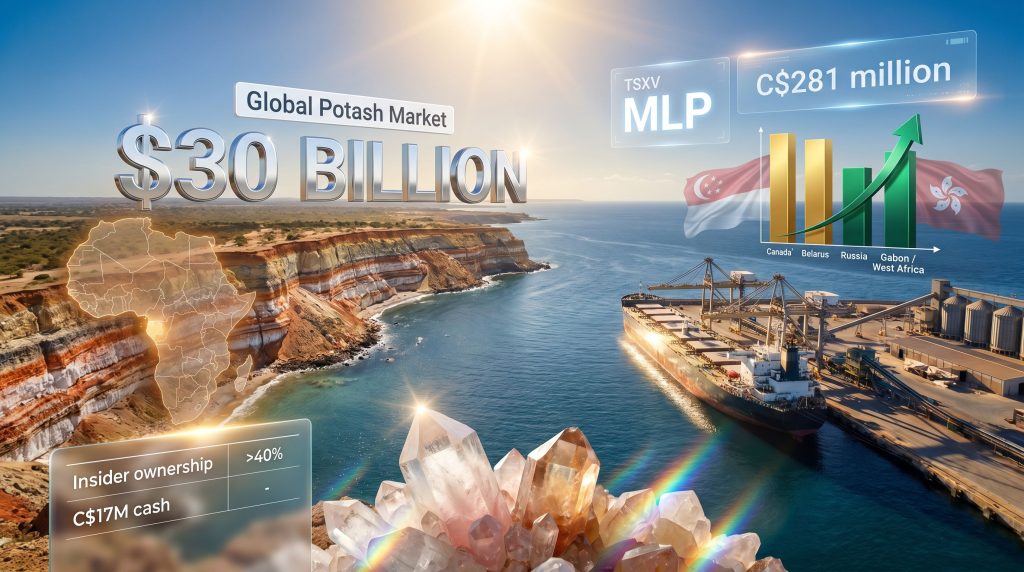
| Estimated global market size | Approximately $30 billion annually |
| Primary producing regions | Canada (Saskatchewan basin), Belarus, Russia |
| US domestic self-sufficiency | Minimal; structurally import-dependent |
| China domestic self-sufficiency | Insufficient relative to agricultural demand |
| US critical mineral classification | Added November 2025 |
| Primary demand driver | Food production and crop yield enhancement |
The supply concentration is the critical variable. Canada's Saskatchewan basin is the world's largest potash reserve, but the other two dominant producers, Belarus and Russia, operate under active or threatened sanctions regimes that introduce material supply chain risk for Western importers. This creates a structural premium for any potash project developed outside this geopolitical corridor, particularly in regions with port access to high-demand agricultural markets like Brazil and Southeast Asia.
When the United States formally added potash to its critical minerals list in November 2025, it was not merely a policy footnote. It was a formal acknowledgment that food security and potash supply are strategically linked, and that import dependency on geopolitically unstable suppliers represents a national vulnerability. For investors who had already internalised this thesis, the reclassification served as a public signal that the broader market had not yet fully priced in.
Strategic Context: When governments reclassify commodities as strategically critical, the market rerating that follows typically lags the policy announcement by months. This creates a window where informed private capital can accumulate positions before institutional flows respond at scale.
The Banio Project: Geography, Geology, and Logistics Advantage
Millennial Potash Corp (TSXV: MLP) is advancing the Banio Potash Project along Gabon's southern coastline in West Africa. The project sits within a recognised geological basin with demonstrated potash resource potential, and the company recently initiated a Phase 3 drill program at the site, increasing its ownership stake in the asset to 80%, reflecting deepening commitment from management.
The project's geographic positioning is a central element of the investment thesis. Rather than operating in a landlocked African setting that would require expensive overland transport corridors, Banio benefits from proximity to the deep-water port at Mayumba on Gabon's southern coast. This logistical configuration allows product to be shipped directly to major agricultural importing markets, including Brazil, without routing through traditional supply bottlenecks or requiring costly midstream infrastructure development.
West Africa as a potash development corridor remains largely underexplored relative to the Saskatchewan and Eastern European basins. For developers who can establish resource credibility and permitting progress in this region, the absence of entrenched competition and the proximity to Atlantic shipping lanes represent structural advantages that are not easily replicated.
The company's financial position provides meaningful near-term operational runway. As of early 2026, Millennial Potash holds approximately C$17 million in cash, supported by a C$15.25 million bought-deal private placement completed in January 2026 under the Listed Issuer Financing Exemption (LIFE) framework. A follow-on placement of up to C$2 million was announced shortly after, reflecting continued investor appetite.
Insider and management ownership exceeds 40% of shares outstanding, a figure that carries significant weight in junior mining analysis. At this level of alignment, management incentives and shareholder interests are functionally unified, which substantially reduces the principal-agent dynamics that often erode value in early-stage resource ventures.
What Is a LIFE Offering and Why Does It Matter for Private Investors?
The Listed Issuer Financing Exemption (LIFE) is one of several capital raising methods specific to the TSX Venture Exchange that allows eligible listed companies to raise funds from public investors without filing a full prospectus. For junior mining companies, this represents a materially faster and less expensive route to capital compared to traditional prospectus offerings.
For sophisticated investors such as family offices, LIFE offerings are particularly attractive because they:
- Enable participation at a defined price, often at or near current market levels, before broader retail flow arrives
- Allow position-building without the disclosure obligations triggered by open-market purchases above certain thresholds
- Create a structured entry point that aligns investor interests with a specific phase of project advancement
- Reduce the execution risk associated with building large positions in low-liquidity junior stocks through open-market trading
The broader implication is that LIFE offerings are structurally designed to facilitate the type of concentrated, high-conviction capital deployment that family offices prefer. They are not passive instruments for portfolio diversification; they are active tools for building meaningful project stakes.
The Family Office Investor Profile: Who Is Buying and Why
The pattern of family offices investing in Millennial Potash reflects a cohort of investors with distinctive characteristics that separate them from both institutional funds and retail participants.
The Quaternary Group
The Quaternary Group is the most prominent disclosed investor. This Singapore-based investment entity is associated with Ross Hamou-Jennings, who previously served as Asia chairman of Cargill Inc., one of the largest privately held agribusiness and commodities companies in the world. Quaternary holds approximately 25% of Millennial Potash, making it the largest external stakeholder by a significant margin.
The significance of this background extends beyond financial capacity. A former senior executive at a company of Cargill's scale has direct operational knowledge of global fertiliser supply chains, market structure, demand patterns, and the valuation mechanics of potash assets at various stages of development. This is not generalist capital allocating to a commodity theme; it is sector-specific expertise identifying a pricing gap between current market valuation and long-term project value.
Hamou-Jennings has articulated a clear preference for owning large, direct stakes in resources that sit at structural supply bottlenecks. Beyond Millennial Potash, his portfolio includes positions in P2 Gold Inc., a Canadian precious metals explorer, and Surge Battery Metals Inc., another Vancouver-area junior. This suggests a consistent philosophy of concentrated exposure to early-stage resource developers rather than diversified sector exposure through managed vehicles.
His perspective on timing is particularly instructive for investors evaluating when to approach early-stage companies. The thesis is direct: families that wait for a project to de-risk before seeking a private placement entry often find that by the time the risk profile has improved materially, the company is fully funded and no longer requires external capital at preferential terms. The entry window closes precisely when most investors feel comfortable enough to act.
Cavendish Investment Corp
Cavendish Investment Corp, a Hong Kong-based multi-family office, represents a second major private wealth participant. The firm, led by managing partner Jean-Sebastien Jacquetin, typically deploys between US$5 million and US$50 million per investment and focuses on assets classified as strategically critical within a fractured geopolitical environment.
Cavendish's broader portfolio philosophy is revealing. As of mid-2025, the firm had allocated approximately one-third of its portfolio to physical gold, a positioning that reflects deep concern about fiat currency stability and the strategic value of hard assets under geopolitical stress. Fertilisers and metals form a second core allocation pillar, underpinned by the view that fundamental physical resources offer a form of supply-chain resilience that financial instruments cannot replicate.
Jacquetin has noted publicly that families are increasingly functioning as active operators rather than passive capital allocators, engaging directly in sectors including mining, healthcare, and renewables. The prevailing geopolitical backdrop, including ongoing conflict and fracturing trade relationships, is driving a return to asset classes grounded in physical, non-substitutable resources.
| Investor Entity | Domicile | Approximate Stake | Investment Background |
|---|---|---|---|
| The Quaternary Group | Singapore | ~25% | Agribusiness and commodities (Cargill background) |
| Cavendish Investment Corp | Hong Kong | Undisclosed (US$5M-$50M range) | Multi-family office, commodities and metals |
| Canadian family office | Canada | Just under 5% | Private, undisclosed |
| US-based family office | United States | Just under 5% | Private, undisclosed |
| Persian Gulf family | Middle East | Just under 5% | Private, undisclosed |
Furthermore, beyond these disclosed participants, Millennial Potash chairman Farhad Abasov has confirmed the presence of additional family office investors from Canada, the United States, and the Persian Gulf region, each holding positions just below the 5% mandatory public disclosure threshold. Active investor relations outreach continues across family office networks in Hong Kong and Singapore.
This below-threshold clustering is not accidental. It reflects a deliberate structural feature of sophisticated private capital participation in junior mining: positions can be built to meaningful size without triggering the mandatory filings that alert competitors and market participants to the accumulation activity.
Stock Performance, Valuation, and the Psychology of Correction
Millennial Potash shares delivered a return exceeding 900% during 2025, driven by the convergence of project advancement milestones, the US critical minerals reclassification, and accelerating awareness of the potash supply gap among non-traditional investor constituencies. Indeed, family offices have continued to build their stake in the company even after this remarkable rise.
Following this surge, the stock experienced a pullback of approximately one-third from its peak, attributed to a combination of funding overhang from private placements (which introduce new shares to the float) and broader global risk sentiment affecting junior resource equities as an asset class.
As of May 2026, the company's market capitalisation stands at approximately C$281 million (roughly US$205 million). At this level, the valuation is grounded in project optionality rather than current revenue, which means the market is pricing the probability of Banio advancing through permitting, feasibility, and ultimately into production.
SCP Research carries a buy rating on the stock, with the investment thesis anchored in part on Abasov's documented management track record at Potash One and Allana Potash, two previous potash development ventures that reached transaction or significant development milestones under his leadership.
Insider conviction beyond management is also visible in the public filing record. A key resource-focused investor holding approximately 10% of the company deployed roughly C$3.4 million across a series of open-market purchases between October 2025 and February 2026.
| Transaction Date | Transaction Type | Value (C$) | Shares Acquired | Price per Share (C$) |
|---|---|---|---|---|
| February 4, 2026 | Market purchase | 672,799 | 250,000 | 2.71 |
| December 16, 2025 | Market purchase | 345,000 | 100,000 | 3.45 |
| December 12, 2025 | Market purchase | 703,000 | ~204,000 | ~3.44 |
| January 16, 2026 | Market purchase (Chairman) | 11,725 | 3,500 | 3.35 |
Open-market purchases by insiders at prices above private placement levels are among the strongest conviction signals available to external investors. They indicate that the buyer is willing to pay market price with no lock-up discount, which is a materially different risk commitment than participation in a structured financing.
The next major ASX story will hit our subscribers first
The Broader Pattern: Family Offices Entering Natural Resource Development
The story of family offices investing in Millennial Potash is most significant not as an isolated corporate development but as a data point within a larger pattern of private wealth engagement with junior resource companies. Understanding the broader junior mining investment landscape helps contextualise why this trend is accelerating.
Two parallel examples illustrate the phenomenon at different scales. Colombia's wealthiest individual, Jaime Gilinski, has progressively increased his direct stake in GeoPark Ltd., an independent Latin American oil and gas producer, using the position as a vehicle to access Venezuela's recovering energy sector. Separately, heirs of the Lundin family, one of the most prominent dynasties in global resource development, deployed nearly C$40 million in March 2025 to build direct positions in copper and diamond mining companies, responding to tightening supply chain conditions in both sectors.
These cases share structural characteristics with the Millennial Potash situation:
- Background expertise in the relevant commodity sector
- A preference for direct ownership over managed fund exposure
- Position sizing that is meaningful relative to the target company's market capitalisation
- A long investment horizon that is incompatible with institutional quarterly performance cycles
- A geopolitical thesis that frames the asset as scarce rather than merely cyclical
The geographic diffusion pattern within the family office community is also worth noting. Participation in early-stage resource ventures appears to have been more active in North American family office networks approximately twelve months before the current reporting period, with the trend subsequently gaining traction in Asia, particularly Singapore and Hong Kong. This geographic migration pattern suggests the investment thesis is spreading through wealth management networks as validated early participants demonstrate positive outcomes.
Singapore's structural position as a global commodity trading hub gives family offices domiciled there a distinct information advantage. Executives and principals with operational backgrounds in commodities trading, agribusiness, or resource logistics are concentrated in this geography, and they are uniquely positioned to assess project-level quality before mainstream financial analysis frameworks catch up.
A Framework for Evaluating Junior Potash Developers
For investors seeking to apply a structured analytical framework to early-stage potash opportunities, understanding the junior mining risks and rewards is essential. Five dimensions typically determine whether a project has genuine long-term value or merely a compelling narrative.
-
Geological credibility – Does the deposit sit within a recognised geological province, and does the mineralogy support economically viable extraction using established processing methods?
-
Infrastructure access – Can the project reach port, power, and water infrastructure without capital expenditure requirements that overwhelm the project economics?
-
Management track record – Has the leadership team previously advanced comparable projects through the critical permitting and financing milestones that separate exploration assets from development-stage properties?
-
Capital structure discipline – Is the company funded through to a value-inflection milestone without requiring serial dilutive financings that erode per-share economics?
-
Market positioning – Does the project address a supply gap that is structural rather than cyclical, with demand anchored to non-substitutable end uses?
Applying this framework to Banio, the project scores positively across most dimensions. Gabon's southern potash basin has geological credibility, deep-water port access at Mayumba materially reduces infrastructure risk, and Abasov's track record at prior potash ventures provides a documented basis for evaluating execution capability. The cash position and insider ownership structure provide near-term funding clarity, and the West African location outside the Russia-Belarus supply corridor addresses a genuine geopolitical supply gap.
Investor Caution: Early-stage resource investments carry material risks including permitting delays, capital raising dilution, commodity price volatility, and host country regulatory uncertainty. The favourable characteristics described above are conditions for potential value creation, not guarantees of investment return. Past management performance in different projects does not ensure equivalent outcomes in future ventures.
What This Capital Shift Signals for Junior Mining Finance
The convergence of family offices investing in Millennial Potash and similar junior developers signals something more durable than a single corporate fundraising story. It reflects a structural reassessment of where asymmetric return potential resides in a world where traditional asset classes are increasingly correlated and geopolitical risk has become a first-order investment variable.
For junior mining companies seeking to diversify their capital base beyond traditional institutional participants, the Millennial Potash model offers a replicable template. The combination of a critical minerals narrative grounded in genuine supply vulnerability, a geopolitical angle that frames the asset as operating outside contested supply corridors, infrastructure positioning that reduces execution risk, and a management team with a verifiable project advancement track record creates the conditions under which commodity-adjacent private wealth is willing to deploy meaningful capital at early-stage valuations.
The below-threshold clustering of family office positions across multiple geographies also suggests that the level of private wealth participation in junior resource development is substantially broader than mandatory disclosure frameworks make visible. For investors and analysts relying solely on publicly filed ownership data, the actual concentration of private capital in this space is likely being systematically underestimated.
As geopolitical fragmentation continues to elevate the strategic value of supply-constrained physical resources, the structural conditions that have drawn family offices into early-stage potash development are not dissipating. If anything, they are intensifying.
This article is intended for informational purposes only and does not constitute financial advice. Junior mining investments carry significant risks including capital loss, illiquidity, and project execution uncertainty. Past share price performance and insider activity are not reliable indicators of future returns. Readers should conduct their own due diligence and consult a licensed financial adviser before making investment decisions.
Want to Track the Next Major Mineral Discovery Before the Broader Market Catches On?
Discovery Alert's proprietary Discovery IQ model delivers real-time alerts on significant ASX mineral discoveries, transforming complex mineral data into actionable insights for both short-term traders and long-term investors — explore historic examples of exceptional discovery returns to understand the scale of opportunity, then begin your 14-day free trial at Discovery Alert to position yourself ahead of the market.