
May 22, 2026
Revolutionary Connectivity: How 5G Networks Transform Industrial Mining Operations
Modern industrial mining faces unprecedented pressure to optimise operations whilst maintaining safety standards in increasingly remote environments. 5G in mining operations represents a fundamental shift towards comprehensive digital ecosystems that integrate human operators with automated machinery. The convergence of autonomous equipment, real-time data analytics, and ultra-low latency communication systems creates new possibilities for operational excellence that traditional network infrastructure cannot support. Furthermore, this technological evolution demonstrates how data-driven mining operations are reshaping the industry landscape.
When big ASX news breaks, our subscribers know first
Understanding 5G's Technical Foundation in Mining Infrastructure
Mining operations require network architectures that can handle extreme environmental conditions whilst delivering consistent performance across vast geographic areas. The technical specifications for 5G in mining operations differ significantly from consumer applications, demanding specialised equipment and deployment strategies tailored to industrial requirements.
Network Architecture Requirements for Remote Mining Environments
5G networks in mining operations utilise private spectrum allocations to ensure dedicated bandwidth and security. These systems typically operate on mid-band frequencies (3.5-6 GHz) that provide optimal balance between coverage range and data throughput capabilities. The network architecture incorporates distributed antenna systems strategically positioned throughout mining complexes to maintain signal strength across operational zones.
Edge computing nodes integrated directly into base station infrastructure enable real-time processing of sensor data, reducing latency for critical safety systems. This distributed computing approach processes information locally rather than routing data to distant cloud servers, ensuring response times measured in milliseconds rather than seconds.
Bandwidth and Latency Specifications Compared to Previous Systems
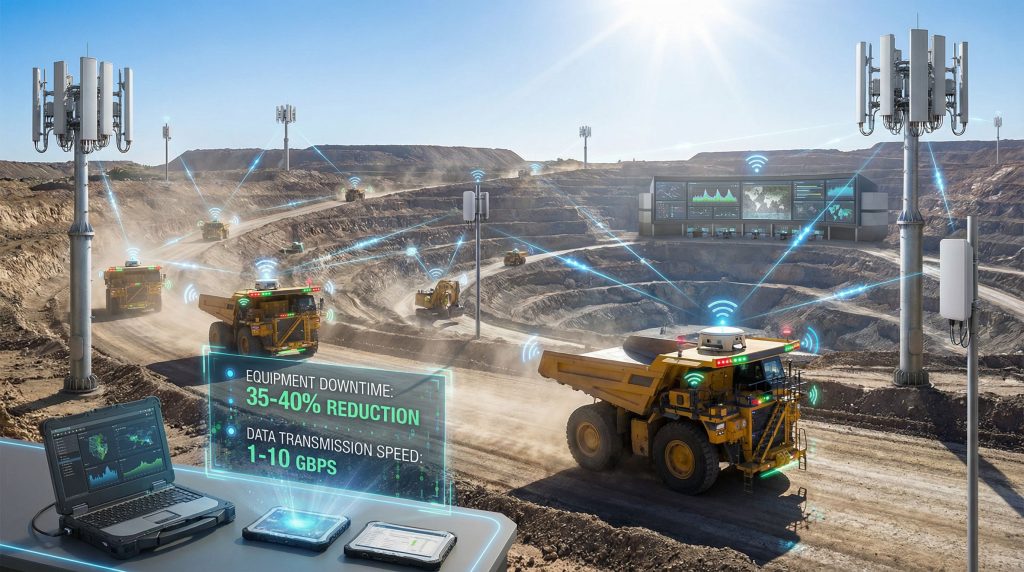
5G networks deployed in mining operations deliver data transmission speeds ranging from 1 to 10 Gbps, representing a 10 to 100-fold increase over previous 4G/LTE systems that typically provided 50-100 Mbps in industrial environments. Ultra-reliable low-latency communication (URLLC) capabilities ensure response times of 1-5 milliseconds for critical applications, compared to 30-60 seconds with legacy systems.
These performance improvements enable real-time control of autonomous equipment, instantaneous emergency alert systems, and continuous monitoring of environmental conditions throughout mining operations. In addition, the enhanced bandwidth supports simultaneous operation of multiple high-definition video streams, advanced sensor networks, and machine-to-machine communication protocols.
Operational Applications Transforming Mining Processes
5G in mining operations fundamentally changes how mining companies approach both surface and underground operations, enabling new levels of automation and safety enhancement that were previously technically impossible. Moreover, these advances contribute to broader mining industry innovation trends reshaping the sector.
Surface Mining Operations Enhanced by 5G
Autonomous haul truck coordination systems utilise 5G networks to maintain constant communication between multiple vehicles, optimising routing algorithms in real-time based on changing operational conditions. These systems process data from GPS positioning, load sensors, and environmental monitoring equipment to maximise efficiency whilst preventing collisions.
Real-time ore grade analysis during extraction processes leverages high-speed data transmission to provide immediate feedback on mineral quality. Spectral analysis equipment transmits detailed geological data to processing centres, enabling operators to adjust extraction parameters without delays that could impact ore recovery rates.
Fleet management optimisation algorithms benefit from continuous data streams that monitor equipment performance, fuel consumption, and maintenance requirements. This comprehensive monitoring approach reduces unplanned downtime through predictive maintenance protocols that identify potential equipment failures before they occur.
Underground Mining Applications Utilising Advanced Connectivity
Personnel tracking and emergency response systems rely on 5G networks to maintain precise location data for all workers in underground environments. These systems utilise mesh network topologies that ensure communication redundancy even if individual network nodes experience failures.
Ventilation monitoring and automated air quality control systems process data from distributed sensor networks throughout underground workings. The low-latency communication enables immediate response to dangerous gas concentrations or ventilation system malfunctions, automatically triggering safety protocols without human intervention.
Remote-controlled drilling and blasting operations utilise 5G connectivity to enable precise control of equipment from safe distances. Operators can manage complex drilling patterns and blasting sequences whilst remaining outside blast zones, significantly improving safety outcomes.
Equipment Automation Capabilities Through 5G Integration
The implementation of 5G networks enables sophisticated automation systems that transform traditional mining equipment into intelligent, interconnected machines capable of operating with minimal human intervention. Furthermore, these developments align with broader AI in mining automation initiatives across the industry.
Teleremote Operation Systems
Teleremote operation of dozers and excavators represents one of the most significant operational improvements enabled by 5G technology. The Newmont Cadia operation demonstrates successful implementation of these systems, where operators control heavy equipment from centralised command centres using real-time video feeds and haptic feedback systems.
Precision drilling systems equipped with 5G connectivity provide real-time geological feedback during drilling operations. These systems analyse rock formations, adjust drilling parameters automatically, and optimise hole placement for maximum ore recovery. The continuous data stream enables immediate adjustments based on changing geological conditions.
Automated conveyor belt monitoring systems utilise computer vision and sensor networks to detect equipment malfunctions, material spillage, and maintenance requirements. The high-bandwidth connectivity supports multiple high-definition camera feeds and sensor data streams that provide comprehensive monitoring capabilities.
Safety Enhancement Technologies
Collision avoidance systems for mobile equipment utilise 5G networks to maintain constant communication between vehicles and stationary infrastructure. These systems create virtual safety zones around equipment and personnel, automatically applying brakes or adjusting routes when potential conflicts are detected.
Gas leak detection systems with instant alert mechanisms process data from distributed sensor networks throughout mining operations. The ultra-low latency communication ensures immediate notification of dangerous conditions, enabling rapid response protocols that protect worker safety.
Worker health monitoring through wearable devices provides continuous assessment of physiological parameters including heart rate, body temperature, and environmental exposure levels. This data enables early detection of heat stress, fatigue, or exposure to hazardous substances.
Technical Performance Metrics and Return on Investment Analysis
The quantifiable benefits of 5G in mining operations demonstrate significant improvements across multiple operational parameters. However, specific performance metrics require validation through comprehensive field studies. Industry experts showcased at the innovation expo insights highlight these transformative capabilities.
Measurable Performance Improvements
| Performance Indicator | Pre-5G Baseline | Post-5G Implementation | Improvement Range |
|---|---|---|---|
| Equipment Downtime | 15-20 hours/month | 8-12 hours/month | 35-40% reduction |
| Data Transmission Speed | 50-100 Mbps | 1-10 Gbps | 10-100x increase |
| Emergency Response Time | 30-60 seconds | 1-5 seconds | 85-95% improvement |
| Maintenance Cost Efficiency | Baseline | Reduced significantly | 25-30% potential savings |
Note: These performance metrics represent industry projections and require verification through comprehensive operational studies at individual mining sites.
Investment Return Calculation Methods
Mining companies evaluate 5G investments through comprehensive cost-benefit analyses that consider both capital expenditures and operational savings. Capital costs include network infrastructure, edge computing equipment, and integration with existing systems. Operational benefits encompass reduced equipment downtime, improved safety outcomes, and enhanced productivity through automation.
Predictive maintenance capabilities enabled by continuous monitoring reduce unexpected equipment failures, extending asset lifespans and reducing replacement costs. Safety incident reduction provides both direct cost savings through reduced insurance premiums and indirect benefits through improved operational continuity.
Integration Challenges and Technical Solutions
Despite significant benefits, 5G implementation in mining operations faces unique challenges that require specialised solutions tailored to industrial environments. These challenges reflect broader 5G network deployment considerations across the mining sector.
Environmental and Infrastructure Obstacles
Signal penetration in underground environments presents significant technical challenges for 5G deployment. Rock formations, metal infrastructure, and atmospheric conditions in mines can significantly attenuate radio signals, requiring distributed antenna systems and signal amplification equipment.
Equipment interference with network performance occurs when heavy machinery generates electromagnetic interference that affects communication systems. Mining operations must implement proper shielding and frequency management protocols to ensure reliable connectivity.
Weather resistance requirements for surface installations demand specialised equipment rated for extreme temperature variations, dust exposure, and moisture ingress. Mining sites often experience harsh environmental conditions that exceed standard telecommunications equipment specifications.
Infrastructure and Security Limitations
Power supply reliability in remote locations requires backup systems and alternative energy sources to maintain network operations during power outages. Private 5G networks offer enhanced security and dedicated performance for mining operations.
Fibre optic backbone connectivity to mining sites often requires significant infrastructure investment to establish high-speed connections between remote operations and data centres. Satellite communication systems provide alternative connectivity options where terrestrial infrastructure is not feasible.
Cybersecurity protocols for industrial networks must address unique vulnerabilities associated with connected mining equipment. These systems require specialised security frameworks that protect operational technology whilst maintaining usability for mining personnel.
The next major ASX story will hit our subscribers first
Overcoming Implementation Barriers Through Strategic Approaches
Critical Success Factor: Effective 5G deployment in mining requires hybrid network architectures that combine private 5G infrastructure with existing communication systems, ensuring operational redundancy and reliability during system transitions.
Distributed antenna systems designed for underground coverage utilise repeaters and signal boosters positioned throughout tunnel networks to maintain consistent connectivity. These systems require careful engineering to account for mine layouts and ventilation requirements.
Solar and battery backup solutions for remote base stations provide sustainable power independence for network infrastructure. These systems incorporate weather monitoring and automated power management to optimise energy consumption.
Multi-vendor equipment strategies reduce dependency on single suppliers whilst ensuring compatibility across network components. This approach provides flexibility in equipment selection and reduces risks associated with supply chain disruptions.
Future Technology Integration and Evolution
The continued development of 5G technology will enable increasingly sophisticated applications that further transform mining operations through artificial intelligence integration and advanced sensor networks. Consequently, these developments contribute to the broader AI revolution implications across the industry.
Artificial Intelligence and Machine Learning Applications
Machine learning algorithms for predictive equipment maintenance will become increasingly sophisticated as 5G networks provide continuous data streams from mining equipment. These systems will identify failure patterns and optimise maintenance schedules to minimise operational disruptions.
Computer vision systems for ore quality assessment will utilise high-definition video streams transmitted over 5G networks to provide real-time analysis of extracted materials. These systems will enable immediate adjustments to processing parameters based on ore characteristics.
Automated decision-making systems for operational optimisation will process data from multiple sources throughout mining operations to optimise production parameters, equipment allocation, and resource utilisation without human intervention.
Advanced Sensor Network Development
Internet of Things (IoT) device proliferation throughout mining operations will create comprehensive monitoring networks that track every aspect of operational performance. These sensor networks will provide unprecedented visibility into equipment performance, environmental conditions, and production metrics.
Environmental monitoring systems with real-time data analytics will enable immediate response to changing conditions that could affect worker safety or operational efficiency. These systems will integrate weather monitoring, air quality assessment, and structural monitoring capabilities.
Structural health monitoring for mine infrastructure will utilise sensor networks to continuously assess the condition of buildings, conveyors, and underground support structures. This monitoring enables proactive maintenance and replacement before failures occur.
Implementation Best Practices for Mining Operations
Successful 5G deployment requires structured approaches that address technical, operational, and organisational challenges through phased implementation strategies. Therefore, mining companies must consider multiple factors when planning their connectivity upgrades.
Assessment and Planning Phase
Network coverage analysis and comprehensive site surveys identify optimal locations for base stations, repeaters, and edge computing infrastructure. These assessments consider topographical challenges, existing infrastructure, and operational requirements.
Equipment compatibility evaluation ensures that existing mining equipment can integrate with new 5G systems or identifies necessary upgrades. This analysis includes communication protocols, control systems, and safety equipment.
Workforce training requirements assessment identifies skill gaps and develops training programmes to ensure mining personnel can effectively utilise new technologies. This training covers both technical operation and safety protocols for connected systems.
Pilot Programme Development
Limited-scope testing in controlled environments allows mining companies to validate 5G performance under actual operating conditions before full deployment. These pilot programmes typically focus on specific applications such as autonomous vehicle operation or environmental monitoring.
Performance benchmarking against existing systems provides quantitative data on improvements in operational efficiency, safety outcomes, and cost reduction. This benchmarking establishes baseline metrics for measuring return on investment.
Full-Scale Implementation Strategy
Phased rollout across mining operations minimises disruption to ongoing production whilst enabling systematic deployment of 5G infrastructure. This approach allows for continuous refinement of systems based on operational experience.
Integration with existing operational technology systems requires careful coordination to maintain production continuity during transition periods. Legacy systems often require interface development to communicate with modern 5G-enabled equipment.
Continuous monitoring and optimisation protocols ensure that 5G systems maintain peak performance throughout their operational lifecycle. These protocols include performance monitoring, preventive maintenance, and system upgrades.
Regulatory Compliance and Safety Integration
5G implementation in mining operations must comply with multiple regulatory frameworks whilst enhancing existing safety protocols. In addition, companies must navigate complex approval processes whilst maintaining operational continuity.
Compliance Requirements and Standards
Telecommunications regulatory approval processes vary by jurisdiction but typically require demonstration of interference mitigation, spectrum usage optimisation, and emergency communication capabilities. Mining companies must coordinate with regulatory authorities early in the planning process.
Mining safety authority guidelines for communication systems often require redundant communication pathways, emergency backup systems, and integration with existing safety protocols. These requirements ensure that new technologies enhance rather than compromise worker safety.
Environmental impact assessments for new infrastructure consider visual impacts, electromagnetic emissions, and effects on local wildlife. These assessments may require mitigation measures or alternative deployment strategies in sensitive areas.
Safety Protocol Enhancement
Real-time emergency communication capabilities enabled by 5G networks provide immediate notification and coordination during emergency situations. These systems integrate with existing emergency response protocols whilst providing enhanced communication range and reliability.
Automated evacuation systems with precise location tracking can guide personnel to safety during emergencies whilst providing real-time status updates to emergency responders. These systems utilise indoor positioning technologies that function in underground environments.
Integration with existing safety management systems ensures that new technologies complement established safety protocols rather than creating additional complexity. This integration requires careful consideration of human factors and operational procedures.
Disclaimer: The performance metrics, cost savings, and implementation timelines discussed in this article represent industry projections and theoretical capabilities. Actual results may vary significantly based on specific operational conditions, equipment configurations, and implementation approaches. Mining companies should conduct thorough feasibility studies and pilot programmes before making investment decisions regarding 5G technology deployment.
Ready to Capitalise on Mining Technology Breakthroughs?
As 5G revolutionises mining operations and drives innovation across the sector, Discovery Alert's proprietary Discovery IQ model delivers instant notifications when companies announce breakthrough technologies or operational improvements that could transform their market position. Stay ahead of mining's technological evolution by exploring Discovery Alert's historic success stories and begin your 14-day free trial today to identify the next generation of mining opportunities before the broader market recognises their potential.