
June 16, 2026
The Silent Tax Nobody Talks About: Monetary Expansion and the Case for Hard Assets
Few financial forces reshape wealth as quietly and as thoroughly as monetary inflation. Unlike a stock market crash or a banking crisis, currency debasement operates in slow motion, eroding purchasing power across decades rather than days. Yet its cumulative effect is arguably more destructive than any single financial event in modern history. Understanding this mechanism is the starting point for any serious silver price prediction and gold standard reset analysis heading into 2026, and why this conversation is gaining traction in institutional and policy circles alike.
The numbers tell a stark story. A household that preserved $30,000 in cash savings during the late 1970s held enough capital to purchase a residential property outright in many parts of the United States. That same $30,000 balance, left untouched in a savings account today, would fall short of financing a mid-range vehicle, with the average new car price now hovering well above $40,000.
Nothing was stolen. No fraud occurred. The balance simply sat there while the monetary system expanded around it, diluting its real-world purchasing power by the vast majority. This is not a market anomaly. It is the predictable, structural outcome of removing commodity constraints from currency issuance.
When big ASX news breaks, our subscribers know first
From the Nixon Shock to the Trillion-Dollar Era: How the Modern Monetary System Was Built
The foundational shift occurred in August 1971, when the United States formally suspended the convertibility of the US dollar into gold, effectively terminating the Bretton Woods system. The 1971 gold standard end meant that the volume of dollars in circulation was no longer anchored, however imperfectly, to a physical commodity with finite supply. After it, the constraint was gone.
The downstream consequences took decades to fully manifest, but the directional outcome was never in doubt. Money supply growth accelerated through the 1980s, 1990s, and 2000s, measured in billions. Then the 2008 financial crisis introduced a new lexicon: quantitative easing, and with it, the first serious expansion into the trillion-dollar territory.
The COVID-19 shock of 2020 compressed what might have been a decade of monetary expansion into a single weekend. Approximately $7 trillion was injected into financial markets to stabilise the system, a figure that would have been considered science fiction in any prior era of economic policy. The downstream effect on asset prices was immediate and durable.
US residential property values have risen by an estimated 30 to 50 percent since 2020 in many markets, not because homes became more valuable as physical structures, but because the unit of currency used to price them became less scarce.
The critical distinction here is between nominal price appreciation and real value creation. When money supply expands faster than the underlying asset base, prices rise as a mathematical consequence of monetary dilution, not genuine wealth generation. A house is not worth more because it became better; it costs more because the dollar measuring its value became worth less.
This dynamic has now extended across five decades, and US national debt has crossed $36 trillion as of 2025. The progression from millions to billions to trillions over that timeframe represents a compounding monetary expansion without peacetime parallel in modern economic history. It is within this structural context that the case for precious metals as long-duration wealth preservation instruments must be understood.
The Gold Standard Reset Debate: Policy Conversation or Coming Reality?
The phrase "gold standard reset" circulates across financial media with varying degrees of seriousness, ranging from speculative retail commentary to formal policy proposals. Separating the credible from the speculative requires understanding what the debate actually encompasses.
At the institutional level, the most substantive proposal in recent years has come from Judy Shelton, an economist with longstanding ties to US monetary policy circles. Her proposal involves the issuance of gold-convertible Treasury bonds, instruments that would allow holders to redeem principal in either dollars or a fixed weight of gold at maturity.
This is not a return to a classical gold standard, but it would re-introduce a commodity anchor into a portion of the sovereign debt market, creating a market-based signal about the real value of US currency. Importantly, no formal policy exists to restore a gold standard in the United States as of 2025.
However, several converging signals suggest the underlying pressure is building:
| Signal | What It Suggests |
|---|---|
| Rising central bank gold purchases globally | Structural diversification away from USD-denominated reserves |
| Gold-convertible Treasury bond proposals | Renewed policy interest in commodity-linked monetary anchors |
| Persistent post-2020 inflation | Structural erosion of fiat currency credibility |
| Geopolitical fragmentation and de-dollarisation | Demand for neutral, non-sovereign reserve assets |
| US debt trajectory above $36 trillion | Growing long-term concerns about dollar purchasing power sustainability |
It is worth noting the historical precedent. The United States suspended domestic gold convertibility in 1933 under President Roosevelt, a decision made during an acute economic emergency. The New Deal era also experimented with silver monetary policy, with the Silver Purchase Act of 1934 directing the Treasury to accumulate silver as a monetary reserve.
These episodes demonstrate that commodity-linked monetary frameworks are not purely theoretical constructs; they have been implemented and dismantled in living memory. Furthermore, central bank gold demand signals that sovereign reserve managers are themselves hedging against long-term fiat currency risk, whether or not a formal reset occurs.
Silver Price Prediction 2025 to 2026: What the Institutional Forecasts Actually Say
Moving from macro context to specific price targets, the institutional outlook for silver over the next 12 to 24 months is meaningfully bullish, though with a wide distribution of outcomes depending on the macroeconomic path.
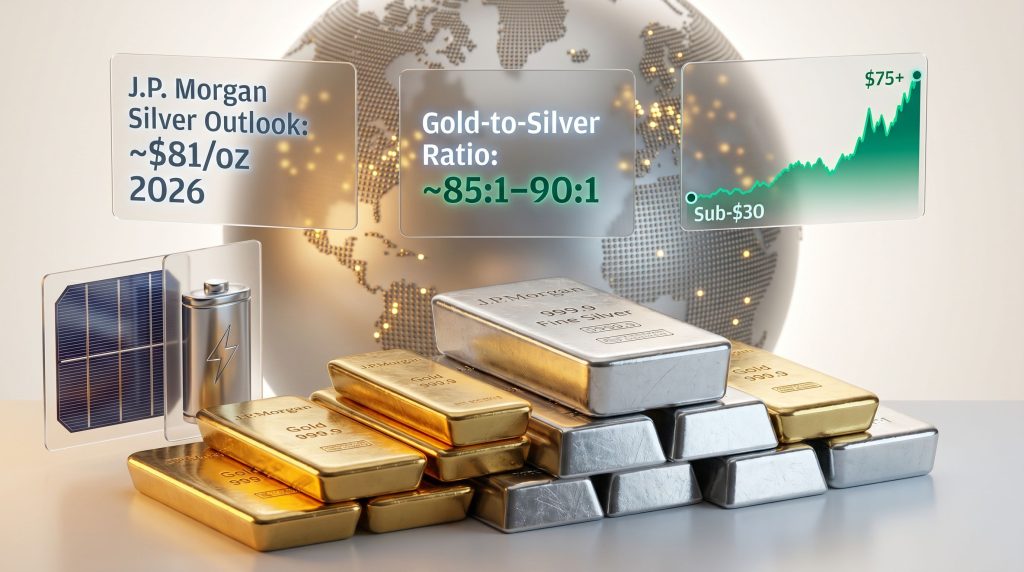
The most closely watched major bank forecast comes from J.P. Morgan, which has published a silver price forecast targeting an average of approximately $81 per ounce in 2026, rising further to around $85.50 per ounce in 2027. These projections are grounded in a combination of persistent industrial demand growth, particularly from the solar and electric vehicle sectors, and ongoing macroeconomic uncertainty supporting investment demand.
LBMA-affiliated survey data places consensus around $79.57 per ounce for 2026, reflecting a broad-based but moderately bullish view across institutional participants.
| Forecast Source | 2025 Estimate | 2026 Estimate | Primary Driver |
|---|---|---|---|
| J.P. Morgan | Elevated (above current) | ~$81/oz | Industrial demand plus macro uncertainty |
| LBMA Consensus | Varies | ~$79.57/oz | Broad institutional survey |
| Bearish scenario | $60–$70 | $65–$75 | Rate hike resumption, demand contraction |
| Bullish scenario | $85–$95 | $90–$100+ | Supply deficit, monetary reset narrative |
| Speculative targets | $100+ | $120+ | Biblical/cycle-based analysis, contested |
The bearish scenario, while a minority position among current forecasters, is not implausible. A resumption of Federal Reserve rate hiking, a significant slowdown in Chinese industrial output, or a reversal in solar installation growth could all exert meaningful downward pressure. At the same time, the structural silver supply deficits in physical silver markets provide a fundamental floor that purely macro-driven bear cases must account for.
It is important to note that more aggressive retail-level forecasts, including projections of silver surpassing $120 per ounce in the near term, carry substantially higher uncertainty and are not reflected in mainstream institutional analysis. Investors should treat speculative price targets as one data point within a broader research framework rather than as predictive guidance.
Past performance in silver markets does not guarantee future results. All price forecasts involve material uncertainty and should not be construed as financial advice.
Industrial Demand: The Structural Engine Beneath the Monetary Story
One of the most important distinctions between the current silver bull market and prior cycles is the degree to which industrial demand, rather than pure investment sentiment, is providing structural support to prices. Silver's physical properties make it irreplaceable in several high-growth manufacturing applications:
- Photovoltaic solar panels use silver paste in cell interconnections; each panel requires a measurable silver input, and global solar installation capacity is expanding rapidly
- Electric vehicles consume silver in battery management systems, charging infrastructure, and various electrical contacts, with silver intensity per vehicle ranging from 25 to 50 grams depending on design
- Consumer electronics and advanced semiconductor manufacturing rely on silver's unmatched electrical conductivity for miniaturised components
- Medical and antimicrobial applications represent a smaller but growing demand category, particularly post-pandemic
The aggregate effect of these demand vectors has created a supply-demand imbalance that extends beyond the influence of investment flows. Silver markets have recorded consecutive annual supply deficits in recent years, with total industrial and investment consumption exceeding new mine production.
Global silver mining output faces structural constraints including declining ore grades at major producing mines, extended permitting timelines for new projects, and rising extraction costs.
Industrial demand from the green energy transition alone is expected to absorb an increasing share of annual silver mine supply through the remainder of this decade. This is a supply dynamic that exists independently of monetary policy debates and reinforces the structural bullish case for silver regardless of whether a gold standard reset materialises.
Understanding the Price Manipulation Debate in Silver Markets
Any serious examination of silver must engage with the price manipulation question, which has moved from fringe commentary into documented legal history. Several major financial institutions have paid significant regulatory fines related to precious metals spoofing, a practice in which large orders are placed and rapidly cancelled to create artificial price signals in futures markets. The mechanics of silver price manipulation are worth understanding:
- Silver's spot price is largely determined by the COMEX futures market, where paper contracts for silver delivery are traded in volumes that dwarf annual physical mine production
- Because futures positions can be held and rolled without physical delivery, paper supply is essentially unlimited, allowing well-capitalised participants to exert disproportionate influence on price
- This creates a structural tension between the paper-based price discovery mechanism and the physical supply-demand fundamentals that would otherwise determine value
The extent to which price suppression prevents long-term price discovery remains a genuinely contested analytical question. What is not contested is that documented manipulation has occurred, that it was prosecuted, and that the structural features of futures-based pricing create conditions conducive to short-term price management by large participants.
For investors, the practical implication is that physical metal ownership provides a form of insulation from derivative-based price dynamics. Physical bullion carries no counterparty risk and no exposure to futures market mechanics, though it introduces considerations around liquidity, storage costs, and insurance.
The next major ASX story will hit our subscribers first
The Gold-to-Silver Ratio: A Historical Lens on Relative Valuation
The gold-to-silver ratio, which measures how many ounces of silver are required to purchase one ounce of gold, has historically served as a relative valuation tool for investors positioning across the two metals.
| Historical Period | Gold-to-Silver Ratio | Monetary Context |
|---|---|---|
| Classical bimetallic era (pre-1873) | ~15:1 | Legal tender ratio under bimetallic standard |
| Post-Bretton Woods transition (1971–1980) | 17:1 to 40:1 | Adjustment to full fiat system |
| 2020 COVID liquidity shock peak | ~125:1 | Extreme flight to liquidity in gold |
| 2025 current range | ~85:1 to 90:1 | Industrial demand plus macro uncertainty |
The historical context is instructive. Under bimetallic monetary systems, where both gold and silver served as legal tender, the ratio was legally fixed at approximately 15:1, reflecting the relative geological abundance of the two metals. The subsequent expansion of the ratio to modern levels reflects primarily the demonetisation of silver following the end of bimetallic standards in the late 19th century and the full fiat transition after 1971.
At current levels near 85 to 90:1, many analysts interpret silver as significantly undervalued relative to gold on a historical basis. If any form of monetary reset were to restore a commodity-linked framework, the ratio would likely compress sharply, implying considerably greater percentage upside in silver than in gold from current price levels. Even without a formal monetary reset, mean reversion toward a 50:1 to 60:1 ratio would represent a substantial silver outperformance.
Macroeconomic Catalysts That Could Accelerate Precious Metal Demand
Beyond the structural supply-demand dynamics and monetary reset narrative, several near-term macroeconomic variables could act as accelerants for precious metal prices.
Federal Reserve Rate Policy: Historically, gold and silver have tended to outperform during Federal Reserve rate-cutting cycles, as lower real interest rates reduce the opportunity cost of holding non-yielding assets. The current trajectory of Fed policy, following an extended hiking cycle, is being closely watched for signals of a pivot that could meaningfully redirect institutional capital toward precious metals.
Geopolitical Fragmentation: The structural shift away from a unipolar dollar-dominated global financial system is generating sovereign-level demand for neutral reserve assets. Central banks in Asia, the Middle East, and Eastern Europe have been consistent net buyers of gold, a trend that reduces the floating supply available to private markets and provides a persistent price floor.
US Debt Sustainability Concerns: With national debt exceeding $36 trillion and deficit spending showing no structural reversal, the long-term credibility of the dollar as a store of value faces increasing scrutiny. Historically, periods of sovereign debt stress have corresponded with precious metal outperformance as capital seeks assets without counterparty or devaluation risk.
Cycle Analysis and Trend Positioning: Some market analysts who focus on price cycles rather than event-driven analysis argue that identifying the direction of a trend matters more than reacting to individual data releases. This framework suggests that being positioned correctly within a multi-year upcycle provides more durable returns than attempting to time entry around specific news events. For a broader view of how these dynamics are shaping markets, commodities market forecasts for 2026 offer useful institutional context.
Physical vs. Paper: A Structural Framework for Precious Metal Ownership
For investors considering exposure to silver and gold, the method of ownership carries material consequences for risk profile and return characteristics.
Paper-Based Instruments include ETFs, futures contracts, and unallocated storage accounts. These provide price exposure with high liquidity but introduce counterparty risk and, in some cases, fractional reserve dynamics where paper claims may exceed physical backing.
Physically Allocated Bullion involves direct ownership of specific, identifiable metal stored in an audited facility or held personally. This eliminates counterparty risk but introduces storage costs, insurance requirements, and reduced liquidity compared to exchange-traded products.
Practical Allocation Frameworks by Investor Profile
- Conservative allocation (5 to 10% of portfolio): Precious metals as portfolio insurance against tail risks, currency debasement, and systemic financial stress
- Moderate allocation (15 to 25%): Tactical overweight during periods of elevated monetary uncertainty, designed to benefit from both investment and industrial demand tailwinds
- Concentrated positioning (above 25%): Full conviction positioning aligned with a monetary reset thesis or a near-term supply deficit breakout scenario, carrying commensurately higher volatility and concentration risk
Each allocation framework carries distinct risk characteristics. Investors should consult a qualified financial adviser before making portfolio decisions. Precious metal investments do not guarantee returns and can experience significant price volatility.
Frequently Asked Questions: Silver Price Prediction and Gold Standard Reset
What is the most realistic silver price target for 2026?
Mainstream institutional forecasts from J.P. Morgan and LBMA-affiliated analysts cluster around $79 to $85 per ounce for 2026, driven primarily by industrial demand from solar manufacturing and EVs, alongside macroeconomic uncertainty. More aggressive speculative targets exist but carry significantly higher uncertainty and are not reflected in institutional consensus.
Is the United States returning to a gold standard?
No formal policy exists to restore a gold standard in the United States as of 2025. Proposals such as gold-convertible Treasury bonds have received policy attention, and central bank gold accumulation globally signals a structural shift in reserve management strategy, but these do not constitute official government commitments to a gold standard framework.
Why is silver considered both an industrial and monetary metal?
Silver serves a dual function as both a critical industrial input in solar panels, electronics, and electric vehicles, and as a historical monetary metal and inflation hedge. This dual demand profile makes silver uniquely sensitive to both macroeconomic conditions and green energy transition dynamics, giving it a more complex demand structure than gold.
What drove silver from under $30 to above $74 between 2024 and 2025?
The rally was driven by a combination of persistent supply deficits, accelerating industrial demand from the energy transition, macroeconomic uncertainty following global monetary expansion, and renewed investor interest in hard assets as inflation concerns persisted. Many investors who had been accumulating silver at sub-$30 prices found themselves in significantly improved positions as the multi-year thesis played out.
How does the gold-to-silver ratio inform investment decisions?
The gold-to-silver ratio measures how many ounces of silver are required to purchase one ounce of gold. Ratios historically above 80:1 have been interpreted by many analysts as silver being undervalued relative to gold on a mean-reversion basis. At current levels near 85 to 90:1, silver is widely considered to offer more asymmetric upside potential than gold from a relative valuation perspective.
Key Takeaways: Why the Structural Case for Silver Is Converging
The silver price prediction and gold standard reset thesis for 2025 and 2026 is not built on a single variable. It rests on the convergence of multiple structural forces:
- Five decades of unconstrained monetary expansion have systematically eroded fiat currency purchasing power, creating structural demand for hard asset alternatives
- Industrial demand from solar, EVs, and electronics is generating annual supply deficits that exist independently of investment flows
- Institutional forecasts from J.P. Morgan and LBMA-affiliated analysts project silver in the $79 to $85 per ounce range by 2026
- The gold-to-silver ratio near 85 to 90:1 implies significant relative undervaluation compared to historical bimetallic-era norms
- The gold standard reset debate, while not yet official policy, reflects genuine institutional and policy-level pressure on fiat monetary frameworks
- Documented futures market manipulation and the paper-versus-physical structural tension remain live considerations for investors evaluating ownership format
The most durable positioning strategy, according to cycle-focused analysts and institutional commentators alike, is to identify the direction of the trend, understand the structural fundamentals driving it, and ensure exposure is established before the most significant price moves occur rather than in response to them.
Timing risk cuts in both directions. Entering too early carries the cost of extended waiting periods. Entering too late carries the cost of missing the majority of a generational price move. The historical pattern of silver price breakouts suggests the asymmetric risk increasingly favours early positioning over caution.
This article is for informational and educational purposes only. It does not constitute financial advice. All forecasts and projections involve material uncertainty. Investors should conduct their own due diligence and seek qualified financial advice before making investment decisions. Precious metal prices can be highly volatile and past performance is not indicative of future results.
Want to Identify the Next Major Mineral Discovery Before the Market Does?
While structural forces continue to reshape precious metals markets, Discovery Alert's proprietary Discovery IQ model delivers real-time ASX mineral discovery alerts, instantly translating complex data across 30-plus commodities into actionable insights for both traders and long-term investors — explore historic discovery returns on Discovery Alert's discoveries page and begin your 14-day free trial today to position yourself ahead of the market.