May 22, 2026
The Investment Case for Long-Horizon Carbon Policy: Why Price Certainty Matters More Than Price Level
Carbon markets have a well-documented credibility problem. Across multiple jurisdictions over the past two decades, the pattern has repeated itself: governments announce ambitious carbon pricing trajectories, industries begin preliminary planning, and then political cycles intervene. Prices stall, caps are loosened, or exemptions multiply. The result is a chronic underinvestment in capital-intensive decarbonisation technologies that require decade-long payback horizons to justify the initial outlay.
This dynamic is precisely why the Canada Alberta carbon pricing deal and carbon capture policy framework announced between Ottawa and Alberta deserves careful analysis beyond its headline figures. The numbers are significant, but the structural architecture underneath them is what separates this agreement from prior announcements that never translated into physical infrastructure in the ground.
When big ASX news breaks, our subscribers know first
Canada's Layered Carbon Pricing Architecture: A System Most Investors Misunderstand
A critical and frequently misunderstood aspect of Canadian carbon policy is that the federal carbon price and the provincial industrial carbon price are not the same instrument applied to the same emitters. Canada operates a dual-track system in which provinces can design their own industrial pricing frameworks, provided those frameworks meet or exceed federal minimum standards under an equivalency arrangement.
Alberta's Technology Innovation and Emissions Reduction system, known as TIER, governs large industrial emitters producing more than 100,000 tonnes of CO₂ annually. These facilities, which include oil sands operators, upgraders, petrochemical plants, and cement producers, are not subject to the federal Output-Based Pricing System. They operate under TIER's compliance-based mechanism, which works as follows:
- Facilities that reduce emissions below their individual benchmarks earn tradeable carbon credits
- Facilities that exceed their benchmarks must purchase credits from outperformers or contribute to Alberta's technology fund
- Benchmarks are set on an emissions intensity basis, meaning production growth does not automatically trigger proportional compliance costs
- The TIER fund has historically been reinvested into clean technology programmes, including early-stage CCUS development
This design creates a nuanced compliance environment that differs meaningfully from a simple carbon tax. Operators can arbitrage between reducing emissions, purchasing credits from others, or paying into the fund, which means the effective cost of carbon varies by facility performance and credit market conditions.
Furthermore, because Alberta's TIER system operates under federal equivalency rather than direct federal control, the Canada Alberta carbon pricing deal and carbon capture framework is essentially a renegotiation of the equivalency conditions, embedding new price floors, carbon contracts for difference, and co-investment commitments directly into the provincial compliance architecture.
What the New Implementation Agreement Actually Changes
The structural modifications introduced by the Ottawa-Alberta Implementation Agreement are best understood through comparison with the prior trajectory. According to reporting from the CBC, this agreement represents a significant shift in how federal and provincial climate obligations interact.
| Policy Element | Previous Trajectory | Post-Agreement Trajectory |
|---|---|---|
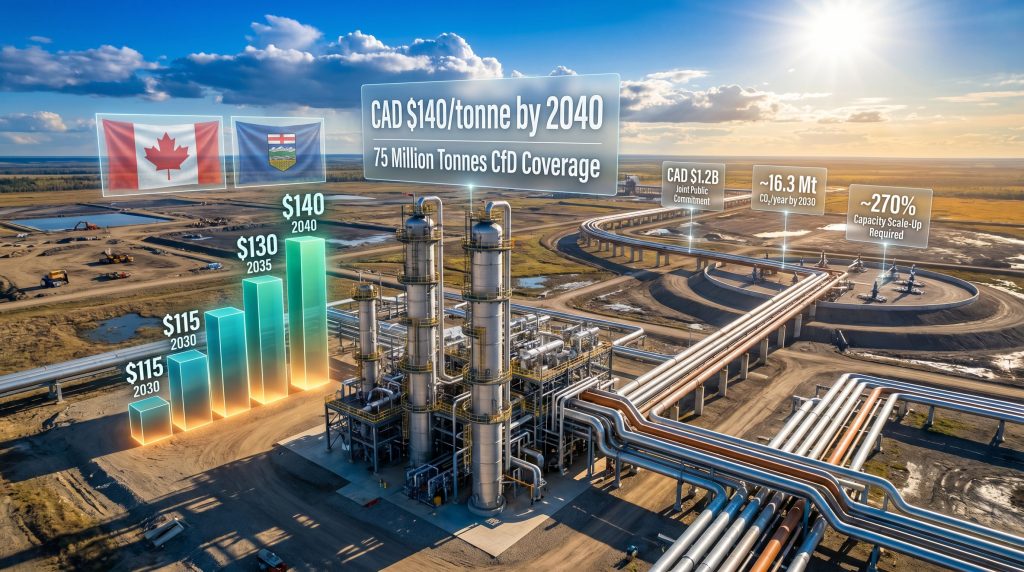
| Effective Industrial Carbon Price | Rising under federal benchmark | CAD $115/tonne by 2030; CAD $130/tonne by 2035; CAD $140/tonne by 2040 |
| TIER Credit Floor Price | No minimum floor | Minimum floor introduced from 2030 onward |
| Carbon Contracts for Difference | Not in place | 75 million tonnes of CfDs split equally between Ottawa and Alberta |
| CCS Public Co-Investment | Project-by-project basis | Up to CAD $1.2 billion jointly committed (CAD $600M per party, 2030-2040) |
| Federal Carbon Price Benchmark | Scheduled to reach CAD $170/tonne by 2030 | TIER trajectory now formally anchored below the federal benchmark |
The introduction of a minimum floor price for TIER credits from 2030 is arguably the most technically significant change, and it receives the least attention in mainstream coverage. Without a floor, an oversupply of credits within the TIER market can cause credit prices to collapse well below the stated carbon price, effectively rendering the price signal meaningless for long-term investment planning. The floor closes this gap.
Carbon Contracts for Difference: The Risk Transfer Mechanism Enabling CCUS at Scale
Carbon capture, utilisation, and storage projects face a distinctive financial challenge that sets them apart from most industrial investments. A CCUS facility built today may require 20 to 30 years of continuous operation to recover its capital cost and generate acceptable returns. Over that timeframe, the revenue stream generated by avoiding carbon compliance costs is entirely dependent on whether carbon prices remain at levels that justify the original investment thesis.
Carbon Contracts for Difference address this problem through a structured price guarantee mechanism:
- A strike price is established, representing the carbon price level at which the CCUS project becomes economically viable
- If the prevailing market carbon price falls below the strike price, the government pays the difference to the project operator
- If the market price rises above the strike price, the operator repays the excess to the government
- This two-way mechanism eliminates the most damaging scenario for private capital: committing billions of dollars to infrastructure that becomes stranded if policy reverses
The agreement allocates 75 million tonnes of CfD coverage, split equally between the federal government and Alberta at 37.5 million tonnes each. This is not simply a subsidy. It is a risk transfer instrument that converts a speculative, policy-dependent revenue stream into something closer to a contracted cash flow, which dramatically improves bankability for project financing.
In addition, lenders underwriting CCUS project debt need to model debt service coverage ratios across multiple decades. Without a CfD, the carbon price input in that model carries enormous uncertainty, making the financing structure fragile. With a CfD, the downside carbon price scenario is contractually bounded, enabling more aggressive leverage and lower blended cost of capital.
Alberta's Multi-Layer CCUS Incentive Stack: Mapping the Full Financial Architecture
One aspect of this policy framework that receives insufficient analytical attention is the degree to which multiple incentive programmes layer on top of each other to reduce the effective capital burden for CCUS project developers. Understanding the full stack is essential for evaluating the realistic decarbonisation economics of Alberta-based carbon capture investment.
Alberta Carbon Capture Incentive Programme (ACCIP)
- Provides a 12% capital grant on eligible new CCUS infrastructure costs
- Structured to complement, rather than duplicate, federal investment tax credits
- Reduces the upfront capital outlay that determines whether a project clears internal investment hurdles
TIER Fund CCUS Kickstart Allocation
- CAD $40 million in recent TIER fund disbursements targeting 11 carbon capture projects in various development stages
- These 11 projects, if fully advanced to construction and operation, are collectively projected to:
- Unlock more than CAD $20 billion in aggregate private and public capital investment
- Achieve approximately 24 million tonnes of CO₂ reduction annually at full operational capacity
To provide context for that 24 million tonne figure: Alberta's large industrial facilities collectively emit approximately 100 to 110 million tonnes of CO₂ per year. A 24 million tonne reduction from CCUS alone would represent roughly 22% of that total, which is substantial but also illustrates how far the province remains from its longer-term targets.
Canada's CCUS Capacity Gap: The 270% Scale-Up Challenge
Any credible assessment of the Canada Alberta carbon pricing deal and carbon capture framework must grapple with the scale of physical infrastructure deployment required to achieve stated targets. Current national CCUS operational capacity sits at approximately 4.4 million tonnes of CO₂ per year, anchored by facilities including the Quest Carbon Capture and Storage project in Alberta, which captures and stores roughly 1 million tonnes annually.
| Metric | Current Status |
|---|---|
| National CCUS operational capacity | ~4.4 million tonnes CO₂/year |
| Projected capacity by 2030 | ~16.3 million tonnes CO₂/year |
| Required growth rate (5 years) | ~270% |
| Canada's share of planned global CCUS capacity | ~11.5% |
Achieving that 270% capacity expansion within five years is an extraordinarily demanding physical and logistical target. It requires not just policy signals but simultaneous progress across permitting, engineering procurement, construction, and workforce scaling in a sector where experienced labour is globally constrained.
However, according to DNV forecasting data, CCUS costs in North America and Europe are projected to remain significant through 2050, with transport and storage costs constituting a meaningful proportion of total project cost. This persistent cost pressure reinforces why the CfD mechanism and the ACCIP capital grant are structural necessities rather than optional enhancements.
The next major ASX story will hit our subscribers first
The Compliance Cost Curve: Why Rising Carbon Prices Eventually Flip the Economics
A core principle of carbon pricing theory is that the economics of abatement investment improve as compliance costs rise. For Alberta's large industrial emitters, the new carbon price trajectory creates an increasingly compelling internal rate of return case for CCUS relative to continued permit purchases or fund contributions.
Consider the illustrative compliance cost scenario for a facility emitting 5 million tonnes of CO₂ annually:
| Year | Carbon Price (CAD/tonne) | Annual Compliance Cost Estimate | Investment Signal Strength |
|---|---|---|---|
| 2026 | ~$65-80 | ~$325-400M | Moderate |
| 2030 | $115 | ~$575M | High |
| 2035 | $130 | ~$650M | Very High |
| 2040 | $140 | ~$700M | Critical |
At annual compliance costs approaching CAD $700 million, the levelised cost of a large-scale CCUS facility, typically estimated in the range of CAD $80 to $120 per tonne of CO₂ captured depending on facility type and geological storage conditions, becomes economically rational compared to indefinite permit purchasing. The CfD mechanism then removes the residual policy risk that might otherwise delay the final investment decision.
Furthermore, if carbon credit prices within the TIER market converge toward the new floor price and CfD strike prices are set near the projected trajectory, the effective internal rate of return for a well-sited CCUS facility in Alberta could cross the threshold required for major institutional capital participation sometime between 2028 and 2032. However, this projection depends heavily on construction cost inflation, geological storage performance, and credit market liquidity.
The Pathways Project: Policy Dependency in Its Purest Form
The federal government has explicitly connected the Implementation Agreement to the Pathways Project, described as the world's largest planned carbon capture, utilisation, and storage initiative. The project targets multiple oil sands facilities concentrated in the Athabasca region and proposes shared CO₂ transport pipeline infrastructure connecting individual capture sites to a centralised geological storage hub.
What is rarely communicated clearly in public discourse is the degree to which a project of this scale cannot achieve financial close under conventional project finance without the specific instruments this agreement provides:
- Carbon price certainty over a multi-decade horizon (provided by the CfD mechanism)
- Government co-investment to reduce the public equity requirement for participating operators (provided by the CAD $1.2 billion commitment)
- Minimum credit price floors that prevent TIER credit market collapse from eroding the project's carbon revenue stream (provided by the floor price mechanism)
The Pathways Project is therefore not merely linked to the Implementation Agreement. It represents the specific use case that the agreement's architecture was designed to enable. Broader energy transition pressures across the resources sector make this kind of structured policy support increasingly necessary for capital-intensive projects.
How Canada Compares Globally on Industrial Carbon Pricing
Canada's evolving framework must be evaluated against competing jurisdictions, as trade-exposed industries routinely cite international competitiveness when opposing domestic carbon cost increases. Canada's energy transition challenges are particularly acute given the scale of its fossil fuel export economy.
| Jurisdiction | Carbon Pricing Mechanism | Approximate Current/Target Price | CCUS Policy Integration |
|---|---|---|---|
| Canada (Alberta TIER) | Compliance-based industrial pricing | CAD $140/tonne by 2040 | High – CfDs, grants, co-investment |
| European Union (EU ETS) | Cap-and-trade | ~€60-70/tonne (2025) | Growing via Innovation Fund |
| United Kingdom | UK ETS | ~£40-50/tonne (2025) | Developing via CCS cluster strategy |
| United States | No federal price; state-level only | Varies by jurisdiction | IRA 45Q tax credits as primary tool |
| Norway | Carbon tax plus ETS | ~€80-90/tonne equivalent | Longshore CCS infrastructure operational since 1996 |
Norway's Sleipner project, operational since 1996, provides the most important geological precedent: CO₂ stored in a saline aquifer beneath the North Sea with no reported containment failures across nearly three decades. This track record matters enormously for regulatory confidence in geological storage permanence, a question that remains among the most debated technical uncertainties in the CCUS field.
Canada's trajectory toward CAD $140/tonne by 2040 would place it among the most aggressive industrial carbon pricing jurisdictions globally, comfortably above current EU ETS and UK ETS levels and far above the US, where the absence of federal carbon pricing continues to create competitive distortions for North American industrial operators.
The Structural Tension: Climate Governance vs. Energy Export Strategy
Canada exports approximately 4 million barrels of oil per day to international markets, making petroleum exports a foundational component of national revenue. The oil and gas sector accounts for approximately 25 to 31% of Canada's total greenhouse gas emissions, making it simultaneously the largest sectoral emitter and the largest sectoral economic contributor.
This creates a governance tension that the Implementation Agreement does not resolve so much as manage. Consequently, recent federal policy has simultaneously rolled back certain proposed oil and gas emissions caps while strengthening carbon pricing mechanisms, reflecting the political difficulty of governing a major fossil fuel exporter through a clean energy transition.
The agreement's linkage of CCUS deployment to future infrastructure approvals, including potential pipeline expansion, represents an important evolution in how climate compliance functions within Canada's regulatory landscape. According to Reuters reporting on the Carney-Alberta deal, carbon capture is increasingly positioned not as an optional add-on for industrial operators but as a qualifying condition for continued operational and infrastructure expansion approvals.
However, if carbon prices follow the agreed trajectory but CCUS deployment lags due to construction cost inflation, labour shortages, or permitting delays, the gap between compliance costs and available abatement options could become politically destabilising, potentially triggering pressure to reduce price obligations. This represents the primary systemic risk to the framework's long-term credibility.
Frequently Asked Questions: Canada Alberta Carbon Pricing Deal and Carbon Capture
What is the Canada-Alberta Implementation Agreement?
A bilateral policy framework that establishes a long-term industrial carbon price trajectory, introduces Carbon Contracts for Difference, sets a minimum floor price for TIER carbon credits, and commits up to CAD $1.2 billion in joint public funding for carbon capture and storage projects between 2030 and 2040, with each party contributing up to CAD $600 million.
What is the carbon price pathway under the new agreement?
The agreement targets an effective industrial carbon price of CAD $115/tonne by 2030, rising to CAD $130/tonne by 2035, and reaching CAD $140/tonne by 2040 under Alberta's TIER system. The federal carbon price benchmark is separately scheduled to reach CAD $170/tonne by 2030.
What is Alberta's Carbon Capture Incentive Programme?
ACCIP is a provincial grant programme offering a 12% capital grant on eligible new CCUS infrastructure costs, designed to complement federal tax credits and reduce upfront capital requirements for project developers pursuing large-scale carbon capture deployment in Alberta.
How large is Canada's current CCUS capacity and what is the 2030 target?
Canada currently operates approximately 4.4 million tonnes of CO₂ per year in CCUS capacity. The 2030 projection targets approximately 16.3 million tonnes annually, representing a roughly 270% expansion that is contingent on policy certainty, capital mobilisation, and physical construction at significant scale. The mining energy transition broadly mirrors these challenges across resource-intensive industries.
Key Assessment: What the Agreement Signals for Long-Term Climate Governance
| Dimension | Assessment |
|---|---|
| Price certainty for industry | Strong – multi-decade trajectory with floor price protection |
| CCUS deployment support | Substantial – CfDs, grants, and direct co-investment combined |
| Federal-provincial alignment | Improved but dependent on sustained political commitment |
| Net-zero credibility | Mixed – CCUS as bridge technology carries risk if fossil fuel expansion continues |
| Global competitiveness positioning | Complex – high carbon price creates compliance costs alongside investment signals |
Three structural outcomes this framework is designed to produce:
- Regulatory certainty through a known, legally anchored carbon price path that removes the single largest barrier to long-horizon investment in clean industrial technology
- Capital mobilisation by leveraging public instruments, particularly CfDs and co-investment, to unlock multiples of private capital, with Alberta's $40 million TIER allocation alone projected to catalyse more than CAD $20 billion in aggregate investment
- Provincial integration by embedding Alberta's TIER system within a renewed federal equivalency framework, reducing the jurisdictional fragmentation that has historically disrupted Canadian climate policy continuity
The ultimate measure of this agreement will not be found in the text of the policy documents but in whether sufficient tonnes of CO₂ are permanently stored underground per dollar of public investment, and whether successive federal and provincial governments maintain the carbon price trajectory across electoral cycles. That political durability remains the most uncertain variable in any long-term carbon governance architecture, and the one that no contract can fully guarantee.
This article contains forward-looking statements, projections, and analytical assessments that are subject to significant uncertainty. Carbon price trajectories, CCUS deployment timelines, and capital investment figures are based on current policy commitments and publicly available data and should not be construed as investment advice. Readers should conduct independent research before making investment decisions related to carbon markets or related infrastructure sectors.
Want to Identify the Next Major Resource Discovery Before the Market Does?
Discovery Alert's proprietary Discovery IQ model delivers real-time alerts on significant ASX mineral discoveries — turning complex resource data into clear, actionable insights for both short-term traders and long-term investors. Explore how historic discoveries have generated substantial returns and begin your 14-day free trial today to position yourself ahead of the broader market.