May 22, 2026
The Hidden Cost of Digging and Shipping: How Australia's Resource Tax Settings Shape a Nation's Future
Across the global economy, the countries that have built lasting intergenerational wealth from natural resources share one defining characteristic: they treated extraction not as an ongoing revenue stream, but as a one-time conversion of a permanent national asset. That philosophical distinction, simple in theory but enormously difficult to execute in practice, sits at the heart of Australia's ongoing debate over Australia resource tax reform and whether the current fiscal architecture is fit for purpose in an era of energy transition and geopolitical resource competition.
The question is not whether Australia taxes its resource sector. It does. The question is whether the design of that taxation adequately reflects the permanent, irreversible nature of extraction from publicly owned reserves, and whether the proceeds are being structured in a way that benefits all Australians, including those not yet born.
When big ASX news breaks, our subscribers know first
A Dual System With Structural Cracks
Australia's approach to resource revenue rests on two parallel pillars: state-based royalties applied to the volume of material extracted, and the federal Petroleum Resource Rent Tax (PRRT), which targets profits from petroleum projects above a defined return threshold. On paper, this creates complementary coverage. In practice, the interaction between these two mechanisms produces a system that critics argue is neither efficient nor equitable.
Volume-based royalties are straightforward to administer but fundamentally indifferent to profitability. A company extracting iron ore during a supercycle boom pays the same royalty rate as one operating in a trough. The public receives a fixed slice of production value rather than a share of genuine economic surplus. Profit-based rent taxes, by contrast, theoretically capture more during commodity price surges while easing the burden during downturns, making them economically preferable in the view of mainstream tax economists.
The PRRT, which applies a 40% rate on petroleum project profits above a threshold return, has faced sustained criticism not for its rate but for the rules governing deductible expenses. Generous provisions allowed companies to carry forward exploration and development costs at uplift rates that effectively inflated the size of deductible losses over time. The practical outcome: several of Australia's largest LNG export projects, operating during a period of near-record global gas prices in 2022 and 2023, paid minimal or no PRRT.
The contrast between record export revenues and negligible rent tax contributions became a flashpoint for parliamentary reform advocacy. The federal government's 2023 response was to cap deductions at 90% of a project's assessable income, ensuring projects contribute some tax sooner. However, whether that correction is sufficient, or whether it represents an incremental repair to a structurally compromised mechanism, remains a live debate among policy economists and independent parliamentarians.
Independent MP Allegra Spender has argued for a more comprehensive redesign linking resource tax architecture to critical minerals industrial strategy, furthermore demonstrating how global taxes and royalties in comparable jurisdictions increasingly inform domestic reform conversations.
The Queensland Experiment and the Investment Deterrence Problem
At the state level, Queensland made international headlines in 2022 by introducing a tiered coal royalty structure that scales to 40% during price spikes, representing one of the most aggressive subnational resource revenue measures adopted in the Asia-Pacific region. The policy rationale was straightforward: during extraordinary commodity price events, resource companies generate windfall profits from publicly owned reserves, and the community should capture a larger portion of that surplus.
The industry response was immediate. BHP publicly signalled a pause on certain regional investment decisions, citing sovereign risk concerns. That reaction encapsulates the fundamental tension embedded in every resource tax reform proposal: the more aggressively a government attempts to capture rent during booms, the greater the risk that long-cycle capital projects become less attractive to institutional investors with fiduciary obligations to manage sovereign risk exposure.
This tension does not resolve neatly. Progressive royalties can deliver genuine short-term fiscal gains. However, mineral extraction projects are not like retail businesses that can rapidly adjust capital deployment in response to margin changes. They involve sunk costs, multi-decade development timelines, and infrastructure commitments evaluated at the point of investment against an assumed regulatory and fiscal environment. Retrospective or unexpected changes to that environment are priced as risk, increasing the cost of capital for future Australian projects.
Australia Compared: The Global Resource Tax Landscape
Placing Australia's settings in an international context reveals a wide spectrum of approaches to sovereign resource capture.
| Country | Primary Mechanism | Effective Rate | Sovereign Wealth Outcome |
|---|---|---|---|
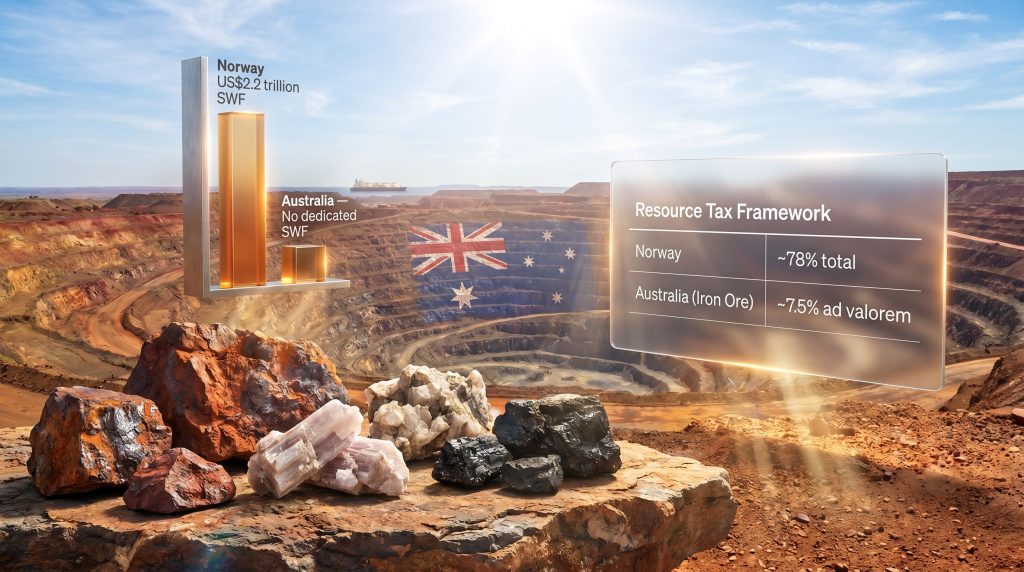
| Norway | Petroleum rent tax + mandatory state equity | ~78% total | ~US$2.2 trillion sovereign wealth fund |
| Australia (LNG) | PRRT (post-2023 reform) | Variable / historically low | No dedicated resource sovereign fund |
| Australia (Coal) | State royalties + QLD progressive tiers | Up to 40% (QLD) | State budget revenues |
| Australia (Iron Ore) | WA state royalties | ~7.5% ad valorem | State royalty income |
| Indonesia | Export processing mandates (non-tax mechanism) | N/A | Downstream FDI inflows |
Norway's petroleum framework is routinely held up as the global benchmark, and for good reason. By combining a resource-specific levy with mandatory state co-investment positions in extraction projects, Norway engineered a system where the windfall from a finite national asset was converted into a permanent financial asset. The resulting sovereign wealth fund, valued at approximately US$2.2 trillion, is the largest of its kind on the planet and has meaningfully reduced the fiscal pressure placed on Norwegian income and consumption taxpayers.
The philosophical foundation underlying Norway's model deserves attention. Norwegian policymakers recognised decades ago that petroleum in the ground, once extracted, is gone permanently. The extraction event is therefore not a recurring revenue source but a one-time transformation of a national balance sheet asset into cash. If that cash is consumed in annual budgets, the nation ends up poorer in real terms. If it is reinvested in diversified financial assets, the wealth is preserved and compounded.
That logic has not found equivalent institutional expression in Australia's fiscal architecture. Australia has the Future Fund, a significant vehicle established to cover public sector superannuation liabilities. It is emphatically not a resource revenue reinvestment mechanism. There is no dedicated federal sovereign wealth fund equivalent to Norway's Government Pension Fund Global, meaning resource depletion is not being systematically offset by financial asset accumulation at the national level.
Indonesia's Value-Chain Strategy: Lessons and Limits
While Norway provides the fiscal benchmark, Indonesia offers a different but equally instructive case study in resource nationalism through industrial strategy rather than taxation. In 2020, Jakarta imposed a complete ban on raw nickel ore exports, forcing any company seeking access to one of the world's largest nickel reserves to establish downstream processing operations within Indonesian borders.
The strategy was deliberately confrontational. It communicated unambiguously that Indonesia would no longer accept the role of raw material supplier at the bottom of the value chain. The result was a substantial inflow of foreign direct investment into Indonesian smelting and refining infrastructure. Furthermore, Indonesia's nickel strategy has repositioned the country as a meaningful participant in battery supply chains serving the global electric vehicle industry.
However, the Indonesian model carries conditions that cannot be directly transplanted into an Australian context. Its competitive advantage in downstream processing rested on cost structures, labour cost profiles, and regulatory frameworks that reflect very different economic and environmental settings. Any Australian downstream strategy that attempts to replicate those conditions would be working against the grain of the country's industrial cost base, community standards, and international environmental commitments.
The more credible Australian pathway to value-chain capture involves advanced automated manufacturing, green energy inputs that are increasingly cost-competitive, and the regulatory certainty and geopolitical alignment that makes Australia a preferred supplier to allied-nation industrial ecosystems. That is a fundamentally different competitive proposition, one built on premium positioning rather than cost competition.
Critical Minerals and the Strategic Dimension of Resource Tax Reform
The conversation around Australia resource tax reform has taken on a new strategic dimension as critical minerals transition from niche industrial inputs to core components of geopolitical leverage. Australia's critical minerals — including significant reserves of lithium, cobalt, copper, and rare earth elements — are now central to the global energy transition and to defence technology supply chains.
China has demonstrated with considerable strategic sophistication the leverage available to dominant holders of these materials. Through targeted restrictions on export licences for gallium, germanium, antimony, and rare earth processing chemicals, Beijing has been able to exert pressure on semiconductor manufacturing and defence supply chains in ways that extend well beyond conventional trade policy. The implicit signal is that resource dominance, properly managed, confers geopolitical influence that transcends the direct commercial value of the materials themselves.
Australia's current posture, characterised predominantly by high-volume raw material export with limited onshore processing, means this latent strategic leverage is largely transferred to offshore processors. The nation supplies the critical inputs but captures a fraction of the value, and essentially none of the geopolitical leverage, embedded in finished products.
This creates an argument for treating critical minerals under a distinct fiscal and industrial policy framework. A differentiated approach might include higher rent capture during commodity price surges, offset by concessional treatment for verified onshore processing investment. The concept of a dedicated Critical Minerals Sovereign Fund, ring-fencing a portion of rents from lithium, cobalt, and rare earth extraction for future-generation investment, has emerged as a policy idea worthy of serious structural analysis. In addition, accelerating critical minerals demand driven by the global energy transition makes the urgency of this structural analysis increasingly difficult to defer.
The next major ASX story will hit our subscribers first
The Fuel Tax Credit Question
No honest accounting of the net fiscal relationship between Australia's resource sector and the public balance sheet can avoid the fuel tax credit (FTC) scheme. Under current settings, mining companies receive refunds of the excise paid on diesel used in off-road industrial applications, including within mine sites. The total annual value of these credits to the mining sector runs into the billions of dollars, representing a material reduction in the sector's net fiscal contribution.
Industry groups characterise FTCs as a technical correction rather than a subsidy: the diesel excise was designed to fund road infrastructure, and fuel consumed off-road within mining operations does not use that infrastructure, so no excise liability should accrue. The logic is internally consistent.
Critics, however, argue that in the context of Australia's climate commitments and the broader energy transition, continuing to refund fossil fuel excise to large resource exporters operates as an indirect subsidy whose justification weakens with each passing year. The Australia Institute has noted that the middle-ground policy proposal gaining traction is a phased reduction in FTC eligibility tied explicitly to the electrification of mining fleet operations, rewarding companies that transition away from diesel dependency while gradually withdrawing the credit from those that do not.
Designing a Resource Tax Framework That Actually Works
Reforming Australia's resource tax architecture is not primarily a matter of political will, though that is a genuine constraint. It is fundamentally a design challenge: building a fiscal framework that captures a genuinely equitable public return from finite national assets without systematically deterring the long-cycle capital investment needed to develop them.
A credible reform framework would need to incorporate several core design principles:
- Profit-sensitivity at scale — tax rates should escalate in line with profitability, not just extraction volume, ensuring windfall capture without penalising genuinely marginal projects operating on thin economics
- Investment neutrality — the framework should not place greenfield development, particularly in critical minerals, at a structural disadvantage relative to competing jurisdictions
- Jurisdictional coordination — state royalties and federal rent taxes should be designed in complementary rather than conflicting ways, avoiding perverse incentives or effective double-counting of the same economic surplus
- Downstream processing incentives — onshore value-add investment should attract concessional treatment within the rent framework, creating a direct fiscal reward for building processing capability rather than simply exporting raw material
- Mandatory project-level disclosure — public accountability requires that project-level tax contribution data be transparently reported, enabling informed policy evaluation rather than reliance on sector-wide aggregates
The Intergenerational Equity Dimension
Does Australia's Current Framework Serve Future Generations?
At its core, the Australia resource tax reform debate is an intergenerational equity question. Non-renewable resources extracted today cannot benefit future Australians in their natural form. The only mechanism through which future generations share in the value of those resources is the fiscal and financial architecture that governs what happens to the proceeds of extraction.
When that architecture systematically underprices public ownership, allows deductions to outpace revenues during commodity booms, and fails to convert temporary extraction windfalls into durable financial assets, the intergenerational bargain breaks down. Future Australians inherit depleted reserves and no financial offset.
The urgency of resolving this question is compounded by timing. The global energy transition is accelerating demand for precisely the critical minerals in which Australia holds structural reserve advantages. That window of peak strategic value will not remain open indefinitely. Competing jurisdictions are developing their own reserves, processing capabilities, and supply chain relationships.
Australia's ability to convert its geological endowment into lasting national prosperity depends on whether the policy settings governing its resource sector are fit for the moment. Green metals leadership at both a commercial and policy level will be essential to that outcome. Consequently, that assessment demands honest engagement with the evidence rather than deference to the status quo. Melbourne Institute research suggests that well-designed resource tax reform could simultaneously strengthen fiscal foundations and long-term economic competitiveness.
The central challenge is not choosing between public return and investment attraction. It is designing a framework sophisticated enough to deliver both simultaneously, while building the industrial capability to capture value beyond the mine gate.
This article is intended for informational and analytical purposes only. It does not constitute financial or investment advice. Readers should seek independent professional advice before making investment or policy-related decisions.
Want to Identify ASX Mineral Discoveries Before the Broader Market Does?
Discovery Alert's proprietary Discovery IQ model delivers real-time alerts on significant ASX mineral discoveries, instantly transforming complex geological data into actionable investment insights for traders and investors at every experience level — start your 14-day free trial today and explore historic discovery returns that demonstrate why timing your entry to major mineral finds can be genuinely transformative.