May 22, 2026
The Economics of Clean Energy Are Broken — And a New Paradigm Is Emerging Underground
The promise of a hydrogen-powered industrial economy has been one of the defining narratives of clean energy policy over the past decade. Governments committed billions. Corporate boardrooms aligned strategy around it. Energy analysts projected cost curves bending toward competitiveness with fossil fuels by the mid-2020s. Yet the gap between that vision and commercial reality has grown wider with each passing year, not narrower.
This disconnect is forcing a fundamental reassessment. Not just of green hydrogen's delivery failures, but of whether the foundational premise — that manufactured hydrogen would be the linchpin of industrial decarbonisation — was ever structurally sound. Into that uncertainty, a geologically sourced alternative is drawing serious scientific and commercial attention, with geologic hydrogen cost per kilogram emerging as the central figure in that debate.
When big ASX news breaks, our subscribers know first
The Green Hydrogen Collapse: Why the Numbers Never Added Up
The data on green hydrogen's commercial progress is stark. A 2025 study published in Nature Energy, which tracked 190 planned green hydrogen projects over three years, found that only 7% of globally announced capacity reached completion on schedule. That figure represents not a minor underperformance but a systemic failure of an entire production paradigm to deliver at the scale its advocates projected.
The reasons are structural, not incidental. Green hydrogen is produced by running renewable electricity through an electrolyser to split water molecules into hydrogen and oxygen. The process works at a molecular level, but it creates an immediate problem at an economic level: every unit of clean electricity directed into hydrogen production is a unit that cannot power homes, factories, or transportation systems directly.
This opportunity cost argument has been articulated with increasing clarity in academic research. Work published through the Harvard University Center for the Environment found that even if production costs decline in line with the most optimistic forecasts, downstream storage and distribution expenses will continue to block hydrogen from achieving price competitiveness across most industrial sectors. The same research challenged the framing of hydrogen as a universal decarbonisation tool.
Furthermore, the structural cost problem is persistent:
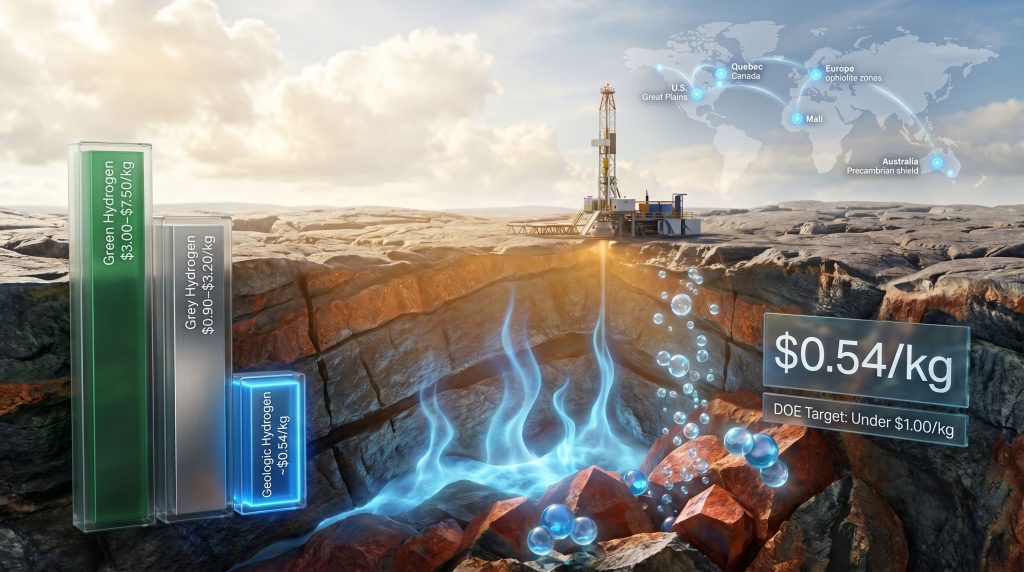
- Green hydrogen production currently costs between $3.00 and $7.50 per kilogram, depending on renewable energy availability and electrolyser scale
- Storage requires either high-pressure compression or cryogenic cooling, adding significant cost beyond the production figure
- Distribution infrastructure for hydrogen pipelines does not exist at scale in most markets
- Industrial offtake agreements require supply consistency that early-stage production cannot reliably guarantee
The conclusion is unavoidable: green hydrogen's commercial momentum has stalled not because the technology is fraudulent, but because its economics are fundamentally misaligned with the sectors it was supposed to serve.
What Is Geologic Hydrogen and How Does the Chemistry Work?
Geologic hydrogen — also referred to in scientific literature as white hydrogen or gold hydrogen — is naturally occurring molecular hydrogen generated through subsurface chemical processes. It is not manufactured. No electrolysis is required. No fossil fuel combustion is involved. The hydrogen forms spontaneously through a geological reaction that has been occurring in the Earth's crust for billions of years.
The primary mechanism is serpentinisation: a reaction between water percolating through rock formations and iron-bearing minerals, particularly olivine and pyroxene found in ultramafic rock. When water contacts these minerals at the right temperature and pressure conditions, it triggers an oxidation reaction that releases molecular hydrogen as a byproduct. The process is exothermic — it generates heat — and can be self-sustaining under the right subsurface conditions.
What makes this scientifically significant is the absence of any upstream energy requirement. Unlike every other hydrogen production pathway, geologic hydrogen does not consume energy to exist. The Earth's geology does the work. A recent white hydrogen discovery in France has further underscored the growing global interest in naturally occurring subsurface hydrogen resources.
The Geological Settings That Matter
Not every rock formation is prospective for geologic hydrogen. The specific conditions required are:
- Ultramafic rock formations: ancient mantle-derived rocks rich in iron and magnesium, including peridotite and dunite
- Water access: sufficient groundwater infiltration to sustain ongoing serpentinisation reactions
- Appropriate depth and temperature: too shallow and reactions are too slow; too deep and the hydrogen may be consumed by microbial activity before it can accumulate
- Structural trapping: impermeable cap rock formations capable of concentrating hydrogen rather than allowing it to migrate to surface and disperse
Ancient cratons — the geologically stable cores of continental plates that have remained largely undisturbed for hundreds of millions of years — are particularly prospective. So are ophiolite complexes, which are slices of ancient oceanic crust that have been thrust onto continental margins, exposing ultramafic mantle material to surface and near-surface conditions.
The Hydrogen Colour Spectrum: Where Geologic Hydrogen Fits
| Hydrogen Type | Production Method | Estimated Cost Range (USD/kg) | Carbon Intensity |
|---|---|---|---|
| Grey Hydrogen | Steam methane reforming (no CCS) | $0.90 – $3.20 | High |
| Blue Hydrogen | Steam methane reforming (with CCS) | $1.50 – $2.90 | Medium |
| Green Hydrogen | Renewable-powered electrolysis | $3.00 – $7.50 | Near-zero |
| Geologic (White/Gold) Hydrogen | Natural subsurface extraction | $0.50 – $1.00 (estimated) | Very low |
Geologic Hydrogen Cost Per Kilogram: What the Data Actually Shows
The geologic hydrogen cost per kilogram is where this emerging resource category makes its most compelling argument. The U.S. Department of Energy has cited a production potential of below $1.00 per kilogram under favourable geological conditions. Peer-reviewed techno-economic modelling has provided more granular estimates:
- Natural geological hydrogen (direct extraction from existing subsurface accumulations): approximately $0.54/kg
- Stimulated geological hydrogen (induced serpentinisation through engineered subsurface interventions): approximately $0.92/kg
To place these figures in context, the U.S. Energy Information Administration's 2026 Annual Energy Outlook references mainstream hydrogen pathway modelling costs of approximately $5.89/kg in certain application contexts. The U.S. Department of Energy's Hydrogen Shot initiative has set $1.00/kg as the clean hydrogen target by 2031 — a goal that has required enormous investment in electrolyser manufacturing scale-up, renewable energy cost reduction, and infrastructure development.
Geologic hydrogen's modelled production costs suggest it could approach or undercut that threshold without requiring the same decade-long scaling journey.
Critical Caveat: These figures represent wellhead production cost estimates derived from techno-economic modelling under geologically favourable assumptions. They do not capture compression, surface processing, transport, or distribution costs. Delivered cost to an industrial end-user will be materially higher. Commercial-scale geologic hydrogen extraction has not been validated globally, and no basin has yet demonstrated sustained production at these cost levels.
The Full Cost Competitiveness Picture
| Metric | Value | Context |
|---|---|---|
| Estimated geologic H₂ cost (natural extraction) | ~$0.54/kg | Techno-economic modelling, favourable geological settings |
| Estimated geologic H₂ cost (stimulated) | ~$0.92/kg | Induced serpentinisation scenarios |
| DOE sub-$1/kg production target | <$1.00/kg | Cited under favourable conditions |
| Current green hydrogen cost range | $3.00 – $7.50/kg | Renewable electrolysis, global average |
| Current grey hydrogen cost range | $0.90 – $3.20/kg | Steam methane reforming, no CCS |
| Current blue hydrogen cost range | $1.50 – $2.90/kg | Steam methane reforming with CCS |
| EIA 2026 AEO reference cost | ~$5.89/kg | Mainstream pathway modelling context |
| Commercial-scale validation status | Not yet achieved | Early exploration and pilot stage globally |
The Hard-to-Abate Sectors That Make This Cost Discussion Critical
Understanding why the geologic hydrogen cost per kilogram matters requires understanding which industrial sectors are currently trapped between decarbonisation ambition and economic reality.
Steelmaking is the clearest example. Conventional blast furnace steel production requires metallurgical coal as both a fuel and a chemical reducing agent to strip oxygen from iron ore. Processes involving hydrogen iron ore reduction can achieve the same chemistry without coal, leaving water as the byproduct rather than CO₂. However, the economics only work if hydrogen can be delivered at a cost competitive with thermal coal. At current green hydrogen prices of $3.50 to $6.00/kg, the substitution is economically irrational for most producers.
At sub-$2/kg delivered hydrogen, the calculation changes fundamentally. Initiatives focused on green iron production are already demonstrating the industrial ambition, and efforts such as South Australia green iron programmes illustrate how regional policy frameworks are beginning to align around hydrogen-based steelmaking at scale.
Industrial shipping presents a similar dynamic. Heavy fuel oil is currently the dominant marine fuel because it is cheap, energy-dense, and globally available. Hydrogen or hydrogen-derived ammonia could replace it, but only if the price gap narrows to a point where fuel switching becomes commercially rational rather than aspirational.
High-temperature industrial processes including cement kilns, glass furnaces, and chemical manufacturing require heat at temperatures that electricity cannot cost-effectively deliver with current technology. For these sectors, hydrogen is not one option among many — it is functionally the only low-carbon pathway.
A reduction in geologic hydrogen cost per kilogram from $5–6/kg to below $1/kg at production — even if delivered cost reaches $2.00–$2.50/kg after processing and transport — would shift hydrogen from aspirational fuel to economically competitive input. That is not an incremental improvement. It is a structural transformation of the decarbonisation calculus for industries that collectively represent approximately 30% of global CO₂ emissions. The broader energy transition demand for affordable low-carbon inputs makes this cost trajectory consequential well beyond the hydrogen sector alone.
Where Global Exploration Is Happening and What It Is Finding
The global prospectivity map for geologic hydrogen is still being drawn. Several regions have attracted early exploration activity based on their geological characteristics:
| Region | Geological Setting | Exploration Stage | Key Activity |
|---|---|---|---|
| Mali (West Africa) | Precambrian craton | Operational (small-scale) | Community power generation from natural seep |
| Quebec, Canada | Shield geology | Early exploration | Startup-led drilling programmes |
| United States | Multiple basin types | Research and pilot | DOE-funded feasibility studies |
| Australia | Precambrian shield | Prospectivity mapping | Academic and government survey work |
| Europe (ophiolite zones) | Ophiolite complexes | Early academic research | University-led geological assessment |
Mali represents the most operationally advanced case globally. Natural hydrogen seeps at Bourakébougou have been documented for years, and the gas has been used to power a small community energy generator — demonstrating that subsurface hydrogen can be captured and utilised at a basic level, even if it remains far from industrial-scale production.
Quebec's geological setting is considered structurally favourable due to its Precambrian shield basement. Early-stage exploration programmes there are applying oil and gas drilling methodology to a fundamentally different resource category — an approach that carries both operational familiarity and significant geological uncertainty.
One aspect rarely discussed in mainstream coverage is the microbial consumption problem: at certain depths and temperature ranges, naturally occurring subsurface bacteria consume hydrogen before it can accumulate in economic concentrations. Identifying geological settings where hydrogen can form and accumulate without being biologically consumed is one of the less visible but critical challenges facing the sector.
The next major ASX story will hit our subscribers first
The Technology Readiness Gap: What Needs to Be Solved
Geologic hydrogen is currently at an early technology readiness level. The chemistry is understood in principle. The geological environments are being mapped. However, the distance between scientific plausibility and commercial production is substantial.
The pathway to commercial viability requires sequential validation across six stages:
- Regional basin characterisation: geological mapping of prospective serpentinisation environments at a scale sufficient to identify drill targets
- Pilot well production testing: demonstrating that subsurface hydrogen can be extracted at flow rates and purity levels that support commercial economics
- Delivered cost validation: establishing that wellhead production economics translate into competitive delivered costs after processing and distribution
- Regulatory framework development: adapting permitting, safety, and carbon accounting standards from oil and gas and mining precedents to a new resource category
- Demonstration-scale operations: sustained production at a scale sufficient to underwrite long-term industrial offtake agreements
- Commercial production: operating at industrial supply volumes with validated, repeatable economics
Most current programmes are at stages one and two. The gap to stage six is measured in years or decades, not months.
Key Technical Unknowns
- Subsurface hydrogen flow rates and whether reservoirs will deplete over production timescales or replenish through ongoing serpentinisation
- Hydrogen purity at the wellhead, and how co-produced gases (potentially including methane, CO₂, or helium) affect processing costs and carbon accounting
- Whether stimulated serpentinisation can be engineered reliably at depth, or whether the reaction rate proves too slow for commercial production
- Long-term reservoir behaviour under production drawdown conditions, for which there is no established industry precedent
Risk Framework: What Investors and Policymakers Must Understand
Geologic hydrogen carries a risk profile that is genuinely asymmetric. The potential upside — a naturally occurring, low-carbon hydrogen source producible at below $1/kg — is transformational. The probability of achieving that outcome at commercial scale, within a commercially relevant timeframe, remains unproven.
Technical risks include unproven extraction methodology, unknown reservoir depletion dynamics, and uncertain purity profiles. Economic risks include the gap between modelled wellhead costs and actual delivered economics, and the exploration risk inherent in any early-stage subsurface resource programme. Regulatory risks include the absence of dedicated regulatory frameworks in most jurisdictions. Market risks include the requirement for demonstrated production consistency before industrial buyers will commit to long-term supply agreements.
According to an independent analysis of geologic hydrogen economics, the sector's cost advantage is real but conditional on geological factors that remain incompletely characterised at a global level — a nuance that both advocates and sceptics frequently understate.
Energy Futures Initiative vice president Madeline Schomburg has described the opportunity in terms of asymmetric risk-reward: even if the probability of commercial success is low, the scale of potential impact justifies sustained exploration investment. This framing reflects how many early-stage resource sectors have historically been evaluated, from unconventional oil and gas in the 1990s to rare earth exploration in the 2000s.
The Macro Tailwinds Accelerating Interest
The current global energy security environment is creating conditions favourable to geologic hydrogen research even before commercial viability is demonstrated. Geopolitical disruption to fossil fuel supply chains has intensified governmental interest in domestically producible energy alternatives across multiple regions.
The documented failure of green hydrogen to deliver at projected scale has created a policy and investor vacuum that alternative hydrogen pathways are now positioned to fill. Capital reorientation is early but observable. Investment flows into geologic hydrogen exploration are beginning to emerge as green hydrogen project pipelines stall. National geological surveys in multiple countries are incorporating natural hydrogen prospectivity into their resource assessment programmes for the first time.
None of this constitutes confirmation that geologic hydrogen will succeed. However, it does reflect a rational market response to a situation in which the incumbent clean hydrogen pathway has underdelivered dramatically, while a structurally cheaper alternative with a fundamentally different cost basis has entered the frame.
Frequently Asked Questions: Geologic Hydrogen Cost and Viability
What is the current estimated geologic hydrogen cost per kilogram?
Techno-economic modelling suggests natural geological hydrogen could be produced at approximately $0.54/kg under favourable conditions, with stimulated geological hydrogen estimated at around $0.92/kg. The U.S. Department of Energy has referenced a sub-$1.00/kg production potential. These are modelling estimates, not validated commercial production costs.
How does geologic hydrogen cost compare to green hydrogen?
Current green hydrogen production costs range from approximately $3.00 to $7.50/kg. Geologic hydrogen's estimated production cost of $0.50 to $1.00/kg represents a potential reduction of 80 to 90%, though delivered costs including processing and distribution will be higher.
Is geologic hydrogen commercially available today?
No. Commercial-scale geologic hydrogen extraction has not been demonstrated globally. Exploration programmes are at early pilot and feasibility stages, and the geological and engineering validation needed to support commercial production are still in development.
What geological conditions are needed to produce geologic hydrogen?
Geologic hydrogen forms primarily through serpentinisation — a reaction between water and iron-rich ultramafic rocks. Favourable settings include ancient cratons, ophiolite complexes, and deep basement rock formations with appropriate temperature and pressure profiles and structural trapping capacity.
Why does the $1/kg threshold matter for hydrogen economics?
The U.S. Department of Energy's Hydrogen Shot initiative targets $1.00/kg as the price point at which clean hydrogen becomes broadly cost-competitive across major industrial applications. Geologic hydrogen's modelled production costs suggest this threshold could be approached without the same scaling investment required for electrolysis-based pathways.
This article is for informational and educational purposes only. It does not constitute financial, investment, or technical advice. Cost estimates referenced are derived from techno-economic modelling and academic research and should not be interpreted as confirmed commercial production economics. Geologic hydrogen extraction remains at an early stage of technical and commercial development. Readers should conduct their own research and consult qualified advisors before making investment decisions.
Want to Track the Next Major Resource Discovery Before the Market Catches On?
Discovery Alert's proprietary Discovery IQ model scans ASX announcements in real time, delivering instant alerts on significant mineral discoveries — from emerging commodities like geologic hydrogen to established resources — so subscribers can act on actionable opportunities ahead of the broader market. Explore how major discoveries have historically generated exceptional returns on Discovery Alert's discoveries page, and begin your 14-day free trial today to secure a market-leading edge.