
May 22, 2026
The Metallurgical Divide Reshaping Global Nickel Investment
Not all nickel is created equal. This is a fact that battery supply chain engineers understand intimately, yet one that continues to be underappreciated by generalist investors scanning headline commodity prices. The fundamental chemical distinction between nickel sulfide and nickel laterite deposits has quietly become one of the most consequential fault lines in the global critical minerals landscape, separating projects that can feed next-generation battery cathodes directly from those that require expensive, energy-intensive intermediate processing steps to get there.
Against that backdrop, the Kabanga Nickel Project in northwestern Tanzania has emerged as one of the highest-grade undeveloped nickel sulfide deposits on the planet. With Lifezone Metals (NYSE: LZM) targeting a mid-2026 Kabanga Nickel Project final investment decision, the question for capital markets is no longer whether the project is technically credible. The Q1 2026 execution record has largely answered that. The question is now how much residual risk separates the current pre-FID position from authorisation, and what that means for investors with exposure to the nickel supply chain.
When big ASX news breaks, our subscribers know first
Why Nickel Sulfide Deposits Command a Structural Premium
To understand why the Kabanga Nickel Project final investment decision carries significance beyond Tanzania's borders, it helps to understand what makes nickel sulfide fundamentally different from the laterite ores that now dominate global nickel production. Understanding nickel properties and uses provides essential context for why this distinction matters so profoundly to battery manufacturers and downstream supply chains.
Nickel laterites form through the weathering of ultramafic rocks in tropical environments. They are abundant, shallow, and relatively easy to mine. However, the nickel they contain is locked within complex mineral matrices that require either high-pressure acid leaching or pyrometallurgical smelting to extract. The pyrometallurgical route produces nickel pig iron, a product well suited to stainless steel manufacturing but largely incompatible with battery-grade nickel sulfate refining without further costly processing.
The high-pressure acid leach route can produce battery-grade material, but it is capital-intensive, chemically aggressive, and carries significant environmental liability. By contrast, magmatic nickel deposits such as Kabanga produce a high-purity concentrate through conventional flotation circuits. That concentrate can be refined directly into the nickel sulfate used in nickel-manganese-cobalt and nickel-cobalt-aluminum battery cathodes.
As electric vehicle manufacturers tighten quality specifications for cathode active materials, the direct processing pathway from sulfide concentrate to battery-grade product is becoming a commercial differentiator rather than merely a technical distinction.
Kabanga's high-grade sulfide ore positions it at the premium end of the nickel quality spectrum, with processing economics and environmental credentials that laterite-derived material simply cannot replicate at equivalent cost.
How Kabanga Sits Within the Global Development Pipeline
Very few undeveloped nickel sulfide projects globally combine high grade with significant scale. The following comparison illustrates where Kabanga sits relative to other major development-stage projects:
| Project | Location | Deposit Type | Grade Profile | Development Stage |
|---|---|---|---|---|
| Kabanga | Tanzania | Nickel Sulfide | High-grade | Pre-FID (mid-2026 target) |
| Crawford | Canada | Nickel Sulfide | Large tonnage, lower grade | Pre-feasibility / DFS |
| Dumont | Canada | Nickel Sulfide | Bulk tonnage | Feasibility complete |
| Tamarack | USA | Nickel Sulfide | High-grade | Exploration / Early study |
| Araguaia | Brazil | Nickel Laterite | Moderate | Construction-ready |
The combination of high grade and advanced permitting gives Kabanga a position in the development pipeline that no other African nickel sulfide project currently occupies. Grade matters profoundly in project finance: higher-grade deposits generate proportionally higher operating margins, which in turn support greater debt capacity relative to project capital expenditure.
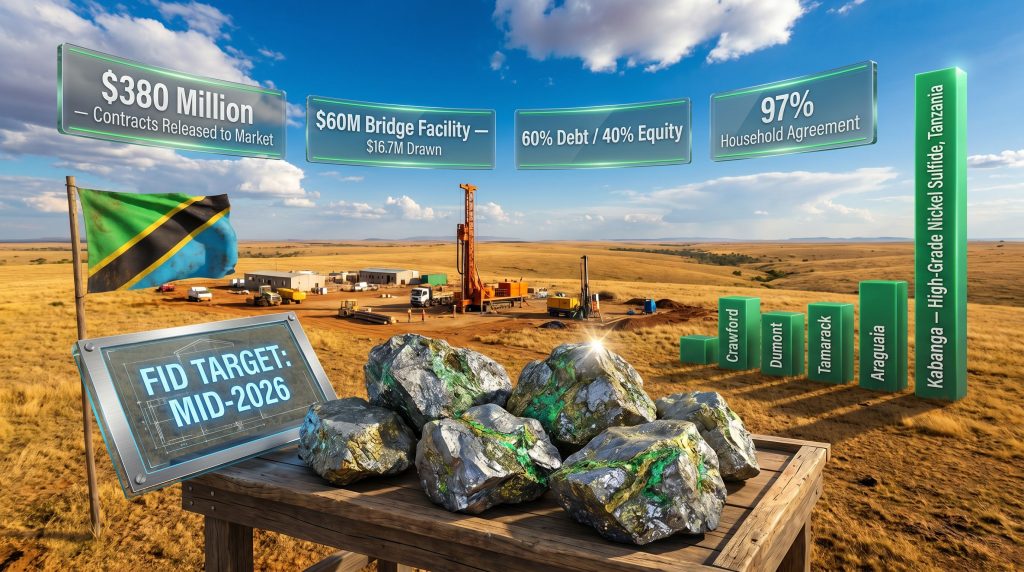
Lifezone Metals' CFO Ingo Hofmaier has articulated this directly, noting that because of Kabanga's high grade and resulting profitability, the project's debt capacity is substantial. Following multiple rounds of discussions with lenders, the anticipated capital structure sits at approximately 60% debt and 40% equity, a ratio that reflects genuine lender conviction in the project's cash generation potential rather than optimistic modelling.
The Q1 2026 Execution Record: What Was Actually Delivered
The first quarter of 2026 produced a dense body of execution evidence across five distinct workstreams. Taken together, these deliverables constitute a transition from study-phase planning into construction readiness. Lifezone Metals' official press release outlines the full scope of milestones achieved during this period.
Geotechnical Field Programmes
The subsurface data set required for detailed engineering input is now materially complete. Key deliverables from the geotechnical programme include:
- 163 geotechnical test pits completed across the full project footprint
- Boreholes finalised for the North and Tembo boxcuts and all associated waste rock dump infrastructure
- All geotechnical holes completed for eight ventilation raises across both mine areas
- LiDAR and topographical surveys advanced across the broader project area
- Potable water borehole drilling commenced, with one production borehole reaching 132 metres depth and yielding 28,000 litres per hour
Hofmaier has described the depth of geological understanding that informed this programme, noting that across the 18-year mining period, the team has a well-developed picture of underground access, topography, entry points, rock stability characteristics, and open stoping geometry. From a mining method perspective, the project is well understood, which reduces the subsurface uncertainty premium that lenders and equity investors typically assign to pre-construction projects.
The Five-Pillar Pre-FID Execution Framework
The outline Project Execution Plan organises pre-FID delivery across five operational pillars, each designed to operationalise the shift from study-phase governance into construction-phase management:
- Project Setup and Governance – Seven senior pre-FID roles filled within the Owner's team during Q1 2026; governance and cost management frameworks advanced concurrently
- Engineering and Technical Delivery – Front-End Engineering Design and value engineering progressing; dual-train milling technical note completed
- Procurement and Contracting – 52 critical path Expressions of Interest received Mining Commission approval; 45 released to market representing approximately $380 million in contract value
- Construction, Commissioning, and External Delivery – Site camp upgrades advanced covering accommodation, laydown, storage, maintenance, sewerage, and water treatment
- Project Controls and Risk – Project Labour Plan received internal approval and was formally submitted to the Tanzanian Labour Commissioner; Local Skills Survey completed
The scale of the procurement release is particularly significant. Releasing $380 million in contracts to market is not a paper exercise; it activates contractor engagement, generates competitive tension among suppliers, and begins to lock in the pricing inputs that feed the lender financial model.
Permitting Position: A Strong Baseline With One Open Variable
One of Kabanga's underappreciated strengths is the depth of its permitting position relative to its development stage. The current licence and agreement inventory includes:
| Permit or Agreement | Status |
|---|---|
| Special Mining Licence | Secured |
| Water Use and Abstraction Permit | Secured |
| Resettlement Action Plan | 97% household agreement; full cash compensation distributed |
| Framework Agreement | Secured; under active renegotiation |
| ISO Life Cycle Assessment | Completed; low emission profile confirmed |
Hofmaier has characterised the permitting baseline as well advanced for this stage, with a Framework Agreement, a Special Mining Licence, and most of the operating licences required for construction commencement already in place. The Resettlement Action Plan merits particular attention. Cash compensation to Project Affected Households was completed in full by the end of 2025, with 97% of households having signed agreements and received funds.
The remainder was deposited into an escrow account, a standard approach for households that cannot be contacted or where legal disputes prevent direct payment. Furthermore, the ISO-compliant Life Cycle Assessment confirming a low climate change emission impact for nickel concentrate production is also more commercially significant than it might appear. As downstream battery manufacturers and automotive OEMs embed Scope 3 emissions requirements into their supply chain procurement criteria, an independently verified low-emission production profile becomes a de facto qualification requirement for premium offtake agreements.
Three Financing Workstreams Running in Parallel
Rather than sequencing its capital assembly activities, Lifezone Metals is running three financing workstreams concurrently, a structural choice that compresses the timeline to financial close at the cost of greater organisational complexity. The broader battery metals investment landscape provides important context for why this parallel approach is increasingly common among developers seeking to accelerate critical minerals projects.
Bridge Facility: Immediate Capital Deployed
A $60 million senior secured bridge facility with Taurus Mining Finance provides the near-term capital runway. $16.7 million was drawn in April 2026, designated specifically for pre-FID early works, development activities, and advancement of the project financing workstream. This drawdown confirms that pre-FID expenditure is actively occurring rather than being deferred pending financing resolution.
Société Générale-Led Project Financing Syndicate
The development finance institution and export credit agency-led project financing represents the largest capital component. Progress through Q1 2026 includes:
- DFI and Export Credit Agency pathfinder selection described as largely complete
- Independent engineer reports received covering technical, logistics, environmental, social, and commodity market dimensions
- US Development Finance Corporation due diligence completed during Q1 2026
- Roadshows conducted and site visits by potential lenders completed
- Target capital structure: approximately 60% debt / 40% equity
Strategic Equity Investor Process via Standard Chartered Bank
The equity component of the capital structure is being assembled through a competitive process led by Standard Chartered Bank. Multiple offers have been received from major mining companies, sovereign investors, and private equity funds. Term sheet negotiations are described as completed, with concentrate offtake negotiations advancing in parallel.
The combination of offtake and equity interest from the same counterparty pool is a common feature of project finance transactions in the mining sector, where strategic investors often seek to secure both a financial return and a guaranteed supply of raw material. An independent analysis by Mining Technology further examines how strategic partnerships, including the BHP relationship, are shaping Kabanga's financing trajectory.
The next major ASX story will hit our subscribers first
The Three Gating Conditions That Remain
With the technical, procurement, permitting, and financing workstreams all materially advanced, the distance between the current pre-FID position and authorisation is now defined by three identifiable conditions:
These are negotiation and documentation tasks, not open-ended engineering or geological unknowns. For investors assessing timeline risk, that distinction is material.
Gating Condition 1: Framework Agreement Renegotiation
The existing Framework Agreement with the Tanzanian government is under active renegotiation. The scope covers amendment of existing terms, agreement on staging concept details, and finalisation of the joint financial model that defines the sharing of fiscal benefits between the project and the government. Negotiations are described as constructive.
Gating Condition 2: TANESCO Implementation and Power Supply Agreements
The 220kV Tanzania Electric Supply Company overhead line is essential for project operations. The Implementation Agreement and Power Supply Agreements for this infrastructure remain under negotiation. LiDAR and topographical survey activities for the line commenced during Q1 2026, indicating active technical preparation running alongside the commercial negotiation.
Gating Condition 3: Lender Financial Model Completion
The project financing package cannot be closed without a finalised lender financial model. This model integrates the technical inputs from the feasibility study, the procurement pricing from the EOI process, the fiscal terms from the Framework Agreement, and the debt service assumptions from the lending syndicate. It is the last document in a long sequence of inputs, which means its completion is structurally dependent on the resolution of the other two gating conditions.
FID Milestone Tracker: Where the Project Stands Today
| Milestone | Status |
|---|---|
| Feasibility Study completion | Completed (2025) |
| Geotechnical field programme | Completed (Q1 2026) |
| Mining Commission approval for EOIs | Completed (Q1 2026) |
| Bridge facility drawdown ($16.7M) | Completed (April 2026) |
| DFC due diligence completion | Completed (Q1 2026) |
| Independent engineer reports received | Completed (Q1 2026) |
| Framework Agreement renegotiation | In progress (constructive) |
| TANESCO Implementation Agreement | In progress |
| Lender financial model completion | Pending |
| Strategic equity investor announcement | Pending |
| FID and financial close | Target: mid-2026 |
Frequently Asked Questions: Kabanga Nickel Project Final Investment Decision
What is the Kabanga Nickel Project?
Kabanga is one of the world's largest and highest-grade undeveloped nickel sulfide deposits, located in the Kagera region of northwestern Tanzania. It is being developed by Lifezone Metals (NYSE: LZM).
What is the target date for the Kabanga FID?
The current target for the Kabanga Nickel Project final investment decision is mid-2026, subject to resolution of the three remaining gating conditions.
What financing is in place ahead of the Kabanga FID?
A $60 million senior secured bridge facility with Taurus Mining Finance is in place, with $16.7 million drawn in April 2026. A Société Générale-led project financing syndicate and a Standard Chartered Bank-led strategic equity investor process are advancing concurrently.
What are the main risks that could delay the Kabanga FID?
The three gating conditions are: completion of the Framework Agreement renegotiation with the Tanzanian government, finalisation of the TANESCO Implementation and Power Supply Agreements, and completion of the lender financial model. Each is a bounded, identifiable task rather than an open-ended technical risk.
Why is Kabanga considered strategically important for the global nickel supply chain?
Kabanga's high-grade sulfide ore produces a premium concentrate that is directly compatible with battery-grade nickel sulfate refining. In an environment where EV supply chains are tightening quality thresholds and seeking geographic diversification away from the Indonesian nickel industry, Kabanga occupies a distinctive position in the global nickel supply architecture. Furthermore, its role in supporting nickel in the energy transition cannot be overstated, as battery manufacturers increasingly require verified, low-emission feedstocks.
What does the expected 60/40 debt-to-equity structure signal about the project?
A 60% debt weighting reflects lender conviction in the project's cash generation capacity, which is a direct function of Kabanga's high grade and resulting operating margins. Projects with lower grades and thinner margins typically carry more equity-heavy capital structures because they offer lenders less debt service coverage headroom.
This article is for informational purposes only and does not constitute financial advice. Forward-looking statements, timelines, and financial projections referenced herein involve inherent uncertainty and should not be relied upon as guarantees of future outcomes. Investors should conduct their own due diligence before making any investment decisions.
Want to Stay Ahead of the Next Major Nickel Discovery on the ASX?
Discovery Alert's proprietary Discovery IQ model delivers real-time alerts the moment significant mineral discoveries — including high-value nickel sulfide finds — are announced on the ASX, giving subscribers an immediate edge over the broader market. Explore why historic mineral discoveries have generated extraordinary returns and start your 14-day free trial today to ensure you never miss a market-moving opportunity.