
May 22, 2026
When Familiarity Becomes a Financial Bias: Rethinking CEO Departures in Gold Mining
Behavioural finance has long documented a phenomenon that plays out repeatedly in equity markets: investors systematically overweight the perceived importance of individual leaders relative to the institutional systems those leaders helped build. In capital-intensive industries like gold mining, this cognitive bias is amplified by the long timelines, complex operational variables, and high-stakes capital projects that make continuity feel essential. When a well-known CEO announces a planned exit at a major ASX gold producer, the market rarely pauses to ask whether the reaction is proportionate. It simply sells first.
Understanding how this psychological mechanism operates is the first step toward separating genuine investment risk from sentiment-driven noise, and nowhere is that distinction more relevant right now than in the case of the Northern Star CEO Stuart Tonkin exit.
When big ASX news breaks, our subscribers know first
The Key-Man Illusion and Why It's Stronger in Resource Stocks
How Investor Identity Gets Fused With Executive Identity
In large-cap mining, the key-man risk cognitive bias operates differently than it does in technology or consumer sectors. Gold miners are asset-heavy, geographically concentrated, and defined by decade-long capital cycles. When a single executive presides over a period of transformational growth, investors begin to unconsciously treat that individual as a proxy for the entire company's capability and direction.
Research across mining and resource sector CEO transitions consistently shows that announcement-day share price declines average somewhere between 2% and 5%, even when the succession is clearly planned and well-structured. This reflects the market pricing the symbol of departure rather than the substance of what has changed operationally.
Stuart Tonkin joined Northern Star's executive leadership in November 2016, a period when the company was still a mid-tier Western Australian gold producer with ambitions well beyond its then-current scale. Over the following nine-plus years, his tenure coincided with a sequence of strategic transactions that fundamentally reshaped the business:
- The acquisition of the Pogo Mine in Alaska, providing Northern Star with a foothold in one of the world's most productive hard-rock gold jurisdictions
- The transformative merger with Saracen Minerals, creating Australia's largest domestic gold producer by output
- Full operational integration of the Kalgoorlie Consolidated Gold Mines (KCGM), commonly known as the Kalgoorlie Super Pit, one of the largest open-cut gold operations in the world
- The De Grey acquisition, folding the large-scale Hemi gold project in the Pilbara into the company's future production pipeline
The cumulative effect of these moves elevated Northern Star to a company running three major production hubs with a workforce exceeding 10,000 employees across Western Australia and Alaska. For many investors, Tonkin was Northern Star's growth story. That psychological fusion is precisely what makes any departure announcement emotionally destabilising, regardless of how orderly the transition structure actually is.
Dissecting the Announcement: Structure, Market Response, and What the Data Reveals
The Intraday Price Story That Most Investors Missed
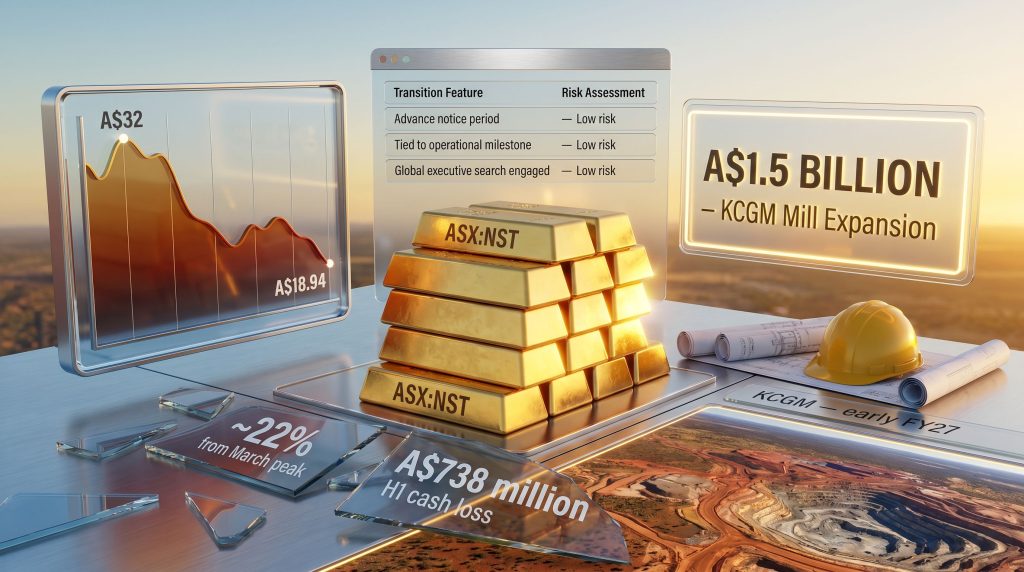
Northern Star disclosed that Tonkin would step down in the first quarter of FY27, a forward-dated exit explicitly tied to the completion of the company's A$1.5 billion KCGM mill expansion. The board simultaneously confirmed it had engaged a global executive search firm and would evaluate both internal promotions and external candidates.
The market's immediate response saw ASX:NST shares fall sharply in early trade before partially recovering, ultimately closing approximately 2% lower at A$18.94. That intraday pattern carries more analytical information than the closing number alone.
The partial recovery off intraday lows is a classical behavioural signature of an overreaction correction. When markets digest the actual informational content of an announcement after the initial emotional wave, stocks that fell too sharply tend to recover within the same session.
What makes this particularly telling is the broader sector context. On the same trading day, the ASX gold sector as a whole moved higher, meaning Northern Star's decline was an isolated, company-specific price event driven by leadership sentiment. Furthermore, this was not driven by changes in the gold price and mining equities outlook, or macroeconomic conditions. This sector divergence is a meaningful analytical signal.
Benchmarking the Transition Against Industry Governance Standards
One of the most underappreciated elements of this particular succession is how well-structured it is compared to industry norms. The table below measures the key structural features of the Northern Star handover against recognised governance best practice for large-cap miners.
| Transition Feature | Northern Star (NST) | Industry Best Practice | Risk Level |
|---|---|---|---|
| Advance notice provided | 12+ months | 6 to 12 months | Low |
| Tied to defined operational milestone | Yes (KCGM mill completion) | Strongly recommended | Low |
| Global executive search engaged | Yes | Standard best practice | Low |
| Internal candidates considered | Yes | Recommended | Low |
| Abrupt or unplanned departure | No | High risk if yes | Low |
| Outgoing CEO retained through transition | Yes | Ideal structure | Low |
By virtually every governance metric, this transition scores in the lowest possible risk bracket. The decision to anchor the departure date to the KCGM mill expansion coming online in early FY27 is particularly notable. It means Tonkin retains accountability for the company's single most important capital project through to commissioning, rather than handing over an incomplete and technically complex asset to an untested incoming leader.
The Operational Context That Preceded the Announcement
Why the CEO News Landed on Already-Strained Ground
To properly evaluate the market's reaction, investors must understand the trajectory of NST's share price well before Tonkin's exit was announced. The stock had already retreated approximately 22% from its March peak of near A$32, a decline driven entirely by operational factors that had nothing to do with leadership.
The specific issues that drove that earlier decline included:
- Repeated production guidance downgrades across multiple consecutive quarters
- Performance failures at an ageing processing mill, which disrupted throughput volumes and increased per-ounce costs
- Output shortfalls at the Jundee mine, a key contributor to Northern Star's overall production profile
These are asset-level and infrastructure-level challenges. They would exist regardless of who occupied the CEO chair, and they will need to be resolved regardless of who takes over from Tonkin. In fact, Northern Star boss Stuart Tonkin faced significant scrutiny over these production downgrades well before the succession announcement emerged.
Understanding the FY2026 First-Half Financial Impact
The A$738 million cash outflow reported by Northern Star in the first half of FY2026 intensified scrutiny of the company's financial management and disclosure practices. This figure reflected the intersection of several concurrent pressures: elevated capital expenditure associated with the KCGM mill expansion, unplanned costs from plant failures, and the revenue shortfall caused by production cuts.
The contrast with the company's financial position just months earlier was sharp. In early 2025, Northern Star held a net cash position anchored by approximately A$1.2 billion in cash and bullion, a position management characterised at the time as reflecting the company's strong financial standing.
Investor Warning: The rapid shift from a A$1.2 billion cash-backed position to a A$738 million first-half cash outflow illustrates how quickly capital allocation dynamics can turn in large-scale mining operations undergoing concurrent expansion and operational disruption. Investors who purchased shares based on the early-2025 balance sheet narrative without anticipating this trajectory faced a materially different risk profile than they had modelled.
This is the backdrop against which the CEO transition announcement arrived. The market's negative reaction was not purely about the succession itself. Consequently, it was a confluence of pre-existing operational frustration and leadership uncertainty colliding simultaneously.
The KCGM Mill: Why This Project Is the Only Variable That Matters
What the Kalgoorlie Super Pit Expansion Actually Involves
The Kalgoorlie Consolidated Gold Mines mill expansion is not a routine infrastructure upgrade. It represents one of the largest single capital commitments in Australian gold mining in recent history. The A$1.5 billion project is designed to substantially increase Northern Star's processing capacity at its flagship Western Australian operation, enabling the company to handle higher ore volumes at lower unit costs once commissioned.
From a geological and operational perspective, the KCGM is distinctive. The Kalgoorlie goldfield sits within the Eastern Goldfields region of Western Australia, one of the most prolific Archaean-age gold-bearing terranes on the planet. The ore bodies here have been mined continuously for over 130 years, yet continue to yield economically viable resources at depth. The expanded mill is designed to process ore from both the open pit and underground sources more efficiently, capturing value from lower-grade zones that were previously uneconomic at current throughput rates.
The expected completion timeline of early FY27 sets the clock for Northern Star's earnings re-rating potential. Once the expanded facility reaches operational capacity, the gold production outlook should improve materially, providing a direct positive impact on margins against what remains an elevated gold price environment.
Current Valuation and What the Numbers Actually Tell Us
A Fair Price, Not a Bargain Bin
The key question for any investor evaluating NST at current levels is whether the share price has fallen far enough to create a genuine margin of safety, or whether it simply reflects risks that are now correctly priced.
| Metric | Data Point |
|---|---|
| Price decline from March 2026 peak | ~22% (from ~A$32 to ~A$18.94) |
| Cash and bullion position (early 2025) | A$1.2 billion |
| KCGM expansion capital outlay | A$1.5 billion |
| FY2026 first-half cash outflow | A$738 million |
| Consensus valuation characterisation | Fairly priced |
At current levels, Northern Star is broadly considered fairly priced rather than deeply discounted. The lower share price genuinely reflects identifiable operational risks, including guidance reliability, mill performance, and capital discipline. These are real challenges, not investor overreactions. This means the stock does not yet represent the kind of asymmetric opportunity where risk is substantially mispriced to the downside.
The primary upside pathway is clear: successful commissioning and ramp-up of the KCGM mill in FY27, followed by a return to reliable production guidance. If those milestones are achieved, the earnings uplift and the resulting positive re-rating of the stock could be significant. If they are missed, however, the current price offers limited cushion.
The next major ASX story will hit our subscribers first
A Decision Framework for Different Investor Types
Positioning Yourself Correctly Based on Your Risk Profile
The Northern Star CEO Stuart Tonkin exit situation calls for differentiated thinking depending on when and why you hold, or are considering holding, the stock.
For existing long-term shareholders:
- The CEO transition does not invalidate the core investment thesis built around world-class assets in Tier 1 jurisdictions
- The Hemi project pipeline, the Pogo mine's deep resource base, and the KCGM expansion upside all remain intact; in addition, broader Australian gold M&A activity continues to support sector consolidation trends
- Monitor quarterly production updates for signs that the guidance reliability problem is being resolved
- The most important near-term data point is KCGM mill commissioning progress, not the CEO appointment timeline
For prospective new investors:
- Entering before the next quarterly update exposes you to continued operational uncertainty that the data has not yet resolved
- A staged or tranched entry approach, building a position gradually, reduces the timing risk inherent in a stock where negative operational surprises have been frequent
- Waiting for the identity of the incoming CEO provides additional signal about whether the board is prioritising operational continuity or strategic change
For risk-averse or income-focused investors:
- The dividend outlook remains uncertain until free cash flow recovers from current elevated capital expenditure levels
- The FY27 KCGM commissioning milestone is the most meaningful value inflection point; monitoring progress toward that event is more analytically useful than reacting to the leadership news cycle
Strategic Note: The single most important near-term data point for NST investors is not who replaces Tonkin. It is whether the KCGM mill expansion delivers on its production and cost targets when it comes online. Leadership transitions are structurally manageable. Capital project underperformance carries much longer recovery timelines.
Five Principles for Evaluating CEO Transitions at ASX Resource Companies
When leadership changes occur at major miners, investors who apply a structured framework tend to make better decisions than those who react purely to the emotional signal. The following principles apply directly to the Northern Star situation and more broadly across the ASX resources sector.
Furthermore, understanding these principles is especially relevant given the prevalence of undervalued mining stocks during periods of sector-wide sentiment disruption:
-
Evaluate the structural quality of the transition. A planned, milestone-linked handover with a global search underway is fundamentally different from an abrupt or unplanned departure. Context determines risk.
-
Separate the leadership variable from the operational variable. If a company had production problems before the CEO news, those problems do not disappear when the CEO does. Attribute risk correctly.
-
Read the sector divergence signal. When a stock falls while its sector rises on the same day, the market is pricing company-specific risk. Determine whether that risk is sentiment or substance before acting.
-
Assess whether the valuation has moved to a genuine discount. A lower price is not automatically an opportunity. It is only a margin of safety if the price has fallen more than the underlying risk warrants.
-
Identify the actual value catalyst. For Northern Star, the KCGM mill is the fundamental earnings driver over the next 12 to 18 months. That is the variable to track, not the succession timeline.
Frequently Asked Questions: Northern Star CEO Transition
Has Stuart Tonkin officially left Northern Star?
As of the most recent available company disclosures, Tonkin remains in the Managing Director and CEO role. The announced departure is forward-dated to the first quarter of FY27, explicitly contingent on the KCGM mill expansion reaching completion. No confirmed exit date has been formalised beyond that milestone framework.
Why did Northern Star shares fall on the CEO announcement?
The price decline reflects a combination of investor sentiment around leadership continuity and the pre-existing context of operational underperformance, including multiple production guidance reductions and a significant first-half cash outflow. The partial intraday recovery suggests the opening selloff incorporated an emotional component that was partially unwound once investors processed the structured nature of the transition.
Who will replace Stuart Tonkin as CEO of Northern Star?
Northern Star's board has engaged a global executive search firm and confirmed it will consider both internal and external candidates. No appointment has been publicly announced.
Is Northern Star (ASX:NST) a buy after the CEO announcement?
At current price levels, Northern Star is broadly characterised as fairly valued rather than deeply discounted, with the existing share price already reflecting known operational risks. The primary upside catalyst is the KCGM mill expansion delivering production volume and cost improvements from FY27. Prospective investors are generally well-served by awaiting the next quarterly production update and the incoming CEO announcement before committing to a full position. This article is general information only and does not constitute financial advice. Always conduct your own research before making investment decisions.
What is the KCGM mill expansion and why does it matter to NST investors?
The Kalgoorlie Consolidated Gold Mines mill expansion is a A$1.5 billion capital project designed to materially increase Northern Star's ore processing capacity at its flagship Western Australian operation. It represents the company's most significant near-term growth catalyst, the milestone to which Tonkin's departure is explicitly linked, and the primary variable that will drive any positive earnings re-rating from FY27 onward.
This article is intended for informational and educational purposes only. It does not constitute personal financial advice. Past share price movements are not indicative of future performance. Readers should seek independent financial advice tailored to their individual circumstances before making any investment decisions. For additional ASX gold sector analysis and independent research, visit Stocks Down Under.
Want to Stay Ahead of the Next Major ASX Gold Discovery?
While navigating CEO transitions at established producers like Northern Star requires patience and careful analysis, the most asymmetric returns in the resources sector have historically emerged from significant new mineral discoveries the moment they are announced — and Discovery Alert's proprietary Discovery IQ model scans every ASX announcement in real time, instantly identifying high-potential discovery events across more than 30 commodities before the broader market reacts. Explore the historic returns that major mineral discoveries have generated and begin your 14-day free trial to ensure you are positioned ahead of the market when the next transformative find is announced.