May 22, 2026
The Electrochemical Bet That Could Rewrite Industrial Metals Production
Every few decades, a genuinely new production paradigm emerges in heavy industry. Not an incremental efficiency gain, not a marginal emissions reduction, but a fundamental rethinking of how metals are made. The history of steelmaking offers only a handful of such moments: the Bessemer converter in the 1850s, the basic oxygen furnace in the 1950s, and the widespread adoption of electric arc furnaces in the latter half of the twentieth century. Each transition took decades to fully mature and reshaped the competitive landscape of global metals production in ways that were difficult to predict at the outset.
Boston Metal molten oxide electrolysis investment thesis rests on the proposition that MOE represents the next such inflection point, and a growing roster of industrial heavyweights appears to be taking that proposition seriously.
When big ASX news breaks, our subscribers know first
What Molten Oxide Electrolysis Actually Does at a Molecular Level
Understanding why Boston Metal's molten oxide electrolysis investment has attracted over $388 million in cumulative capital requires stepping back from the financial narrative and examining what the technology actually accomplishes at a chemical level.
Conventional steelmaking is, at its core, a carbon chemistry problem. Blast furnaces use metallurgical coke derived from coal to strip oxygen atoms away from iron ore, producing iron metal and releasing carbon dioxide as the unavoidable chemical byproduct. Every tonne of steel produced via this route generates roughly 1.8 to 2.1 tonnes of CO₂, contributing to an industry share of approximately 8% of global greenhouse gas emissions, according to widely cited figures from the World Steel Association.
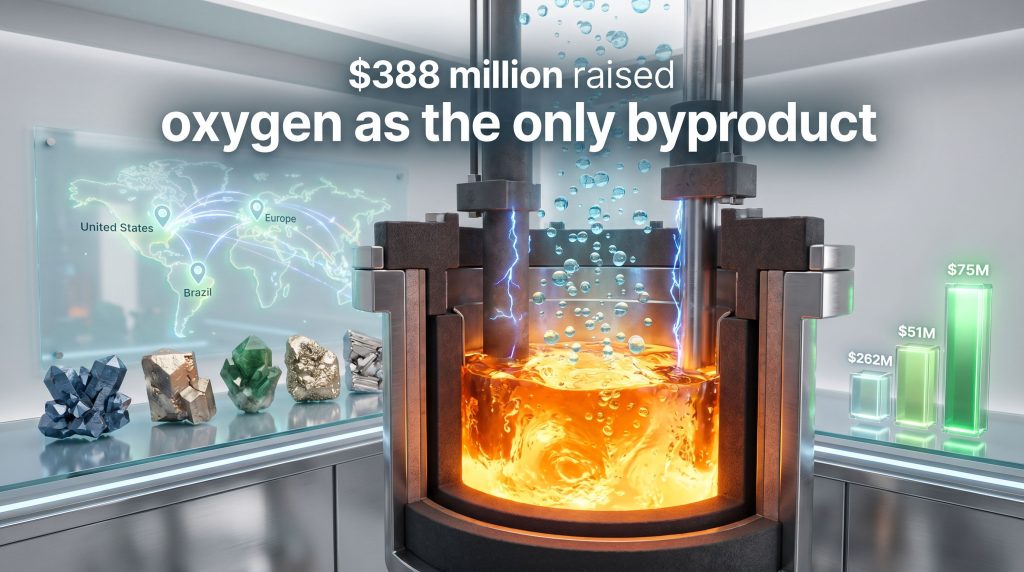
MOE replaces this carbon chemistry with electrochemistry. Inside an MOE cell operating at approximately 1,600 degrees Celsius (2,900 degrees Fahrenheit), an electrical current passes through a molten oxide electrolyte bath. The current cleaves the oxygen-iron bond directly, driving oxygen to the anode and depositing liquid iron at the cathode. The only gaseous byproduct released is oxygen, not carbon dioxide. The carbon is not merely reduced or captured; it is absent from the reaction entirely.
Several less-appreciated technical nuances make this significant beyond the headline emissions story:
- MOE consolidates what are typically three to five discrete processing stages in conventional steelmaking into a single electrochemical unit operation, reducing cumulative energy penalties and capital intensity per stage
- The oxygen released at the anode is industrial-grade and can potentially be captured and sold as a co-product, creating a secondary revenue stream that partially offsets operating costs
- Because MOE's energy input is electrical rather than chemical, the platform's carbon intensity scales directly with the carbon intensity of the electricity grid supplying it, meaning the technology becomes progressively cleaner as renewable energy penetration increases
- The molten oxide electrolyte environment is inherently selective, allowing different metal species to be reduced at distinct electrical potentials, which is the core mechanism enabling Boston Metal's expansion into multi-metal critical minerals recovery
Technical note: The electrochemical selectivity of MOE is not a secondary feature added to a steelmaking platform. It is a fundamental property of the molten oxide system that Boston Metal's researchers have deliberately engineered to target specific metal-oxygen bond energies across a range of commercially important species.
From MIT Laboratory to a Multi-Metal Commercial Platform
Boston Metal was founded in 2012 by Massachusetts Institute of Technology researchers Donald Sadoway, Antoine Allanore, and Jim Yurko, whose combined expertise spanned electrochemistry, materials science, and metallurgical engineering. The founding mandate was specific: commercialise MOE as a pathway to carbon-free primary iron production.
What has evolved over the intervening years is considerably more expansive. The company recognised relatively early that the electrochemical selectivity enabling iron recovery also unlocked a broader metallurgical capability. If the system could be tuned to recover iron from complex oxide mixtures, it could, in principle, be tuned to recover other metals with similar thermodynamic profiles from similarly complex feedstocks.
This insight drove a deliberate strategic pivot. Rather than pursuing green steel commercialisation as its sole near-term revenue pathway, Boston Metal began developing MOE's application to critical metals recovery, targeting a portfolio of five metals: nickel, niobium, tantalum, tin, and vanadium. All five share a commercially important characteristic: they are classified as critical minerals demand priorities by the United States, European Union, and allied governments, and all face varying degrees of supply chain concentration risk.
The company established operational infrastructure in Brazil specifically to pursue niobium recovery, a strategically rational choice given that Brazil accounts for approximately 90% of global niobium supply, primarily from the Araxá and Catalão carbonatite deposits. Boston Metal's Brazilian operations target niobium recovery from mining waste streams and industrial slag, materials that conventional processing economics struggle to treat profitably at scale.
This is a less-understood but commercially important point: niobium is not scarce in an absolute geological sense, but its supply is extraordinarily geographically concentrated and controlled by a small number of producers. Furthermore, any technology capable of recovering niobium from waste streams at competitive cost creates genuine supply chain optionality for industries dependent on niobium-bearing ferroniobium for high-strength steel alloys, superalloys, and next-generation superconducting applications.
The Investor Architecture: Reading the Capital Table as a Technology Validation Signal
The composition of Boston Metal's investor base across successive financing rounds communicates something that headline funding figures alone cannot convey. Capital tables in deep-tech climate sectors tend to follow recognisable patterns, and Boston Metal's evolution across rounds is instructive.
| Financing Round | Amount | Selected Participants | Strategic Signal |
|---|---|---|---|
| Series C (2023) | $262 million | ArcelorMittal, BHP Ventures, Aramco Ventures, Breakthrough Energy Ventures, Microsoft Climate Innovation Fund, Baillie Gifford, M&G Investments, IFC | First major industrial strategic participation; mainstream asset manager entry |
| Convertible Note | $51 million | Mix of existing and new investors | Bridge capital for Brazil metals operations and green steel R&D continuity |
| Strategic Round (2026) | $75 million | Tata Steel, Prelude Ventures, Climate Investment, others | Second major integrated steel producer enters; confirms industrial credibility of commercial pathway |
The progression from climate-focused venture capital in early rounds to the successive entry of ArcelorMittal and then Tata Steel as strategic investors is the single most analytically important signal in Boston Metal's funding history. These are not financial investors seeking exposure to a thematic trend. They are integrated steel producers with existing blast furnace infrastructure, deep metallurgical expertise, and sophisticated internal technology assessment capabilities.
When ArcelorMittal and Tata Steel independently conclude that MOE warrants direct capital participation, it represents an implicit technical endorsement by organisations with the institutional knowledge to evaluate the platform's commercial plausibility with rigour. Their participation also creates natural licensing and joint venture pathways if MOE achieves commercial-scale milestones.
Mark Gupta, managing director at Prelude Ventures, has observed that MOE's flexibility as a platform technology capable of operating across multiple metal systems with a high degree of selectivity is what distinguishes it from narrower single-application approaches in the green metals leadership space.
The presence of the International Finance Corporation (IFC) as a Series C participant adds a further dimension. IFC participation typically signals that a technology has been assessed as commercially viable and relevant to emerging market industrial development, not merely as a laboratory curiosity. For Boston Metal, IFC backing opens potential deployment pathways across developing economies with significant mineral endowments and growing industrial sectors.
Why Critical Metals Come First: The Commercial Sequencing Logic
A common misreading of Boston Metal's strategy treats the critical metals business as a detour from the core green steel mission. The actual commercial logic, however, runs in the opposite direction.
Green steel at scale requires demonstrating MOE cell performance across very large production volumes, a capital-intensive and time-consuming engineering challenge. Critical metals recovery, by contrast, can generate meaningful revenue at much smaller cell scales because the per-unit value of nickel, niobium, tantalum, vanadium, and tin is substantially higher than commodity steel.
Rick Cutright, technology director at Climate Investment, has articulated this sequencing clearly, noting that critical metals represent the right initial market because the commercial need is immediate, the per-unit economics are more attractive than steel at current scales, and MOE's ability to process feedstocks that conventional methods cannot economically treat creates supply from otherwise stranded materials.
This approach also provides important technical validation benefits. Operating MOE cells at commercial scale for critical metals recovery generates real-world performance data on cell lifetime, electrolyte stability, anode integrity at 1,600 degrees Celsius, and metal quality specifications. That data directly de-risks the subsequent green steel commercialisation effort, because the fundamental electrochemical engineering challenges are largely shared across applications.
The five target metals present distinct supply chain dynamics worth understanding individually:
| Metal | Primary Industrial Applications | Key Supply Chain Vulnerability | MOE Processing Advantage |
|---|---|---|---|
| Niobium | High-strength steel, superalloys, superconducting wire | ~90% of supply from Brazil; single-commodity concentration | Recovery from Brazilian slag and mining waste streams |
| Tantalum | Capacitors, semiconductors, medical devices, aerospace | Conflict-mineral exposure; limited primary diversity | Selective electrochemical recovery from mixed oxide feedstocks |
| Vanadium | Vanadium redox flow batteries, steel strengthening agents | China dominates refining capacity | Recovery from industrial slag and secondary streams |
| Nickel | EV batteries (NMC chemistry), stainless steel, aerospace alloys | Indonesian and Chinese processing concentration | Potential processing of lower-grade laterite-type oxide feeds |
| Tin | Electronics solder, advanced semiconductor packaging | Limited primary production diversification | Recovery from complex polymetallic streams |
How MOE Compares to Competing Decarbonisation Technologies
Boston Metal molten oxide electrolysis investment case is strengthened by understanding where MOE sits relative to the competing approaches that are also attracting significant capital in the green metals space.
| Technology | Primary Use Case | CO₂ Reduction Potential | Critical Metals Recovery | Commercialisation Status |
|---|---|---|---|---|
| MOE (Boston Metal) | Steel + multi-metal recovery | Near-zero (grid-dependent) | High, multi-metal selective | Pilot to early commercial |
| Hydrogen Direct Reduction (H-DRI) | Steel production | ~85-95% reduction | Negligible | Early commercial (HYBRIT, H2 Green Steel) |
| Electric Arc Furnace (EAF) | Scrap-based steel | ~75% vs. blast furnace | None | Mature, widely deployed |
| Hydrometallurgy | Critical metals, base metals | Moderate reduction | Moderate, feedstock-specific | Mature commercial |
| Conventional Pyrometallurgy | Steel, base metals, ferroalloys | Minimal | Limited | Mature, dominant globally |
Several characteristics differentiate MOE in ways that are not always apparent in headline technology comparisons:
- Hydrogen-based direct reduction requires substantial parallel infrastructure investment in electrolytic hydrogen production, compression, storage, and distribution. MOE requires only electricity supply and feedstock preparation, removing an entire infrastructure dependency from the commercialisation pathway. In addition, hydrogen iron ore reduction faces higher logistical complexity compared to MOE's more streamlined electrical input model.
- Electric arc furnaces are scrap-dependent, meaning their scaling potential is ultimately constrained by the availability of high-quality steel scrap. Global scrap availability is sufficient to supply only a portion of projected steel demand growth through 2050. MOE can process primary oxide feedstocks without scrap dependency.
- MOE's ability to generate industrial oxygen as a co-product is an underappreciated economic feature. Industrial oxygen commands commercially meaningful prices in markets supplying steelmakers, chemical producers, and medical gas distributors.
The next major ASX story will hit our subscribers first
Key Risks That Sophisticated Investors Must Quantify
Boston Metal's technology trajectory and investor validation are compelling, but a balanced assessment requires honest engagement with the risk factors that could constrain or delay commercial outcomes.
Electricity cost and grid carbon intensity represent the most fundamental sensitivity. MOE's carbon advantage relative to blast furnace steelmaking is a function of the electricity supply's carbon content. In grids where renewable penetration is low, the operational carbon footprint compresses toward conventional alternatives. The business case in any given geography is therefore directly tied to electricity pricing and decarbonisation trajectory, variables that are outside Boston Metal's operational control.
High-temperature materials engineering at industrial scale presents persistent challenges. Maintaining electrochemical cell integrity at 1,600 degrees Celsius across thousands of operational hours requires refractory materials, anode compositions, and containment architectures that perform reliably under extreme thermal and chemical stress. Cell lifetime data at commercial-relevant scale is one of the most important technical metrics that outside investors cannot yet fully evaluate.
Feedstock qualification is a non-trivial commercial variable. Not all mine tailings or industrial slag streams will present the chemical consistency and oxide speciation that MOE processing requires. Characterising, qualifying, and securing contractual access to feedstock pipelines of sufficient volume and consistency is an operational challenge that sits alongside the electrochemical engineering work.
Critical metals price cyclicality affects the near-term revenue case. Vanadium prices, for example, have historically shown significant volatility tied to Chinese steel production rates and the commissioning cycle for vanadium redox flow battery projects. A sustained period of depressed critical metals prices could compress the financial returns that make the current commercial sequencing rational.
Investor due diligence checklist: Assess electricity procurement contracts and grid mix, cell lifetime data across pilot operations, feedstock pipeline volume and characterisation, and critical metals price sensitivity in financial models before drawing conclusions from headline funding metrics alone.
Geographic Deployment and the Licensing Model
Boston Metal's commercial expansion strategy reflects a recognition that directly owning and operating MOE facilities globally would require capital deployment at a scale that would strain even a well-funded private company. The more likely pathway for green steel applications, which require very large cell arrays to achieve competitive production economics, is a technology licensing model analogous to the approaches used by process technology companies in petroleum refining and chemical manufacturing.
Under this model, Boston Metal licences the MOE process technology and associated engineering know-how to steel producers, who then build and operate facilities using their existing infrastructure networks and operational expertise. This preserves Boston Metal's intellectual property position while allowing geographic reach and production scale that far exceed what direct ownership could achieve.
ArcelorMittal and Tata Steel, as strategic investors with existing plant infrastructure on multiple continents, are the most natural early licensing partners. Their capital participation in successive rounds may represent not just financial investment but early-stage positioning for preferential licensing access.
Geographic priorities for near-term deployment include:
- Brazil: Active niobium recovery operations targeting waste streams from the world's most concentrated niobium-producing region
- United States: DOE-supported chromium facility in West Virginia, with alignment to domestic critical minerals policy frameworks
- Europe: Potential licensing demand driven by EU Critical Raw Materials Act obligations and steel sector decarbonisation requirements under the EU Emissions Trading System. The green transition raw materials policy framework is creating urgent demand for technologies that can support both emissions reduction and supply chain resilience simultaneously.
- Asia and Middle East: Exploratory pathways enabled by the regional network access of energy-linked investors with presence in those markets
The Convergence That Creates Boston Metal's Strategic Window
Two structural pressures are converging in ways that create an unusually wide commercial window for technologies capable of addressing both simultaneously.
The first is industrial decarbonisation urgency. Steel producers in the EU, UK, and increasingly in North America face carbon pricing mechanisms, customer scope-3 emissions requirements, and investor ESG mandates that are beginning to translate into genuine capital allocation pressure on production technology choices. The timeline for decisions that will determine 2030 and 2035 emissions profiles is measured in years, not decades.
The second is critical minerals supply chain restructuring. Allied governments have identified the concentration of critical mineral processing capacity, particularly in China, as a strategic vulnerability requiring active policy and investment responses. Nickel, niobium, tantalum, vanadium, and tin all appear on major government critical minerals lists precisely because their supply chains present concentration risks that are incompatible with strategic resilience planning.
Boston Metal CEO Tadeu Carneiro has framed this dual positioning explicitly, describing MOE as creating "a scalable and cost-effective pathway to recover critical, high-value metals, support industrial onshoring, and strengthen the secure supply of critical materials needed for advanced technologies, manufacturing, and AI infrastructure."
Furthermore, green steel pricing dynamics are evolving rapidly as industrial buyers increasingly factor carbon content into procurement decisions, adding additional commercial momentum behind the Boston Metal molten oxide electrolysis investment case. A technology platform that addresses industrial decarbonisation and critical minerals supply chain resilience within a single electrochemical architecture is genuinely rare.
Whether Boston Metal's execution across the near-term milestones in Brazil and its U.S. operations can convert that architectural advantage into demonstrated commercial performance is the central question that the next two to three years of operations will begin to answer. As Reuters reports, MOE is among the green technologies widely expected to transform the geopolitics of steelmaking in the coming decade.
This article is intended for informational purposes only and does not constitute financial advice. Forecasts, technology assessments, and commercial projections involve inherent uncertainty. Readers should conduct independent due diligence before making any investment decisions related to companies or technologies discussed herein.
For ongoing coverage of critical minerals processing technology and green metals innovation, Metal Tech News provides regular reporting at metaltechnews.com.
Want To Be First When The Next Major Mineral Discovery Hits The ASX?
Discovery Alert's proprietary Discovery IQ model delivers real-time alerts on significant ASX mineral discoveries across critical minerals, green metals, and beyond — turning complex data into actionable insights for investors at every level. Explore historic discoveries and their exceptional returns, then start your 14-day free trial at Discovery Alert to position yourself ahead of the market.