
May 22, 2026
When Oil Falls and Gold Soars: What Diverging Commodities Signal for Friday's ASX Market Open
Commodity markets rarely move in straight lines, and when two of the world's most closely watched raw materials begin pulling in sharply opposite directions, experienced investors pay close attention. The simultaneous retreat of crude oil prices and the surge of gold above a historically significant threshold creates a distinctive analytical environment, one that carries meaningful implications for how capital flows across ASX sectors at the open. Understanding this dynamic requires looking beyond headline index moves and interrogating the underlying forces that shape what the ASX market open oil dips while gold jumps actually reflects for Australian investors.
When big ASX news breaks, our subscribers know first
The Overnight Information Set: How Global Moves Shape the ASX Pre-Market
ASX futures do not simply mirror Wall Street's performance. They absorb an entire constellation of overnight signals, including commodity repricing, currency movements, geopolitical developments, and bond market behaviour, then compress all of that information into a single directional indicator for the Australian pre-market window.
On this particular Friday, that indicator is pointing to a 0.5% gain at the open. This figure is notable not because it suggests a euphoric session, but because it arrives despite a largely unremarkable night on Wall Street. The S&P 500 gained just 0.2%, the Dow Jones added 0.5%, and the NASDAQ finished essentially flat. By conventional logic, those numbers alone would not justify a meaningfully positive ASX open.
The differentiating factor is the commodity complex. Australian listed companies carry heavy exposure to resource prices, and when gold and oil diverge as sharply as they have overnight, the net effect on the ASX market performance tends to exceed what pure equity index correlations would predict.
A 0.5% indicated gain represents orderly, fundamentally-driven positioning rather than speculative momentum. It signals that investors are selectively repositioning across sectors rather than broadly buying risk, a distinction with important implications for which parts of the market are likely to see genuine buying interest versus which simply ride the tide.
The Oil-Gold Divergence: What It Means for Australian Markets
Why Are Oil and Gold Moving in Opposite Directions?
The divergence playing out in commodity markets right now is analytically rich precisely because oil and gold do not share a fixed inverse relationship. Their simultaneous movement in opposite directions tells a layered story about how different types of risk are being priced simultaneously.
| Commodity | Price Level | Direction | Market Signal |
|---|---|---|---|
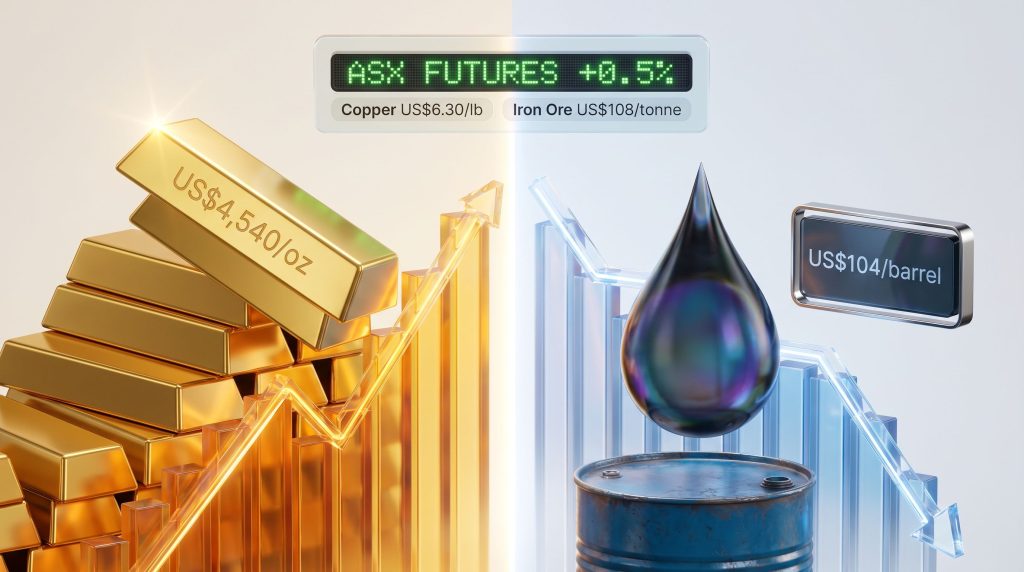
| Brent Crude | US$104/barrel | Declining | Geopolitical risk premium fading |
| Gold | US$4,540/oz | Rising | Structural macro uncertainty persists |
| Copper | US$6.30/lb | Stable | Industrial demand holding |
| Iron Ore | US$108/tonne | Stable | China demand baseline intact |
The key insight here is that these two moves are not contradictory. They reflect two different layers of uncertainty being repriced simultaneously. Oil is responding to specific geopolitical news flow, while gold is responding to deeper structural forces that have little to do with any single conflict or diplomatic development.
Oil's Retreat: The Geopolitical Risk Premium Unwinding
Crude oil pricing is notoriously sensitive to geopolitical signals from the Middle East. When conflict risk escalates in oil-producing regions, traders apply a premium above what fundamental supply-demand analysis would justify. That premium can be substantial, often representing US$5 to $15 per barrel above the equilibrium price in periods of acute tension.
The current retreat in Brent crude toward US$104 per barrel appears connected to market interpretation of diplomatic signals around a potential US-Iran framework. Importantly, this does not mean a deal is confirmed or imminent. Furthermore, markets are pricing the possibility of reduced conflict risk, not a resolved outcome. Recent coverage from the Australian Financial Review highlights how sensitive ASX energy positioning has been to these oil price shifts.
There is a well-documented asymmetry in how geopolitical shocks move oil prices. Escalation tends to produce sharp, fast spikes as traders rush to price in supply disruption risk. De-escalation, by contrast, tends to produce slower, more gradual retreats as participants wait to see whether diplomatic progress is durable. Consequently, even partial unwind of a conflict premium can create a noticeable price move without requiring any formal resolution.
One lesser-known dynamic worth understanding here is the relationship between US Treasury yields and foreign policy signalling. When the 10-year Treasury yield approaches levels like 4.7%, it creates bond market pressure that has historically coincided with US administrations seeking foreign policy wins that reduce commodity cost pressures domestically. This is not a mechanical rule, but it is a pattern that sophisticated macro traders track carefully. For further context on how these oil price trends have evolved in 2025, the broader trajectory reinforces this analytical framework.
OPEC+ production decisions remain a secondary variable. Even if geopolitical risk partially fades, OPEC+ capacity management can moderate how far Brent actually falls from current levels, providing a degree of structural support that prevents sharp downside moves in crude.
Gold Above US$4,500: Structural Repricing, Not Just Fear Buying
The more analytically complex part of Friday's commodity picture is gold trading at US$4,540 per ounce. At this level, gold is not simply responding to a single catalyst. The move reflects multiple overlapping forces that have been building over an extended period.
It is important to distinguish between two fundamentally different types of gold price appreciation:
- Tactical safe-haven flows arise when investors rotate into gold during periods of acute fear or uncertainty, then exit when conditions normalise. These moves tend to be shallow and quickly reversed.
- Structural repricing occurs when gold's role as a long-term hedge against currency debasement, sovereign debt concerns, or persistent inflation expectations causes a permanent re-rating of its fair value range. These moves are far more durable.
The current move above US$4,500 has characteristics of the second category. Central bank gold demand from emerging market institutions has been running at historically elevated rates, providing structural support independent of short-term sentiment shifts. When sovereign institutions buy gold as a reserve diversification tool, they do not sell it back when diplomatic news improves. This creates a durable floor under prices that tactical traders cannot easily dislodge.
When gold rises alongside elevated bond yields rather than falling as conventional models would predict, it typically signals that market participants have reduced confidence in the real return on sovereign debt as a store of value. This is a meaningful divergence from textbook financial theory.
For ASX-listed gold producers, the threshold of US$4,500 per ounce is particularly significant. Most Australian gold miners operate with all-in sustaining costs in the range of US$1,200 to US$1,800 per ounce. At current spot pricing, the implied margin per ounce for well-run mid-tier producers is exceptional by historical standards, often reaching levels that trigger institutional re-rating, dividend speculation, and increased merger and acquisition activity within the sector.
The operating leverage embedded in gold mining is a concept that is frequently underestimated by investors who focus solely on the gold price. Because a miner's cost base is largely fixed in the short term, a 1% increase in the gold price can translate to a 5% to 15% improvement in free cash flow, depending on the producer's cost structure and hedging position. This amplification effect is why gold equities can dramatically outperform the underlying metal during sustained price upswings. The broader gold price forecast for 2025 suggests this upward momentum has further structural support behind it.
How Does the Oil-Gold Split Reshape ASX Sector Positioning?
ASX Energy Sector: Reading the Oil Dip's Implications
Falling Brent prices create an uneven landscape across ASX-listed energy companies. The impact is not uniform and depends heavily on each company's exposure structure.
Pure-play exploration and production companies with direct exposure to spot crude pricing face the most immediate headwind. Their revenue projections compress in near-linear proportion to the oil price decline. Integrated energy majors, which have downstream refining and marketing operations, can partially offset upstream revenue losses through improved refining margins when crude input costs fall.
Beyond the energy sector itself, lower oil prices create a meaningful secondary effect across the broader ASX:
- Airlines and travel operators see direct fuel cost relief, improving their margin outlook
- Logistics and freight businesses benefit from reduced operating costs on fuel-intensive routes
- Consumer discretionary and retail companies gain indirectly as household fuel spending eases, freeing disposable income
- Agricultural and mining services businesses with large diesel fuel exposures see input cost improvements
The transmission of oil price movements into ASX equity valuations typically occurs within one to three trading sessions as analysts update earnings models and institutional investors adjust sector weightings accordingly.
ASX Gold Sector: The Margin and M&A Opportunity
At US$4,540 per ounce, ASX-listed gold producers are operating in an exceptional margin environment. Large-cap producers such as Northern Star Resources and Evolution Mining, which have substantial Australian operational footprints, are generating cash flows that in some cases represent multi-decade highs relative to their cost bases.
The distinction between different tiers of gold equity exposure matters here:
- Large-cap producers offer lower volatility exposure with dividend growth potential as margins expand
- Mid-tier developers carry higher operational risk but also higher upside leverage to the gold price
- Junior explorers provide the most speculative but potentially highest-returning exposure, with value driven primarily by discovery risk rather than production margins
- Royalty and streaming companies offer leveraged exposure to gold price upside while avoiding direct operational risk
A less commonly understood aspect of the current gold environment is the impact of the Australian dollar on domestic producer margins. Because gold is priced in US dollars but Australian miners incur costs primarily in Australian dollars, the AUD/USD exchange rate acts as a secondary lever on profitability. A weaker Australian dollar amplifies the benefit of rising US dollar gold prices for domestic producers, while a stronger AUD partially offsets it.
What Is the Geopolitical Variable Driving Both Moves?
US-Iran Diplomacy and the Risk Premium Framework
Middle East geopolitical risk has been a persistent feature of oil markets for decades, with multiple conflict cycles demonstrating the same basic pattern: escalation spikes prices, de-escalation gradually unwinds the premium. What makes the current situation analytically interesting is the speed at which market participants have partially priced a diplomatic scenario that remains uncertain.
The scenario modelling below illustrates how different outcomes could flow through to key ASX sectors:
| Scenario | Oil Direction | Gold Direction | ASX Energy | ASX Gold |
|---|---|---|---|---|
| Peace deal confirmed | Sharp decline | Moderate pullback | Underperform | Mild pullback |
| Talks stall, no escalation | Range-bound | Stable to mild rise | Neutral | Neutral-positive |
| Talks collapse, re-escalation | Sharp spike | Strong rally | Outperform | Strong outperform |
The asymmetric risk profile in the scenario table above is worth noting carefully. Gold performs reasonably well in two out of three scenarios, while oil's direction is highly binary. This asymmetry helps explain why institutional investors have been comfortable holding gold exposure even as geopolitical risk partially unwinds.
This scenario analysis is illustrative and speculative. Actual market outcomes will depend on a wide range of factors. This is not financial advice.
What Else Is Moving the ASX This Friday?
Corporate Catalysts Worth Watching at the Open
Beyond the macro commodity picture, three company-specific developments warrant attention as the ASX opens. According to recent market reporting, these corporate stories are adding additional complexity to an already nuanced session.
Guzman y Gomez has flagged its intention to exit the United States market. This is significant because the US expansion opportunity was a central pillar of the growth narrative that underpinned the company's IPO valuation. When the international thesis that justified a premium valuation is withdrawn, investors are forced to recalibrate what the business is actually worth on its domestic merits alone. This is a broader cautionary lesson for ASX investors evaluating any consumer brand carrying a meaningful offshore expansion premium.
Nuix faces renewed regulatory pressure after ASIC lodged an appeal against the dismissal of its earlier case against the listed software company. Regulatory overhang of this kind has a well-documented suppressive effect on institutional participation in a stock, regardless of how well the underlying business is actually performing. The legal uncertainty alone tends to keep risk-averse funds on the sidelines until resolution is clear.
Super Retail Group's Rebel Sport brand is now subject to a class action related to alleged underpayment of workers. Wage underpayment class actions in Australia have historically involved prolonged timelines and difficult-to-quantify settlement exposures, making them particularly challenging for analysts trying to model the financial impact on affected companies.
The Concept of Idiosyncratic Versus Systematic Risk
These three corporate developments serve as a useful reminder that macro tailwinds and systematic sector trends do not eliminate stock-specific risks. Even on a broadly positive session driven by favourable commodity moves, individual companies can face substantial downside pressure from idiosyncratic factors.
Sophisticated investors maintain a clear mental separation between sector-level commodity exposure, which determines the tide, and company-specific legal, strategic, or governance risks, which determine how well individual boats float within that tide.
The next major ASX story will hit our subscribers first
ASX Sector Rotation: Where Capital Is Likely to Flow
Based on Friday's commodity configuration, the following sector landscape takes shape:
Likely to attract buying interest:
- Gold and precious metals producers, with direct operating leverage to US$4,540/oz spot pricing
- Airlines and travel businesses, benefiting from lower Brent crude fuel cost relief
- Consumer discretionary names, gaining from easing household energy cost pressures
- Quality defensive industrials supported by gold-driven risk-off sentiment
Facing near-term headwinds:
- Oil and gas producers with direct spot crude pricing exposure
- Energy infrastructure businesses tied to commodity throughput volumes
Neutral to monitor:
- Iron ore and base metals: the iron ore demand outlook at US$108/tonne suggests China demand is stable but not accelerating, with copper at US$6.30/lb reinforcing this view
- Financials: broadly neutral unless bond yield movements create margin pressure for banks
FAQs: ASX Market Open, Oil, and Gold Dynamics
Why does gold rise when oil falls?
The two commodities do not share a fixed inverse relationship. In the current environment, oil is falling because a specific geopolitical risk premium is partially unwinding, while gold is rising because broader macro concerns around inflation, sovereign debt, and currency stability persist independently. These are different types of uncertainty being priced by different categories of market participants.
How does an oil price dip affect ASX energy stocks?
ASX energy producers with direct spot crude exposure typically see downward pressure when Brent falls, as lower oil compresses forward revenue projections. The magnitude depends on each company's hedging ratios, production volumes, and cost structure. Integrated companies with downstream operations are generally more insulated than pure-play exploration and production names.
What does gold above US$4,500/oz mean for ASX gold miners?
With most Australian producers carrying all-in sustaining costs well below current spot pricing, the current environment represents exceptional margin expansion. This level of profitability tends to attract institutional re-rating, increased dividend expectations, and heightened M&A interest across the sector. The operating leverage dynamic means that even modest further gold price gains translate to disproportionately large improvements in miner free cash flow.
Why are ASX futures positive if Wall Street was mostly flat?
ASX futures incorporate the full overnight information set, not just Wall Street equity index performance. Rising gold, falling oil, and stable base metals create a net positive signal for Australian resource companies that outweighs the modest equity index moves from the US session. This is precisely the dynamic that makes the ASX market open oil dips while gold jumps scenario so analytically distinctive.
The Bigger Picture: What Friday's Open Reveals About Current Market Psychology
The simultaneous existence of positive equity futures and elevated gold prices reveals something important about the current market temperament. This is not a confident, euphoric bull market. It is a cautiously optimistic one, where investors are willing to take selective risk in specific sectors while maintaining meaningful defensive positioning.
This duality, which can be described as a soft landing narrative with residual structural uncertainty, tends to produce more durable session gains than gap-up opens driven by single catalysts. When markets rise because multiple overlapping signals converge rather than because of one dramatic event, the resulting moves tend to be better supported by fundamental repositioning rather than momentum chasing.
Friday sessions also carry their own distinct psychology. Institutional investors routinely use end-of-week sessions to rebalance portfolios, lock in profits, and reduce exposure ahead of weekend uncertainty. This pattern can moderate intraday gains even when the pre-market signal is genuinely positive.
Friday's pre-market configuration is best understood not as a single-day trading signal but as a window into the dominant macro narrative currently shaping ASX sector rotation: specific geopolitical risk is partially receding in energy markets, while deeper structural uncertainty continues to support defensive asset pricing. Investors who recognise both sides of this duality are better positioned to allocate across sectors with genuine conviction rather than simply following the index direction.
This article is for informational purposes only and does not constitute financial advice. Commodity prices, geopolitical developments, and market conditions can change rapidly. Readers should conduct their own research and consult a licensed financial adviser before making any investment decisions.
Want to Capitalise on the Next Major ASX Gold Discovery Before the Market Catches On?
With gold trading above US$4,540 per ounce and ASX gold producers generating exceptional margins, identifying significant new discoveries early has never been more valuable — Discovery Alert's proprietary Discovery IQ model delivers real-time alerts on significant ASX mineral discoveries, instantly translating complex geological data into actionable investment insights. Explore how historic discoveries have generated extraordinary returns on Discovery Alert's dedicated discoveries page and begin your 14-day free trial today to position yourself ahead of the broader market.