July 31, 2026
When Majority Control Is Not Enough: The Strategic Battle for Minim-Martap
In the global bauxite industry, the distance between a world-class deposit and a producing mine is rarely measured in geology. It is measured in capital, logistics, and the alignment of commercial interests. Few projects illustrate this more clearly than the Minim-Martap bauxite deposit in Cameroon's Adamawa Region, where the A2MP takeover bid for Canyon Resources Minim-Martap bauxite project has placed a technically credible asset at the centre of a shareholder control contest. This will determine not just who owns the project, but what the project fundamentally becomes.
The A2MP takeover bid for Canyon Resources is not a conventional acquisition story. A2MP Investments FZCO already holds 55.56% of Canyon's issued shares, making it the company's dominant shareholder by a wide margin. What the bid represents is something more structurally significant: an attempt to eliminate minority oversight, remove the company from public market scrutiny, and redirect one of the world's largest undeveloped high-grade bauxite project deposits toward a privately controlled, vertically integrated development model.
Understanding what is at stake requires examining not just the offer mechanics, but the competing economic frameworks, the logistics realities on the ground, and the scenario pathways that will ultimately determine Minim-Martap's role in the bauxite supply chain.
When big ASX news breaks, our subscribers know first
The Geology That Makes Minim-Martap Worth Fighting Over
Before examining the corporate contest, it is worth grounding the discussion in what makes this deposit strategically significant. Minim-Martap is widely regarded as one of the largest undeveloped high-grade, low-silica bauxite deposits accessible to the seaborne market. In a global bauxite trade increasingly dominated by Guinea's high-grade material and Australia's large-volume output, a deposit offering both scale and quality carries distinct commercial appeal.
Furthermore, the critical quality parameter for bauxite refiners is the reactive silica content, which directly affects how much caustic soda must be consumed during the Bayer refining process used to produce alumina. Low reactive silica means lower operating costs per tonne of alumina produced, which is why refiners are willing to pay a premium for material that reduces their reagent consumption. Canyon's definitive feasibility study embedded an average USD 11 per dry tonne marketing premium to capture this quality advantage.
The question A2MP has placed before the market is whether that premium is still achievable, and at what freight cost. The answer to those two questions determines everything else.
Canyon's DFS: The Baseline Economics
Canyon Resources published its Definitive Feasibility Study in September 2025, establishing the following headline parameters for the Minim-Martap project:
| Metric | DFS Estimate |
|---|---|
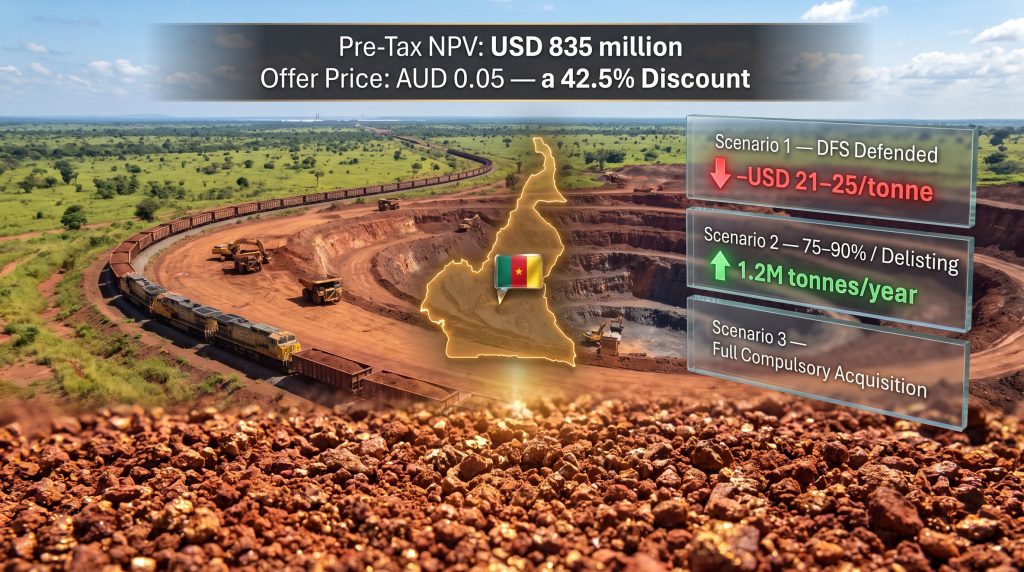
| Pre-Tax NPV | USD 835 million |
| Pre-Tax IRR | 29% |
| Total Capital Expenditure | USD 446 million |
| Rail Infrastructure Allocation | USD 348 million |
| Assumed Marketing Premium | USD 11 per dry tonne |
| Assumed Freight Cost | USD 17 per tonne |
| Annual Production Target | 1.2 million tonnes per year |
At the time of publication, Canyon maintained it had reasonable grounds to pursue project financing despite not having secured the full funding package. The DFS positioned Minim-Martap as a commercially compelling operation with a strong return profile, underpinned by the quality premium and a freight assumption reflecting prevailing market conditions.
The rail infrastructure allocation of USD 348 million out of USD 446 million total capex reflects a fundamental characteristic of African mining development that is often underappreciated by investors: the logistics burden frequently exceeds the mining cost itself. In landlocked and semi-landlocked regions, the cost of moving material from mine to port can determine viability as much as the ore grade does. Consequently, mine-to-port logistics strategy is a critical consideration for any investor assessing this project.
A2MP's Revised Economics: Where the Gap Opens
Following six months of direct engagement with prospective offtake customers, A2MP arrived at materially different commercial assumptions. The divergence between the two parties' numbers is the central battleground of this entire contest.
| Economic Variable | DFS Assumption | A2MP Revised Estimate | Variance |
|---|---|---|---|
| Marketing Premium | USD 11/dry tonne | ~USD 5/dry tonne | -USD 6/tonne |
| Freight Cost | USD 17/tonne | USD 32-36/tonne | +USD 15-19/tonne |
| Combined Economic Impact | -USD 21-25/tonne |
Beyond the headline freight and premium divergence, A2MP identified additional cost categories it believes were underestimated in the DFS:
- Insurance obligations across the logistics chain
- Export duty exposure on bauxite shipments
- Fuel cost variability across rail and port operations
- Sampling and quality assurance expenses at scale
- Logistics infrastructure investment requirements not fully captured in the study
At an annual production rate of 1.2 million tonnes, a USD 21-25 per tonne reduction in net realisation translates to an annual revenue and margin erosion of approximately USD 25-30 million per year at the lower end of the range. Applied across the project's operating life, this figure is large enough to fundamentally alter the NPV and undermine the financing case Canyon has been constructing.
A per-tonne economics gap of USD 21-25 may appear manageable in isolation, but compounded across a multi-decade mine life and a capital structure requiring external financing of several hundred million dollars, the effect on bankability can be decisive. Lenders and equity investors price not just the base case but the downside scenario, and A2MP's revised assumptions effectively represent a credible downside that any independent financier must stress-test.
A2MP's position, stated in its bidder's documentation, is that the project may no longer be viable in its current form given the financing currently available — a direct challenge to Canyon's standing as an ASX-listed development company pursuing a large-scale seaborne export strategy.
The Offer Structure and What It Signals About A2MP's Conviction
A2MP's cash offer of AUD 0.05 per share represents a 42.5% discount to Canyon's closing price of AUD 0.087 on 28 July 2026. This is not a typical takeover premium. Most successful hostile bids offer a premium to the undisturbed share price to incentivise acceptance. A deep discount of this magnitude signals something specific: A2MP believes the market has been valuing Canyon on DFS assumptions it considers structurally overstated.
| Valuation Metric | Figure |
|---|---|
| Offer Price Per Share | AUD 0.05 (~USD 0.035) |
| Canyon Closing Price (28 July 2026) | AUD 0.087 (~USD 0.061) |
| Discount to Market | 42.5% |
| Implied Equity Value | |
| Enterprise Value (incl. net debt) | |
| Maximum Acquisition Cost (shares) | AUD 45.82 million (~USD 32.1 million) |
| Maximum Acquisition Cost (incl. options) | AUD 46.57 million (~USD 32.6 million) |
| A2MP Available Cash | ~USD 127 million |
The offer carries a minimum acceptance condition requiring A2MP to reach at least 75% ownership. Two further ownership thresholds carry distinct strategic consequences:
- 75% to 90% ownership: A2MP retains the ability to pursue ASX delisting, subject to exchange requirements, removing Canyon from public market oversight without triggering compulsory acquisition
- Above 90% ownership: Compulsory acquisition of all remaining shares is triggered, and ASX delisting becomes the stated intention, granting A2MP complete strategic control with no residual minority obligations
The delisting pathway is strategically material. Public listing imposes continuous disclosure obligations, shareholder approval requirements for major transactions, and reputational constraints on capital allocation decisions. Removing these constraints would give A2MP latitude to restructure Minim-Martap's development timeline, scale, and commercial model without reference to minority shareholders or market scrutiny.
Operational Progress on the Ground: The Rail Agreement and Its Implications
One of the more complex dimensions of this situation is that Minim-Martap has been advancing operationally even as the corporate control contest unfolds. Canyon's Cameroonian subsidiary CAMALCO SA, which holds 100% ownership of the project, secured a rail operations agreement with Camrail during the 48th Extraordinary Session of the Interministerial Committee for Railway Infrastructure (COMIFER). The agreement establishes a transport corridor linking the Adamawa Region mine site with the Port of Douala via Cameroon's national rail network.
Claude Misse Ntone, Director of Railway Transport at Cameroon's Ministry of Transport, confirmed at the COMIFER session that the committee had noted the progress made by CAMALCO and its stated intention to begin transporting bauxite in the near term. CAMALCO's current logistics position can be summarised as follows:
| Fleet Component | Status |
|---|---|
| Locomotives (initial fleet) | 7 units assembled |
| Rail wagons (total ordered) | 160 wagons |
| First wagon shipment (60 wagons) | Expected by mid-August 2026 |
| Remaining wagons (100 units) | Scheduled for later in 2026 |
| Phase 1 transport capacity | ~35,000 tonnes per month |
To scale from 35,000 tonnes per month to the 105,000 tonnes per month required to support the DFS production target, Canyon estimates a further USD 160 million is needed to procure 15 additional locomotives, 400 more rail wagons, and upgrade sections of the rail corridor. Without this injection, annual throughput would plateau at approximately 420,000 tonnes, representing just 35% of the 1.2 million tonne target in the DFS.
CAMALCO has also moved to consolidate its position across the logistics chain through two strategic investments:
- An increased stake in Camrail to 26.9%, providing direct influence over rail operations and scheduling
- An acquired interest in Terminal Bois du Port de Douala, securing oversight of port-side bauxite export handling
These moves reflect a deliberate strategy to control the full logistics corridor from mine gate to vessel loading, reducing third-party dependency but simultaneously increasing capital exposure. The first commercial bauxite shipment, originally targeted for the first half of 2026, has been pushed back to the fourth quarter of 2026. While a single scheduling delay does not invalidate a project, it adds to the credibility challenge Canyon faces when defending its DFS assumptions against A2MP's more conservative commercial assessment.
The next major ASX story will hit our subscribers first
The Freight Cost Question: Why It Matters More Than It Appears
The freight cost divergence between Canyon's DFS (USD 17 per tonne) and A2MP's revised estimate (USD 32-36 per tonne) deserves particular attention because it reflects structural realities about landlocked African mineral export economics that are frequently underweighted in feasibility studies.
Cameroon's rail network, while improved, was not originally built for high-volume mineral export. The Camrail corridor connecting the Adamawa Region to Douala covers approximately 1,200 kilometres of mixed-quality track with capacity constraints that require investment to overcome. Freight rate assumptions in early-stage feasibility studies often rely on theoretical network tariffs rather than negotiated commercial rates under actual volume and scheduling conditions.
The gap between USD 17 and USD 32-36 per tonne is consistent with the kind of revision that emerges when theoretical freight modelling is replaced by actual offtake and logistics negotiations. For context, global bauxite producers in Guinea benefit from purpose-built dedicated rail infrastructure and port facilities constructed specifically for high-volume mineral export, giving them a structural freight cost advantage over deposits relying on shared national infrastructure.
This structural disadvantage is not unique to Minim-Martap. It is a recurring feature of Central and West African mineral development that distinguishes projects with strong resource economics from projects with strong project economics.
Three Scenario Pathways for Minim-Martap's Future
Scenario 1: Canyon Defends the DFS and Secures Independent Validation
In this outcome, Canyon's board commissions an independent expert report that validates the DFS assumptions as materially sound, demonstrates that A2MP's freight and premium revisions overstate the deterioration in market conditions, and builds sufficient minority shareholder confidence to hold acceptance below the 75% threshold.
Key requirements for this scenario to succeed:
- A credible independent freight analysis using actual Camrail commercial terms rather than theoretical tariffs
- Documented offtake interest from refiners prepared to pay premiums above USD 5 per dry tonne for low-silica material
- A visible pathway to securing the full USD 446 million capex plus USD 160 million in additional rail investment
- Maintenance of ASX listing and continued minority shareholder support
If Canyon cannot present updated offtake intelligence that contradicts A2MP's customer engagement findings, this scenario becomes difficult to sustain on financial logic alone.
Scenario 2: A2MP Reaches 75-90% and Pursues Delisting Without Compulsory Acquisition
Sufficient minority shareholders accept the discounted offer to push A2MP above 75%, but not all remaining holders tender their shares. A2MP pursues ASX delisting, transitioning Minim-Martap into a privately managed asset and conducting its strategic review away from public market disclosure obligations.
In this scenario, the large-scale seaborne export model is likely shelved in favour of a scaled-back operation integrated into A2MP's broader African aluminium value chain. The project's contribution to global bauxite supply diversity would, however, be materially reduced compared to the DFS vision.
Scenario 3: Full Compulsory Acquisition and Complete Strategic Restructure
A2MP crosses the 90% threshold, triggering compulsory acquisition of all remaining shares and full delisting. Independent advisers confirm the revised economics, and the 1.2 million tonne DFS production plan is formally set aside.
This outcome would effectively remove one of the world's largest undeveloped high-grade bauxite deposits from the seaborne export market. For global alumina refiners relying on supply diversification away from Guinea's dominant position, the loss of Minim-Martap as a potential independent export source would represent a meaningful reduction in supply optionality for premium low-silica feedstock.
Minim-Martap would instead be developed as a captive feedstock supply for A2MP's Cameroonian alumina refining and aluminium production ambitions, with its commercial output never entering the seaborne spot or term market as Canyon envisaged.
What Canyon Must Prove and What Shareholders Must Weigh
Canyon's board has confirmed it is reviewing A2MP's bidder's statement and preparing its formal Target's Statement, which will contain both the board's recommendation and an independent expert opinion on whether the offer is fair and reasonable. Shareholders have been urged to take no action until that document is released.
The Target's Statement process will require Canyon to address two foundational questions that go beyond the offer price mechanics:
- Can the DFS freight and premium assumptions be independently validated against A2MP's customer-engagement-based revisions, which emerged from six months of direct market discussions?
- Can Canyon demonstrate a fully funded, credible pathway to the 1.2 million tonne production target, including the additional USD 160 million in rail investment, without the degree of dilution or financing risk that A2MP has flagged?
Failure to answer either question convincingly may erode minority shareholder confidence in the standalone development thesis, even among holders reluctant to accept a 42.5% discount to the prevailing market price.
Key Takeaways for Investors and Industry Observers
The A2MP takeover bid for Canyon Resources Minim-Martap bauxite project raises considerations that extend well beyond a single corporate transaction. Furthermore, the implications for Canyon Resources as a company are significant in terms of its long-term strategic direction and market positioning.
- The USD 21-25 per tonne economic gap between the two parties' assumptions is the decisive battleground, and independent expert validation of freight and premium assumptions will likely determine the outcome
- The 42.5% discount embedded in the offer price reflects A2MP's view that Canyon's market valuation is built on economic assumptions it considers no longer achievable under current market conditions
- The logistics funding gap of USD 160 million for rail capacity expansion represents a discrete financing challenge that exists regardless of which party controls the project
- The first shipment delay from H1 2026 to Q4 2026 adds credibility to the argument that the project's execution timeline has been optimistic
- For global bauxite markets, Scenario 3 would reduce seaborne supply optionality for premium low-silica feedstock at a time when refinery diversification strategies are increasingly important
This article contains forward-looking statements, financial projections, and scenario analyses based on publicly available information and industry context. It does not constitute investment advice. Readers should conduct their own independent research and consult qualified financial advisers before making any investment decisions. All financial figures are sourced from publicly disclosed company documentation and industry reporting.
Want to Stay Ahead of Significant ASX Mineral Discoveries as Soon as They Hit the Market?
Discovery Alert's proprietary Discovery IQ model scans ASX announcements in real time, instantly identifying high-potential mineral discoveries across more than 30 commodities and converting complex data into clear, actionable insights — so subscribers can act before the broader market catches on. Start your 14-day free trial at Discovery Alert today, or explore historic discovery returns to understand the scale of opportunity these moments can represent.