June 11, 2026
The Processing Gap That Battery Ambitions Cannot Ignore
The global race to electrify transportation and modernise energy infrastructure runs directly through one critical bottleneck: the ability to convert raw lithium-bearing geology into battery-grade material at commercial scale. The ABAT DOE grant reinstatement Tonopah Flats Lithium Project sits squarely within this challenge, as enormous investment has flowed into EV manufacturing and gigafactory construction across North America, yet the upstream refining capacity needed to feed those factories remains dangerously concentrated overseas. This imbalance is not a future problem. It is an active structural vulnerability shaping procurement decisions, project valuations, and federal policy in real time.
According to data published by the U.S. Geological Survey, the United States holds approximately 30 million metric tons of identified lithium resources against a global total of roughly 150 million metric tons, representing around 20% of the world's known supply. Despite this geological endowment, domestic processing capacity for lithium, nickel, cobalt, and manganese combined accounts for less than 1% of global output. That contrast between resource ownership and processing capability sits at the centre of why the ABAT DOE grant reinstatement Tonopah Flats Lithium Project carries strategic weight well beyond a single company's balance sheet.
When big ASX news breaks, our subscribers know first
Understanding the Tonopah Flats Lithium Project
Geology, Scale, and What Makes Claystone Different
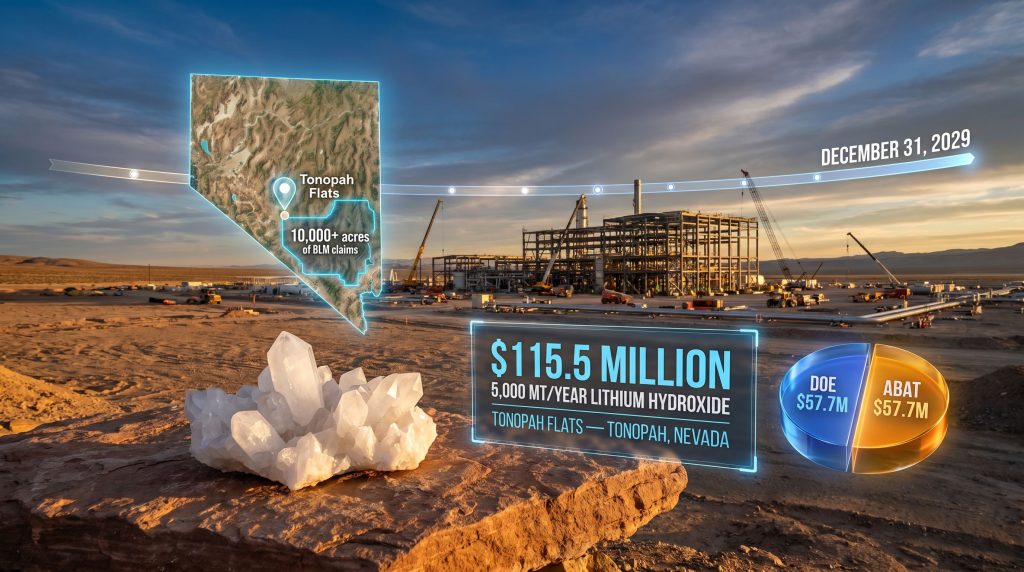
Positioned near Tonopah in central Nevada, the Tonopah Flats Lithium Project (TFLP) covers more than 10,000 acres across multiple Bureau of Land Management mining claims. The project targets lithium hosted in sedimentary claystone formations, a deposit classification that is fundamentally different from the two dominant global lithium source types: evaporite lithium brines concentrated in South America's Lithium Triangle and hard-rock spodumene pegmatites found primarily in Australia and Africa.
Claystone-hosted lithium deposits form through different geological processes than brines or pegmatites. In Nevada's case, lithium-bearing volcanic ash was chemically altered over geological time into clay minerals, primarily hectorite and illite, which trap lithium within their crystalline lattice structures. This mineralogy creates distinct extraction challenges but also distinct opportunities for technology-driven processing at lower environmental cost compared to high-temperature hard-rock refining.
Furthermore, direct lithium extraction methods are increasingly being applied to unconventional deposit types like claystone, offering alternative processing pathways that reduce reagent consumption and environmental impact compared to legacy approaches.
Geological Context Worth Understanding: Unlike brine projects where lithium is dissolved in subsurface water and pumped to evaporation ponds, claystone deposits are mined as solid material. This means processing must separate lithium from the mineral matrix using chemical or electrochemical methods, which is precisely where proprietary extraction technology becomes the commercial differentiator.
Project Parameters at a Glance
| Project Parameter | Detail |
|---|---|
| Location | Tonopah, Nevada, USA |
| Land Area | 10,000+ acres (BLM-managed claims) |
| Deposit Type | Sedimentary claystone |
| Target Output | 5,000 MT/year battery-grade lithium hydroxide |
| Development Stage | Pre-feasibility completed; permitting underway |
| Exploration commenced | 2021 |
| Project Timeline | Through December 31, 2029 |
American Battery Technology Company (NASDAQ: ABAT) initiated exploration in 2021 and has since completed resource definition studies, economic assessments, and a pre-feasibility study. The phase one refinery is designed to produce 5,000 metric tons per year of battery-grade lithium hydroxide, a specification meeting the purity thresholds required for direct integration into lithium-ion cathode manufacturing for EVs and stationary storage applications.
The DOE Grant: Termination, Appeal, and Full Reinstatement
A Sequence of Events Investors Should Understand
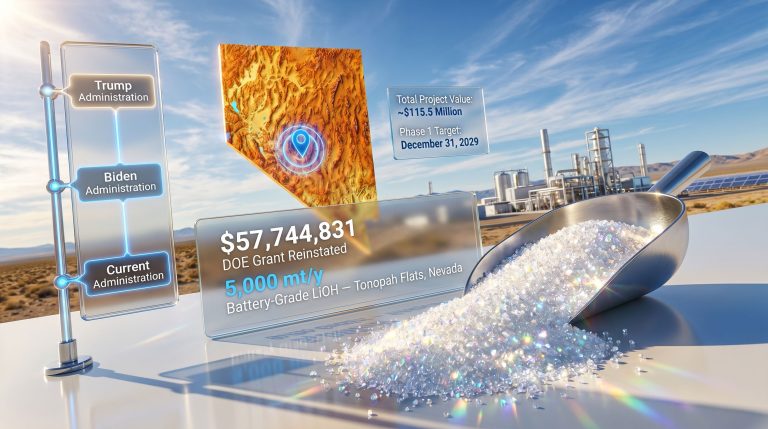
The DOE originally awarded ABAT the grant in October 2022 under a five-year programme structure, with the effective start date established as September 1, 2023. Funding was routed through the DOE's Advanced Materials and Manufacturing Technologies Office and subsequently through the Manufacturing Energy Supply Chain programme, providing federal co-investment toward phase one refinery construction.
In October 2025, the grant was terminated as part of a broader federal review that cancelled multiple clean energy and critical minerals funding commitments simultaneously. ABAT challenged this outcome by initiating the DOE's Informal Dispute Resolution process, a formal administrative mechanism that relatively few grant recipients have successfully used to reverse federal termination decisions.
Over the following months, DOE programme officials conducted a structured technical and programmatic review, evaluating the project's milestone completion rates, extraction technology development, and commercial readiness indicators. Following this review, the DOE concluded the project had satisfied its requirements and reinstated the grant in full, with reinstatement retroactively effective from September 1, 2025, creating continuity in the funding record with no gap between termination and restoration.
Why This Outcome Is Noteworthy: Full reinstatement of a terminated federal energy grant through dispute resolution is a rare administrative result. It signals that the project's documented technical progress was sufficient to withstand rigorous federal scrutiny, which functions as an independent validation of ABAT's development trajectory and extraction technology.
What Changed and What Remained the Same
| Element | Status After Reinstatement |
|---|---|
| Total funding commitment | Unchanged at $115.5 million |
| DOE contribution | Unchanged at $57.7 million |
| ABAT co-investment requirement | Unchanged at $57.7 million |
| Technical milestones | All original targets intact |
| Project completion timeline | Extended to December 31, 2029 |
| Cost-share structure | 50/50 between DOE and ABAT |
Breaking Down the $115.5 Million Funding Architecture
How Federal Grant Co-Investment Works in Practice
The DOE's cost-share model requires ABAT to match federal funding dollar-for-dollar, meaning the $57.7 million federal contribution is contingent on the company deploying an equivalent $57.7 million in private capital. This structure is deliberately designed to ensure recipients have sufficient skin in the game, aligning federal investment with commercially credible project sponsors rather than speculative early-stage ventures.
| Funding Component | Amount | Share |
|---|---|---|
| DOE Federal Contribution | $57.7 million | ~50% |
| ABAT Private Co-Investment | $57.7 million | ~50% |
| Total Project Funding | $115.5 million | 100% |
The grant covers phase one construction of a commercial-scale lithium hydroxide refinery, continued development and scaling of the proprietary selective leach extraction (SLE) technology, and engineering and infrastructure buildout at the Tonopah Flats site. It also supports ongoing applied research conducted in collaboration with the Nevada Center for Applied Research at the University of Nevada, Reno.
The university partnership is particularly significant from a technology de-risking perspective. Academic collaboration provides independent scientific validation of extraction performance data and access to research infrastructure that supports iterative process optimisation without the full capital burden of in-house R&D facilities.
ABAT's Selective Leach Extraction Technology: Why It Matters
The Core Processing Challenge With Claystone Lithium
Conventional approaches to extracting lithium from claystone deposits rely on aggressive acid leach chemistry, high reagent volumes, significant water consumption, and energy-intensive downstream processing to achieve acceptable product purity. These characteristics translate into elevated operating costs, complex waste management requirements, and heightened environmental compliance burdens, particularly challenging in Nevada's water-constrained operating environment.
Hard-rock spodumene extraction presents a different but equally demanding cost profile. High-temperature calcination, required to convert spodumene into a leachable form, consumes substantial energy and produces a carbon-intensive processing footprint that is increasingly scrutinised by EV manufacturers with Scope 3 emissions reporting obligations.
How SLE Targets These Inefficiencies
ABAT's selective leach extraction (SLE) process is engineered specifically for the mineralogical characteristics of Nevada claystone lithium deposits. Rather than dissolving the entire mineral matrix with aggressive chemistry, the SLE process targets lithium ions selectively, reducing the co-extraction of gangue minerals, processing contaminants, and chemically complex waste streams.
Key claimed performance advantages of the SLE process include:
- Reduced chemical reagent consumption relative to conventional acid leach benchmarks
- Lower water intensity, critical for operational sustainability and permitting in Nevada's arid regulatory environment
- Reduced processing contamination, improving final product purity and compatibility with battery cell manufacturing specifications
- Lower projected cash production costs, improving the project's economic threshold relative to imported lithium hydroxide
- Smaller environmental footprint, supporting ESG compliance frameworks and streamlining environmental impact assessments
ABAT has already demonstrated the production of battery-grade lithium hydroxide directly from Nevada claystone feedstock at laboratory and pilot-scale settings, providing tangible proof-of-concept validation ahead of commercial-scale refinery construction.
Three Structural Pressures Driving U.S. Domestic Lithium Development
Pressure 1: Import Dependency and Supply Security
The United States imports the overwhelming majority of its processed lithium, with the concentration of global refining capacity in China creating systemic supply chain exposure for domestic battery manufacturers. Lithium, alongside nickel, cobalt, and manganese, is formally classified as a strategically critical mineral under U.S. federal policy, recognising that supply disruption would have cascading consequences across EV manufacturing, grid storage deployment, and defence electronics.
Pressure 2: Demand-Side Cost Pressures
Accelerating EV adoption and the buildout of utility-scale battery storage installations are compressing the timeline between projected lithium supply growth and actual consumption growth. Domestic refinery capacity, developed at commercial scale, could moderate long-run lithium hydroxide pricing for U.S.-based cell manufacturers by introducing a geographically proximate supply alternative not subject to international freight costs, tariff risk, or geopolitical supply interruptions.
Pressure 3: Carbon Intensity and Regulatory Compliance
Emerging Scope 3 emissions disclosure requirements are increasing automaker and battery manufacturer demand for traceable, low-carbon battery material supply chains. Lithium processed using lower-impact domestic extraction methods carries a more favourable lifecycle carbon profile than imported material refined in jurisdictions with lower environmental standards. This creates a premium market positioning opportunity for projects like Tonopah Flats that can document reduced processing emissions.
A Point Often Overlooked: The battery recycling process, while strategically important for the circular economy, cannot independently satisfy projected lithium demand growth at the pace required. The lead times involved in scaling recycling infrastructure mean that primary production projects with proven geology and advancing technology remain structurally necessary for at least the next decade of battery material supply.
The next major ASX story will hit our subscribers first
Bipartisan Federal Support: A Rare Project-Level Continuity
The Tonopah Flats project has maintained federal engagement across three distinct administrations, a characteristic that substantially reduces the political risk premium typically assigned to federally supported resource development projects.
- First Trump administration: Original DOE grant awarded through the Advanced Materials and Manufacturing Technologies Office
- Biden administration: Funding continued and expanded through the Manufacturing Energy Supply Chain programme
- Second Trump administration: Full grant reinstatement following dispute resolution; Priority Project designation by the White House National Energy Dominance Council in June 2025
The Priority Project designation provides access to streamlined federal permitting pathways by reducing inter-agency coordination friction, a meaningful operational benefit given that permitting timelines represent one of the primary risk factors for large-scale resource development projects in the United States.
U.S. Lithium Project Landscape: Where Tonopah Flats Sits
Nevada has emerged as the focal geography for domestic claystone lithium development, driven by the state's geological endowment, established mining regulatory framework, and proximity to existing industrial infrastructure. The Thacker Pass lithium mine is one notable peer project in this landscape, currently advancing through construction and similarly reliant on DOE loan facilities to bridge the gap between exploration and commercial output.
| Project | Developer | Deposit Type | Status | Federal Engagement |
|---|---|---|---|---|
| Tonopah Flats | ABAT (NASDAQ: ABAT) | Claystone | Pre-feasibility; DOE-funded refinery | $57.7M DOE grant reinstated |
| Thacker Pass | Lithium Americas | Claystone | Construction phase | DOE loan facility |
| Nevada North | Surge Battery Metals | Claystone | Resource upgrade to 10.5 Mt LCE M&I | Exploration stage |
The ABAT DOE grant reinstatement Tonopah Flats Lithium Project positions Tonopah Flats among a very small group of U.S. lithium projects with confirmed federal co-investment at the refinery construction financing stage, a distinction that materially differentiates the project's capital formation outlook from earlier-stage peers.
What the Grant Reinstatement Means for ABAT Stock
Resolving the Financing Uncertainty Overhang
Prior to reinstatement, the grant termination introduced material uncertainty around ABAT's capacity to fund phase one refinery construction without identifying alternative capital sources on commercially equivalent terms. The restoration of the full $57.7 million federal contribution removes this financing ambiguity and preserves the project's development trajectory through the revised December 31, 2029 completion target.
From a market positioning perspective, ABAT shares reacted positively to the reinstatement news, though they currently trade below their 52-week high of $11.49, sitting near the 50-day moving average while remaining below the 200-day moving average. This technical configuration reflects cautious medium-term sentiment rather than outright bearish conviction. One analyst has published a 12-month price target of $6.00 per share, implying meaningful upside from current trading levels if the project continues advancing through permitting and engineering phases.
Key Execution Milestones for Investors to Track
The path from DOE-funded refinery authorisation to commercial-scale lithium hydroxide production involves a sequential set of execution dependencies that investors should monitor carefully:
- Permitting completion — BLM and state-level environmental approvals for refinery construction at the Tonopah Flats site
- Engineering advancement — Progression from pre-feasibility study through definitive feasibility and front-end engineering design (FEED)
- SLE technology scale-up — Demonstration of selective leach extraction performance at commercial throughput rates, not just laboratory or pilot scale
- Lithium hydroxide offtake agreements — Securing binding supply contracts with battery manufacturers or EV OEMs to underpin revenue projections
- Construction commencement — Physical mobilisation of refinery construction within the 2029 project timeline
Investor Consideration: Federal grant reinstatement functions simultaneously as a financing catalyst and an independent technology validation signal. However, the execution risks associated with scaling novel extraction technology to commercial output, navigating multi-agency permitting, and achieving battery-grade product consistency remain material factors in any risk-adjusted assessment of the project's development timeline.
Frequently Asked Questions: ABAT DOE Grant Reinstatement
What is the total value of the DOE grant reinstated for ABAT's Tonopah Flats project?
The total project funding is $115.5 million, structured as a 50/50 cost-share between the DOE ($57.7 million) and ABAT ($57.7 million). The grant was reinstated in full with no reduction to the original funding commitment.
Why was the DOE grant originally terminated?
The grant was terminated in October 2025 as part of a broader federal review affecting multiple DOE programme commitments simultaneously. ABAT contested the decision through the DOE's Informal Dispute Resolution process and secured full reinstatement following a multi-month technical and programmatic assessment.
What will the DOE funding be used for?
The funding supports construction of the first phase of a commercial-scale lithium hydroxide refinery at Tonopah Flats, targeting production of 5,000 metric tons per year of battery-grade lithium hydroxide.
What is the updated project completion timeline?
Following reinstatement, the project timeline runs through December 31, 2029, adjusted from the original schedule to account for the review period. All original technical milestones remain unchanged.
What makes ABAT's extraction technology distinct?
The selective leach extraction (SLE) process is designed specifically for Nevada claystone mineralogy and is engineered to reduce chemical reagent consumption, water use, and processing contamination compared to conventional acid leach approaches or high-temperature hard-rock refining methods.
Has the project received support across multiple administrations?
Yes. Tonopah Flats received federal engagement during the first Trump administration, continued through the Biden administration, and has received further support under the second Trump administration through both grant reinstatement and Priority Project designation by the National Energy Dominance Council in June 2025.
Disclaimer: This article is intended for informational purposes only and does not constitute financial or investment advice. Forward-looking statements regarding project timelines, production targets, technology performance, and stock price targets involve material uncertainties and execution risks. Investors should conduct independent due diligence before making investment decisions. Past federal funding does not guarantee future project outcomes.
For further coverage of U.S. lithium market developments, domestic battery supply chain trends, and federal energy funding programmes, visit CarbonCredits.com.
Want to Catch the Next Major Mineral Discovery Before the Market Does?
Discovery Alert's proprietary Discovery IQ model scans ASX announcements in real time, instantly translating complex mineral data into actionable insights for investors across the battery materials and critical minerals sectors — explore how historic discoveries have delivered extraordinary returns and begin your 14-day free trial to position yourself ahead of the market.