June 11, 2026
The Refining Bottleneck That Defines America's Battery Future
The United States sits atop some of the world's most significant lithium deposits, yet for years the country has exported raw or minimally processed lithium material only to import it back in refined form, predominantly from Chinese processing facilities. This structural paradox has become one of the most widely discussed vulnerabilities in the domestic energy transition. Building mines is only half the equation. Without refining infrastructure on home soil, the U.S. battery supply chain remains exposed at its most critical conversion point: turning lithium-bearing rock and brine into the battery-grade chemical compounds that power electric vehicles.
That refining gap is precisely why the DOE reinstates grant for American Battery Technology Co. carries significance well beyond a single company's balance sheet. It reflects a broader federal recognition that processing capacity, not just resource discovery, determines true supply chain independence. Furthermore, understanding how lithium mining works from extraction through to refinement helps clarify why domestic processing bottlenecks are so consequential.
When big ASX news breaks, our subscribers know first
Understanding the Lithium Refining Gap and Why It Matters
Global lithium production has grown rapidly over the past decade, but the geography of refining has remained stubbornly concentrated. China controls an estimated 60% or more of global lithium chemical refining capacity, meaning that even lithium mined in Australia, Chile, or the United States typically passes through Chinese processing before reaching battery manufacturers. This arrangement exposes Western automakers and battery cell producers to compounding geopolitical and logistical risks.
The distinction between lithium carbonate (Li2CO3) and lithium hydroxide (LiOH) is critical to understanding why new refinery projects must meet a precise technical standard. While lithium carbonate dominated earlier battery chemistries, the transition to high-nickel cathode formulations — particularly NMC 811 and NCA chemistries used in premium EV battery packs — has shifted demand firmly toward lithium hydroxide monohydrate. Battery-grade LiOH enables higher energy density and better thermal stability, making it the preferred feedstock for next-generation cathode active material production.
Battery-grade lithium hydroxide must meet minimum purity thresholds, typically above 56.5% LiOH content with tightly controlled limits on impurities such as sodium, calcium, and sulfate. Failure to meet these specifications disqualifies material from use in premium battery cell manufacturing, regardless of cost.
This technical threshold creates a high barrier to entry. Consequently, DOE grant programmes targeting commercial-scale LiOH refining represent genuine strategic value rather than routine industrial subsidies. The broader critical minerals demand picture makes this point even more pressing for policymakers and investors alike.
What Is the Tonopah Flats Lithium Project?
Location, Infrastructure, and Strategic Positioning
The Tonopah Flats Lithium Project (TFLP) is located in Nevada, a state with a well-established mining regulatory framework, existing processing infrastructure, and proximity to major western U.S. transportation corridors. Nevada's geological endowment includes significant sedimentary lithium deposits, a formation type that differs meaningfully from the hard-rock spodumene deposits dominant in Australia and the lithium brine systems of South America's Lithium Triangle.
Sedimentary lithium deposits, such as those associated with Tonopah Flats, present distinct metallurgical challenges and opportunities. The ore typically contains lithium within clay mineral structures, most notably hectorite, requiring processing approaches that differ from conventional hard-rock spodumene roasting or brine evaporation. ABTC's proprietary extraction technology was specifically developed to address the recovery challenges inherent in these clay-hosted systems, which represent a large and largely undeveloped share of U.S. lithium resources. In this respect, it shares conceptual ground with advances in direct lithium extraction that are reshaping how non-conventional deposits are commercially approached.
Project Parameters and Financial Structure
The financial architecture of the Tonopah Flats project reflects a genuine cost-sharing model between federal and private capital:
| Parameter | Detail |
|---|---|
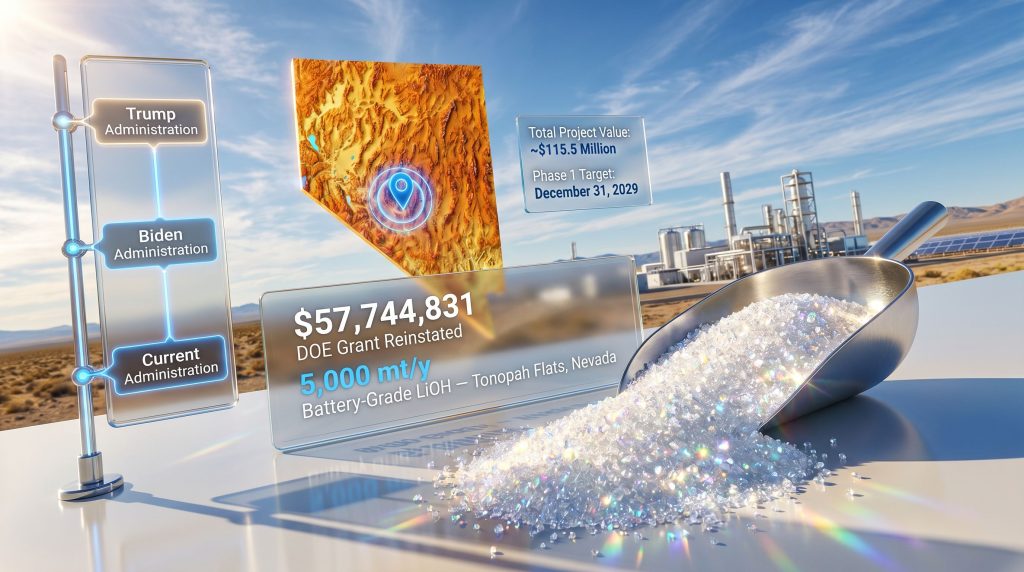
| Phase 1 Target Output | 5,000 metric tons per year of battery-grade LiOH |
| Total Project Value | ~$115.5 million |
| DOE Grant Contribution | $57,744,831 |
| Company Cost Share | $57,744,831 |
| Project Schedule | September 1, 2023 to December 31, 2029 |
| Product Specification | Battery-grade lithium hydroxide monohydrate |
The precise 50/50 cost-sharing structure is not accidental. DOE competitive grant programmes for critical mineral infrastructure typically require substantial applicant co-investment as a condition of award, ensuring that recipients have genuine commercial skin in the game rather than treating federal funding as a substitute for private capital formation.
How the DOE Grant Was Terminated and Subsequently Reinstated
The October 2025 Termination Wave
On October 9, 2025, ABTC received notification that its DOE grant had been terminated. This action was not isolated. The termination affected hundreds of DOE grants across the battery manufacturing, recycling, and critical mineral processing sectors, with the aggregate value of terminated awards estimated at approximately $700 million. The breadth of the action reflected a department-wide portfolio review rather than findings specific to any individual project's technical or commercial performance.
For context, DOE grant terminations of this scale are relatively rare. When they occur, they typically stem from one of three causes:
- Documented failure to meet contractual technical milestones
- Material changes in the commercial or economic viability of the project
- Broader programmatic or policy reviews affecting entire categories of funded work
In ABTC's case, the subsequent appeals process would confirm that the termination did not arise from project-specific performance failures. According to Mining Weekly, the reinstatement followed a formal appeals win that validated ABTC's milestone execution record.
The Appeal Mechanism and Dispute Resolution Process
Federal grant recipients facing termination notices have access to formal appeal and informal dispute resolution mechanisms administered through the DOE's grants management framework. ABTC engaged this process immediately following the October 2025 notification, initiating a structured series of technical and commercial reviews with DOE programme staff.
This type of process is rarely quick. Recipients are required to present documented evidence of milestone completion, demonstrate continued commercial viability, and address any specific concerns raised during the portfolio review. The fact that ABTC navigated this process to a successful conclusion is, in itself, an indicator of the quality of its project documentation and milestone execution record.
The DOE's formal conclusion — that rescission of the termination notice and continuation of the project was warranted — constituted an affirmative finding that all contracted technical and commercial milestones had been achieved. This is a materially different outcome from an administrative reversal or a policy-driven reinstatement.
Reinstatement Terms: Unchanged Across Every Material Dimension
The reinstatement preserved the original grant in its entirety:
- Funding amount: No reduction from the awarded $57,744,831
- Technical milestones: Unchanged from original contract
- Commercial milestones: Unchanged from original contract
- Only modification: Updated project schedule to account for elapsed review time
The absence of any funding reduction or milestone renegotiation is significant. In federal grant dispute resolutions, partial reinstatements with modified terms are far more common than full reinstatements. A complete restoration of original terms signals strong confidence in the project's execution record.
Recycling Today reported that the reinstatement confirms the full $115.5 million combined project value remains intact, underlining the DOE's confidence in ABTC's execution track record.
The Bipartisan Funding Thread: A Rare Signal in a Polarised Environment
Three Administrations, One Project
What distinguishes TFLP from most federally supported energy projects is the continuity of DOE engagement across politically divergent administrations. The critical minerals executive order framework has also reinforced the strategic importance of domestic processing projects such as TFLP across successive policy regimes.
- First Trump Administration: Bench-scale research and construction of an integrated demonstration facility received DOE grant support
- Biden Administration: Competitive selection in October 2022 for a commercial-scale grant of $57.7 million
- Current administration: Reinstatement confirmed following the formal appeals process
This thread of continuity across administrations is genuinely uncommon in U.S. energy policy, where funding priorities and programmatic emphases frequently shift with political transitions. For institutional investors and potential offtake partners, a project that has demonstrated relevance to successive administrations with divergent energy policy philosophies carries a substantially different risk profile than one whose federal support is tied to a single political moment.
FAST-41 Priority Project Designation
In June 2025, Tonopah Flats was designated a critical mineral Priority Project by the White House's National Energy Dominance Council and the FAST-41 Permitting Council. FAST-41 refers to the Fixing America's Surface Transportation Act's Title 41, which established a federal permitting framework designed to improve coordination, transparency, and efficiency in environmental reviews for major infrastructure projects.
Under FAST-41, designated projects benefit from:
- A defined permitting timetable with agency accountability mechanisms
- A dedicated Federal Permitting Improvement Steering Council dashboard for public tracking
- Improved inter-agency coordination to reduce duplicative review processes
- Enhanced transparency for project proponents during the permitting timeline
It is important to note that FAST-41 designation streamlines the process architecture of permitting but does not predetermine outcomes or guarantee approvals. However, what it does provide is meaningful reduction in timeline uncertainty, which is one of the most significant risk factors for capital-intensive refinery construction projects.
Comparing Reinstatement to a New Grant Award
For analysts assessing the practical implications of the DOE decision, it is worth distinguishing between what a reinstatement represents versus what starting the grant process anew would mean:
| Factor | Grant Reinstatement (ABTC) | New Competitive Grant Award |
|---|---|---|
| Milestone Requirements | Partially fulfilled and verified | Beginning from baseline |
| Funding Certainty | Restored to original terms | Subject to new competitive process |
| Timeline Impact | Schedule adjustment only | Full timeline reset |
| Federal Priority Status | Existing FAST-41 designation retained | No pre-existing designation |
| DOE Validation | Milestone completion independently verified | Unproven at point of award |
| Commercial Risk Signal | Performance record established | No execution track record at this scale |
The reinstatement therefore represents a materially stronger position than receiving a new award would, because it comes with an attached performance verification that no new grant can replicate at inception.
The next major ASX story will hit our subscribers first
Downstream Implications for the U.S. Battery Supply Chain
Who Benefits From Domestic LiOH Production?
The commercial significance of a 5,000 mt/y domestic LiOH refinery extends well beyond ABTC's own revenue projections. The downstream beneficiaries span multiple layers of the battery raw materials market:
- Battery cell manufacturers seeking to qualify domestically processed material under Inflation Reduction Act critical mineral sourcing requirements, which affect both production tax credits and consumer EV purchase incentives
- Cathode active material producers that require consistent, specification-compliant LiOH supply to manufacture NMC and NCA cathode powders
- Automakers navigating domestic content thresholds embedded in federal incentive frameworks and increasingly in offtake and supply agreements with fleet buyers
- The Nevada state economy, which benefits from refinery construction employment, operational jobs, and the broader economic multiplier effects of an anchor processing facility
Scenario Analysis: Pathways to First Production
| Scenario | Projected Outcome |
|---|---|
| On-schedule completion (December 2029) | 5,000 mt/y LiOH online; domestic supply chain milestone established |
| 12-month schedule slippage | First commercial output by late 2030; still competitive with most greenfield refinery peers |
| Phase 2 expansion | Potential capacity scaling beyond 5,000 mt/y subject to offtake demand and capital access |
| Technological performance improvement | Higher lithium recovery rates from clay-hosted ore could improve unit economics materially |
Disclaimer: The scenario projections above are illustrative and based on publicly disclosed project parameters. Actual outcomes will depend on construction execution, regulatory approvals, lithium market conditions, and capital availability. This analysis does not constitute financial advice.
Frequently Asked Questions
What is the total value of the reinstated DOE grant for ABTC?
The reinstated grant totals $57,744,831, matched by an equivalent company cost share, bringing the combined project value to approximately $115.5 million for Phase 1 construction of the commercial-scale LiOH refinery.
Why was the grant originally terminated in October 2025?
The termination was part of a broad DOE portfolio review affecting approximately $700 million in battery and manufacturing-related grants across multiple recipients. It was not the result of a project-specific adverse finding against ABTC.
Were any terms changed when the grant was reinstated?
No material terms were altered. The awarded funds, technical milestones, and commercial milestones remained identical to the original contract. The only modification was an updated project schedule reflecting time elapsed during the review process.
What is the significance of lithium hydroxide versus lithium carbonate?
Lithium hydroxide monohydrate is the preferred feedstock for high-nickel cathode chemistries used in premium EV battery packs. It commands a processing premium over lithium carbonate and is the specification required by most advanced battery cell manufacturers for next-generation cathode active material production.
What does FAST-41 designation mean for the project timeline?
FAST-41 designation establishes a structured, accountable federal permitting process with defined timelines and inter-agency coordination requirements. It reduces permitting timeline uncertainty but does not guarantee specific approval outcomes.
Key Takeaways for Industry Watchers and Investors
- The DOE reinstates grant for American Battery Technology Co. outcome represents a verified milestone-completion finding, not a political or administrative reversal
- Full reinstatement with no change to funding, technical milestones, or commercial milestones eliminates a significant uncertainty that had weighed on the project's near-term development trajectory
- The three-administration continuity of federal support for TFLP is a statistically uncommon signal in U.S. energy project financing
- ABTC's proprietary extraction technology for clay-hosted lithium deposits addresses a processing challenge that has historically limited the commercial development of a large class of U.S. lithium resources
- Phase 1 output of 5,000 mt/y LiOH, while modest at a global scale, represents an important proof point for the scalability of domestic refining capacity built on non-conventional lithium sources
- Investors and offtake partners should assess this outcome within the context of the broader domestic critical mineral supply chain, where verified execution track records at the demonstration and early commercial scale remain genuinely scarce
Readers seeking further context on U.S. critical mineral policy and domestic battery supply chain infrastructure can find relevant coverage and analysis at Engineering & Mining Journal, which tracks federal energy and mining developments across North America.
Want to Stay Ahead of the Next Major Critical Minerals Discovery?
Discovery Alert's proprietary Discovery IQ model delivers real-time alerts on significant ASX mineral discoveries — instantly translating complex geological and commodity data into actionable investment insights for both short-term traders and long-term investors. Explore how historic discoveries have generated extraordinary returns on Discovery Alert's dedicated discoveries page, and begin your 14-day free trial today to position yourself ahead of the broader market.