June 10, 2026
Europe's Lithium Supply Chain Is an Engineering Problem as Much as a Policy One
Battery manufacturing capacity across Europe has expanded at a pace that has outrun the continent's ability to supply the raw materials feeding it. While gigafactories take shape from Germany to Hungary, the upstream mineral infrastructure that should anchor those facilities remains conspicuously underdeveloped. This disconnect sits at the heart of what processing engineers and project developers are now being asked to resolve, and the solutions being discussed go well beyond simply digging more holes in the ground.
The challenge of engineering Europe's lithium future is genuinely multidimensional. It involves choosing the right extraction technology for each geological setting, building midstream refining capacity that can produce battery-grade product consistently, navigating permitting environments that were never designed with critical mineral timelines in mind, and earning the trust of communities who live near proposed operations. Each of these dimensions carries its own set of technical and commercial risks.
When big ASX news breaks, our subscribers know first
The Raw Material Gap: Where Europe Stands and What It Faces
Europe currently produces less than 0.1% of global lithium mine output, a figure that becomes increasingly uncomfortable when set against demand forecasts. EU lithium consumption is projected to reach 58,000 tonnes per year by 2030, driven primarily by electric vehicle adoption and grid-scale energy storage deployment. The arithmetic of that gap is stark.
What makes the situation more acute is that the challenge is not simply about mining volume. Europe risks recreating a different form of dependency if ore is extracted domestically but shipped to Asia for refining, only to return as processed hydroxide or carbonate. The strategic objective has to be an integrated supply chain, from rock to battery-grade product, completed within the continent.
Furthermore, according to research into Europe's evolving lithium market, domestic production ambitions are increasingly backed by regulatory frameworks designed to reduce strategic vulnerability across the entire value chain.
The lithium challenge facing Europe is fundamentally a supply chain architecture problem, not merely a production shortfall. Solving the upstream without solving the midstream simply relocates the vulnerability.
The EU's Three Benchmarks and What They Demand in Practice
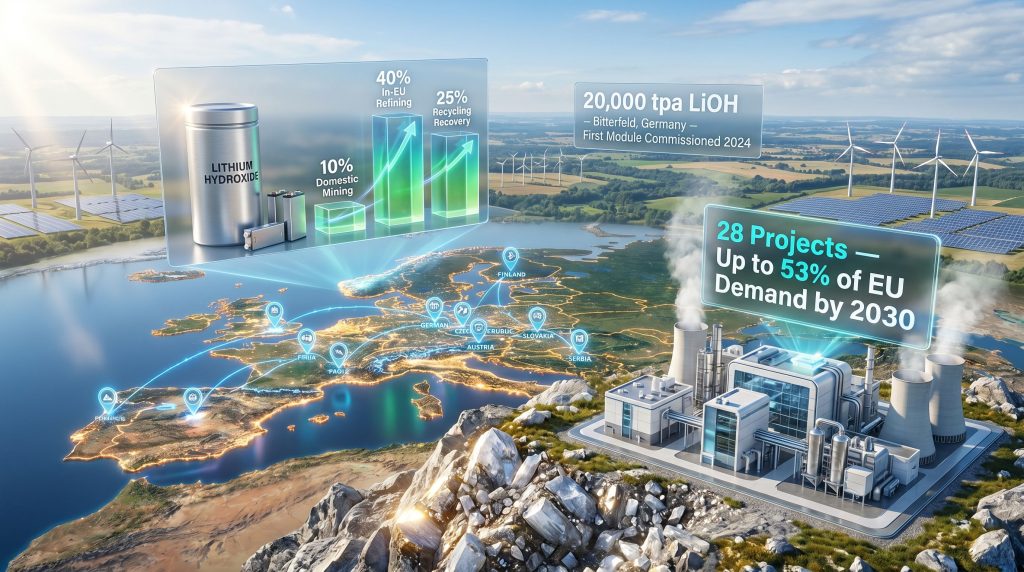
Europe's strategic raw materials framework has established three quantified targets that now shape investment decisions across the project pipeline:
| Policy Target | Benchmark | Current Status |
|---|---|---|
| Domestic Mining Share | 10% of EU consumption | Near zero as of 2025 |
| In-EU Refining Capacity | 40% of processed lithium | Early-stage commissioning |
| Recycling Recovery | 25% from end-of-life batteries | Infrastructure being built |
The 40% refining target is arguably the most technically demanding of the three. Producing battery-grade lithium hydroxide monohydrate (LiOH·H₂O) or lithium carbonate (Li₂CO₃) requires chemical processing infrastructure of significant complexity. Purity specifications for battery cathode applications are stringent, with impurity thresholds for elements such as sodium, calcium, magnesium, and iron measured in parts per million.
Meeting those thresholds consistently from European feedstocks, which carry their own mineralogical characteristics, is not a trivial engineering task. Consequently, the European critical raw materials supply agenda has placed refining capacity at the centre of its industrial policy priorities.
The recycling target, while achievable in principle, depends on a timing dynamic that is easy to overlook. The volume of lithium recoverable from end-of-life EV batteries is a direct function of how many batteries were sold several years earlier. Meaningful recycled lithium volumes will not materialise until the first generation of large-format EV batteries begins reaching end-of-life at scale, which points to the late 2020s at the earliest. Building the hydrometallurgical recovery infrastructure now, before those volumes arrive, is a calculated investment in a supply stream that does not yet fully exist.
Mapping Europe's Lithium Resource Base
Europe's lithium geology is more varied and geographically distributed than commonly appreciated. The continent's resource base spans multiple countries and deposit types:
- Portugal hosts hard-rock spodumene deposits and is home to some of Europe's most advanced mining projects, benefiting from established mining tradition and significant identified resources.
- The Czech-German border region is home to the Cinovec and Zinnwald pegmatite systems, which together represent one of the largest hard-rock lithium accumulations in Europe. The cross-border nature of these deposits adds jurisdictional complexity to an already intricate development picture.
- Finland is host to the Keliber project, which is targeting first production in 2026 and is structured as a fully integrated operation from mine to refinery, positioning it as a potential template for European integrated development.
- Spain, France, Austria, Serbia, and Ukraine all host active exploration or development-stage projects, reflecting the genuine breadth of the continent's prospective geology.
- The United Kingdom, through both hard-rock pegmatite projects in Cornwall and geothermal lithium extraction concepts, has emerged as a meaningful participant in the European pipeline.
Industry analysis has identified 28 mining, refining, and integrated lithium projects across Europe with the potential to materially contribute to reducing import dependence. According to research from Lund University, new European lithium mines could cut EU imports by half if developed on schedule.
However, if all were fully developed on schedule, European mined output could theoretically satisfy up to 53% of projected EU demand by 2030. The critical qualifier is that gap between theoretical pipeline capacity and actual production. Permitting timelines, capital availability, and community acceptance have historically converted ambitious project pipelines into much smaller delivery outcomes.
Processing Technologies: Matching Method to Geology
Hard-Rock Spodumene Processing
The dominant processing pathway for European lithium projects involves spodumene-bearing pegmatites. The technical sequence is well established: crushing and grinding followed by froth flotation to produce a spodumene concentrate, high-temperature calcination to convert alpha-spodumene to the more chemically reactive beta phase, acid roasting or other chemical treatment to solubilise lithium, and finally purification and crystallisation to produce battery-grade hydroxide or carbonate.
The engineering challenge specific to European projects lies in the detailed chemistry. Understanding the various spodumene processing routes is essential, as spodumene concentrates from different pegmatite systems carry different impurity signatures. European deposits commonly contain elevated levels of iron, manganese, and various alkali elements that must be removed to reach battery specification.
Process engineers working on European projects invest significant effort in impurity deportment studies, mapping where each contaminant element reports across the processing flowsheet and designing reagent and separation strategies accordingly.
A less widely discussed technical factor is the role of lithium mineralogy beyond spodumene. Some European pegmatites contain lithium hosted in minerals such as lepidolite, petalite, or amblygonite rather than spodumene, or in combinations of these phases. Each mineral responds differently to thermal and chemical treatment, meaning that a flowsheet optimised for spodumene may perform poorly on a mixed-mineralogy feed. Thorough mineralogical characterisation before flowsheet selection is not optional — it is foundational to project economics.
Direct Lithium Extraction: Technology in Transition
Direct lithium extraction encompasses a family of selective separation technologies including ion exchange resins, solvent extraction systems, and electrochemical methods. The unifying principle is selective isolation of lithium from a liquid medium — whether geothermal brine, oilfield water, or the process liquors generated during ore processing — without the need for large solar evaporation ponds.
The relevance of DLE to European contexts is particularly strong for several reasons:
- Land footprint: European landscapes are densely populated and environmentally sensitive. The compact infrastructure associated with DLE systems is a meaningful practical advantage over operations requiring extensive evaporation pond areas.
- Water consumption: Several European lithium regions, particularly in the Iberian Peninsula, face water stress. DLE systems can operate as closed-loop or near-closed-loop water circuits, substantially reducing freshwater draw.
- Energy integration: DLE can be configured to operate efficiently with intermittent renewable energy, which aligns with the sustainability credentials that European battery manufacturers are beginning to require from their supply chains.
However, the technology carries risks that are important to represent accurately:
- Commercial scale demonstration of DLE remains limited. Several projects worldwide have progressed to pilot scale, but consistent performance across the full lithium recovery, purity, and cost triangle at commercial volumes has not been universally established.
- The regulatory pathways for novel DLE operations are not standardised across EU member states. An operation involving lithium brine extraction, for instance, may require environmental assessment frameworks that do not yet exist in some jurisdictions.
- Ion exchange selectivity, a core DLE mechanism, is sensitive to feed chemistry. Variations in brine or process liquor composition, which are inevitable in real operating environments, can affect lithium recovery and product purity in ways that are difficult to model perfectly at the design stage.
DLE is genuinely promising for European conditions, but treating it as a solved technology would be premature. The gap between pilot-scale data and commercial operating confidence is still being closed by the industry.
Refining Infrastructure: Europe's Midstream Is Beginning to Take Shape
The commissioning of AMG Advanced Metallurgy Group's Bitterfeld lithium hydroxide refinery in Germany during 2024 represented a meaningful milestone. With a nameplate target of 20,000 tonnes per year of battery-grade lithium hydroxide, it stands as one of the most significant midstream processing investments made on European soil.
Keliber's Finnish operation, targeting refinery commissioning in 2026, is structured as a vertically integrated project connecting mine to battery-grade product within a single corporate structure. This model is significant because it removes the commercial intermediary step between concentrate producer and hydroxide seller, potentially improving project economics and supply chain transparency simultaneously.
| Refinery Project | Location | Target Capacity | Status |
|---|---|---|---|
| AMG Bitterfeld | Germany | 20,000 tpa LiOH | First module commissioned 2024 |
| Keliber Refinery | Finland | To be confirmed | Targeted 2026 commissioning |
| Slovakia Project | Slovakia | To be confirmed | Development stage |
| UK Projects | United Kingdom | To be confirmed | Announced / early development |
Additional refining projects announced in Slovakia and the United Kingdom signal that midstream capacity is beginning to follow the upstream development pipeline, though the sequencing remains a concern. Refineries require stable, long-term concentrate supply commitments to justify their capital investment, and those commitments depend on mines reaching production on schedule.
The next major ASX story will hit our subscribers first
The Permitting Problem: Europe's Hidden Timeline Risk
One of the least discussed risks in European lithium development is the sheer length of permitting processes. Mining permit timelines in many European jurisdictions commonly span seven to ten years or more from initial discovery to a production decision. This creates a structural mismatch with the urgency of battery supply chain buildout.
Regulatory fragmentation compounds the challenge. There is no harmonised permitting pathway for critical mineral projects across EU member states. A project in Portugal navigates a fundamentally different regulatory environment than an equivalent project in Finland or the Czech Republic. Engineering and legal teams working across multiple European jurisdictions must essentially rebuild their regulatory knowledge base for each project.
The policy debate around this issue is active and genuinely contested. Advocates for streamlining argue that accelerated permitting for critical mineral projects need not compromise environmental rigour, pointing to risk-proportionate assessment frameworks used successfully in other jurisdictions. Opponents argue that the environmental and social stakes in densely populated European landscapes are precisely why full assessment timelines are warranted, and that shortcuts generate long-term social and legal risk for projects.
Process Optimisation: The Engineering Detail That Determines Project Economics
Beyond the headline technology choices, the difference between a European lithium project that succeeds economically and one that struggles often comes down to process engineering detail. Several variables determine whether a project can consistently produce on-specification product at commercially viable cost:
-
Lithium grade and mineralogy in the feed: Higher grades reduce processing intensity per unit of product, but mineralogy determines which processing route is viable. A high-grade lepidolite deposit may require a fundamentally different flowsheet than a lower-grade spodumene ore.
-
Impurity profile management: Sodium, potassium, calcium, magnesium, and iron are the most commercially significant impurities in lithium processing. Their concentration and the mineral phases hosting them determine reagent consumption, processing steps required, and the achievable product purity ceiling.
-
Water chemistry and availability: Water quality affects reagent performance, corrosion rates in plant equipment, and the behaviour of separation processes. European projects in water-stressed regions must design for minimal net water consumption from the outset.
-
Energy cost and carbon intensity: Processing lithium to battery-grade specification is energy-intensive. The carbon footprint of that energy, and its cost, materially affects both project economics and the sustainability credentials that are increasingly required for European offtake agreements.
-
Process simulation and pilot validation: Responsible project development sequences process simulation modelling ahead of pilot plant construction, and pilot plant results ahead of full-scale design. Skipping or abbreviating these steps to accelerate timelines is a known source of cost overruns and performance shortfalls at commercial scale.
Sustainability as a Competitive Differentiator
The EU Battery Regulation introduces mandatory carbon footprint declarations and supply chain due diligence requirements that will progressively disadvantage high-emission lithium sources regardless of their origin. This regulatory framework creates a genuine commercial opportunity for European projects that can demonstrate low-carbon, water-efficient, transparent production credentials.
In addition, the role of battery recycling processes is becoming increasingly central to the European lithium strategy, as circular economy integration reduces dependence on primary extraction over time. However, it is important to note that domestic origin alone does not guarantee lower environmental impact.
A well-designed project in a renewable-energy-rich European location, operating with closed-loop water management and responsible waste handling, can legitimately claim a lower lifecycle footprint than imports from distant sources. The five pillars of sustainable European lithium development can be summarised as:
- Renewable electricity integration throughout extraction and processing
- Process water efficiency through closed-loop system design
- Closed-loop reagent recovery to minimise chemical waste streams
- Circular economy integration by designing supply chains to incorporate recycled lithium
- DLE adoption in settings where the technology reduces land and water impact relative to conventional methods
Sustainability credentials should reflect genuine performance data, not geographic assumption. Battery manufacturers conducting due diligence will ultimately distinguish between projects with verified low-impact credentials and those merely benefiting from proximity.
How Europe Compares to Established Producing Regions
| Dimension | Europe | Australia | South America (Lithium Triangle) |
|---|---|---|---|
| Primary Resource Type | Hard-rock pegmatite, geothermal brine | Hard-rock spodumene | Brine (salar) |
| Permitting Environment | Complex, multi-year | Moderate, established | Variable by country |
| Proximity to Battery Demand | High (in-region) | Distant (Asia-focused) | Distant (Asia/US-focused) |
| Refining Infrastructure | Early-stage | Developing | Limited in-country |
| Sustainability Credentials | High potential | Moderate | Water-stress concerns |
| Current Production Scale | Near zero | World-leading | Significant and growing |
Australia's Pilbara experience is instructive. The rapid scaling of hard-rock spodumene operations there over the past decade demonstrated that large-scale lithium mining can be developed within a decade under supportive regulatory conditions with established institutional processes. The key lesson is that integrated project structures, combining mining and downstream processing within a single investment thesis, generate stronger project economics and reduce the risk of ore leaving the jurisdiction without value addition.
The Path Forward: Priorities by Phase
Near-Term Priorities (2025 to 2028)
- Advance permitting reform frameworks that maintain environmental rigour while reducing duplicative assessment processes
- Commission first-of-kind European refining capacity to establish the battery-grade production model on home soil
- Progress DLE pilot programmes in geothermal and brine settings to generate the commercial-scale operating data that de-risks broader adoption
- Secure offtake agreements between European lithium producers and battery cell manufacturers to anchor project financing
Medium-Term Structural Goals (2028 to 2032)
- Scale integrated mining-to-refining operations toward the 10% domestic mining and 40% refining targets
- Establish functional battery recycling infrastructure capable of recovering lithium at commercially meaningful volumes
- Develop cross-border project coordination frameworks, particularly for deposits like Cinovec and Zinnwald that span national boundaries
The strategic and commercial case for engineering Europe's lithium future is clear. The engineering pathway, while demanding, is navigable. What the sector needs now is the patience to do the technical work properly, the capital to fund it, and the regulatory environment to allow it to proceed at a pace commensurate with the energy transition it is meant to serve.
Readers seeking further technical perspectives on European lithium development and processing engineering strategies can explore related reporting from Mining Magazine, including coverage of the UK Mining Conference 2026, where senior processing engineers discussed the specific challenges and opportunities facing engineering Europe's lithium future in detail.
Want to Capitalise on the Next Major Mineral Discovery Before the Broader Market Does?
Discovery Alert's proprietary Discovery IQ model delivers real-time alerts on significant ASX mineral discoveries, instantly transforming complex mineral data into actionable investment insights for both short-term traders and long-term investors — explore how historic discoveries have generated substantial returns and begin your 14-day free trial at Discovery Alert to position yourself ahead of the market.