June 10, 2026
Why the Race for Sovereign Lithium Supply Has Never Been More Consequential
Battery supply chains are increasingly being treated as national infrastructure. Across North America, Europe, and Asia, governments are recalibrating industrial policy around one central insight: the countries that control battery-grade mineral processing will hold significant leverage in the clean energy economy. Lithium sits at the core of that calculation, and Canada, with its vast sedimentary brine formations, is positioning itself as a credible alternative to the South American lithium triangle and Chinese refining dominance.
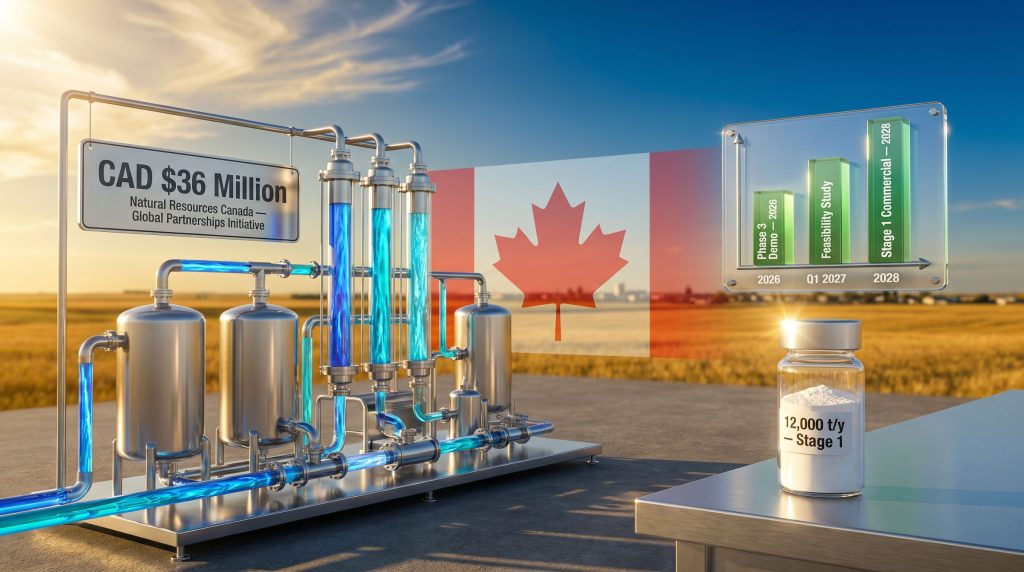
Against this backdrop, E3 Lithium Clearwater demo plant funding milestone carries weight that extends well beyond a single project. The execution of a contribution agreement worth CAD $36 million through Natural Resources Canada's Global Partnerships Initiative (GPI) marks a tangible commitment to proving that Canadian lithium brine can be commercially viable at scale, using next-generation extraction technology. Furthermore, this development arrives at a moment when critical minerals demand is reshaping geopolitical priorities across the globe.
When big ASX news breaks, our subscribers know first
Understanding the Funding Architecture Behind the Clearwater Project
One of the most underappreciated aspects of this development is not just the size of the federal contribution, but the structural layering of financial support that surrounds it. The GPI grant does not stand alone.
A Multi-Source Capital Stack Designed to Reduce Execution Risk
The CAD $36 million non-repayable GPI contribution covers approximately 75% of the project's current CAD $48 million capital requirement, providing extraordinary financial coverage at a stage when most mineral projects must rely almost entirely on equity dilution or expensive debt. This structure meaningfully reduces the risk premium that private capital typically demands at the pre-final investment decision (FID) stage.
The broader funding picture looks like this:
| Funding Source | Amount (CAD) | Type | Purpose |
|---|---|---|---|
| Natural Resources Canada (GPI) | $36 million | Non-repayable grant | 75% of $48M current capital requirement |
| Emissions Reduction Alberta (TIER Fund) | ~$5 million | Provincial grant | Demo facility expansion |
| Critical Minerals Infrastructure Fund | $4.4 million | Reimbursable (50% eligible expenses) | Preconstruction work |
| Undrawn financial grants (end of 2024) | ~$23 million | Various | Program pipeline |
| Working capital (end of 2024) | ~$18.4 million | Corporate | Operational liquidity |
A particularly important technical detail is the retroactive eligibility date of April 1, meaning E3 can claim reimbursement for eligible expenditures incurred from the start of Q2 2026 onwards. This provision effectively allowed the company to begin accelerating technical work ahead of formal agreement execution, without leaving sunk costs unrecoverable.
For investors, the non-repayable nature of the GPI funding is significant. Unlike convertible notes or royalty-backed financing, a non-repayable grant carries no claim on future cash flows, no equity dilution, and no interest burden. It is, consequently, pure project equity from a sovereign source. In addition, Alberta backed E3 Lithium with approximately $5 million from its TIER Fund specifically for the expanded demonstration facility.
What Makes the Clearwater Project Technically Distinctive
Direct Lithium Extraction: A Fundamental Departure from Conventional Methods
To appreciate why the Clearwater project attracts this level of institutional attention, it is worth understanding what separates direct lithium extraction from the two dominant conventional approaches to lithium production.
Traditional hard-rock spodumene mining, as practised in Western Australia, involves blasting, crushing, and chemical conversion of ore at high temperatures. It is energy-intensive and capital-heavy. Conventional brine operations in the South American altiplano rely on vast solar evaporation ponds that can take 12 to 24 months to concentrate lithium before any chemical processing begins, consuming enormous tracts of land and freshwater in some of the world's most water-stressed environments.
DLE operates on an entirely different principle. Rather than waiting for passive solar evaporation, DLE uses selective sorbent or ion-exchange materials to extract lithium ions directly from brine in a matter of hours. The processed brine can then be re-injected into the aquifer, dramatically reducing surface water consumption and land disturbance. Recovery rates that were once considered ambitious are now being demonstrated at pilot scale.
For Clearwater, the Phase 3 demonstration targets include:
- Lithium recovery rates greater than 85% through a single commercial-scale DLE column
- Lithium chloride production at a rate equivalent to up to 100 tonnes per year of lithium carbonate
- Increased volumes of battery-grade lithium carbonate to support product qualification with potential offtake partners
These are not trivial benchmarks. An 85% recovery rate through a single commercial column would represent a compelling proof point for bankability, particularly given that early-stage DLE projects globally have often struggled to demonstrate consistent recovery at column diameters approaching commercial specifications.
The Alberta Brine Advantage
The Clearwater project sits near Olds, Alberta, within a geological setting that has attracted sustained interest from both academic researchers and commercial developers. Alberta's deep sedimentary basins contain lithium-bearing brine formations co-produced alongside oil and gas operations, a characteristic that creates both a logistical opportunity and a technical challenge.
The opportunity lies in the existing subsurface infrastructure: well casings, pipelines, and production data that reduce the upfront cost of reservoir characterisation. The challenge, however, is managing the co-produced fluids, gas handling, and reinjection in a manner that satisfies both environmental regulators and subsurface engineers. The Phase 3 engineering scope explicitly includes final designs for reservoir development and gas-handling systems, signalling that E3 is taking these subsurface management questions seriously as part of the feasibility pathway.
Phase 3 of the Demonstration Facility: A Step-by-Step Technical Breakdown
Understanding what Phase 3 actually entails requires context from the earlier phases.
Phase 1 established baseline DLE performance using field-extracted Clearwater brine, validating that the Alberta brine chemistry was compatible with the chosen sorbent technology. Phase 2 expanded throughput and integrated purification and carbonation processing into a continuous circuit, producing initial quantities of battery-grade lithium carbonate.
Phase 3 represents the critical scale-up step, and it has two parallel workstreams:
- Operation of the previously commissioned 30-column DLE system alongside purification and carbonation skids, generating increased product volumes and process stability data.
- Construction and commissioning of a single commercial-scale DLE column, which will be operated to demonstrate recovery rates and throughput metrics that can be directly extrapolated to full commercial design.
The second workstream carries particular significance for project financing. Most project financiers and strategic partners require demonstration of technology at or near commercial column dimensions before committing capital to full-scale development. Operating at 30-column pilot scale is valuable, but a single large-format commercial column provides the specific data point that de-risks the extrapolation from pilot to plant.
Phase 3 success will serve as the primary technical evidence package for potential offtake partners, strategic investors, and project financiers evaluating whether to commit capital to a CAD $3.4 billion commercial build-out.
Sedgman's Role and Why FEED Credibility Matters
Choosing an Engineering Firm With DLE-Specific Credentials
The selection of Sedgman to lead front-end engineering design (FEED) for Clearwater is a strategically important signal. FEED is the engineering phase that bridges conceptual design and detailed engineering, and its outputs — including process flow diagrams, equipment specifications, cost estimates, and project execution plans — form the primary basis on which project financiers conduct their technical due diligence.
Sedgman brings direct relevance here: the firm is currently involved in the engineering and delivery of other advanced lithium processing facilities that incorporate DLE technologies and are progressing toward commercial implementation. This means Sedgman is not approaching DLE-specific process design as a theoretical exercise, but as a practitioner with active project experience in the same technology family.
For a project seeking to attract institutional project finance, having a globally recognised FEED contractor with demonstrable DLE engineering credentials is not a minor detail. It directly affects the confidence level of technical independent engineers retained by lenders, who must assess whether the process design is commercially sound and constructable within the estimated budget. For further detail, E3 Lithium's 2025 demonstration plant development plans provide additional context on how this engineering partnership fits within the broader project roadmap.
The Feasibility Study: What Q1 2027 Publication Will Reveal
Key Engineering Deliverables Within the Feasibility Study Scope
The feasibility study, targeting publication in Q1 2027, will synthesise Phase 3 demonstration results with Sedgman's FEED outputs into a bankable technical and economic case for Stage 1 commercial operations. The engineering scope encompasses:
- Final designs for reservoir development and subsurface management
- Gas-handling system design, critical for managing co-produced hydrocarbons from lithium brine extraction
- Lithium extraction and purification process design at commercial throughput
- Lithium carbonation final design, converting purified lithium chloride to battery-grade lithium carbonate
The Stage 1 commercial target embedded in the feasibility study is 12,000 tonnes per year of battery-grade lithium carbonate, with a long-term production ambition of 36,000 tonnes annually as the project scales to full capacity. Total estimated capital cost for full commercial build-out stands at CAD $3.4 billion, placing Clearwater among the larger-scale lithium development projects in the Western Hemisphere. Moreover, the lithium carbonate market in 2025 presents both headwinds and tailwinds that will factor significantly into the feasibility study's economic modelling.
The next major ASX story will hit our subscribers first
Project Timeline: From Demonstration to Commercial Operations
| Milestone | Target Date | Status |
|---|---|---|
| GPI contribution agreement executed | June 2026 | Completed |
| Phase 3 equipment orders commenced | Q2 2026 | In progress |
| Phase 3 demonstration operations | 2026 | In progress |
| Feasibility study publication | Q1 2027 | Pending |
| Final investment decision | Post-Q1 2027 | Pending |
| Construction commencement | 2026-2027 (est.) | Planned |
| Stage 1 commercial operations target | 2028 | Planned |
The retroactive funding eligibility from April 1 is particularly consequential for this timeline. By allowing cost recovery from the beginning of Q2, it effectively means the technical program has been running at full pace since April, with financial support now formalised. This removes a period of potential momentum loss that often occurs when projects wait for funding confirmation before committing to long-lead equipment orders.
Clearwater's Position in the North American Battery Supply Chain
Battery-Grade Lithium Carbonate vs. Lithium Hydroxide: Why Specification Matters
A distinction that often escapes general commentary is the difference between lithium carbonate and lithium hydroxide as end products, and why it matters for offtake partner qualification.
Lithium carbonate is the primary precursor for lithium iron phosphate (LFP) cathode chemistry, which is now the dominant chemistry in grid-scale energy storage and is gaining rapid share in entry-level and mid-range electric vehicles. Lithium hydroxide is the preferred precursor for high-nickel NMC cathode chemistries used in performance EV applications.
Clearwater's innovative extraction approach positions the project squarely within the LFP supply chain, which many analysts project will capture the largest share of volume growth in stationary storage applications through the end of the decade. Qualifying this product with offtake partners during Phase 3 is not merely a commercial formality; it is the process by which the product chemistry is validated against the specific purity and particle size specifications demanded by cathode manufacturers.
Risks and Opportunities Facing the Clearwater Project
Key Opportunities:
- First-mover advantage in Alberta's lithium brine sector with established field infrastructure
- Substantial non-dilutive government co-investment reducing equity funding requirements ahead of FID
- DLE technology scalability across the broader Clearwater brine resource footprint
- Strategic positioning within North American domestic content frameworks for EV manufacturers
Key Risks:
- Lithium carbonate spot price volatility and its potential impact on project economics at the time of FID
- Technology scale-up risk in transitioning from demonstration-scale to commercial-scale DLE columns
- Timeline sensitivity to Phase 3 results, feasibility study outcomes, and capital market conditions at FID
- Subsurface and permitting variables inherent to large-scale brine development projects
Disclaimer: The risks and opportunities outlined above represent analytical observations based on publicly available information and should not be construed as financial advice. Investors should conduct their own due diligence before making investment decisions.
Frequently Asked Questions: E3 Lithium Clearwater Demo Plant Funding
What is the total federal funding E3 Lithium has received for the Clearwater project?
E3 Lithium has secured a CAD $36 million non-repayable contribution through Natural Resources Canada's Global Partnerships Initiative, covering 75% of the project's current $48 million capital requirement. Additional funding includes approximately $5 million from Alberta's TIER Fund and $4.4 million from the Critical Minerals Infrastructure Fund.
What is Direct Lithium Extraction and why does it matter for Clearwater?
Direct Lithium Extraction is a processing technology that selectively removes lithium from brine solutions using sorbent or ion-exchange materials, bypassing the multi-year solar evaporation process used in conventional South American brine operations. For Clearwater, DLE enables faster processing cycles, reduced surface footprint, and targeted recovery rates above 85% through a single commercial column.
When will the Clearwater feasibility study be published?
The feasibility study is expected to be published in Q1 2027, following the completion of Phase 3 demonstration operations and engineering design work led by Sedgman. This represents a critical milestone in the E3 Lithium Clearwater demo plant funding timeline, as the study's outputs will directly inform the final investment decision.
What is the long-term production target for the Clearwater project?
The project targets 12,000 tonnes per year of battery-grade lithium carbonate in Stage 1, scaling toward an estimated 36,000 tonnes per year at full commercial capacity.
What is the estimated total capital cost of the Clearwater project?
The full commercial build-out carries an estimated capital cost of CAD $3.4 billion.
Is the GPI funding repayable?
No. The $36 million GPI contribution is structured as a non-repayable grant, representing a direct federal investment in Canada's domestic critical minerals processing capability. Consequently, this structure distinguishes E3 Lithium Clearwater demo plant funding from more typical project financing arrangements, offering a materially stronger financial foundation as the project advances toward its feasibility milestone.
Want to Stay Ahead of the Next Major Critical Minerals Discovery?
Discovery Alert's proprietary Discovery IQ model delivers real-time alerts on significant ASX mineral discoveries, transforming complex mineral data into actionable investment insights for both short-term traders and long-term investors — explore the historic returns major discoveries have generated and begin your 14-day free trial to position yourself ahead of the market.