August 21, 2026
When a Single Processing Plant Fire Sends Shockwaves Through Global Battery Supply Chains
The architecture of modern battery supply chains rests on a surprisingly narrow foundation. A handful of world-class lithium deposits, concentrated in a small number of jurisdictions, feed the global pipeline of cathode materials, battery cells, and ultimately the electric vehicles rolling off assembly lines across Asia, Europe, and North America. When operational disruptions occur at these anchor sites, even contained ones, the reverberations travel far beyond the mine gate.
The fire at Greenbushes lithium operation on 9 June 2026 is a textbook case study in how a single incident at a multi-plant complex can simultaneously test operational resilience frameworks, trigger investor sentiment responses, and remind downstream industries of their exposure to concentrated supply chain risk.
When big ASX news breaks, our subscribers know first
Understanding Greenbushes: More Than a Mine
Greenbushes sits in Western Australia's South West region, approximately 250 kilometres south of Perth. It is not merely a significant lithium deposit. It is routinely classified as one of the highest-grade hard-rock lithium operations on the planet, with lithium oxide (Li₂O) concentrations that substantially exceed the global average for spodumene deposits. While most commercially viable hard-rock lithium projects operate at grades between 1.0% and 1.5% Li₂O, Greenbushes has historically reported reserve grades well above 2.0% Li₂O, a differential that translates directly into lower processing costs and higher yields per tonne of ore mined.
The deposit produces spodumene concentrate, the intermediary product that chemical converters in China, Japan, and South Korea transform into lithium hydroxide and lithium carbonate, the feedstocks for cathode active materials used in lithium-ion batteries. The supply chain flow looks like this:
- Mining at Greenbushes produces spodumene concentrate grading typically around 5.5% to 6.0% Li₂O
- Chemical conversion facilities process spodumene into battery-grade lithium hydroxide or lithium carbonate
- Cathode manufacturers incorporate lithium chemicals into active materials for battery cells
- Battery cell producers supply EV manufacturers, grid storage operators, and consumer electronics companies
A disruption at step one, even a partial and temporary one, creates inventory pressure across every subsequent stage. This is why global commodity traders, battery manufacturers, and institutional investors monitor Greenbushes with unusual intensity for a single mining operation.
Joint Venture Governance and the IGO Disclosure Obligation
Greenbushes is operated by Talison Lithium, a joint venture entity in which ownership is distributed across three major participants. IGO Limited (ASX: IGO) holds its interest through the TLEA (Tianqi Lithium Energy Australia) structure alongside Tianqi Lithium, while Albemarle Corporation also holds a stake in the operation. This layered JV architecture means that operational decisions, including incident response and public disclosure, are coordinated across multiple corporate entities with different regulatory obligations and investor bases.
For ASX market participants, IGO is the most directly scrutinised entity following any Greenbushes operational event. As an ASX Top 200 company, IGO carries continuous disclosure obligations under ASX Listing Rule 3.1, requiring timely notification of material operational developments. The speed of IGO's public statement following the 9 June fire reflects both this regulatory obligation and the company's awareness that information asymmetry — the gap between what is known and what the market assumes — is one of the most potent drivers of short-term equity volatility in the resources sector.
What the Fire at Greenbushes Involved, and What It Did Not
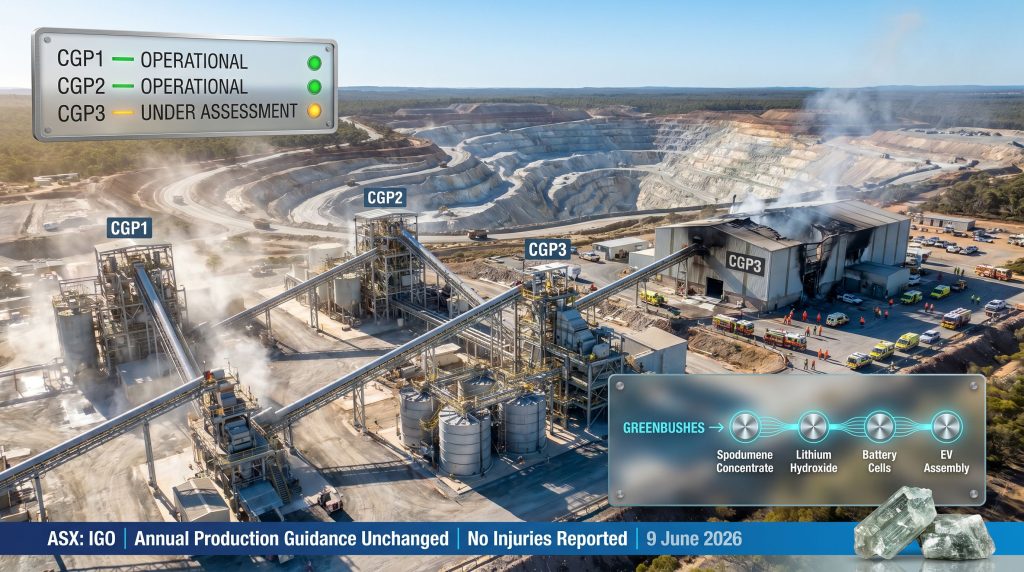
The fire broke out on 9 June 2026 at Chemical Grade Plant 3, known within the operation as CGP3. According to reports covering the incident, by the time public disclosure was made, the fire had been extinguished and no injuries had been reported among site personnel. Talison Lithium immediately initiated a full investigation into the origin and cause of the incident, with damage assessment and repair scoping underway.
Critically, the fire was confined to CGP3. The broader Greenbushes complex operates multiple processing facilities, each functioning as a semi-independent production unit. The operational status of the three primary chemical grade plants at the time of the incident was as follows:
| Processing Plant | Post-Incident Status | Function |
|---|---|---|
| CGP1 | Fully operational | Legacy chemical-grade spodumene processing |
| CGP2 | Fully operational | Expanded chemical-grade processing capacity |
| CGP3 | Fire occurred; under damage assessment | Newer capacity addition; extent of damage under review |
This compartmentalised architecture is not accidental. Large-scale hard-rock lithium operations have increasingly adopted modular processing designs precisely because they limit single-point failure risk. A fire that disables one processing train does not propagate to others unless interconnected systems are compromised. Furthermore, the fact that CGP1 and CGP2 continued operating normally is the single most important operational variable in assessing the near-term production impact of this event.
Fire Hazard Profiles in Lithium Spodumene Processing
Chemical grade processing plants in hard-rock lithium operations present a distinct fire risk profile compared to open-pit extraction areas. Understanding these risks is relevant context for assessing how such incidents originate and propagate.
Key fire hazard categories in spodumene processing environments include:
- Conveyor belt systems carrying dry ore and concentrate, which can generate friction-based ignition points and provide substantial fuel loads
- Electrical infrastructure, including switchrooms, motor control centres, and high-voltage cabling running through dense industrial environments
- Reagent storage areas containing chemical inputs used in froth flotation and other beneficiation processes
- Dust management systems where fine lithium-bearing particulates, if allowed to accumulate, can create conditions conducive to combustion or deflagration events
- Lubrication and hydraulic systems associated with heavy processing equipment
The investigation into the CGP3 fire will systematically examine each of these categories. Under Western Australia's Mines Safety and Inspection Act 1994, operators are required to notify the Department of Mines, Industry Regulation and Safety (DMIRS) of serious incidents and to preserve scene integrity for forensic assessment. The investigation process at an ASX-listed operation of this scale typically follows a structured sequence:
- Scene preservation and access control to protect forensic evidence
- Electrical fault analysis covering all systems within the affected zone
- Process equipment review examining mechanical failure modes
- Human factors assessment covering operational procedures and shift records
- Structural and instrumentation damage quantification
- Regulatory notification and compliance reporting to DMIRS
- Repair scope development and contractor mobilisation
- ASX disclosure of findings once material conclusions are reached
Production Guidance and What It Actually Signals
IGO confirmed following the incident that annual production guidance for Greenbushes remains unchanged. This is a significant statement, but it requires careful interpretation, particularly for investors who may take it at face value without understanding the nuances embedded in how mining companies communicate during active damage assessments.
A guidance confirmation issued in the immediate aftermath of an incident reflects the information available at that moment. It signals that the operator does not currently anticipate a material production shortfall, but it does not constitute a guarantee against subsequent revision. The damage assessment for CGP3 was ongoing at the time of the initial disclosure, meaning the full cost and timeline implications of restoring the plant to service had not yet been quantified.
Investor Caution: In mining operations, early-stage incident disclosures are intentionally conservative. A statement confirming unchanged guidance at the time of an incident does not preclude future revision if investigation findings reveal greater-than-initially-anticipated damage. Investors should treat follow-up ASX announcements as the primary source of updated material information.
The risk matrix for the Greenbushes fire across different time horizons can be assessed as follows:
| Risk Dimension | Short-Term (0 to 3 Months) | Medium-Term (3 to 12 Months) |
|---|---|---|
| Production volume | Maintained via CGP1 and CGP2 | Dependent on CGP3 repair timeline |
| Guidance revision risk | Low based on initial disclosure | Moderate if CGP3 damage is extensive |
| Insurance and cost impact | Under active assessment | Repair costs and insurance recovery to be quantified |
| Supply chain disruption | Minimal at this stage | Contingent on investigation findings |
| Regulatory scrutiny | Elevated during investigation period | Expected to normalise post-findings |
How Lithium Markets Process Operational Disruption Signals
Spodumene concentrate and lithium chemical spot markets respond differently to supply disruption news depending on the severity and duration of the disruption. Short-lived, contained incidents at multi-plant operations with confirmed guidance maintenance tend to produce muted fundamental market responses, even when equity markets react more sharply.
The distinction between a sentiment-driven equity sell-off and a fundamentals-driven commodity price move is important. When news of the fire at Greenbushes emerged, IGO shares experienced downward pressure as investors processed uncertainty about the extent of CGP3 damage. This is a rational response to information asymmetry, not necessarily a signal that the underlying lithium supply picture had materially changed.
Historically, lithium spot prices have shown sensitivity to production disruption signals from major operations, but the magnitude of the price response has been closely correlated with the proportion of global supply at risk. Given that CGP3 represents one plant within a multi-plant complex, and that CGP1 and CGP2 remained operational, the structural supply impact in the near term appears limited.
A nuance worth noting: Greenbushes operates in a lithium market that has experienced significant price volatility since the 2022 to 2023 peak cycle. Spodumene concentrate prices, which reached extraordinary highs above USD $8,000 per tonne in late 2022, have since retreated substantially. In this environment, any supply disruption signal at a top-tier operation carries amplified psychological weight even when the fundamental impact is contained, because market participants are acutely sensitised to factors that could shift the supply-demand balance.
The Systemic Significance of Greenbushes to Global Lithium Supply
What makes the fire at Greenbushes lithium operation more than a local operational story is the site's disproportionate role in the global lithium supply chain. The concentration of world-class hard-rock lithium mining operations across a small number of countries — primarily Australia, Chile, and Argentina — means that individual site-level events at the largest operations carry systemic implications.
Greenbushes consistently ranks among the world's largest producers of spodumene concentrate by volume. Its grade advantage over competing deposits translates into a structural cost advantage that makes it a foundational supplier across multiple processing relationships. Chemical converters in China in particular have developed supply chain configurations that assume reliable Greenbushes output as a baseline input.
The Downstream Dependency Chain
The depth of downstream dependency on Greenbushes output is not always appreciated by investors focused purely on the mine economics. Consider the compounding sensitivity:
- A sustained reduction in Greenbushes spodumene output creates inventory pressure at Chinese lithium hydroxide converters
- Converter inventory drawdowns elevate spot prices for spodumene concentrate, affecting competing supply sources
- Tightening lithium hydroxide availability pushes cathode material costs higher for battery manufacturers
- Elevated battery material costs compress margins for battery cell producers and their EV manufacturer customers
This cascade effect means the systemic consequences of a prolonged Greenbushes disruption would be substantially larger than a simplistic volume analysis would suggest. The fire at CGP3, while contained, is a useful reminder of this leverage. Investors monitoring the Greenbushes controversy more broadly will recognise this incident as yet another chapter in a complex operational narrative.
The next major ASX story will hit our subscribers first
Key Milestones to Monitor Following the Incident
For investors and industry observers tracking developments, the following disclosure triggers represent the most material information events to watch:
- Damage assessment completion from Talison Lithium confirming the scope and cost of CGP3 restoration
- Cause determination from the formal investigation, which may have implications for insurance recovery and regulatory response
- DMIRS regulatory determination regarding compliance and any required remediation actions
- IGO's quarterly production report providing the first quantified Greenbushes output data following the incident
- Any guidance revision announcement from IGO if investigation findings alter the production outlook
- Insurance recovery disclosures quantifying the financial offset against repair and any lost-production costs
Furthermore, investor commentary on the fire damage at CGP3 suggests that market participants are watching these milestones with particular attention given the broader context of lithium price volatility.
Frequently Asked Questions: Fire at Greenbushes Lithium Operation
Was anyone injured in the Greenbushes fire on 9 June 2026?
No. Both IGO and Talison Lithium confirmed that no site personnel sustained injuries as a result of the fire at CGP3.
Which facility was affected at Greenbushes?
The fire occurred at Chemical Grade Plant 3 (CGP3). Chemical Grade Plants 1 and 2 remained unaffected and continued normal operations.
Has production guidance changed following the fire?
At the time of initial disclosure, IGO confirmed that annual production guidance for Greenbushes remains unchanged. The damage assessment for CGP3 was ongoing, and investors should monitor subsequent ASX announcements for any updates.
Who operates the Greenbushes lithium mine?
The operation is run by Talison Lithium, a joint venture entity in which IGO Limited (ASX: IGO), Tianqi Lithium, and Albemarle Corporation hold ownership interests.
What caused the fire at CGP3?
The cause remains under active investigation. Talison Lithium has commenced a formal investigation process, and findings have not yet been publicly disclosed.
What does this mean for global lithium supply?
Given the continued operation of CGP1 and CGP2 and the confirmed maintenance of production guidance, the near-term fundamental supply impact is assessed as limited. However, investors should monitor the CGP3 repair timeline and subsequent IGO disclosures closely.
Operational Resilience as a Critical Minerals Investment Variable
The Greenbushes incident raises a broader question that the critical minerals investment community is increasingly being forced to address: how should operational resilience be priced into the valuation of hard-rock lithium assets?
Traditional mining valuation frameworks focus on grade, tonnage, strip ratio, and processing recovery rates. Fire risk, plant redundancy design, and emergency response capability have historically been treated as qualitative footnotes rather than quantifiable valuation inputs. As lithium operations scale up globally to satisfy accelerating EV demand, the operational risk profile of processing infrastructure is becoming an increasingly material consideration for institutional investors, project financiers, and insurers.
Multi-plant architectures like the one at Greenbushes — where CGP1, CGP2, and CGP3 function as independent processing units — represent a deliberate engineering response to single-point failure risk. This design philosophy is not universal across the lithium sector. Several competing operations, particularly newer projects with single-train processing configurations, would face complete production cessation from a similar incident. In addition, innovations such as direct lithium extraction technology are increasingly being evaluated partly on the basis of their operational resilience characteristics.
The fire at Greenbushes lithium operation, while contained and apparently limited in its immediate production impact, serves as a timely prompt for both operators and investors to scrutinise the resilience architecture of critical mineral processing facilities with the same rigour applied to geological and financial risk assessment.
This article is intended for informational purposes only and does not constitute financial advice. Forward-looking statements, production guidance assessments, and market impact analysis are based on information available at the time of writing and are subject to change as investigation findings and subsequent company disclosures become available. Investors should conduct their own due diligence and consult a licensed financial adviser before making investment decisions.
Want to Stay Ahead of Significant ASX Mineral Discoveries Before the Broader Market Reacts?
The Greenbushes incident underscores just how rapidly operational disruptions at critical mineral operations can move markets — and how quickly informed investors need to act. Discovery Alert's proprietary Discovery IQ model delivers real-time alerts on significant ASX mineral discoveries, transforming complex mineral data into actionable insights the moment announcements hit the exchange; explore historic discoveries and their returns to understand the scale of opportunity, then begin your 14-day free trial at Discovery Alert to position yourself ahead of the market.