June 10, 2026
The Processing Bottleneck Nobody Talks About in the Lithium Debate
Most conversations about lithium supply focus on where the metal is found. The more consequential question is where it gets transformed. Ore in the ground is inert potential. What determines whether that potential reaches an EV battery is the chemistry that converts raw mineral into battery-grade compound, and for decades, that chemistry has been dominated by one country, run at enormous energy cost, and largely invisible to public debate.
This is the real constraint shaping the global energy transition. Not the geology, which is reasonably well distributed across multiple continents, but the processing infrastructure, which is geographically concentrated to a degree that creates genuine strategic vulnerability. Understanding why that concentration exists, and what it would take to break it open, requires a closer look at the mineral itself.
When big ASX news breaks, our subscribers know first
What Makes Spodumene So Difficult to Refine
Spodumene, the primary lithium-bearing hard-rock mineral, has the chemical formula LiAlSi₂O₆. Its structure is a dense lithium-aluminium pyroxene silicate, which means the lithium content is locked tightly within a silica matrix that does not release its constituents easily. This structural resistance is the central challenge of hard-rock lithium processing, and it has historically required extreme solutions.
Conventional refining subjects crushed spodumene ore to temperatures exceeding 1,050°C (approximately 1,900°F). This thermal treatment converts alpha-spodumene, which is chemically inert and highly resistant, into beta-spodumene, a more reactive polymorph that can be attacked with sulphuric acid in subsequent leaching steps. The roasting stage is not a minor preprocessing step. It is the energy and cost centrepiece of the entire operation, accounting for the substantial carbon footprint and high capital requirements that have historically made spodumene lithium extraction far more expensive than brine-based extraction methods.
Industry context: The cost gap between hard-rock and brine lithium has long made South American salar operations the preferred source of battery-grade supply. Hard-rock projects in Australia, Canada, and the United States have generally required higher lithium prices to justify the additional processing expense, creating cyclical investment barriers.
Silica has typically been treated as the enemy in this process, an inert obstacle that must be thermally destroyed before anything useful can be recovered. This assumption held for decades. Then a researcher at MIT remembered a bathroom renovation.
MIT Lithium Extraction from Spodumene: The Chemistry Behind the Breakthrough
The conceptual origin of MIT's process stretches back roughly 25 years, when Yet-Ming Chiang, MIT's Kyocera Professor of Materials Science and Engineering, encountered an ammonium fluoride etching cream at a hardware store during a home renovation. The product dissolved silica on glass surfaces at room temperature. Chiang noted this and filed it away.
When later confronting the challenge of breaking apart spodumene, he connected that earlier observation to the silica-rich structure of the mineral. If ammonium fluoride could dissolve silica in glass at ambient temperatures, perhaps the same chemistry could disrupt the silica matrix binding lithium within spodumene ore. Experiments confirmed the intuition.
What makes this insight non-obvious, and what gives it genuine scientific weight, is that silica dissolution had always been framed as the problem to overcome rather than the mechanism to exploit. The MIT team inverted the entire logic of the process. Rather than destroying silica through heat so that lithium could be accessed, they dissolved silica at room temperature, simultaneously liberating lithium, aluminium, and silica into solution without any thermal roasting step.
Step-by-Step: How the MIT Closed-Loop Process Works
The process sequence is elegantly circular:
-
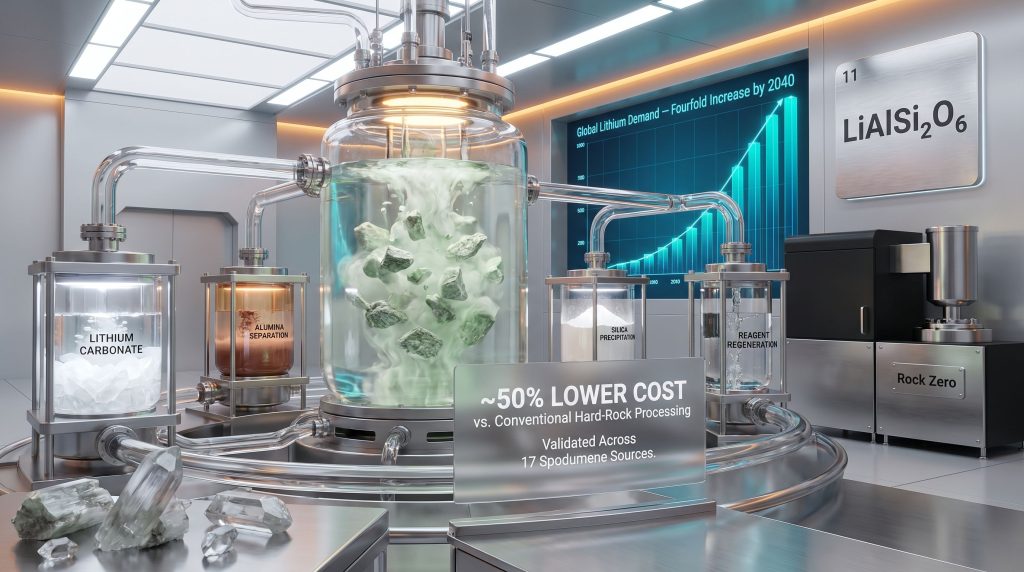
Dissolution – Spodumene ore is combined with an ammonium fluoride solution at room temperature. The silica matrix dissolves, releasing lithium, aluminium, and silica simultaneously into the liquid phase.
-
Lithium Recovery – Battery-grade lithium compounds are precipitated from solution by introducing either carbon dioxide (producing lithium carbonate) or sodium carbonate (producing lithium hydroxide), the two primary compounds used in cathode manufacturing.
-
Aluminium Separation – The aluminium-rich fraction of the solution is subjected to a targeted high-temperature separation step, recovering smelter-grade alumina suitable for commercial aluminium production.
-
Silica Precipitation – Ammonia gas released during the aluminium recovery stage is reintroduced into the remaining solution, causing cement-grade silica to precipitate out as a recoverable solid co-product.
-
Reagent Regeneration – The precipitation of silica in step four simultaneously regenerates the ammonium fluoride solution, returning it to its starting condition for continuous reuse in a closed loop.
As Chiang explained in describing the process to Metal Tech News, the dissolution of spodumene liberates all constituent elements including aluminium and lithium, with silica remaining in solution. When ammonia gas is reapplied, it precipitates the silica back out of solution, and this precipitation step is precisely what reconstitutes the starting ammonium fluoride. That sequence is what makes it a genuinely circular process rather than a batch operation with a waste stream.
What is the MIT lithium extraction process from spodumene?
MIT researchers developed a room-temperature, closed-loop method using ammonium fluoride solution to dissolve spodumene ore without high-temperature roasting. The process recovers battery-grade lithium salts, smelter-grade alumina, and cement-ready silica as co-products, while continuously regenerating the solvent for reuse, achieving near-zero waste output.
How MIT's Method Compares to Conventional Processing
The performance gap between the MIT approach and conventional spodumene refining is substantial across multiple dimensions:
| Parameter | Conventional Processing | MIT Closed-Loop Process |
|---|---|---|
| Roasting Temperature | >1,050°C (1,900°F) | Room temperature (ambient) |
| Primary Reagent | Sulphuric acid | Ammonium fluoride (water-based) |
| Energy Intensity | High (thermal roasting + acid leaching) | Significantly lower (no roasting stage) |
| Estimated Cost vs. Conventional | Baseline | Approximately 50% lower |
| Lithium Output | Battery-grade Li carbonate/hydroxide | Battery-grade Li carbonate/hydroxide |
| Aluminium Recovery | Typically discarded as waste | Smelter-grade alumina (marketable) |
| Silica Recovery | Typically discarded as waste | Cement-grade silica (marketable) |
| Solvent Reuse | Limited | Closed-loop regeneration |
| Waste Generation | Significant acid waste streams | Near-zero (circular process) |
| Deposit Versatility | Varies by ore chemistry | Validated across 17 spodumene sources |
The cost comparison is particularly significant. MIT researchers estimate the closed-loop process could reduce processing costs by approximately 50% relative to conventional hard-rock methods, bringing hard-rock lithium into cost parity with lithium brines, which has historically been the lowest-cost source globally. When the revenue contribution from aluminium and silica co-products is factored in, the unit economics improve further, as those materials effectively subsidise the cost of lithium recovery.
Camden Hunt, a former project manager at MIT's Center for Electrification and Decarbonization of Industry, framed the broader supply challenge clearly in reporting by Metal Tech News: the world needs to quadruple lithium production by 2040, equivalent to hundreds of new producing assets, and while hard-rock deposits are geologically abundant and globally distributed, the vast majority of hard-rock conversion capacity currently sits in China.
Why Deposit Versatility Is an Underappreciated Advantage
One technically significant but frequently overlooked aspect of the MIT process is its validation across 17 distinct spodumene rock sources. This matters more than it might initially appear.
Spodumene deposits are not uniform. Natural mineralogical variability between deposits, and sometimes within the same deposit, means that a processing method optimised for one ore chemistry may underperform on another. Furthermore, the conventional acid-leach approach shows varying lithium recovery rates depending on the specific silica structure, impurity profile, and particle characteristics of the ore being processed.
A process demonstrated to work consistently across 17 geologically diverse sources suggests genuine adaptability to the natural variability that any commercial-scale operation would encounter. This also strengthens the case for licensing the technology broadly, since operators in geologically distinct regions could deploy the same process without extensive site-specific chemistry modifications. MIT's low-cost technique for processing lithium from rocks represents a meaningful departure from the assumptions that have governed hard-rock refining for decades.
The Closed-Loop Advantage at Commercial Scale
From a pure process engineering perspective, the circular reagent regeneration built into the MIT process carries advantages that compound at scale:
- Ongoing reagent costs are minimised because ammonium fluoride is continuously regenerated rather than consumed
- Near-zero waste output eliminates the need for costly acid effluent treatment infrastructure
- The absence of large-scale acid waste streams reduces environmental permitting complexity, which is a material barrier to new lithium project development in Western jurisdictions
- Modular process design lowers the capital threshold for deployment, making smaller-scale or regionally distributed installations economically viable
- Co-product marketability converts what were previously cost centres (aluminium and silica disposal) into revenue streams
Co-Product Economics: From Waste to Working Capital
| Co-Product | Recovered Form | End Market |
|---|---|---|
| Lithium Carbonate | Battery-grade | EV cathodes, grid storage |
| Lithium Hydroxide | Battery-grade | High-nickel NMC cathode manufacturing |
| Alumina | Smelter-grade | Aluminium smelting, advanced ceramics |
| Silica | Cement-grade | Construction materials, cement additives |
The researchers explicitly evaluated whether global aluminium and silica markets could absorb the co-product volumes that would be generated if the process were scaled to support 100 terawatt-hours of cumulative battery production, a figure representing a substantial portion of projected long-term EV and grid storage demand. That analysis returned a favourable conclusion, suggesting the co-product volumes would not cause commodity price displacement at the scales anticipated.
Analyst perspective: The ability to monetise aluminium and silica from what is effectively a lithium processing operation changes the business model fundamentally. At large scale, co-product revenues are not marginal adjustments to project economics; they are structural contributors to profitability that could make otherwise marginal deposits commercially viable.
The next major ASX story will hit our subscribers first
Strategic Implications for Western Supply Chains
The geographic concentration of hard-rock lithium conversion capacity is not an accident of geology. It reflects decades of Chinese investment in the downstream processing infrastructure that Western nations largely chose not to develop. The result is a structural vulnerability for EV manufacturers, battery cell producers, and governments that have committed to electrification timelines.
MIT's process directly addresses this by lowering the technical and capital barriers to establishing domestic conversion capacity. A process that requires no high-temperature roasting infrastructure, generates minimal waste streams, and can be scaled modularly is far more amenable to deployment in North America, Europe, and Australia than conventional mega-refinery designs. Consequently, it presents a compelling case for reshaping the global lithium market in ways that reduce single-point concentration risk.
Hunt described the alignment between the MIT process and the push to onshore critical mineral production in the United States, noting that finding an easier way to crack spodumene and produce battery-grade lithium salts at lower cost has the potential to reshape lithium supply chain development domestically.
Policy frameworks across major Western economies, including the U.S. Inflation Reduction Act and the EU Critical Raw Materials Act, do prioritise domestic battery mineral processing. These frameworks create a policy environment in which technology that enables Western-based hard-rock refining is commercially well-positioned, though it should be noted that Rock Zero has not, to date, announced any specific government funding or project designation in connection with these frameworks.
From Laboratory Chemistry to Rock Zero: The Commercialisation Pathway
Validating a chemistry at bench scale and deploying it commercially at the volumes required to influence global lithium supply are separated by an engineering chasm that has ended many promising laboratory discoveries. The MIT team is pursuing commercialisation through Rock Zero, a startup operating within The Engine, MIT's nonprofit hard-tech incubator and venture capital ecosystem.
The Engine model is specifically designed for deep-tech ventures with long development timelines, providing patient capital, engineering infrastructure, and industry connectivity that conventional venture capital frameworks are poorly suited to supply. This institutional context matters because the lithium processing industry is not forgiving of under-capitalised or prematurely launched commercial ventures.
Benjamin Mowbray, a former MIT postdoctoral researcher and co-developer of the process, outlined the commercial readiness requirements clearly: producing target products is only the first step. Characterising purity and confirming compliance with end-market specifications for battery-grade lithium, smelter-grade aluminium, and construction-grade silica are all prerequisites before commercial deployment becomes viable. Any product stream that fails to meet market specifications does not become a co-product; it becomes a waste stream, which would undermine the core economic logic of the process.
In addition, the broader context of battery raw materials market dynamics means that the timing of Rock Zero's commercial scale-up will be closely watched by producers, cell manufacturers, and policymakers alike.
Commercialisation scenario: Rock Zero could pursue at least two distinct business model pathways. As a technology licensor, it could deploy the chemistry across multiple mining operations without taking ownership of ore supply. As a toll processor, it could accept spodumene concentrates from diverse sources and return battery-grade compounds. Either model allows rapid scaling without the capital intensity of greenfield mine development, but each carries different risk and revenue dynamics that will ultimately depend on how quickly pilot-scale validation can be completed.
How Does MIT Lithium Extraction from Spodumene Compare to Direct Extraction Approaches?
It is worth noting that while the MIT process specifically targets hard-rock spodumene feedstocks, parallel innovation is also reshaping brine-based production. Direct lithium extraction technologies are advancing independently and address a different segment of the supply base. However, the MIT closed-loop method for hard-rock processing is arguably more strategically significant given the geographic distribution of spodumene deposits relative to brine resources. MIT Technology Review's coverage of the breakthrough highlights how the approach could fundamentally alter the economics of lithium production from hard-rock sources.
Key Takeaways for the Battery Materials Industry
| Theme | Core Implication |
|---|---|
| Energy Reduction | Elimination of high-temperature roasting dramatically lowers process energy intensity |
| Cost Competitiveness | ~50% cost reduction vs. conventional hard-rock; competitive with brine extraction |
| Supply Chain Geography | Enables domestic processing in ore-rich Western nations, reducing single-point concentration risk |
| Circular Economy | Near-zero waste through closed-loop reagent regeneration |
| Co-Product Revenue | Aluminium and silica recovery creates additional revenue per tonne of ore processed |
| Deposit Versatility | Validated across 17 spodumene sources, suggesting broad applicability |
| Commercialisation Stage | Early-stage deep-tech startup (Rock Zero) backed by MIT incubator infrastructure |
The broader significance of MIT lithium extraction from spodumene extends beyond any single process improvement. It represents a conceptual reframing of hard-rock lithium refining, one that treats the mineral's full constituent profile as an asset rather than an obstacle. Whether Rock Zero can translate that reframing into commercial-scale reality will be one of the more consequential technology development stories in battery materials over the next decade.
This article contains references to early-stage technology under commercial development. Statements regarding cost projections, co-product economics, and scaling potential are based on laboratory and modelling results and should not be interpreted as guarantees of commercial performance. Investors and industry participants should conduct independent due diligence.
Want to Capitalise on the Next Major Mineral Discovery Before the Broader Market Does?
Discovery Alert's proprietary Discovery IQ model delivers real-time ASX alerts on significant mineral discoveries — including lithium and other battery materials — instantly converting complex data into actionable investment insights for both short-term traders and long-term investors. Explore historic discoveries and their remarkable returns on Discovery Alert's dedicated discoveries page, and begin your 14-day free trial today to secure a market-leading edge.