June 10, 2026
The Refining Bottleneck Nobody Talks About
Battery metals conversations almost always gravitate toward mining. Headline deposits, drill results, grade announcements. But the more consequential constraint sitting inside the U.S. electric vehicle supply chain is not ore in the ground. It is the industrial capacity to transform that ore into something a battery factory can actually use. Lithium hydroxide, the battery-grade chemical feedstock that powers modern cathode chemistries, requires sophisticated processing infrastructure that the United States has barely begun to build domestically.
That gap is the real story behind the ABTC Tonopah Flats lithium refinery grant being reinstated by the U.S. Department of Energy in June 2026. The event is not simply a federal funding headline. It marks a milestone in the slow, difficult process of constructing an entirely new processing industry on American soil, one capable of converting unconventional domestic lithium sources into the refined chemical outputs that battery manufacturers actually purchase.
When big ASX news breaks, our subscribers know first
Why Domestic Lithium Processing Sits at the Centre of Supply Chain Risk
The structure of global lithium supply chains reveals an uncomfortable reality for U.S. manufacturers. Even when lithium-bearing rock is mined domestically, the overwhelming majority of refining capacity that converts raw material into battery-grade lithium hydroxide currently sits offshore, concentrated primarily in China. According to the International Energy Agency, China controlled approximately 60% of global lithium refining capacity as of recent years, a concentration that creates systemic exposure for any downstream manufacturer dependent on that supply pathway.
This is not a mining problem. The United States has identified substantial lithium resources across Nevada, North Carolina, and elsewhere. The structural vulnerability lies one step downstream, at the point where lithium-bearing material is chemically converted into a specification-controlled product that a cathode manufacturer can accept. Building that conversion capacity domestically requires purpose-built facilities, novel processing technology in some cases, and the capital certainty that federal cost-share programs are specifically designed to provide.
Why Claystone Lithium Changes the Processing Equation
Most public discussion of lithium sources centres on two established types: lithium brine operations (where lithium-rich saltwater is pumped from underground aquifers and concentrated through solar evaporation) and spodumene extraction from hard-rock mining (where lithium-bearing pegmatite is mined, crushed, and roasted before chemical conversion). Both are well-understood, commercially mature approaches.
Claystone lithium, by contrast, represents a third pathway that is less widely understood but potentially significant for the United States specifically. Nevada's geology contains substantial quantities of lithium-bearing sedimentary claystone, a rock type formed through ancient volcanic and hydrothermal processes that deposited lithium within fine-grained clay minerals. The extraction chemistry differs fundamentally from brine or spodumene processing, requiring purpose-developed leaching and purification approaches rather than existing off-the-shelf flowsheets.
This novelty carries both opportunity and risk. On the upside, claystone deposits in Nevada are large, near-surface, and concentrated within a jurisdiction that already has developed mining infrastructure. On the risk side, scaling a novel extraction technology from pilot to commercial production introduces execution uncertainty that more conventional lithium sources do not face to the same degree.
Inside the Tonopah Flats Resource: Scale That Commands Attention
The Tonopah Flats Lithium Project sits in Nevada's Big Smoky Valley, occupying more than 10,000 acres of federally managed land. American Battery Technology Company (ABTC) acquired the project in 2021 and has since progressed it through systematic exploration, pilot-scale extraction testing, and federal permitting processes.
The resource figures reported from the most recent calculation position this project among the largest identified lithium accumulations in the country:
| Resource Category | Tonnage | Average Grade (ppm Li) | Contained Lithium (MT) |
|---|---|---|---|
| Measured | 1.13 billion MT | 876 ppm | ~978,000 MT |
| Indicated | 2.53 billion MT | 639 ppm | ~1.62 million MT |
| Inferred | 2.15 billion MT | 423 ppm | ~911,000 MT |
| Combined Total | ~5.81 billion MT | Blended | ~3.51 million MT |
Several aspects of this resource warrant closer examination beyond the headline tonnage figures. The measured resource grade of 876 ppm lithium is worth contextualising. While this figure sits below the lithium concentrations typically found in high-grade spodumene pegmatites (which can run at several thousand ppm lithium equivalent), claystone deposits compensate through sheer volume and near-surface mineable geometry. The economic logic shifts from high-grade selectivity to bulk-scale throughput, which changes the capital and operating cost profile considerably.
The grade differential between measured (876 ppm), indicated (639 ppm), and inferred (423 ppm) categories also reflects the typical pattern in large sedimentary systems, where the highest-confidence, most intensively drilled zones tend to coincide with higher-grade mineralisation cores, while grade tapers toward the edges of the system as drilling density decreases.
A combined measured, indicated, and inferred resource exceeding 5.8 billion metric tons with more than 3.5 million metric tons of contained lithium across all categories places Tonopah Flats in a distinct tier of domestic lithium development projects.
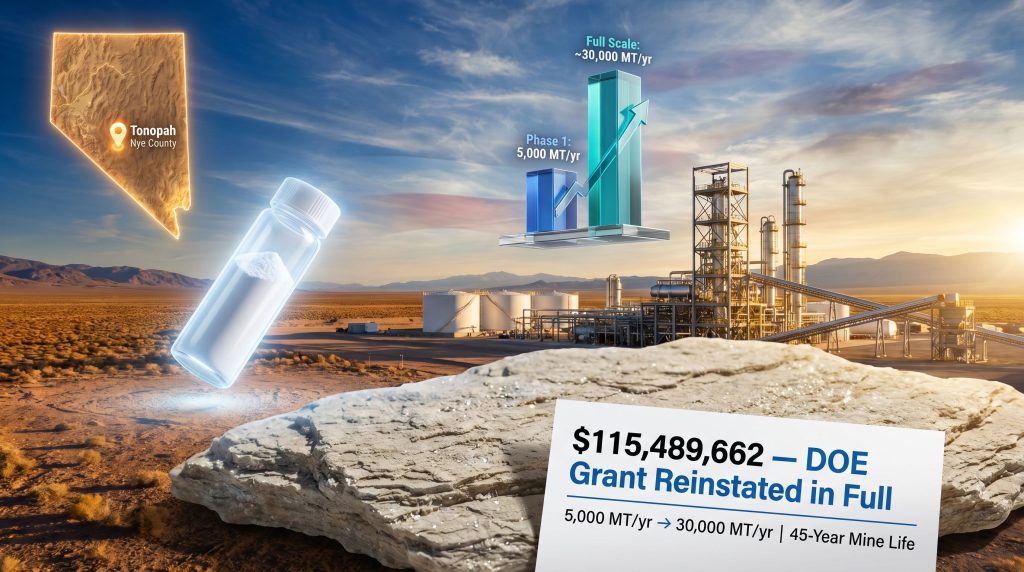
A pre-feasibility study released in October 2025 translated this resource into a staged production scenario targeting approximately 30,000 metric tons per year of battery-grade lithium hydroxide at full commercial scale, sustained across a projected 45-year mine life. The staged approach begins with a Phase 1 refinery targeting 5,000 metric tons per year, designed to prove commercial-scale operability before subsequent capital deployments expand throughput.
The DOE Grant: Structure, Termination, and Full Reinstatement
A Funding Timeline Worth Understanding in Detail
The financial architecture of the DOE grant program deserves careful attention because the cost-share structure it employs carries specific implications for project risk allocation:
| Grant Element | Detail |
|---|---|
| Total program value | $115,489,662 |
| DOE federal contribution | $57,744,831 (~50%) |
| ABTC matched contribution | $57,744,831 (~50%) |
| Original grant award | 2022 |
| Grant termination notice | October 2025 |
| Final DOE review meeting | December 2025 |
| Full reinstatement confirmed | June 2026 |
| Updated project period end | December 31, 2029 |
The 50/50 cost-share structure is a deliberate feature of DOE's grant design philosophy for first-of-kind processing infrastructure. By requiring the private recipient to match federal contributions dollar-for-dollar, the program filters for projects where the developer has sufficient capital conviction and commercial confidence to commit equivalent funding alongside federal dollars. This co-investment structure also aligns incentives: the developer bears real downside exposure, not just upside participation.
Why the Termination Happened and What Reinstatement Required
The October 2025 termination of ABTC's grant was part of a sweeping federal review process that affected hundreds of DOE-funded programs simultaneously. This context matters for interpreting the event accurately: the termination was not triggered by any project-specific performance failure, technical setback, or change in ABTC's circumstances.
What followed is the less-understood part of the story. Rather than accepting the termination as final, ABTC invoked DOE's Informal Dispute Resolution process, a formal appeals mechanism that requires the appealing party to submit comprehensive technical performance data, commercial milestone documentation, and evidence of contractual compliance. This is not a routine administrative step. It places the project under renewed scrutiny by DOE technical and commercial evaluators who must assess whether the grant meets the threshold for reinstatement.
The standard is demanding. According to reporting from the Canadian Mining Journal, DOE's reinstatement determination in June 2026 confirmed that ABTC had met all contracted milestones through the period of performance. This conclusion carries weight beyond the funding outcome itself: it represents an independent technical validation of the project's execution quality by a federal agency with direct access to all project data.
The fact that DOE reinstated the grant in full, with no reduction in award amount and no modification to technical or commercial milestones, signals that the project's progress met the evidentiary bar required under the dispute resolution framework.
Phase 1 Refinery: What 5,000 Metric Tons Per Year Actually Means
Contextualising the Output Target Against U.S. Demand
Five thousand metric tons per year of battery-grade lithium hydroxide is a figure that requires industry context to interpret meaningfully. A single large-format EV battery gigafactory operating at full capacity can consume lithium hydroxide measured in tens of thousands of metric tons annually. By that yardstick, Phase 1 output represents a contribution rather than a solution.
However, this framing misses the strategic purpose of staged project development. Phase 1 serves three functions simultaneously:
-
Commercial validation of ABTC's proprietary claystone extraction process at production scale, generating real operational data that de-risks subsequent expansion phases.
-
Supply chain entry by establishing a domestic lithium hydroxide producer with operational credentials, allowing battery manufacturers to begin qualifying the product against their cathode specification requirements.
-
Capital pathway demonstration that reduces the perceived technology risk for the institutional financing required to fund the much larger Phase 2 and beyond expansions toward the 30,000 metric ton/year target.
The jump from 5,000 to 30,000 metric tons per year is not simply a matter of replicating Phase 1 infrastructure six times. Scaling hydrometallurgical processing operations involves non-linear complexity in reagent management, water handling, waste stream processing, and product quality control. This is precisely why the staged approach carries strategic logic that a single large-scale construction attempt would not.
The Technology Platform: Claystone-to-Lithium Extraction
ABTC's processing approach for Tonopah Flats is distinct from both brine and hard-rock lithium processing methodologies. Furthermore, advances in direct lithium extraction technology are increasingly relevant to how claystone-hosted resources might be processed at commercial scale. Claystone-hosted lithium is bound within the crystal lattice of clay minerals, primarily hectorite-type smectite clays in the case of many Nevada deposits.
Liberating that lithium requires acid or alkaline leaching conditions that break down the clay structure, followed by purification steps to remove co-dissolved impurities before the final conversion to lithium hydroxide. The challenge is that claystone leaching generates significant volumes of fine-grained residue that must be managed, and the selectivity of the leach for lithium over co-present elements like magnesium, aluminium, and silicon requires careful chemistry optimisation. The pilot-scale work that ABTC has conducted to advance to pre-feasibility represents the critical empirical foundation for understanding how these process variables behave at increasing scale.
Risk Factors That Informed Investors Must Assess
The ABTC Tonopah Flats lithium refinery grant reinstatement removes one category of risk from the project's profile. However, several material uncertainties remain:
-
Permitting complexity: Construction on federally managed land involves NEPA environmental review processes that can extend timelines significantly and introduce outcomes that are difficult to predict at the project planning stage. In addition, underground lithium mining developments in other jurisdictions illustrate how permitting complexity can affect even well-capitalised projects.
-
Technology scale-up execution: Moving from pilot-scale to commercial-scale claystone processing has not been done before at the throughput levels Tonopah Flats requires. First-mover advantage and first-mover execution risk are two sides of the same coin.
-
Lithium hydroxide price sensitivity: The lithium carbonate market and hydroxide prices have experienced substantial volatility in recent years, moving from historic lows to multi-year highs and back within compressed timeframes. Project economics at the pre-feasibility stage are highly sensitive to the price assumption embedded in the model.
-
Capital requirement beyond the grant: The DOE grant covers Phase 1 refinery construction within a defined cost-share envelope. Subsequent phases require additional capital formation at a scale that will demand either project finance, offtake-backed debt, or equity raising.
The next major ASX story will hit our subscribers first
What the Reinstatement Signals Beyond the Funding Itself
A Precedent for DOE's Dispute Resolution Mechanism
The successful reinstatement of the ABTC grant through DOE's Informal Dispute Resolution process establishes a practical precedent that other critical mineral developers navigating similar termination events should study carefully. The process demonstrated that a well-documented record of milestone achievement can survive a federal funding review that terminated hundreds of other grants simultaneously.
For developers currently holding DOE grants across the critical minerals processing portfolio, this outcome underlines the importance of maintaining rigorous milestone documentation and technical reporting throughout the grant performance period. Consequently, this applies not just as administrative compliance, but as the evidentiary foundation for any future dispute resolution proceeding.
The Project Finance Signalling Effect
For institutional investors and project finance lenders evaluating Tonopah Flats, the reinstatement outcome delivers a signal that extends beyond the dollar value of the reinstated federal contribution. A DOE technical review that independently confirms milestone achievement represents a form of third-party due diligence that private capital markets rarely receive for early-stage processing projects.
The cost-share structure also means that for every dollar of federal funding that flows into Phase 1 construction, an equivalent dollar of ABTC capital follows. This alignment reduces the moral hazard concerns that can complicate project finance assessments for government-supported developments. Details of the project's technical scope confirm the scale of what ABTC is attempting to deliver within the Phase 1 envelope.
Frequently Asked Questions
What is the ABTC Tonopah Flats lithium refinery grant?
A U.S. Department of Energy grant totalling $115,489,662, structured as a 50/50 cost-share between DOE ($57,744,831) and ABTC ($57,744,831), awarded to fund construction of the first phase of a commercial-scale lithium hydroxide refinery at the Tonopah Flats Lithium Project in Nevada.
Why was the DOE grant terminated in October 2025?
The termination occurred as part of a broad federal funding review that affected hundreds of DOE grants across multiple programs simultaneously. It was not triggered by any project-specific performance failure on ABTC's part.
How did ABTC secure full reinstatement of the grant?
ABTC entered DOE's Informal Dispute Resolution process, submitted comprehensive technical and commercial performance documentation, and demonstrated that all contracted milestones had been met through the period of performance. DOE reinstated the grant in full in June 2026 following a final review meeting in December 2025.
What will Phase 1 of the Tonopah Flats refinery produce?
The first-phase facility is designed to deliver 5,000 metric tons per year of battery-grade lithium hydroxide, serving as the commercial validation stage before subsequent phases ramp output toward approximately 30,000 metric tons per year across a projected 45-year mine life.
How large is the Tonopah Flats lithium resource?
The project hosts a combined measured, indicated, and inferred resource exceeding 5.8 billion metric tons of lithium-bearing claystone, containing more than 3.5 million metric tons of lithium across all resource categories.
When does the updated grant period expire?
Following full reinstatement, the project performance period has been extended through December 31, 2029.
This article contains forward-looking statements and projections derived from published pre-feasibility study data and federal grant documentation. Actual project outcomes, production timelines, and economic results may differ materially from those described. This content is intended for informational purposes only and does not constitute financial or investment advice. Readers should conduct their own due diligence before making investment decisions.
Want to Stay Ahead of the Next Major Mineral Discovery?
Discovery Alert's proprietary Discovery IQ model delivers real-time alerts on significant ASX mineral discoveries, instantly turning complex resource data into actionable investment insights for both short-term traders and long-term investors. Explore how historic discoveries have generated substantial returns by visiting Discovery Alert's dedicated discoveries page, and begin your 14-day free trial today to position yourself ahead of the broader market.