June 10, 2026
The Midstream Gap: Why Lithium Refining Defines Battery Supply Chain Sovereignty
The global race to secure battery supply chains is often framed as a mining story. Governments celebrate new lithium discoveries, announce resource estimates, and tout their geological endowments as strategic advantages. Yet the more consequential bottleneck sits further downstream, in the industrial chemistry of converting raw lithium-bearing material into the ultra-pure compounds that battery manufacturers actually need. For most Western nations, this refining capability barely exists at domestic scale, and Canada is no exception.
Understanding why this gap matters requires tracing the full lithium value chain. At the base sits spodumene extraction, the hard-rock feedstock typically grading around 6% lithium oxide (Li₂O), which commands roughly USD $800 to $1,200 per tonne on international markets. By the time that material is converted into lithium carbonate, the value jumps to an estimated USD $10,000 to $15,000 per tonne. Battery-grade lithium hydroxide monohydrate (LiOH·H₂O), the preferred precursor for high-nickel cathode chemistries including NMC and NCA, commands even more, ranging from approximately USD $15,000 to $25,000 per tonne.
| Processing Stage | Approximate Value per Tonne | Value-Add vs. Raw Ore |
|---|---|---|
| Spodumene concentrate (6% Li₂O) | ~USD $800–$1,200 | Baseline |
| Lithium carbonate (Li₂CO₃) | ~USD $10,000–$15,000 | 10–15x |
| Battery-grade lithium hydroxide (LiOH·H₂O) | ~USD $15,000–$25,000 | 15–25x |
Canada's ability to capture this upstream-to-downstream value differential has historically been constrained by the absence of industrial-scale domestic refining capacity. Raw spodumene concentrates have largely been exported for processing overseas, with China controlling an estimated 60 to 70 percent or more of global lithium hydroxide refining capacity according to industry analysts. This structural dependency is increasingly viewed as an economic and security vulnerability, particularly as geopolitical fault lines widen around critical mineral supply chains.
It is within this context that NESI lithium refining funding has emerged as a significant development in Canada's effort to build genuine midstream processing infrastructure.
When big ASX news breaks, our subscribers know first
How NORSCAND Electrochemical Technology Actually Works
Most commercial lithium refining today relies on chemical-intensive processes. Spodumene is acid-roasted at high temperatures, then subjected to a series of precipitation and purification steps using reagents such as soda ash and lime. These methods are energy-intensive, generate complex effluent streams, and have substantial carbon footprints tied to both thermal energy consumption and chemical reagent production.
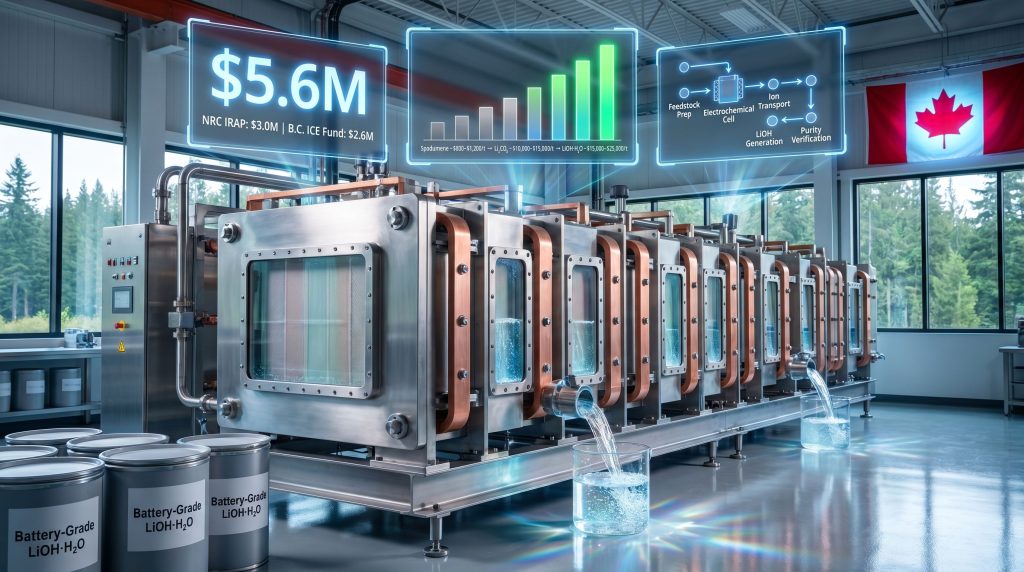
NORAM Electrolysis Systems Inc. (NESI), headquartered in Richmond, British Columbia, has developed an alternative pathway through its proprietary NORSCAND membrane electrolysis platform. Rather than relying on chemical transformation, the process uses electrical current and selective ion-exchange membranes to drive lithium hydroxide production. The operational sequence can be understood through the following stages:
-
Feedstock preparation: Raw material input, whether derived from spodumene concentrate, lithium brines, or battery recycling streams, is conditioned to the appropriate concentration and purity for electrochemical processing.
-
Electrochemical cell configuration: The prepared feedstock enters a membrane electrolysis cell, where selective ion-exchange membranes partition the electrochemical environment and control ion transport pathways.
-
Ion transport and LiOH generation: Under applied electrical potential, lithium ions migrate through the membrane toward the cathode compartment, where they combine with hydroxide ions to form lithium hydroxide in solution.
-
Product purification and quality verification: The lithium hydroxide solution undergoes concentration and purification steps to achieve battery-grade specification, typically requiring greater than 56.5% LiOH content and stringent limits on impurities such as sodium, potassium, calcium, and sulphate.
-
Effluent management: Byproduct streams, particularly sodium sulfate, are managed through electrochemical regeneration pathways rather than conventional disposal, a feature that connects directly to NESI's broader closed-loop processing philosophy.
The technical contrast with conventional refining is substantial:
| Parameter | Conventional Chemical Refining | NORSCAND Electrochemical Process |
|---|---|---|
| Energy input type | Thermal and chemical reagents | Electrical (electrified process) |
| Carbon intensity | High, reagent-dependent | Lower, electrification pathway |
| Chemical reagent consumption | High (acids, soda ash, lime) | Significantly reduced |
| Scalability | Large capital-intensive plants | Modular, scalable infrastructure |
| Waste stream complexity | Complex effluent treatment | Electrochemical regeneration potential |
| Feedstock flexibility | Primarily spodumene or brine | Multiple feedstock types |
Electrochemical approaches to lithium refining substitute thermal and chemical energy inputs with electrical processes. As grid electricity becomes progressively cleaner, particularly in jurisdictions powered predominantly by renewables or hydroelectricity, this substitution translates directly into lower lifecycle carbon intensity for the battery materials produced.
One dimension of NESI's technology that receives relatively little attention outside specialist circles is its sodium sulfate regeneration capability. Lithium-ion battery manufacturing generates sodium sulfate as a significant process byproduct, and managing this waste stream is both a regulatory and operational challenge for producers. Furthermore, NESI validated an electrochemical approach to regenerating this sodium sulfate effluent in a 2024 project supported by $947,500 from the B.C. Centre for Innovation and Clean Energy. This closed-loop capability is not merely an environmental feature; it has commercial implications for battery manufacturers seeking to reduce waste disposal costs and strengthen their sustainability credentials in an increasingly scrutinised supply chain.
The $5.6 Million Funding Package: Structure and Significance
The latest round of NESI lithium refining funding totals $5.6 million, structured across two complementary programs:
| Funding Source | Amount | Program | Jurisdiction |
|---|---|---|---|
| National Research Council of Canada | Up to $3.0M plus advisory services | NRC Industrial Research Assistance Program (IRAP) | Federal |
| B.C. Innovative Clean Energy (ICE) Fund | $2.6M | ICE Fund | British Columbia |
| Total | $5.6M |
The NRC IRAP component is particularly notable from a commercialisation perspective. IRAP is not a grant program in the conventional sense; it is specifically designed to bridge the gap between laboratory-scale innovation and industrial deployment, providing both financial support and direct access to NRC technical advisory services. For a deep-tech company navigating the difficult transition from pilot-scale demonstration to pre-commercial infrastructure, this advisory dimension can be as valuable as the capital itself.
IRAP participation functions as a credibility signal within Canada's innovation ecosystem. When the NRC co-invests in a technology platform, it signals institutional confidence in both the technical merit and the commercialisation pathway, which in turn lowers the perceived risk for private capital considering downstream investment.
The B.C. ICE Fund component reflects the provincial government's strategic interest in clean energy technology development, with a particular focus on electrified industrial processes. British Columbia's electricity grid, which is approximately 98% generated from clean sources, predominantly hydroelectric, gives electrochemical industrial processes a meaningful carbon advantage that is difficult to replicate in coal-heavy grid jurisdictions.
Placed in a longer timeline, this funding represents the latest step in a multi-year capital accumulation trajectory:
| Year | Funding Source | Amount | Purpose |
|---|---|---|---|
| 2017 | Early-stage | Not disclosed | Demonstration plant construction |
| Prior federal round | Canadian federal government | $4.5M | Industrialisation of membrane electrolysis |
| 2024 | B.C. Centre for Innovation and Clean Energy | $947,500 | Sodium sulfate electrochemical regeneration |
| 2026 | NRC IRAP + B.C. ICE Fund | $5.6M | Next-gen electrochemical platform and domestic refining infrastructure |
The cumulative funding base now spans multiple federal and provincial programs across nearly a decade of development, reflecting sustained institutional engagement rather than a single opportunistic grant. In addition, the Government of Canada's investment of over $9 million in the broader British Columbia lithium battery supply chain underscores how strategically aligned NESI's work is with national priorities.
What the Capital Will Actually Build
The $5.6 million allocation is directed toward developing a next-generation electrochemical platform at NESI's Richmond, British Columbia facility. The B.C. location serves as both a product development centre and a test facility for validating performance metrics before any commercial-scale transition is attempted.
Key engineering priorities likely targeted by this funding round include:
- Electrochemical cell stack scaling: Moving from pilot-scale cell configurations toward stacks capable of continuous industrial-throughput operation
- Membrane performance optimisation: Improving ion selectivity, membrane longevity, and operational stability under extended continuous processing conditions
- Battery-grade LiOH purity consistency: Demonstrating reliable achievement of battery-grade specification across variable feedstock inputs, a critical requirement for offtake agreements with battery manufacturers
- Energy efficiency benchmarking: Establishing competitive kilowatt-hour consumption figures per tonne of LiOH produced, which directly determines operating economics at commercial scale
- Effluent system integration: Connecting sodium sulfate regeneration capabilities to the main processing circuit for closed-loop operation validation
The development arc from 2017 to the present follows a recognisable deep-tech commercialisation pathway. The 2017 demonstration plant established proof-of-concept, validating that membrane electrolysis could produce lithium hydroxide from relevant feedstocks. Subsequent funding rounds have progressively scaled and optimised the underlying technology. The current phase represents pre-commercial industrial demonstration, where the objective is proving that the process performs reliably at throughput levels relevant to commercial contracts.
The transition from demonstration to industrial-scale operation carries the highest technical and financial risk in any deep-tech commercialisation journey. Co-funding at this stage is specifically structured to absorb a portion of that risk, creating conditions under which private capital can enter with greater confidence at the subsequent commercial deployment phase.
Geopolitical Drivers and Canada's Sovereign Processing Ambition
The strategic rationale behind NESI lithium refining funding extends well beyond a single company's technology development. It reflects a structural reorientation of Canadian industrial policy in response to global supply chain vulnerabilities that became acutely visible during the COVID-19 pandemic and have intensified since.
China's dominance in lithium chemical processing is not merely a market share statistic. It represents decades of deliberate industrial policy investment that built refining and precursor manufacturing capacity far exceeding domestic demand, effectively making Chinese processors the default option for lithium producers worldwide. For Western battery supply chains, this creates a chokepoint that raw material extraction capacity alone cannot resolve.
Canada has responded through several overlapping policy instruments, including a comprehensive critical minerals strategy that explicitly prioritises downstream processing capacity alongside extraction. However, the full suite of programs includes:
- Membership in the Minerals Security Partnership (MSP), a multilateral framework among allied nations aimed at diversifying critical mineral supply chains away from concentrated geopolitical risk
- Provincial programs such as B.C.'s ICE Fund, which direct capital toward clean technology development with strategic industrial applications
- The NRC IRAP program, which functions as a systematic mechanism for converting research-stage innovation into deployable industrial technology
The peer-nation context illustrates how Canada's approach compares internationally:
| Country | Key Program | Strategic Focus |
|---|---|---|
| Canada | NRC IRAP, ICE Fund, Critical Minerals Strategy | Electrochemical refining, midstream processing |
| United States | DOE Loan Programs Office, IRA Battery Manufacturing Credits | Gigafactory buildout, refining capacity |
| Australia | Critical Minerals Facility (Export Finance Australia) | Downstream processing, offtake agreements |
| European Union | European Battery Alliance, IPCEI on Batteries | Cell manufacturing, refining sovereignty |
The economic multiplier logic underlying these programs is straightforward. Every tonne of spodumene concentrate exported without domestic processing represents a foregone value-add opportunity of roughly 10 to 25 times the raw material price. At industrial scale, the cumulative economic impact of capturing that value domestically is substantial, encompassing direct revenue, employment, tax base, and industrial ecosystem development.
Feedstock Flexibility and the Circular Economy Dimension
One of the less-discussed competitive advantages of electrochemical lithium refining is feedstock flexibility. Conventional chemical refining plants are typically optimised for a specific input type and retrofitting for alternative feedstocks involves significant capital expenditure and process redesign.
Direct lithium extraction systems and membrane electrolysis platforms, by contrast, can in principle be adapted to process multiple lithium-bearing inputs, including:
- Hard-rock spodumene concentrate from Canadian projects in Quebec, Ontario, and British Columbia
- Lithium brine concentrates from international sources or emerging Canadian brine deposits
- Battery black mass leachate from end-of-life lithium-ion battery recycling, where lithium recovery is increasingly economically viable as battery volumes grow
This last application connects NESI's technology to Canada's nascent but rapidly expanding battery recycling infrastructure. Consequently, as electric vehicle adoption accelerates, the volume of end-of-life batteries requiring processing will grow substantially. The ability to recover and re-refine lithium from recycled streams using the same electrochemical platform represents a potential second revenue pathway, and battery recycling processes of this kind make a meaningful contribution to circular economy objectives.
British Columbia's clean electricity grid amplifies all of these advantages. When the electrical energy driving electrochemical refining is sourced predominantly from hydroelectric generation, the resulting battery-grade lithium hydroxide carries a materially lower carbon footprint than product refined using fossil-fuel-dependent grid electricity. This is increasingly relevant as automakers and battery cell manufacturers face pressure to reduce Scope 3 emissions across their supply chains.
The next major ASX story will hit our subscribers first
Frequently Asked Questions: NESI and the $5.6M Lithium Refining Funding
What is NESI and what does the company do?
NORAM Electrolysis Systems Inc. (NESI) is a Canadian clean technology company based in Richmond, British Columbia. The company develops electrochemical processing systems for producing battery-grade lithium hydroxide, using membrane electrolysis technology as an alternative to conventional chemical refining methods.
What is NORSCAND technology?
NORSCAND is NESI's proprietary membrane electrolysis platform. It uses electrical current and selective ion-exchange membranes to convert lithium-bearing feedstocks into battery-grade lithium hydroxide, replacing the acid roasting and chemical precipitation steps used in conventional processing with an electrified, lower-carbon approach.
How is the $5.6 million in NESI lithium refining funding being used?
The $5.6 million, comprising up to $3 million from the federal NRC Industrial Research Assistance Program (including advisory services) and $2.6 million from British Columbia's Innovative Clean Energy Fund, is allocated to advance a next-generation electrochemical refining platform. Development activities are centred at NESI's Richmond, B.C. facility and focus on scaling the technology toward industrial-grade throughput and battery-grade output consistency.
Has NESI received prior public funding?
Yes. NESI previously received $4.5 million from the Canadian federal government to support the industrialisation of its membrane electrolysis technology, and $947,500 from the B.C. Centre for Innovation and Clean Energy in 2024 for validating electrochemical sodium sulfate regeneration processes.
Why is battery-grade lithium hydroxide strategically important?
Battery-grade lithium hydroxide monohydrate is the primary cathode precursor for high-energy-density lithium-ion batteries used in electric vehicles and stationary storage applications. Domestic production capability eliminates dependence on overseas chemical processing, captures significantly more economic value per tonne than raw mineral exports, and supports supply chain resilience for Canadian and allied-nation battery manufacturers.
What is NRC IRAP?
The National Research Council's Industrial Research Assistance Program is Canada's primary federal instrument for supporting small and medium-sized enterprises through the transition from innovation to commercial deployment. It provides both financial contributions and direct access to NRC technical expertise, and its participation is widely regarded as a quality signal within Canada's innovation and investment ecosystem.
Key Takeaways for Understanding Canada's Lithium Processing Strategy
The NESI lithium refining funding milestone illuminates a broader set of dynamics shaping Canada's battery supply chain ambitions:
- Lithium refining, not lithium mining, is the primary value-creation and strategic vulnerability point in the domestic battery supply chain
- Electrochemical refining offers a technically differentiated, lower-carbon pathway to battery-grade LiOH that aligns with both industrial decarbonisation and supply chain sovereignty objectives
- Multi-program funding stacking, combining federal IRAP support with provincial clean energy funds, is emerging as the standard model for de-risking pre-commercial critical mineral processing technology in Canada
- British Columbia's hydroelectric grid provides a structural carbon advantage for electrochemical industrial processes that is genuinely difficult to replicate in other jurisdictions
- NESI's cumulative funding trajectory across nearly a decade reflects sustained institutional confidence in membrane electrolysis as a viable commercial pathway for domestic lithium refining
- Feedstock flexibility and battery recycling integration position electrochemical platforms as long-duration assets within a circular battery economy, not solely as primary refining infrastructure
- The broader strategic objective, reducing Canadian and allied-nation dependence on concentrated foreign processing capacity, is driving coordinated federal and provincial investment into midstream processing technology at a scale and urgency not seen in previous resource cycles
This article contains forward-looking assessments regarding technology development timelines, commercial applications, and market conditions. These involve inherent uncertainty and should not be interpreted as investment advice. Readers are encouraged to conduct independent research and consult qualified financial advisers before making investment decisions.
Want to Stay Ahead of the Next Major ASX Mineral Discovery?
Discovery Alert's proprietary Discovery IQ model delivers real-time alerts on significant ASX mineral discoveries — instantly translating complex mineral data into actionable insights for both short-term traders and long-term investors. Explore how historic discoveries have generated extraordinary returns and begin your 14-day free trial today to position yourself ahead of the broader market.