June 10, 2026
The Invisible Bottleneck Reshaping American Energy Strategy
Few commodity markets illustrate the collision between industrial ambition and physical reality quite like lithium. Decades of energy policy have assumed that raw materials would follow demand signals with reasonable efficiency. Lithium is now exposing that assumption as dangerously optimistic. The gap between how fast battery demand is growing and how slowly the US supply chain can respond is not a pricing hiccup or a temporary logistics problem. It is a structural fault line running through the foundation of American energy independence.
Understanding why surging lithium demand is outpacing the US supply chain requires looking beyond headlines about EV adoption or battery factory announcements. The real story sits at the intersection of capital cycles, processing chokepoints, geopolitical concentration risk, and the brute physics of building mines in a regulatory environment designed for a slower era.
When big ASX news breaks, our subscribers know first
Demand That Compounds Rather Than Cycles
Most commodity markets move in cycles. Prices rise, investment follows, supply expands, prices fall, and the cycle resets. Lithium is behaving differently. The forces driving demand are not cyclical in nature. They are structurally embedded in long-term decarbonisation commitments, electrification mandates, and the exponential scaling of AI infrastructure.
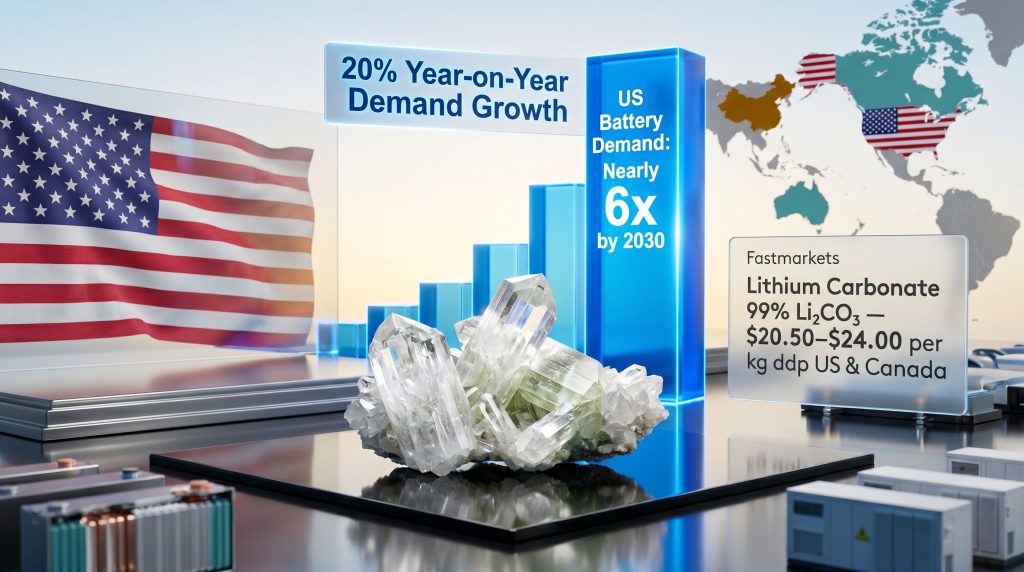
Global lithium demand is projected to grow at approximately 20% year-on-year for the foreseeable future, according to analysis from US Elemental, a lithium development company that tracks these dynamics closely. That rate of compounding does not leave much margin for a supply chain that requires five to ten years to build new production capacity from scratch. Furthermore, the critical minerals demand picture is intensifying across multiple sectors simultaneously, adding further pressure to an already strained system.
The US battery market alone is forecast to expand by nearly six times its current scale by 2030, driven by EV manufacturing targets, utility-scale storage deployment, and the insatiable power appetite of AI-driven data centres. Set against that trajectory, the pace of domestic supply chain development across mining, processing, cell manufacturing, and recycling looks materially insufficient.
The fundamental demand story for lithium has been described by industry executives as exceptionally strong, with the expectation that this trajectory will persist across multiple decades rather than reverting to historical norms.
The Three Pillars of US Lithium Demand Growth
Breaking down where US lithium demand is actually coming from reveals a more nuanced picture than the EV narrative alone suggests:
-
Electric vehicles remain the dominant global driver of lithium consumption, though US-specific momentum has been complicated by policy shifts including the removal of the federal EV tax credit under the One Big Beautiful Bill Act in July 2025.
-
Battery energy storage systems (BESS) have overtaken EVs as the fastest-growing US demand segment, as grid operators respond to renewable intermittency and utilities build buffer capacity at scale.
-
AI and data centre infrastructure represents an emerging but rapidly expanding demand vector, with large-scale facilities requiring uninterruptible power systems increasingly backed by lithium battery technology.
The BESS trajectory deserves particular attention. Unlike EV demand, which can be slowed by consumer sentiment or policy changes, grid-scale storage deployment is being driven by utility procurement cycles and renewable energy integration requirements. This segment is proving far more resilient to near-term political headwinds.
How a Geopolitical Shock Reactivated EV Demand
The removal of the EV tax credit created real uncertainty about near-term consumer demand for electric vehicles in the US. What changed the trajectory was not policy reversal but a geopolitical event. The US-Iran conflict of 2025 triggered a sharp rise in retail fuel prices, with gasoline climbing from approximately $2.80 per gallon during the week ending February 23, 2025, to $4.14 per gallon by the week ending June 1, 2025, according to data from the US Energy Information Administration.
That price shock at the pump functions as a powerful economic incentive for consumers to reconsider the total cost of vehicle ownership. Early market signals suggest the structural shift toward electrified transport remains intact, with fuel price sensitivity continuing to outweigh the removal of purchase incentives for a meaningful segment of buyers.
Why the US Supply Chain Cannot Keep Pace
The 2022-2023 Price Crash Set Development Back Years
The sharp lithium price correction between 2022 and 2023 was one of the most consequential events in the modern history of the battery materials sector. When prices collapsed from their highs, the investment case for early-stage US lithium projects evaporated almost overnight. Capital dried up, development timelines stretched, and many projects were quietly shelved. The lithium market downturn during this period cast a long shadow over project pipelines that are only now beginning to recover.
The price recovery that followed has been real but incomplete. Current market assessments from Fastmarkets illustrate the challenge clearly:
| Lithium Grade and Route | Assessed Price (June 4, 2025) |
|---|---|
| Lithium carbonate 99% Li₂CO₃ min, spot ddp US and Canada | $20.50 – $24.00 per kg |
| Lithium carbonate 99% Li₂CO₃ min, spot cif China, Japan & Korea | $19.50 – $20.50 per kg |
The narrow spread between US-delivered and Asia-delivered pricing is commercially significant. It means that domestic producers face a market where the premium available for locally sourced material barely covers the additional cost burden of operating in a higher-cost regulatory environment. That pricing reality is insufficient to mobilise the long-term capital commitments needed to build large-scale extraction and processing infrastructure in the US.
The Pipeline Problem: Projects That Are Not Ready
One of the least discussed constraints on US lithium supply chain development is the absence of a deep pipeline of shovel-ready, large-scale projects. Government funding programmes designed to accelerate domestic supply chain development face a fundamental obstacle: the projects capable of absorbing that capital at the required scale either do not exist yet or are in development stages too early to deploy funds productively.
This creates a problematic feedback loop. Funding is nominally available, but the project pipeline is too thin to absorb it. Projects cannot advance through development without funding certainty. The result is a system that appears active at the policy level while moving slowly at the project level.
Stage-by-Stage: Where the US Supply Chain Breaks Down
| Supply Chain Stage | Current US Capability | Primary Constraint |
|---|---|---|
| Lithium Extraction (Mining) | Very limited operational capacity | Permitting timelines, capital scarcity |
| Chemical Processing and Refining | Nascent, heavily import-dependent | Absence of domestic refinery infrastructure |
| Cell Manufacturing | Growing but capacity lagging demand | Feedstock dependency on imported lithium chemicals |
| Battery Recycling | Early-stage development | Insufficient end-of-life material volumes at present |
A report linked to the US Department of Energy's Li-Bridge initiative concluded that even under optimistic scenarios the US will remain significantly import-dependent as domestic battery demand expands sharply toward 2030. That assessment underscores the systemic depth of the supply chain deficit rather than framing it as a solvable near-term problem.
China's Processing Chokehold on Global Lithium
Why Origin of Extraction Does Not Equal Supply Chain Independence
One of the most important and least understood features of the global lithium market is that geographic origin of mining activity does not determine where processing occurs. Australia is the world's largest producer of hard-rock lithium in spodumene concentrate form. Chile holds the largest brine-based lithium reserves. Argentina is a growing producer. Yet a dominant share of the world's battery-grade lithium chemicals, including lithium carbonate and lithium hydroxide, are processed in China before reaching end markets.
This means that supply chain independence cannot be achieved simply by expanding mining activity in allied nations. Without domestic or allied-nation refining and processing capacity, raw material continues flowing through Chinese facilities regardless of where it is extracted. Innovations in direct lithium extraction technology offer one promising pathway to reduce this dependency by enabling faster, more efficient processing outside of traditional Chinese refinery networks.
Chinese producers compound this advantage by operating at structurally lower margins than Western competitors, maintaining price competitiveness that independent Western producers cannot match without either subsidisation or premium pricing mechanisms. Currently, buyers across the global lithium market are not willing to pay a meaningful premium for non-Chinese processed material, which creates a near-impossible commercial environment for independent Western supply chains.
Tariffs can create a price wedge at the border, but when virtually all processed lithium material flows through Chinese refining infrastructure regardless of its country of origin, trade barriers primarily raise input costs for US manufacturers without redirecting supply flows in any meaningful way.
Geographic Concentration Risk at a Glance
| Region | Role in Global Lithium Supply | US Strategic Risk |
|---|---|---|
| China | Dominant processor and refiner globally | Very High, processing chokepoint |
| Australia | Largest hard-rock spodumene producer | Moderate, allied nation but China-processed |
| Chile | Largest brine-based lithium reserves globally | Moderate, geopolitically stable but remote |
| Argentina | Growing brine production | Moderate, improving but infrastructure constrained |
| United States | Minimal current production | Critical, domestic supply gap |
What Policy Can and Cannot Fix
What Genuine Bipartisan Recognition Looks Like in Practice
There is growing acknowledgement within the current US administration that battery supply chain sovereignty carries national security implications that transcend standard commodity market dynamics. Industry executives with direct visibility into government engagement have noted an increased emphasis on directing federal funding into the lithium sector and adjacent supply chain segments including processing, cell manufacturing, and recycling infrastructure.
The Inflation Reduction Act established a foundational framework for domestic battery supply chain investment, though the long-term stability of specific incentive provisions remains subject to legislative evolution. What matters more than any individual programme is whether the policy environment generates sustained, predictable support across a timeline that matches the development horizon of major lithium projects. For comparison, Australia's lithium industry has demonstrated how targeted tax incentives and policy consistency can meaningfully accelerate project development timelines.
The Accelerant That Policy Can Provide
Rather than outlining generic policy recommendations, it is worth ranking the interventions by their potential leverage on the supply-demand gap:
-
Permitting reform is the highest-leverage near-term intervention available. The current timeline for new mine permitting in the US spans seven to ten years in many cases, which is incompatible with closing a supply gap that is materialising this decade.
-
Targeted capital deployment into the handful of large-scale US lithium projects already in advanced development offers the fastest route to meaningful production volumes.
-
Domestic processing infrastructure investment addresses the refining bottleneck that makes upstream mining activity insufficient on its own.
-
Strategic lithium reserves would provide buffer capacity against supply disruptions during the long transition period before domestic production reaches scale.
-
Allied nation supply agreements with Australia, Canada, and Chile create a non-Chinese feedstock base for US cell manufacturers while domestic capacity is being developed.
Three Scenarios for US Lithium Supply Through 2030
| Scenario | Key Assumptions | Projected Outcome |
|---|---|---|
| Accelerated Build-Out | Permitting reform plus sustained federal funding plus price recovery | Partial supply independence, import exposure reduced by 30-40% |
| Status Quo Trajectory | Incremental investment, no structural policy change | Persistent import dependency, strategic vulnerability deepens |
| Allied Nation Integration | Deep supply agreements with Australia, Canada, Chile | Reduced China exposure, improved resilience but not full independence |
The Market Trajectory Toward Structural Deficit
The lithium market spent 2022 and 2023 in a period of oversupply that punished producers and chilled investment. That phase created the conditions for the supply challenge now unfolding. Multiple independent forecasting analyses project a potential structural deficit in battery-grade lithium chemicals emerging between 2026 and 2030 if new extraction and processing capacity does not come online at the pace required by demand growth.
The tightening is concentrated in the most technically demanding segment of the supply chain: the conversion of raw lithium material into battery-grade lithium carbonate and lithium hydroxide. These are the forms required by cell manufacturers, and processing capacity constraints at this stage represent the sharpest potential supply bottleneck. According to the IEA's lithium supply analysis, closing this processing gap will require substantial coordinated investment across multiple geographies simultaneously.
A Note on Lithium Chemical Grades
Not all lithium is equal from a battery manufacturing perspective. Battery-grade lithium carbonate requires purity levels of 99.5% or higher, with strict limits on impurity elements that can degrade electrochemical performance. Lithium hydroxide monohydrate is increasingly preferred for high-nickel cathode chemistries used in long-range EVs because it produces lower processing temperatures and superior energy density outcomes.
The technical conversion process from spodumene concentrate or lithium brine production to battery-grade chemical is capital-intensive, chemically complex, and takes years to commission and optimise. This is precisely why the processing stage represents such a durable bottleneck, and why Chinese dominance of this segment translates into structural market leverage that tariffs alone cannot neutralise. Industry research into North America's lithium supply chain consistently identifies this conversion bottleneck as the single most constraining factor in achieving regional supply independence.
The next major ASX story will hit our subscribers first
Frequently Asked Questions: US Lithium Supply Chain
Why is surging lithium demand outpacing the US supply chain so significantly?
The demand side is driven by compounding secular forces including EV adoption, grid-scale energy storage, and AI infrastructure growth, each of which requires lithium-ion battery technology at scale. The supply side is constrained by capital cycles, regulatory timelines, processing infrastructure deficits, and the 2022-2023 investment freeze that delayed a generation of project development.
How significant is China's role in global lithium processing?
China's role extends far beyond its own mining output. Chinese refining and processing facilities handle a dominant share of global battery-grade lithium chemical production, regardless of whether the raw material originates in Australia, Chile, Argentina, or elsewhere. This processing chokepoint gives China structural leverage over global supply that cannot be addressed through mining investment alone.
Could fuel price increases durably accelerate US EV demand?
Historical evidence suggests that sustained elevation in retail fuel prices meaningfully shifts consumer vehicle purchasing behaviour. The sharp rise in US gasoline prices observed through early-to-mid 2025 represents a genuine economic catalyst for accelerated EV consideration, particularly in price-sensitive consumer segments where the removal of the federal tax credit had created the greatest headwind to adoption.
What does a vertically integrated US lithium supply chain actually require?
True supply chain sovereignty requires operational capacity at every stage: domestic mining at scale, domestic chemical processing and refining, domestic cell manufacturing using domestically processed feedstock, and a recycling infrastructure capable of recovering lithium from end-of-life battery systems at commercial volumes. Each stage has a multi-year development horizon. The full integration of all stages is a decade-long undertaking at minimum.
Disclaimer: This article contains forward-looking projections and scenario analyses drawn from industry reporting and publicly available market data. These projections involve inherent uncertainty and should not be interpreted as financial advice or investment recommendations. Lithium market conditions, pricing, and supply-demand dynamics are subject to rapid change. Readers should conduct independent due diligence before making any investment decisions related to lithium or battery materials markets.
Want to Stay Ahead of the Next Major Mineral Discovery on the ASX?
Discovery Alert's proprietary Discovery IQ model delivers real-time alerts on significant ASX mineral discoveries — including critical minerals like lithium — transforming complex market data into actionable insights for investors at every level. Explore historic discoveries and the returns they generated, then begin your 14-day free trial to position yourself ahead of the market.