June 10, 2026
The Securitisation of Battery-Grade Lithium: Why Defence Conglomerates Are Buying Into the Mine Gate
For most of the past decade, lithium was framed almost exclusively as a clean energy story. The dominant narrative centred on electric vehicle adoption curves, gigafactory buildouts, and the race to lock in carbonate and hydroxide supply before demand outpaced production. That framing, while not wrong, was always incomplete. Battery-grade lithium has always carried a dual-use dimension that mainstream market coverage consistently underweighted. As the mid-2020s unfold, that omission is becoming harder to sustain, particularly given how critical minerals and energy security considerations are reshaping global procurement strategies.
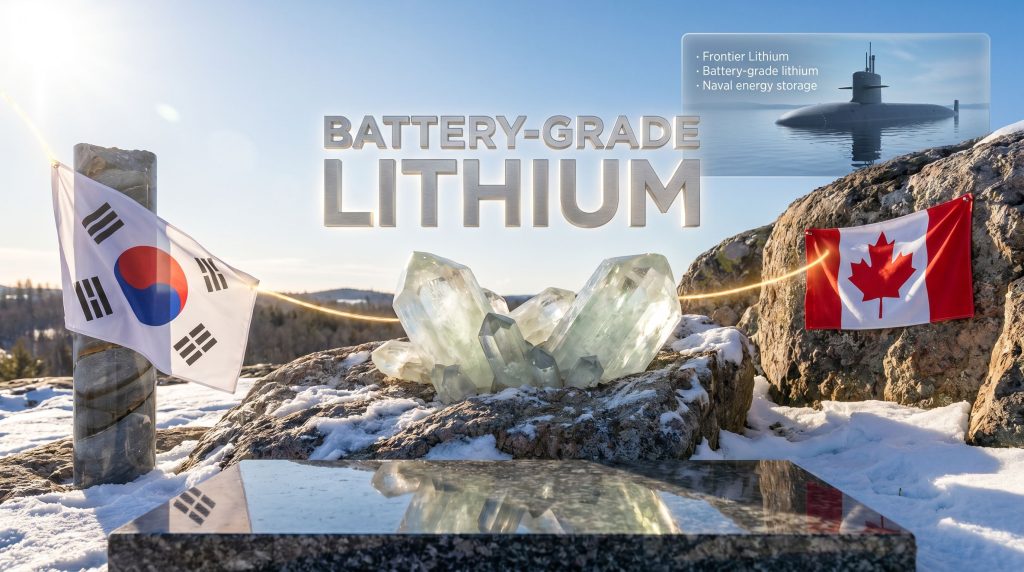
The defence and advanced manufacturing sectors are now moving upstream into lithium supply chains with a speed and strategic intentionality that resembles the resource securitisation playbooks of the Cold War era. The Hanwha Frontier Lithium MOU, signed between Frontier Lithium Inc. and two Hanwha entities — Hanwha Corporation and Hanwha Ocean Co., Ltd. — is a precise expression of this structural shift. Understanding what it means requires looking beyond the headline and into the underlying architecture of why industrial conglomerates with naval shipbuilding portfolios are sitting across the table from Canadian junior miners.
When big ASX news breaks, our subscribers know first
Battery-Grade Lithium Is Not a Commodity: The Technical Distinction That Drives Strategic Demand
The term "battery-grade" carries more weight than most financial commentary acknowledges. Standard lithium carbonate traded on commodity markets typically meets general industrial thresholds, but the purity requirements for advanced energy storage applications — including submarine propulsion systems and military-grade battery platforms — are substantially more demanding.
Battery-grade lithium hydroxide monohydrate used in high-nickel cathode chemistries, such as NMC 811 and NCA formulations, must achieve purity levels exceeding 99.5%, with tightly controlled impurity ceilings for elements like calcium, magnesium, sodium, and sulphate. For defence applications where thermal stability, cycle life, and energy density are mission-critical rather than commercially desirable, these specifications become non-negotiable.
This is why the Hanwha Frontier Lithium MOU specifically references battery-grade lithium products rather than raw spodumene concentrate or generic lithium salts. Frontier Lithium's proposed integrated operations in Ontario are designed as a mine-to-product value chain, targeting the direct production of battery-grade material rather than shipping concentrate to third-party processors. For a buyer like Hanwha Ocean, that vertical integration matters enormously, as it reduces the number of custody transfers, simplifies traceability documentation, and provides greater control over final product specifications.
Traceability and chain-of-custody verification are becoming structural requirements for defence-oriented mineral procurement. A single unaccountable processing step in a multi-party supply chain can disqualify a source entirely from defence-grade applications, regardless of the underlying resource quality.
Why Spodumene Suits Defence-Grade Requirements
In addition to purity considerations, the physical characteristics of spodumene-hosted lithium make it particularly suited to defence applications. Furthermore, the conversion pathway from spodumene concentrate to lithium hydroxide, while capital-intensive, typically produces lower impurity profiles than many brine-derived equivalents. Consequently, hard-rock sources are attracting growing interest from buyers who cannot compromise on thermal stability or cycle performance.
What the Hanwha Frontier Lithium MOU Actually Commits To
Non-binding agreements are frequently misread by market participants as either meaningless formalities or as near-confirmed commercial deals. Neither reading is accurate. In the critical minerals sector, a well-structured MOU functions as a formalised due diligence mandate, a signal of serious commercial intent, and a mechanism for aligning both parties before either commits capital or legal obligations.
The Hanwha Frontier Lithium MOU establishes four evaluation pillars:
- Potential supply and purchase of battery-grade lithium products from Frontier's Ontario operations
- Strategic, technical, and commercial cooperation across the broader value chain
- Project-level financing mechanisms that could accelerate development timelines
- Long-term offtake arrangements conditional on definitive agreement execution
Importantly, Hanwha is also evaluating a potential direct investment in Frontier Lithium, subject to due diligence and negotiation outcomes. This investment dimension elevates the MOU beyond a typical supply evaluation framework and introduces the possibility of equity-level alignment between the two parties.
The distinction between supply-only MOUs and those incorporating investment evaluation is significant. When a buyer signals willingness to take project-level equity exposure, it reflects a degree of conviction about asset quality and development potential that a pure offtake evaluation does not.
Hanwha's Canadian Portfolio: A Multi-Mineral Positioning Strategy
The Hanwha Frontier Lithium MOU does not exist in isolation. Hanwha has assembled a portfolio of Canadian industrial agreements that, when mapped collectively, reveal a deliberate upstream positioning strategy spanning multiple critical material categories.
| Partnership | Material Focus | Strategic Relevance |
|---|---|---|
| Frontier Lithium | Battery-grade lithium | Naval energy storage, advanced batteries |
| Defence Metals | Rare earth elements | Permanent magnets, defence electronics |
| Algoma Steel | Domestic steel supply | Shipbuilding and naval construction |
| Automotive Parts Manufacturers' Association | Industrial manufacturing | Supply chain localisation |
Each of these agreements targets a material category that is directly relevant to naval shipbuilding and advanced defence technology manufacturing. Furthermore, rare earth supply chains sourced through the Defence Metals MOU feed into permanent magnet production for electric motors and guidance systems. Structural steel from Algoma underpins hull fabrication, while battery-grade lithium from Frontier supplies energy storage platforms for submarine propulsion and onboard systems.
Viewed collectively, Hanwha's Canadian MOU portfolio is not a series of opportunistic commercial evaluations. It is an integrated supply chain architecture being built in advance of a single, high-stakes commercial decision: Canada's submarine fleet modernisation programme.
The Submarine Programme Dimension: Defence Procurement as a Mineral Market Catalyst
Canada's submarine fleet renewal is one of the most consequential defence procurement decisions the country has faced in a generation. The programme's multibillion-dollar scope creates a commercial incentive structure in which a bidder's demonstrated commitment to Canadian industrial and resource integration carries measurable weight in the evaluation process.
Hanwha Ocean's active participation in the submarine competition provides the strategic context that makes its Canadian MOU activity legible. Canadian policymakers evaluating submarine bids are expected to weigh the extent to which competing shipbuilders have committed to sourcing materials and industrial content domestically or from allied-nation supply chains.
By securing MOUs across lithium, rare earths, steel, and automotive manufacturing, Hanwha is constructing a supply chain narrative that maps directly onto Canadian industrial benefit expectations. Whether or not each individual MOU converts to a binding contract, the portfolio collectively demonstrates a level of Canadian market engagement that strengthens the broader bid proposition. However, it is worth noting that defence critical materials frameworks globally are increasingly shaping how these deals are structured and evaluated.
Three Potential Pathways for the Frontier Lithium Relationship
Three potential pathways exist for how the Frontier Lithium relationship could evolve:
- Offtake agreement: A long-term supply contract providing Hanwha with price-certain access to battery-grade lithium hydroxide from Frontier's Ontario operations, insulating Hanwha's advanced technology divisions from spot market volatility.
- Strategic equity investment: A direct project-level stake that aligns Hanwha's financial interests with Frontier's development success, potentially accompanied by preferential supply access and board-level representation.
- Integrated financing structure: A project financing mechanism in which Hanwha provides capital tied to offtake rights, accelerating Frontier's development timeline while locking in long-term supply security.
Ontario's Geology and Jurisdiction: Why Location Is as Valuable as the Resource
Frontier Lithium's assets are located in Ontario's Electric Vehicle Battery Belt, a corridor that encompasses some of North America's highest-grade hard-rock lithium deposits. The company's PAK Lithium Project hosts spodumene pegmatite mineralisation with grades that are among the highest documented in Canada — a geological characteristic that directly influences downstream processing economics and final product purity potential.
Spodumene-hosted lithium, as opposed to material sourced via direct lithium extraction from brines, carries inherent processing advantages for battery-grade applications. The conversion pathway from spodumene concentrate to lithium hydroxide, while capital-intensive, produces a product with lower impurity profiles than many lithium brines explained sources — particularly with respect to boron and magnesium contamination thresholds that are critical for high-nickel cathode compatibility.
Ontario's regulatory environment adds a further dimension of value. Canada consistently ranks among the top global mining jurisdictions in terms of regulatory transparency, Indigenous consultation frameworks, and political stability. For a South Korean industrial conglomerate evaluating long-term supply chain risk, jurisdictional reliability carries a geopolitical premium that is increasingly reflected in the willingness of Asian buyers to accept higher per-unit lithium costs in exchange for supply chain sovereignty.
The next major ASX story will hit our subscribers first
How Investors Should Read MOU Activity in the Critical Minerals Sector
MOUs in the mining and critical minerals sectors tend to operate on long conversion timelines. Historical precedent across comparable critical mineral partnerships suggests that the pathway from MOU execution to binding definitive agreement typically spans 12 to 36 months, contingent on feasibility study advancement, permitting milestones, and commercial negotiation outcomes.
| Agreement Characteristic | Hanwha Frontier Lithium MOU | Typical Binding Critical Mineral Offtake |
|---|---|---|
| Binding status | Non-binding | Binding with penalty clauses |
| Scope | Supply, investment, financing, offtake | Typically supply and pricing only |
| Investment component | Under evaluation | Usually a separate equity transaction |
| Timeline to definitive agreement | Subject to due diligence | Typically 6 to 18 months post-MOU |
| Geopolitical alignment | Canada and South Korea allied sourcing | Varies by jurisdiction |
For investors evaluating Frontier Lithium's development trajectory, the MOU represents a material leading indicator rather than a confirmed commercial outcome. The key milestones to monitor include the advancement of the company's feasibility study, progress through Ontario's environmental assessment and permitting processes, and the resolution of financing and investment structures referenced in the MOU itself.
The non-binding nature of the agreement means either party can withdraw without financial consequence. Furthermore, development-stage operations face timeline uncertainty that can delay MOU conversion regardless of strategic intent. These are material risk factors that investors should weigh against the strategic significance of the partnership signal.
The Broader Market Signal: Defence Buyers Are Reshaping Lithium Demand Architecture
The Hanwha Frontier Lithium MOU reflects a structural evolution in who buys battery-grade lithium and why. The conventional demand taxonomy — dominated by EV manufacturers and grid storage operators — is expanding to incorporate a distinct defence and advanced technology vertical that operates on fundamentally different procurement logic.
Defence buyers prioritise supply security and allied-nation sourcing over cost optimisation. They are willing to pay a jurisdictional premium for materials that can be traced through a transparent, geopolitically stable supply chain. Consequently, this creates a new pricing dynamic for Canadian lithium developers — one where the per-unit economics are supplemented by a strategic value premium that commodity pricing models do not fully capture.
| Theme | Market Implication |
|---|---|
| Defence demand emerging | New buyer category with premium pricing tolerance |
| Allied-nation sourcing preference | Canadian assets attract geopolitical valuation uplift |
| Integrated operations preferred | Mine-to-product developers attract strategic buyer interest |
| MOU activity as leading indicator | Signals pipeline of potential binding agreements |
| Korean conglomerate strategy | Multi-mineral, multi-sector Canadian positioning underway |
South Korean industrial conglomerates are among the most structurally active participants in this supply chain reshaping exercise. Korea's position as a major battery cell manufacturer, naval shipbuilder, and advanced technology exporter creates simultaneous demand for lithium across civilian and defence applications — a demand profile that makes Canadian hard-rock lithium assets particularly attractive.
Frequently Asked Questions: Hanwha Frontier Lithium MOU
What companies are parties to the Hanwha Frontier Lithium MOU?
The agreement was signed between Frontier Lithium Inc. and two Hanwha Group entities: Hanwha Corporation and Hanwha Ocean Co., Ltd. Hanwha Ocean is a South Korea-based shipbuilding company currently competing for Canada's submarine fleet modernisation contract.
Is this MOU a binding supply contract?
No. The agreement is explicitly non-binding. It establishes a structured framework for evaluating potential supply, investment, financing, and offtake arrangements, but neither party is contractually committed to a definitive commercial outcome.
What would need to occur for the MOU to convert to a binding agreement?
Both parties would need to complete mutual due diligence, agree on commercial terms including pricing, volume, and delivery specifications, and execute definitive agreements. Key preconditions include advancement of Frontier's feasibility study, progress through Ontario's permitting and environmental assessment processes, and resolution of the investment and financing structures currently under evaluation.
Why is Hanwha targeting Canadian lithium specifically?
Canada offers a combination of high-grade hard-rock lithium resources, a stable regulatory jurisdiction, and geopolitical alignment with South Korea's allied-nation sourcing preferences. Canadian-sourced lithium carries an implicit supply chain sovereignty premium that is increasingly valued by defence-oriented buyers.
What other Canadian agreements has Hanwha signed?
In addition to the Frontier Lithium MOU, Hanwha has signed agreements with Defence Metals covering rare earth elements, Algoma Steel covering domestic steel supply, and the Automotive Parts Manufacturers' Association covering industrial manufacturing supply chain integration.
This article contains forward-looking analysis and scenario projections that are speculative in nature and should not be construed as investment advice. The Hanwha Frontier Lithium MOU is a non-binding agreement and no definitive commercial outcome has been confirmed. Investors should conduct their own due diligence and consult a qualified financial adviser before making investment decisions related to any securities discussed or referenced in this analysis.
Want to Stay Ahead of the Next Major Mineral Discovery on the ASX?
Discovery Alert's proprietary Discovery IQ model delivers real-time alerts the moment significant ASX mineral discoveries are announced, turning complex data across 30-plus commodities into clear, actionable insights for investors at every level — start your 14-day free trial today and explore how historic discoveries have generated extraordinary returns.