July 17, 2026
When Capital Meets Infrastructure: Understanding the Logic Behind Industrial Mega-Deals
The industrial automation sector has entered a consolidation phase unlike anything seen in recent decades. As electrification and decarbonisation demands accelerate across energy, mining, and manufacturing, the companies controlling the physical layer of automation technology have become extraordinarily valuable. Valve actuators, flow control instruments, and field-level process devices were once considered unglamorous sub-sectors of engineering. Today, they sit at the centre of some of the largest corporate transactions in the world.
It is within this context that ABB buys Rotork for US$5.5bn takes on its full strategic meaning. This is not simply a bolt-on acquisition. It is a calculated repositioning by one of the world's most sophisticated industrial conglomerates, executed at scale, funded by a prior divestiture, and timed to coincide with a moment of extraordinary growth in ABB's core markets.
When big ASX news breaks, our subscribers know first
Breaking Down the Transaction: Price, Premium, and Structure
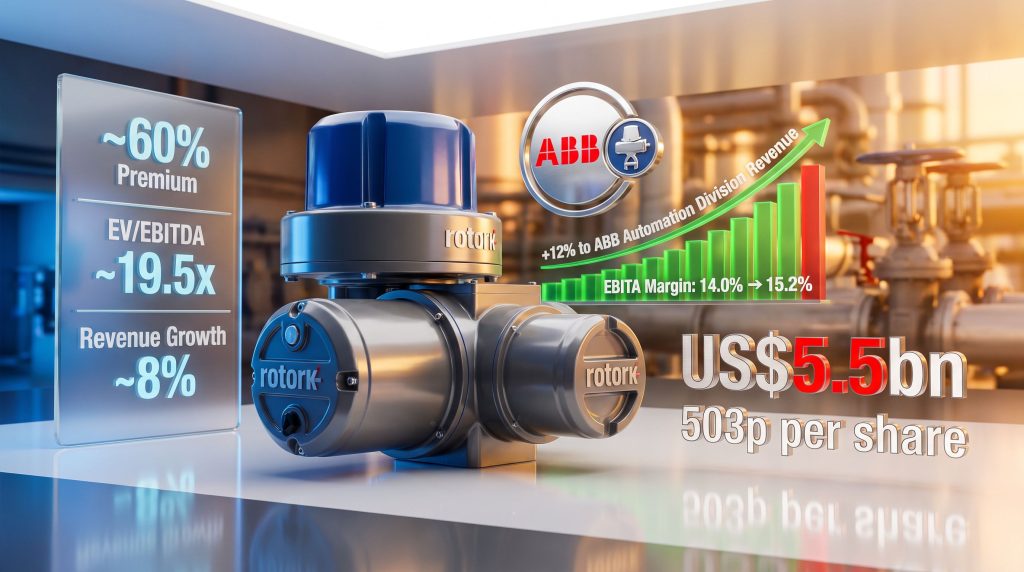
The mechanics of the deal reveal just how seriously ABB values Rotork's market position. Under the terms of the recommended cash offer, Rotork shareholders will receive 503 pence (£5.03) per share, representing a premium of approximately 60% to the company's three-month average share price. Shareholders will also be entitled to an interim dividend of up to £0.03 per share covering the period to 30 June 2026.
The total enterprise value of the transaction stands at approximately US$5.5bn (£4.14bn), making it the largest acquisition in ABB's corporate history. The deal was announced simultaneously with ABB's second-quarter 2026 results, signalling a deliberate effort to contextualise the acquisition within a broader narrative of financial strength.
| Metric | Detail |
|---|---|
| Enterprise Value | ~US$5.5bn (£4.14bn) |
| Offer Price Per Share | 503 pence (£5.03) in cash |
| Premium to 3-Month Average | ~60% |
| Interim Dividend | Up to £0.03 per share |
| EV/Sales Multiple | ~5.3x (2025 actuals) |
| EV/EBITDA Multiple (Pre-Synergies) | ~19.5x |
| EV/EBITDA Multiple (Post-Synergies) | Mid-teens |
| Rotork 2025 Revenue | ~US$1bn |
| Revenue Growth Rate (YoY) | ~8% |
| Expected Close | First half of 2027 |
At first glance, an EV/EBITDA multiple of 19.5x may appear stretched relative to broader industrial sector averages, which typically range between 12x and 16x for quality mid-cap manufacturers. However, once anticipated synergies are incorporated into the model, ABB projects the effective multiple to compress into the mid-teens, bringing the deal closer to sector norms. The implied EV/Sales multiple of approximately 5.3x reflects the premium commanded by Rotork's dominant market position in flow control technology rather than speculative future earnings.
How ABB Is Funding the Deal: The SoftBank Divestiture Connection
Understanding the funding structure of this acquisition requires stepping back to October 2025, when ABB completed the sale of its robotics division to SoftBank Group for approximately US$4.8bn in cash. That transaction effectively created the financial foundation for the Rotork deal, transforming what would otherwise have been a balance sheet strain into a strategically recycled capital allocation.
ABB's CEO Morten Wierod confirmed during the company's second-quarter results presentation that the Rotork acquisition would be financed primarily from these robotics divestiture proceeds, supplemented by ABB's existing cash reserves and credit facilities.
Wierod indicated that even after completing a transaction of this magnitude, ABB retains an estimated US$14 billion in acquisition capacity, supported by the company's low debt levels, strong operating cash generation, and the broader proceeds from recent asset sales.
This level of residual firepower signals that the Rotork deal, despite being ABB's largest ever, is unlikely to represent the ceiling of the company's M&A ambitions. The combination of a disciplined divestiture strategy and a targeted acquisition programme reflects a modern approach to industrial conglomerate management: shedding lower-margin or non-core divisions while concentrating capital in high-value automation segments.
What Rotork Actually Does: The Strategic Asset Beneath the Headlines
Rotork is not a household name outside engineering and industrial procurement circles, but its technology underpins critical infrastructure across some of the world's most essential industries. The company's core product is the electric actuator, a device that automates the opening, closing, and precise positioning of industrial valves controlling the flow of liquids and gases.
This may sound like a narrow niche, but the breadth of application is vast. Rotork's equipment is deployed across:
- Oil and gas production, refining, and pipeline networks
- Water and wastewater treatment facilities
- Power generation plants, including renewable energy installations
- Chemical and petrochemical processing infrastructure
- Marine applications and offshore platforms
- Mining and mineral processing operations
What makes Rotork particularly valuable is its position at the field device layer of industrial automation, a term referring to the physical instruments that directly interact with processes rather than the higher-level software systems that monitor them. As industrial operations push toward greater automation, remote monitoring, and digital integration, field-level devices with intelligent control capabilities have become strategically critical.
Rotork has built a strong software and data layer on top of its mechanical product base, allowing its actuators to communicate diagnostic and performance data back to control systems. This intelligence capability is precisely what makes the company an attractive acquisition target for a major automation platform like ABB.
Strategic Rationale: Where the Value Creation Logic Lives
ABB's automation division already commands significant market presence across industrial control systems, drives, motors, and measurement instruments. Furthermore, the addition of Rotork's flow control portfolio extends ABB's reach into one of the few remaining sub-sectors of process automation where it lacked scale. The broader momentum toward data-driven mining operations and intelligent field devices makes this acquisition particularly timely.
The financial accretion case is compelling on its own terms:
| Financial Impact | Pre-Acquisition | Post-Acquisition (Pro Forma) |
|---|---|---|
| ABB Revenue Contribution | Baseline | +3% to total group revenue |
| ABB Automation Division Revenue | Baseline | +12% to segment revenue |
| ABB Automation EBITA Margin | 14.0% | 15.2% (immediate accretion) |
| EV/EBITDA (Post-Synergies) | 19.5x | Mid-teens |
The anticipated EBITA margin improvement from 14.0% to 15.2% at the automation division level reflects the higher-margin profile of Rotork's installed base business, where recurring service contracts, spare parts, and software upgrades generate consistent revenue with limited incremental cost.
Synergies are expected to materialise from several directions:
- Cross-selling Rotork's actuator products into ABB's existing customer relationships across mining, power, and processing
- Integrating Rotork's field device data into ABB's broader automation and digitalisation platforms
- Rationalising supply chain and procurement where product overlap exists
- Leveraging ABB's global distribution and service network to accelerate Rotork's market penetration in regions where it has historically underperformed
Rotork will operate as a standalone division within ABB's Automation business area following deal completion, preserving its brand identity and operational independence while benefiting from ABB's scale and resources.
ABB's Competitive Positioning: Taking on Emerson, Honeywell, and Siemens
The process automation and flow control market is dominated by a handful of global players. Emerson Electric, which acquired Measurement & Analytics businesses from AspenTech, and Honeywell Process Solutions both maintain significant positions in the field device and valve automation space. Siemens competes across adjacent segments through its Process Automation division.
By integrating Rotork's capabilities, ABB substantially narrows the competitive gap in end-to-end process automation solutions. The ability to offer customers a seamless technology stack from high-level process control software down to intelligent field actuators is increasingly seen as a competitive differentiator, particularly as industrial buyers consolidate vendor relationships to reduce integration complexity and support costs.
ABB reported record orders of US$12.04bn in Q2 2026, a 30% year-on-year increase, with revenue rising 14% to US$9.48bn. Strong demand from AI-driven data centre construction and sustained electrification investment were identified as primary growth drivers, providing the financial confidence to execute a transaction at this scale.
The data centre and AI infrastructure buildout is creating a particularly pronounced demand spike for ABB's power and automation products. Hyperscale facilities require sophisticated power management, cooling system automation, and precise energy distribution, all areas where ABB's expanding product portfolio is well positioned to capture incremental orders.
The next major ASX story will hit our subscribers first
Implications for Mining and Resource Sector Customers
For the mining industry specifically, ABB buys Rotork for US$5.5bn carries meaningful operational implications. Mining operations depend on valve automation across multiple process-critical applications: slurry transfer pipelines, tailings management systems, reagent dosing in flotation circuits, and water management infrastructure all rely on actuated valve technology of the kind Rotork manufactures.
ABB already maintains a substantial footprint in mining automation technology through its drives, motors, hoisting systems, and mine-wide electrification programmes. The addition of Rotork's process instrumentation capabilities creates the potential for deeply integrated automation solutions that span from the pit to the processing plant.
Mine electrification programmes, which are accelerating as operators respond to decarbonisation pressures, require sophisticated process control at every stage of production. Rotork's intelligent actuators, integrated with ABB's broader control architecture, could reduce the need for multiple third-party vendors and simplify the digital backbone of electrified mine operations. In addition, the growing adoption of renewable energy in mining further amplifies the need for this kind of integrated field-level control capability.
The Broader UK M&A Wave: Context for the Rotork Deal
The Rotork acquisition does not exist in a vacuum. The deal is part of a broader and accelerating pattern of foreign corporate interest in UK-listed industrial companies during 2026. A combination of sterling valuation dynamics, relatively compressed UK equity multiples compared to US and European peers, and the strategic quality of British engineering businesses has attracted significant overseas capital.
Other notable foreign approaches to UK-listed companies in 2026 have included bids involving Intertek, Schroders, assets from Unilever's food division, and Ingredion's offer for Tate & Lyle in June. This clustering of activity suggests that the conditions driving foreign interest in UK industrials, including valuation arbitrage and sector consolidation logic, remain firmly intact.
Structural factors making UK-listed industrials attractive acquisition targets include:
- Historically lower price-to-earnings multiples on the London Stock Exchange relative to US equivalents
- A weaker sterling environment that reduces the effective acquisition cost for dollar-funded buyers
- The concentration of genuinely world-class niche technology businesses within the UK mid-cap and large-cap industrial space
- A relatively straightforward regulatory environment for foreign acquisitions compared to jurisdictions such as the US or Australia
Regulatory Pathway and Shareholder Vote Timeline
The transaction remains subject to several closing conditions before its expected completion in the first half of 2027. These include a formal vote by Rotork shareholders, who must approve the recommended cash offer, as well as regulatory clearances across the multiple jurisdictions in which both companies operate.
Rotork's board has unanimously recommended the offer to shareholders, and Dorothy Thompson, Chair of Rotork, indicated that the board views the offer as a strong reflection of Rotork's quality and strategic progress under its Growth+ programme. The board's view is that the transaction provides shareholders with certainty of cash value while recognising the company's future earnings potential.
Regulatory scrutiny is anticipated across antitrust jurisdictions in Europe, the United Kingdom, the United States, and potentially several Asian markets given both companies' global operational footprints. While no specific regulatory obstacles have been publicly identified, deals of this complexity and geographic spread typically require 12 to 18 months to navigate approvals, which is consistent with ABB's stated H1 2027 timeline.
Barclays served as sole financial adviser to ABB on the transaction, with Freshfields acting as legal adviser.
Frequently Asked Questions: ABB Buys Rotork for US$5.5bn
Why is ABB acquiring Rotork?
ABB is acquiring Rotork to extend its automation capabilities at the field device layer, specifically in intelligent valve actuation and flow control technology. The acquisition strengthens ABB's positioning across oil and gas, mining, water, and power generation markets while adding approximately 3% to group revenue with immediate margin accretion.
How much is ABB paying per Rotork share?
ABB is offering 503 pence (£5.03) per share in cash, plus an interim dividend of up to £0.03 per share, representing a premium of approximately 60% to Rotork's three-month average share price prior to the announcement.
When will the ABB-Rotork deal close?
The transaction is expected to close in the first half of 2027, subject to Rotork shareholder approval and regulatory clearances across relevant jurisdictions.
How is ABB financing the acquisition?
ABB is funding the deal primarily using proceeds from the US$4.8bn sale of its robotics division to SoftBank Group, which was completed in October 2025, supplemented by existing cash reserves and credit facilities.
Will Rotork employees face job cuts following the acquisition?
No specific announcements regarding workforce restructuring have been made. ABB has indicated that Rotork will operate as a standalone division within ABB's Automation business area, which typically implies operational continuity rather than immediate headcount reduction, though integration processes can evolve over time.
What happens to Rotork as a company after the deal?
Rotork will be integrated into ABB's Automation business area as a distinct operational division, retaining its brand and product identity while gaining access to ABB's global distribution, service infrastructure, and cross-selling opportunities.
How does the Rotork deal affect ABB's automation business margins?
The acquisition is expected to provide immediate accretion to ABB's operational EBITA margin at the automation division level, lifting it from approximately 14.0% to around 15.2% on a pro forma basis, reflecting Rotork's higher-margin recurring revenue streams.
What This Deal Signals for the Future of Automation M&A
The decision to fund a record-breaking acquisition using proceeds from a prior divestiture represents a sophisticated capital allocation model that more industrial conglomerates are likely to adopt. Rather than raising equity or taking on significant debt, ABB essentially rotated out of a lower-strategic-priority asset (robotics, sold to SoftBank) and into a higher-strategic-priority one (field-level automation, acquired via Rotork). This divestiture-funded acquisition strategy minimises dilution, preserves balance sheet flexibility, and allows management to maintain a coherent strategic narrative.
For investors tracking industrial automation M&A, the transaction also highlights the premium that intelligent field device technology now commands. Rotork's 19.5x pre-synergy EBITDA multiple is not a reflection of near-term earnings growth alone; it prices in the strategic optionality of owning physical automation infrastructure at a time when demand for process efficiency, remote monitoring, and energy optimisation is accelerating across virtually every industrial sector.
Consequently, as the broader clean energy transition reshapes industrial capital flows, assets sitting at the intersection of automation, electrification, and process control will continue to attract strategic premiums. Analysts tracking global water infrastructure investment note that the growing scarcity of freshwater resources is also accelerating demand for precision flow control technologies — precisely the kind of instrumentation Rotork manufactures and ABB will now control. Furthermore, as ABB retains an estimated US$14bn in further acquisition capacity post-closing, the industrial automation landscape may see additional consolidation in the months and years ahead.
The question for competitors and industry observers alike is not whether consolidation will continue, but which assets will attract the next wave of strategic interest. For those monitoring industrial automation trends and the infrastructure underpinning the energy transition, ABB buys Rotork for US$5.5bn may well be remembered as the transaction that redefined the competitive map of process automation for the next decade.
This article is intended for informational purposes only and does not constitute financial advice. Forecasts, synergy projections, and valuation multiples referenced herein are based on publicly available company statements and are subject to material change. Readers should conduct their own due diligence before making investment decisions.
Want to Capitalise on the Next Major Resource Sector Discovery Before the Market Does?
The industrial automation consolidation reshaping mining and processing infrastructure underscores just how rapidly capital flows toward critical resource technologies — and Discovery Alert's proprietary Discovery IQ model delivers real-time ASX mineral discovery alerts, turning complex data across 30-plus commodities into clear, actionable insights the moment significant announcements hit the exchange. Explore how historic discoveries have generated substantial returns on Discovery Alert's dedicated discoveries page, and begin your 14-day free trial today to position yourself ahead of the broader market.