
July 17, 2026
When Energy Markets Become Mining Cost Centers: Understanding the Gulf Escalation Cycle
Few industries feel the tremors of Middle Eastern conflict as acutely as mining, yet the connection between naval blockades and haul truck operating budgets rarely receives the analytical attention it deserves. While equity markets fixate on metal price movements during geopolitical flare-ups, the more immediate and measurable impact on mining profitability arrives through a less glamorous channel: the diesel pump. The sequence linking military escalation in the Persian Gulf to compressed all-in sustaining costs (AISC) at open-pit mines across three continents is not speculative; it is mechanical, well-documented, and currently playing out in real time as US-Iran strikes lift oil prices and diesel costs across mining operations worldwide.
When big ASX news breaks, our subscribers know first
The Strait of Hormuz: A Single Chokepoint With Industrial-Scale Consequences
The Persian Gulf's strategic geography has always concentrated enormous economic leverage into a narrow waterway. Approximately 20% of global oil and LNG trade transits the Strait of Hormuz on any given day, making it the most consequential maritime corridor for energy price formation anywhere on Earth. When that corridor experiences even partial disruption, the effects do not stay confined to energy futures markets; they cascade through refinery throughput, diesel production volumes, and ultimately the operating budgets of every diesel-dependent industrial consumer on the planet.
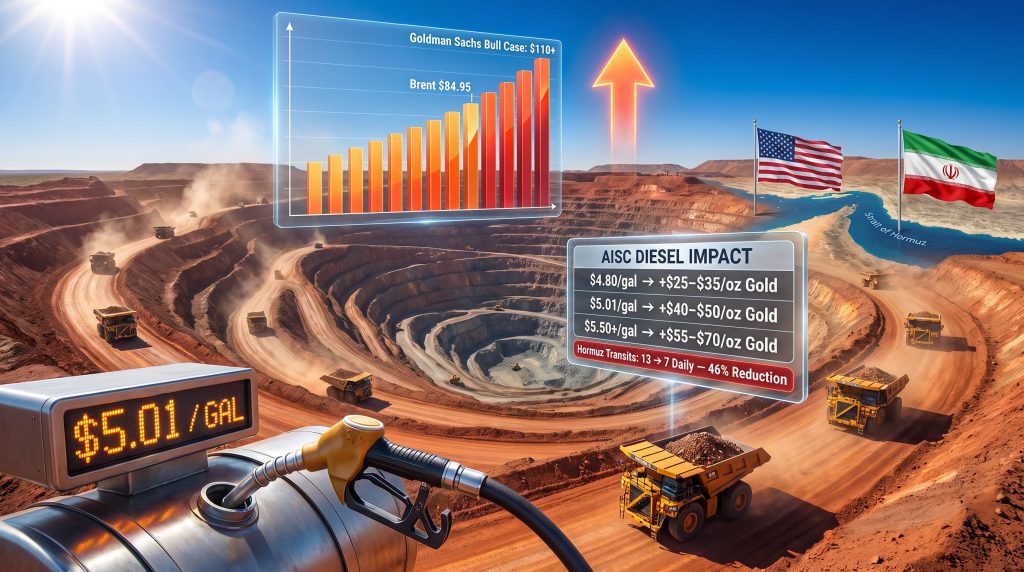
Following the US reimposition of a naval blockade on Iranian ports, daily vessel transits through the strait fell from 13 to just 7 crossings per day, representing a 46% reduction in throughput. This is not a financial signal derived from futures positioning or speculative sentiment; it is a physical supply constraint that feeds directly into crude availability for downstream refining.
The transmission chain operates as follows:
- Military escalation restricts vessel traffic through a critical chokepoint
- Reduced tanker throughput tightens physical crude supply reaching global refineries
- Refinery throughput constraints reduce diesel production volumes
- Tighter diesel supply drives up pump prices for industrial consumers
- Mining operators face higher per-gallon fuel costs across their entire haul fleet
- Quarterly AISC guidance rises, margin compression follows
What makes this chain particularly punishing for mining companies is the asymmetry of timing. Crude price spikes feed through to diesel costs within days, but the reverse journey, where falling crude eventually normalises mining fuel budgets, takes quarters due to hedging lags and fixed-term supply contracts.
What Triggered the Current Escalation: A Sequenced Breakdown
From Ceasefire Collapse to Naval Blockade
The current oil price pressure did not emerge from a single event but from a rapid sequence of escalations following the breakdown of a June 2026 ceasefire between the US and Iran. Understanding the sequence matters for assessing how long the supply disruption is likely to persist. The broader trade war impact on oil markets has furthermore amplified these pre-existing tensions, adding another layer of complexity to an already volatile environment.
- Iran targeted three crude supertankers, immediately halting Gulf shuttle runs and introducing direct physical risk to tanker operators serving regional export terminals
- The US responded by reimposing a naval blockade on Iranian ports and striking coastal defense installations and missile sites
- A proposed 20% transit fee on vessels using the strait under US naval protection was simultaneously dropped, removing a managed-access framework that had briefly offered a structured pathway through the crisis
- Iran signalled the potential reactivation of Houthi forces in Yemen to disrupt the Bab el-Mandeb, the southern Red Sea chokepoint connecting the Gulf of Aden to the Suez Canal
The Bab el-Mandeb dimension deserves particular attention. If both chokepoints face simultaneous disruption, the rerouting burden on global tanker fleets would add weeks to voyage times and significantly inflate freight costs across all commodity supply chains. Freight costs in conflict-affected corridors have already risen by an estimated 40%, compounding the direct fuel cost impact with broader logistics inflation.
Where Crude Prices Stood and What Analysts Project
| Benchmark | Recent Level | Key Movement | Analyst Projection |
|---|---|---|---|
| Brent Crude | $84.95 / bbl | +1.2% intraday high of $85.78 | Above $110 by Q4 2026 (Goldman Sachs bull case) |
| WTI Crude | $79.45 / bbl | +1.1% to $80.19 intraday | $85 to $87 range (Nissan Securities base case) |
| Brent Bear Case | Contingent on de-escalation | Requires mediation success | Low $60s by year-end (Goldman Sachs) |
| Disruption Scenario Upside | Current levels | Sustained blockade | Additional $10 to $20 / bbl |
Hiroyuki Kikukawa of Nissan Securities has indicated that WTI is likely to remain in the $85 to $87 range if mediation efforts hold and naval enforcement stays partial rather than comprehensive. Ritterbusch & Associates has characterised current market conditions as resembling the pre-ceasefire environment rather than the acute early-war spike that briefly pushed prices toward $120 per barrel, while still identifying 8% to 10% additional upside potential from current levels.
John Deal of Post Oak Group has observed that both parties appear oriented toward outcomes they can frame as domestic political victories, a dynamic that simultaneously reduces the probability of immediate further escalation and limits the likelihood of rapid unconditional de-escalation. In practical terms, this means a prolonged period of elevated uncertainty rather than a clean resolution in either direction. Tracking crude oil price trends through this period will consequently be critical for mining operators making fuel cost assumptions in H2 2026 planning.
How Elevated Oil Prices Translate Into Mining Cost Inflation
The Diesel Price Signal That Mining Operators Cannot Ignore
US retail diesel reached $4.796 per gallon as of mid-July 2026, representing a 27.6% year-over-year increase and a $0.218 rise from the prior week alone. In the more acute conflict scenario, diesel prices have exceeded $5.01 per gallon, reflecting a 33% to 41% increase since the onset of renewed hostilities and the highest levels recorded since 2022.
These are not marginal fluctuations to be smoothed out in quarterly reporting. For open-pit mining operations, diesel is not a secondary input; it is the primary energy source for haul trucks, drilling rigs, auxiliary generators, and ore processing infrastructure. Its share of total operating costs is structural, not discretionary.
Sector-by-Sector Exposure: Who Feels the Pressure Most?
Gold Mining
- Diesel typically accounts for 15% to 25% of AISC at open-pit gold operations
- At $100 per barrel crude, the estimated additional cost burden reaches $40 to $50 per ounce of gold produced
- For producers operating with AISC margins below $200 per ounce, this represents a 20% to 25% margin compression from fuel costs alone
Iron Ore Mining
- Large-scale iron ore operations run some of the world's largest diesel-powered haul fleets, with minimal electrification at scale
- A 10-cent movement in diesel price equates to approximately $70 million in annual cost variance for major producers
- A 50-cent diesel move, well within the current scenario range, could therefore represent $350 million or more in additional annual operating costs at comparable scale
Copper Mining
- Chilean copper producers and other large-scale porphyry operators have estimated a 5% increase in overall production costs attributable to the current fuel price environment
- Copper's energy intensity in processing lower-grade deposits amplifies diesel exposure beyond simple haulage calculations, making per-tonne energy costs a critical sensitivity metric
How commodity prices and miners interact during sustained fuel cost inflation is, however, a more nuanced relationship than simple margin subtraction suggests. Metal price strength can partially offset diesel cost headwinds, but this offset is unreliable when geopolitical risk simultaneously suppresses demand sentiment in key consuming economies.
AISC Sensitivity Table: Mapping Diesel Scenarios to Mining Cost Outcomes
| Diesel Price (USD / gallon) | Year-on-Year Change | Estimated AISC Impact (Gold, per oz) | Annual Cost Shift (Large Iron Ore Producer) |
|---|---|---|---|
| $3.76 (pre-conflict baseline) | Baseline | Baseline | Baseline |
| $4.80 (current level) | +27.6% | +$25 to $35 / oz | +$200M to $250M |
| $5.01 (conflict peak) | +33% to 41% | +$40 to $50 / oz | +$300M to $350M |
| $5.50+ (Goldman bull case) | +46%+ | +$55 to $70 / oz | +$400M+ |
Diesel cost sensitivity is not uniform across the mining sector. Operations with higher diesel hedging ratios, newer fuel-efficient fleet technology, or lower diesel consumption per tonne of ore processed will absorb these shocks more effectively than older, less efficient fleets running spot fuel purchases. Company-level disclosures on fuel cost sensitivity within quarterly AISC guidance are a far more reliable indicator of actual exposure than day-to-day crude price movements.
Competing Analyst Scenarios for Oil Price Trajectory in H2 2026
The Bull Case: Prolonged Disruption Pushes Brent Above $110
Goldman Sachs has outlined a scenario in which Brent crude surpasses $110 per barrel by Q4 2026 if Gulf export recovery stalls and shipping disruptions persist through the second half of the year. This scenario requires the continuation of reduced Hormuz vessel transits, no effective ceasefire framework, and the confirmed reactivation of Houthi disruption in the Bab el-Mandeb. In that environment, US diesel could approach or exceed $5.50 per gallon, placing severe margin compression pressure on high-AISC mining operations with limited hedging coverage.
The Base Case: Partial Mediation Keeps WTI in a Bounded Range
Ritterbusch & Associates has noted that current market conditions more closely resemble the pre-ceasefire environment than the acute early-war spike. Their assessment identifies 8% to 10% further upside from current WTI levels, which would push the benchmark toward the $87 to $88 range without a broader bombing campaign. This scenario would keep diesel prices elevated but below the acute pressure zone of the full disruption scenario.
The Bear Case: De-escalation Returns Brent to the $60s
Goldman Sachs' bear case requires a specific and simultaneous combination of conditions: effective mediation achieving a durable ceasefire, the Bab el-Mandeb remaining open to commercial shipping, and EIA inventory data confirming consecutive weekly builds in US crude stockpiles. The probability of all three conditions materialising concurrently in the near term is limited, but the outcome is meaningful for mining operators evaluating whether to lock in diesel hedges at current elevated prices.
The $50+ spread between Goldman Sachs' bull and bear Brent scenarios reflects genuine uncertainty about conflict duration and mediation success, not analytical disagreement between research teams. This range makes diesel cost forecasting for mining companies exceptionally difficult for H2 2026 planning cycles, and any operator presenting narrow fuel cost guidance at this point deserves scrutiny.
Physical Oil Supply Indicators That Will Determine Mining Fuel Costs
EIA Inventory Data: The Earliest Quantitative Warning Signal
US commercial crude inventories stood at 409.7 million barrels for the week ending July 10, 2026, approximately 6% below the five-year seasonal average. This below-average inventory position is a critical contextual factor: it means the market has significantly less buffer to absorb further supply disruption than would exist in a well-stocked environment. Any additional decline in Gulf export volumes would therefore translate more rapidly and more severely into diesel price pressure than historical precedent from better-stocked periods would suggest.
A Decision Matrix for Mining Operators and Investors
| Indicator | Signal for Higher Diesel Costs | Signal for Lower Diesel Costs |
|---|---|---|
| EIA Weekly Crude Inventories | Consecutive weekly draws | Consecutive weekly builds |
| Hormuz Vessel Transits | Further decline below 7 / day | Recovery toward 10 to 13 / day |
| Bab el-Mandeb Status | Houthi disruption confirmed | Corridor remains commercially open |
| Goldman Sachs Brent Forecast Revision | Revision toward $110+ | Revision toward $60s |
| US Retail Diesel Price | Sustained above $5.00 / gallon | Decline toward $4.00 to $4.50 / gallon |
The EIA's Weekly Petroleum Status Report and real-time Hormuz vessel transit counts are the two most actionable early-warning data sources available to mining analysts and investors. Neither requires interpretation of political signals or military intelligence; both reflect the physical reality of supply conditions as they develop.
The next major ASX story will hit our subscribers first
Strategic Cost Management in a High-Fuel-Price Environment
What Mining Companies Can Do Right Now
The current environment demands a structured operational response rather than passive exposure management. Practical levers available to mining operators include:
- Fuel consumption audits targeting inefficiencies in haul route design, truck idling patterns, and load optimisation to reduce per-tonne diesel consumption independent of price
- Procurement diversification to reduce dependence on spot diesel purchases during price spikes, spreading exposure across term contracts at different pricing points
- Production scheduling adjustments that defer high-fuel-intensity ore zones to periods where diesel costs are expected to normalise
- Hedge book review to assess whether current coverage ratios are adequate for a prolonged elevated price environment without over-committing at potentially cyclical peak prices
Fleet Electrification as a Structural Hedge Against Diesel Cycles
Mining companies investing in battery-electric haul trucks, hydrogen-powered mining trucks, or hybrid diesel-electric fleets are building structural insulation against future diesel price cycles. The capital costs of fleet electrification remain high relative to conventional diesel equipment, but the current environment materially strengthens the economic case for accelerating that investment.
An often-overlooked dimension of this transition is that newer-generation diesel fleets, even without full electrification, deliver meaningfully lower fuel consumption per tonne of ore moved than equipment purchased a decade ago. Operators running older fleets face a compounding disadvantage: higher per-gallon costs applied to higher per-tonne consumption rates. Furthermore, mining electrification and decarbonisation initiatives are increasingly being evaluated not only for their environmental credentials but for their role as long-term cost stabilisers in volatile energy markets.
Explosives costs, which are closely linked to energy input prices, have also risen by approximately 10% in the current environment, adding another layer of cost inflation that compounds the direct diesel impact across mining consumables. This is a dimension of the cost transmission mechanism that is frequently absent from high-level analysis but material to total operating cost outcomes at mine site level.
Frequently Asked Questions: US-Iran Conflict, Oil Prices, and Mining Costs
How do US-Iran military strikes affect oil prices?
US military strikes targeting Iranian coastal infrastructure, combined with naval blockades restricting tanker traffic through the Strait of Hormuz, reduce the physical availability of crude oil reaching global markets. With approximately 20% of global oil and LNG trade transiting the strait, even a partial disruption creates immediate upward pressure on both Brent and WTI benchmarks, independent of speculative positioning.
Why does oil price matter so much to mining companies?
Diesel, refined from crude oil, is typically the single largest variable operating cost for open-pit mining operations. It powers haul trucks, drilling rigs, and generators across the mine site. When crude prices rise sharply, diesel costs follow within days, compressing mining margins even when metal prices remain unchanged.
Which mining sectors carry the highest diesel cost exposure?
Open-pit gold, iron ore, and copper operations carry the highest exposure due to large haul truck fleets and long intra-pit haulage distances. Underground operations and processing-intensive facilities also face elevated costs, though typically at lower diesel intensity per tonne of ore moved.
What conditions would allow oil prices to return to pre-conflict levels?
A durable ceasefire, the restoration of normal vessel traffic through the Strait of Hormuz, the Bab el-Mandeb remaining open to commercial shipping, and consecutive builds in US crude inventories would need to occur simultaneously. These are the conditions underpinning Goldman Sachs' bear case scenario for Brent in the low $60s by year-end.
How should investors evaluate mining company exposure to diesel cost inflation?
The most reliable method is to scrutinise quarterly AISC guidance for explicit diesel sensitivity disclosures rather than extrapolating from day-to-day crude price movements. Companies that publish fuel cost sensitivity ranges per barrel of crude or per cent of diesel price change provide the most actionable data for assessing true cost exposure. Hedge book coverage ratios and fleet age profiles are secondary but important indicators of resilience.
Disclaimer: This article contains forward-looking statements, analyst projections, and scenario-based analysis that involve inherent uncertainty. Oil price forecasts from Goldman Sachs, Nissan Securities, and Ritterbusch & Associates represent analyst opinions at a specific point in time and should not be construed as investment advice. Mining cost sensitivity figures are estimates based on industry benchmarks and may differ materially from individual company outcomes. Readers should conduct independent due diligence before making any investment decisions.
Want to Know Which ASX Miners Are Best Positioned Amid Rising Energy Costs?
Discovery Alert's proprietary Discovery IQ model scans ASX announcements in real time, instantly identifying significant mineral discoveries and translating complex data into actionable insights — so investors can assess opportunities before the broader market reacts. Explore how historic discoveries have delivered substantial returns on Discovery Alert's dedicated discoveries page, and begin a 14-day free trial to gain a market-leading edge during one of the most volatile energy cost environments in recent memory.