July 17, 2026
Iron Ore's Infrastructure Imperative: Why Replacement Capital Defines the Next Decade of Pilbara Mining
The economics of large-scale iron ore production are rarely as simple as digging more ore out of the ground. Beneath the headline production figures lies a complex interplay of reserve depletion curves, infrastructure utilisation rates, and capital allocation decisions that determine whether a mining system can sustain its output over decades rather than years. For the world's largest diversified miners, the most consequential investments are often not the ones that expand production, but the ones that prevent it from contracting.
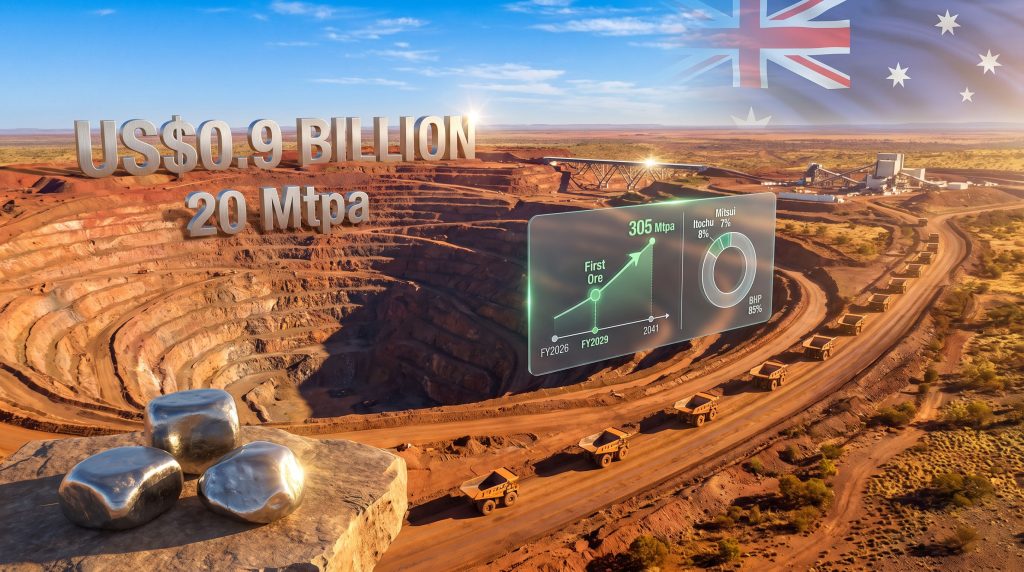
This is the operating reality behind the BHP Ministers North Project, a US$0.9 billion development in Western Australia's Central Pilbara region that quietly represents one of the most strategically significant capital commitments in BHP's near-term portfolio. To understand why, it helps to start not with the project itself, but with the geological and operational lifecycle dynamics that made it necessary.
When big ASX news breaks, our subscribers know first
The Structural Challenge of Long-Life Mining Assets
Every mining operation follows a depletion curve. As ore reserves mature, grades can shift, haul distances extend, and strip ratios climb, all of which erode the economics of continued extraction. Managing this transition, particularly within a large integrated mining system where individual pits feed shared infrastructure, requires anticipatory capital deployment years before the production shortfall actually materialises.
BHP's Yandi operation illustrates this dynamic with particular clarity. Having contributed to the company's Western Australian Iron Ore system for more than 30 years, Yandi has delivered enormous value from its Channel Iron Deposit (CID) ore base. CID ore forms through the weathering and redeposition of iron-rich material within ancient river channels, producing friable, goethite-dominated ore that is relatively straightforward to mine but carries lower iron grades and higher alumina and phosphorus levels compared to hard rock alternatives.
As Yandi's CID reserves approach natural depletion, the production gap it leaves behind cannot simply be absorbed by other system components without compromising BHP's ability to sustain throughput targets. This is precisely the structural challenge that the BHP Ministers North Project is designed to resolve. Furthermore, understanding the broader iron ore deposit types involved helps contextualise why the shift from CID to Brockman ore carries such strategic weight.
What the BHP Ministers North Project Actually Involves
Located approximately 13 kilometres southeast of the Yandi mining hub, the Ministers North Project targets a Brockman formation ore deposit, a fundamentally different ore type from the CID material at Yandi. Brockman ores are part of the Hamersley Group stratigraphy and are characterised by higher iron content, harder mineralogy, and generally lower contaminant profiles. This geological distinction carries real commercial weight: higher-grade Brockman ore commands stronger market positioning in quality-sensitive steel markets, particularly in Asia where blast furnace operators closely manage their burden chemistry.
The project's core specifications reflect a carefully scoped brownfield development:
| Attribute | Detail |
|---|---|
| Location | ~13 km southeast of Yandi, Central Pilbara, WA |
| Investment Value | US$0.9 billion |
| Ore Type | High-grade Brockman deposit |
| Production Capacity | 20 Mtpa at full ramp-up |
| Projected Mine Life | Approximately 11 years |
| First Ore Target | FY2029 (July 2028 to June 2029) |
| Site Works Commenced | July 2026 |
| Final Investment Decision | Confirmed July 2026 |
| Contracting Model | EPCM (Engineering, Procurement, Construction Management) |
| Development Envelope | 5,556.6 hectares |
| Native Vegetation Clearing | Up to 1,848 hectares |
| Operational Horizon | Expected to remain active until at least 2041 |
The project is structured as a joint venture across three partners, with BHP holding an 85% operating majority, Itochu Corporation contributing 8%, and Mitsui & Co. holding the remaining 7%. This configuration mirrors BHP's established Pilbara partnership model and reflects the enduring appetite of Japanese industrial conglomerates for equity exposure to high-quality Australian iron ore supply.
Why Brockman Ore Represents More Than Just a Grade Upgrade
The transition from CID to Brockman ore within the same infrastructure corridor is technically significant and not fully appreciated outside specialist mining circles. CID ore, despite its processing advantages (it requires minimal crushing due to its friable nature), produces a product with elevated alumina levels that can create slag management challenges in steel mills. Brockman ore, by contrast, offers a cleaner chemical profile with higher iron grades and lower penalty element content.
For BHP, this ore-type transition embedded within a replacement capital strategy means the company is not merely defending production volumes, it is simultaneously upgrading the average quality of the product moving through its system. In iron ore markets where iron ore price trends can shift significantly based on steel mill profitability and environmental compliance requirements, product quality is a durable competitive variable.
Industry Insight: Iron ore pricing is not monolithic. A difference of one percentage point in iron content can translate to meaningful price premiums in spot markets, while elevated phosphorus or alumina levels attract discounts that compound at scale across 20 million tonnes of annual production.
Infrastructure Integration: The Brownfield Advantage in Practice
One of the most financially consequential features of the BHP Ministers North Project is its deliberate architecture around existing Yandi infrastructure. Rather than establishing a standalone greenfield operation with its own port access, power generation, water supply, and workforce accommodation, Ministers North slots into BHP's established Pilbara logistics network through targeted new build components:
-
Construction of a 13-kilometre haul road linking Ministers North directly to the Yandi processing hub, supported by the broader Pilbara haul road infrastructure investment trends shaping the region
-
Installation of a purpose-built land bridge to facilitate safe and efficient ore movement across the corridor
-
Upgrades to Yandi's processing capacity through a new primary and secondary crusher installation
-
Integration with BHP's existing rail and port export infrastructure to move product to market
The financial logic of this approach becomes clear when compared to greenfield alternatives:
| Factor | Ministers North (Brownfield) | Typical Greenfield Development |
|---|---|---|
| Infrastructure | Leverages existing Yandi hub | Full standalone build required |
| Development Timeline | ~3 years to first ore | 5 to 8+ years typical |
| Capital Intensity | US$0.9bn for 20 Mtpa | Significantly higher per tonne |
| Permitting Complexity | Moderate (adjacent to existing operations) | High (entirely new environmental footprint) |
| Operational Risk | Lower (proven workforce and systems) | Higher (new site establishment) |
| Product Quality | Brockman (higher grade) | Variable by deposit |
The EPCM contracting model selected for Ministers North adds another layer of cost management discipline, with BHP retaining direct oversight of design and procurement decisions rather than ceding control to a lump-sum contractor. This approach is particularly suited to projects where existing infrastructure integration creates interdependencies that require active management throughout construction.
Production Context: BHP's 305 Mtpa Target and the Volume Mathematics
BHP's FY2026 iron ore production of 264.7 million tonnes — a 1% year-on-year increase — sits within the company's guided range of 258 to 269 Mt. Against its medium-term sustainability target of 305 Mtpa, this leaves a gap of approximately 40 million tonnes that requires new supply sources to bridge.
Ministers North contributes 20 Mtpa to that equation, but critically, this volume replaces output that would otherwise erode as Yandi depletes rather than adding net new capacity above BHP's current production baseline. Achieving 305 Mtpa therefore demands Ministers North plus additional volume growth from other assets across the Western Australian Iron Ore portfolio.
This distinction between replacement capital and growth capital is fundamental to interpreting BHP's investment rationale:
-
Replacement capital preserves existing cash flows and production economics by offsetting natural reserve depletion
-
Growth capital expands the production base beyond its current ceiling, requiring new markets, logistics capacity, and demand to absorb incremental supply
-
Ministers North is firmly in the replacement capital category, making it a lower-risk, infrastructure-adjacent investment compared to greenfield growth projects
Key Analytical Point: Investors evaluating BHP's iron ore division should be careful not to interpret Ministers North as a signal of production expansion ambitions. Its primary function is defensive, maintaining system throughput as a 30-year asset winds down.
The next major ASX story will hit our subscribers first
Open-Pit Mining Mechanics and the Emissions Question
Ministers North will be developed as a conventional open-pit operation, positioned above the regional water table. This geological positioning meaningfully simplifies the project's operational complexity by minimising dewatering requirements, a significant cost and environmental management factor in many Pilbara operations where below-water-table mining necessitates continuous groundwater extraction and management.
Primary ore haulage will rely on diesel truck fleets, which are expected to be the dominant source of direct greenhouse gas emissions from the operation across its approximately 11-year mine life. This creates a forward-looking emissions management question: as BHP progresses toward its broader decarbonisation targets, the pathway to reducing Scope 1 emissions from Ministers North will likely involve either fleet electrification, hydrogen-powered haulage, or alternative fuel substitution programmes, none of which carry certainty in the current technology landscape.
The mine's 5,556.6-hectare development envelope and up to 1,848 hectares of native vegetation clearing represent the project's environmental footprint commitments, subject to ongoing regulatory management and BHP's stated biodiversity offset obligations.
Project Timeline: Key Milestones From Approval to First Ore
-
July 2026 — Final Investment Decision confirmed and site works commence
-
FY2027 to FY2028 — Infrastructure construction phase including haul road, land bridge, and crusher installation
-
FY2029 — First ore production targeted from the Ministers North orebody
-
FY2029 onward — Progressive ramp-up toward 20 Mtpa nameplate capacity
-
Approximately 2041 — Projected end of operational mine life after approximately 11 years of production
BHP's Parallel Copper Strategy: Reading the Dual-Track Capital Allocation
The BHP Ministers North Project announcement arrives alongside a separate but strategically connected development: BHP's award of a staged design and supply contract to China Nerin Engineering valued at more than AU$200 million (approximately US$140 million) to support the scale-up of its Copper South Australia asset.
Global copper demand is projected to increase by approximately 70% by 2050, driven by electrification infrastructure, renewable energy buildout, and electric vehicle adoption. A potential Final Investment Decision for Copper South Australia is anticipated during the 2027 calendar year, with the Nerin contract covering the design optimisation phases that precede that decision point.
BHP's simultaneous capital commitments across iron ore and copper reflect a dual-track portfolio strategy:
-
Defend near-term iron ore cash generation capacity through production continuity investments like Ministers North
-
Build long-cycle earnings exposure in energy transition metals through early-stage copper infrastructure development at Copper South Australia
This approach reflects the fundamental capital allocation challenge facing diversified major miners: balancing the obligation to sustain cash flows from mature bulk commodity assets against the imperative to position in structurally growing markets before competitive windows close.
The Japanese Trading House Dimension
The participation of Itochu Corporation and Mitsui & Co. in the Ministers North joint venture deserves attention beyond the headline ownership percentages. Japanese trading houses have maintained equity positions in Australian iron ore operations since the 1960s, using direct project stakes as a supply security mechanism rather than purely as return-seeking investments. For major Japanese steel producers, maintaining access to a diversified basket of high-quality ore sources is a strategic priority that justifies equity participation at economics that might appear suboptimal to a pure financial investor.
The 85/8/7 split in the Ministers North joint venture preserves BHP's operational authority while distributing capital exposure across partners whose interests are durably aligned around long-term supply continuity. For BHP, this partnership structure reduces the equity capital required from its own balance sheet while maintaining control over the technical and commercial decisions that determine project outcomes. In addition, Australia's iron ore advantages — including ore quality, established logistics, and long-standing trade relationships — continue to make these joint venture structures attractive to Asian industrial partners.
Frequently Asked Questions: BHP Ministers North Project
What is the BHP Ministers North Project?
The BHP Ministers North Project is a US$0.9 billion iron ore development located approximately 13 kilometres southeast of BHP's Yandi mining hub in Western Australia's Central Pilbara region. Confirmed in July 2026, the project targets a high-grade Brockman ore deposit with a production capacity of 20 million tonnes per annum, with first ore targeted in FY2029.
Why is BHP developing Ministers North?
The project is designed to replace production volumes that will be lost as the Yandi mine, which has operated for over 30 years, gradually depletes its Channel Iron Deposit reserves. Ministers North supports BHP's medium-term production target of 305 Mtpa and ensures continuity within the Western Australian Iron Ore system.
Who owns the Ministers North Project?
The project operates as a joint venture between BHP (85%), Itochu Corporation (8%), and Mitsui & Co. (7%). Mitsui's equity participation reflects the strategic rationale Japanese trading houses apply to securing long-term iron ore supply from high-quality Australian sources.
When will Ministers North produce first ore?
First ore is targeted in FY2029, corresponding to the period between July 2028 and June 2029. Site works commenced in July 2026 following confirmation of the Final Investment Decision.
How long will Ministers North operate?
The project carries an estimated mine life of approximately 11 years, with operations expected to continue until at least 2041.
What type of ore will Ministers North produce?
Ministers North will mine Brockman formation ore, a higher-grade iron ore type relative to the Channel Iron Deposit ore at Yandi, offering improved iron content and a lower contaminant profile for downstream steel production applications. Furthermore, the China steel demand outlook suggests that quality-differentiated ores like Brockman will command sustained interest from Asian blast furnace operators managing increasingly stringent environmental standards.
How does Ministers North connect to existing infrastructure?
The project connects to Yandi via a 13-kilometre haul road and a purpose-built land bridge. Ore will be processed through upgraded Yandi facilities before moving through BHP's established rail and port export network.
Readers seeking further analysis of BHP's Western Australian Iron Ore operations and broader Pilbara capital strategy can explore Mining Digital's ongoing coverage of major resource sector developments at miningdigital.com.
Want To Catch the Next Major Mineral Discovery Before the Market Does?
Discovery Alert's proprietary Discovery IQ model scans ASX announcements in real time, instantly transforming complex mineral data into actionable investment insights across iron ore, copper, and more than 30 other commodities — so subscribers can act with confidence, not guesswork. Explore historic discoveries and their remarkable returns to understand the opportunity, then begin your 14-day free trial at Discovery Alert to position yourself ahead of the broader market.