August 1, 2026
When the World's Most Critical Energy Facility Burns in Silence
The global oil market has spent decades operating on a foundational assumption: that Saudi Arabia's export system is functionally indestructible. Redundant pipelines, dual-coast terminals, vast strategic inventories, and unmatched engineering capacity have combined to position the Kingdom as the world's indispensable energy backstop. Every geopolitical stress model, every supply shock scenario, and every strategic reserve policy has been built on that assumption holding firm.
The Abqaiq attack on Saudi oil exports, which occurred in late July 2026, did not shatter that assumption in a single dramatic moment. Instead, it did something potentially more consequential: it placed the assumption itself under sustained, coordinated, and deliberately ambiguous pressure.
When big ASX news breaks, our subscribers know first
Understanding What Abqaiq Actually Does
Before assessing the strategic implications of the attack, it is worth understanding precisely why Abqaiq occupies such singular importance within the global energy system. The facility is not simply a large processing plant. It is the mandatory gateway through which crude extracted from Saudi Arabia's most prolific fields must pass before it can be loaded onto export tankers.
The fields Abqaiq serves include Ghawar, the largest conventional oil field ever discovered, as well as Khurais and Shaybah. Crude extracted from these formations arrives at Abqaiq in a raw, unstabilised state containing dissolved gases and volatile compounds that make it unsafe and non-compliant for international shipping. The stabilisation process at Abqaiq removes these elements, bringing the crude to export specification.
Abqaiq is not simply a processing plant. It is the mandatory gateway through which Saudi Arabia's crude must pass before it can meet international quality specifications and enter global shipping lanes. Disrupting it does not require stopping production; it requires making exports unreliable.
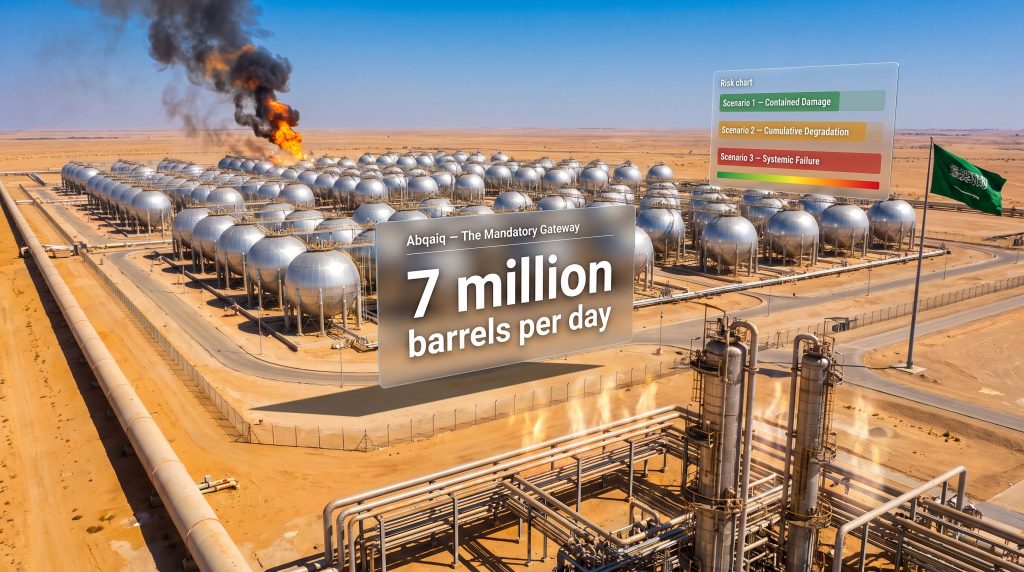
With a processing capacity exceeding 7 million barrels per day, the facility handles a throughput volume that is difficult to comprehend in practical terms. For context, that single installation processes more crude daily than the entire output of every OPEC market influence member except Saudi Arabia itself. The critical distinction that most market commentary misses is the difference between production capacity and export delivery capacity. The attack on Abqaiq targeted the latter while leaving the former largely intact.
What Satellite Imagery Reveals and What Official Silence Conceals
Publicly available satellite imagery captured in the days following the late July 2026 incident revealed burn scarring in areas of the facility associated with crude stabilisation operations rather than peripheral tank storage. This distinction carries significant operational weight.
Storage tanks, while valuable assets, can often be isolated from the wider processing system. A tank fire, while dramatic, does not necessarily interrupt the stabilisation chain. Processing infrastructure operates differently. Stabilisation units function as an integrated sequence, meaning damage to one component can force the shutdown of adjacent systems for inspection, safety certification, and repair, even when those adjacent systems sustained no direct damage.
The absence of any detailed engineering assessment from Saudi Aramco or the Saudi Ministry of Energy in the days following the incident was itself a signal that energy analyst Rory Johnston described on July 30, 2026, as genuinely unusual given the facility's singular importance to global markets. Johnston noted publicly that the world's most strategically important oil installation had been visibly on fire, yet days later, verified operational data remained absent.
This informational vacuum is worth treating as a data point rather than dismissing. Saudi Aramco and the Ministry of Energy have historically communicated clearly and promptly following incidents precisely because transparency protects contractual relationships with long-term buyers. Prolonged silence suggests either ongoing assessment complexity or a deliberate strategy of managed disclosure. Neither interpretation is reassuring.
The Full Export Architecture Under Simultaneous Pressure
The Abqaiq attack does not exist in isolation. It is one node in a broader network that is currently experiencing coordinated stress across multiple critical junctures simultaneously. Furthermore, understanding how the trade war impact on oil interacts with these supply-side pressures adds another layer of complexity to an already volatile environment.
| Infrastructure Node | Core Function | Current Threat Vector |
|---|---|---|
| Abqaiq Processing Complex | Crude stabilisation before export | Direct strike, damage scope unconfirmed |
| East-West Pipeline | Overland route to Red Sea, bypassing Hormuz | Renewed operational pressure |
| Yanbu Export Terminal | Primary Red Sea crude export outlet | Houthi-linked disruption activity |
| Jizan Refinery | Domestic fuel processing and export support | Reported shutdown following Houthi strike |
| Bab el-Mandeb Strait | Maritime chokepoint connecting Red Sea to global markets | Active interdiction operations |
Saudi Arabia's export architecture was deliberately engineered for resilience through redundancy. When the Strait of Hormuz faces pressure, crude can be rerouted overland through the East-West Pipeline to Yanbu on the Red Sea coast. When individual processing units require maintenance, spare capacity elsewhere absorbs the shortfall. This system of overlapping contingencies is precisely what has made the Kingdom the world's supplier of last resort.
The problem with redundancy-based resilience is that it is explicitly designed to handle one failure at a time. The 2026 attack campaign appears structured around the recognition that simultaneous pressure across all redundancy pathways is a fundamentally different strategic challenge than any single disruptive event.
The 2019 Abqaiq Strike: A Historical Benchmark
To understand the magnitude of what is at stake in 2026, the September 2019 attack on Abqaiq and the Khurais oil field provides essential context. Notably, crude oil price trends since that period illustrate how markets have repeatedly underestimated the duration of infrastructure-related supply shocks.
| Dimension | September 2019 Strike | 2026 Multi-Node Campaign |
|---|---|---|
| Primary objective | Maximum immediate production disruption | Systematic erosion of export reliability |
| Confirmed targets | Two upstream and processing facilities | Abqaiq, East-West Pipeline, Yanbu, Jizan |
| Volume removed from market | Approximately 5.7 million bpd confirmed | Unclear, opacity is the strategy |
| Market price response | Largest single-day percentage spike in modern history | Muted, market misreading risk elevated |
| Recovery narrative | Demonstrated resilience within weeks | Ongoing uncertainty, no official timeline |
| Strategic sophistication | High-impact single event | Sustained, coordinated systemic pressure |
The 2019 strikes temporarily removed approximately 5.7 million barrels per day from Saudi production, equivalent to roughly half the Kingdom's total output and approximately 5% of global daily supply. Saudi Arabia deployed strategic stockpiles to maintain contractual export commitments while emergency repairs were completed, delivering a powerful demonstration of operational resilience that actually reinforced market confidence in the country's reliability.
The 2026 campaign appears to have learned from that outcome. A catastrophic, confirmed disruption of that magnitude would invite an overwhelming international response and again allow Saudi Arabia to demonstrate its recovery capabilities. A sustained campaign of ambiguity, forced inspections, insurance escalation, and cumulative uncertainty achieves strategic impact without triggering that response.
Why Oil Markets Are Calm and Why That Calm May Be Misleading
Benchmark crude prices have not yet reflected the full scope of the infrastructure pressure described above. This apparent market serenity warrants scrutiny rather than acceptance. In addition, tracking WTI and Brent futures movements in the weeks following the incident reveals a telling divergence between futures market complacency and physical market friction.
The conventional pricing model for oil operates primarily on confirmed production volumes. Traders price in supply disruptions when barrels are demonstrably absent from the market. The 2026 attack campaign is structured to operate below this threshold by targeting export reliability rather than production volume, creating a scenario where the market prices in normalcy while the physical and logistical foundations of that normalcy are gradually compromised.
The sequence through which physical infrastructure damage eventually reaches financial markets typically follows this pathway:
- Cargo nomination adjustments by long-term Saudi contract holders
- Changes in tanker loading schedules at Ras Tanura and Yanbu terminals
- Crude quality specification variances reported by Asian and European refiners
- Rising war risk insurance premiums for Persian Gulf and Red Sea shipping lanes
- Widening differentials between Saudi benchmark grades and competing crude streams
- Eventual benchmark price movement as commercial consequences become undeniable
Each step in this sequence involves a time lag. The refining margin increases already observed across Europe and Asia during this period represent an early stage of this transmission mechanism, reflecting market sensitivity to processing capacity constraints rather than crude availability alone. Goldman Sachs has separately identified refined fuel availability, rather than crude production, as the primary current supply constraint in oil markets, consistent with the downstream bottleneck thesis.
The next major ASX story will hit our subscribers first
Three Scenarios for Saudi Export Reliability
Scenario 1: Contained Damage, Rapid Recovery
Abqaiq's core stabilisation systems remain functional following the strike, with damage confined to peripheral units. Saudi Aramco's engineering teams, drawing on spare parts inventories developed specifically for post-incident rapid response, complete repairs within weeks. Long-term buyers experience minimal disruption. Key risk: this scenario assumes no follow-on strikes during the repair and certification window, a significant assumption given the campaign's sustained character.
Scenario 2: Cumulative Degradation Without Catastrophic Failure
Repeated lower-intensity strikes force ongoing inspection cycles, insurance reassessments, and diversion of engineering resources. Export reliability deteriorates incrementally through cargo delays, quality variances, and tanker scheduling friction rather than through a single dramatic event. The geopolitical risk premium embedded in crude benchmarks rises structurally. Key risk: markets remain complacent until commercial consequences become simultaneously visible across multiple buyer relationships.
Scenario 3: Systemic Export Architecture Failure
Simultaneous degradation of Abqaiq processing capacity, East-West Pipeline throughput, and Yanbu terminal operations eliminates Saudi Arabia's routing redundancy entirely. Strategic petroleum reserve drawdowns by IEA member nations become operationally necessary rather than precautionary. Global refining margins spike as feedstock quality and delivery certainty collapse. Key risk: this scenario does not require a single catastrophic strike. It can emerge organically from the accumulation of Scenario 2 conditions.
The Insurance Dimension: An Underappreciated Escalation Mechanism
One of the least-discussed consequences of sustained infrastructure pressure on Saudi export infrastructure involves the war risk insurance market. Repeated incidents at or near major loading terminals progressively elevate the war risk premiums assessed on tankers operating in those waters.
These premium increases compound across the supply chain in ways that are not immediately visible in benchmark crude prices but are acutely felt by refiners. Higher insurance costs, combined with potential rerouting requirements around contested maritime zones, increase the landed cost of Saudi crude for price-sensitive Asian and European buyers. Reports of six Saudi oil tankers rerouting around the African continent to avoid Houthi threat vectors in the Red Sea illustrate the commercial reality of this shipping cost escalation, adding weeks of transit time and significant additional operating expense to each voyage.
Reliability Warfare: A Doctrinal Shift in Energy Conflict
The broader strategic lesson of the 2026 attack campaign is the explicit transition from volume disruption to reliability warfare as the primary doctrinal approach to targeting energy infrastructure. From an adversary's perspective, this shift offers significant strategic advantages.
A volume disruption, like the 2019 Abqaiq-Khurais strike, removes barrels from the market in a manner that is immediately measurable, attributable, and likely to trigger a decisive response. A reliability campaign, by contrast, creates sustained uncertainty without generating the unambiguous trigger events that would justify overwhelming military or diplomatic escalation. It also operates on a timeframe that conventional market pricing models are poorly equipped to capture.
Actors attributed with responsibility for the 2026 campaign include Houthi forces operating from Yemen, Iraqi Shia militia groups with documented IRGC affiliations, and broader Iranian strategic coordination. The sophistication of the multi-node, simultaneous pressure approach suggests a level of strategic planning that goes well beyond opportunistic targeting of vulnerable infrastructure. Analysts monitoring the broader oil price rally dynamics of 2025 note that the geopolitical risk premium has been consistently underpriced relative to the physical threat environment.
Reassessing the Supplier of Last Resort
For importing nations, the most consequential implication of the Abqaiq attack on Saudi oil exports is not the immediate barrel count. It is the need to reassess the foundational assumption that Saudi Arabia's export system constitutes an indestructible global backstop.
Asian nations with high Saudi crude dependency and limited alternative supplier access face the greatest exposure under deteriorating scenarios. The adequacy of IEA strategic reserves calibrated against a prolonged rather than acute Saudi export disruption warrants serious policy review. Current IEA reserve release triggers were designed for confirmed, measurable supply shocks, not for the gradual erosion of export reliability that the 2026 campaign is engineered to produce.
Whether the geopolitical risk premium embedded in global crude benchmarks should be repriced structurally rather than cyclically is now a serious analytical question rather than a speculative one.
The traditional model, in which risk premiums spike sharply on headline events and then decay as apparent normalcy returns, may be fundamentally unsuited to pricing the sustained, multi-vector, reliability-focused campaign now underway against the world's most critical energy export system. Consequently, the Abqaiq attack on Saudi oil exports may ultimately be remembered less for the barrels it interrupted and more for the assumptions it permanently disrupted.
The market's quiet should not be mistaken for safety. It may simply reflect the lag between infrastructure vulnerability and commercial consequence, a lag that historically resolves in ways that are both significant and sudden.
This article is for informational purposes only and does not constitute financial or investment advice. Forward-looking scenario analysis involves inherent uncertainty, and readers should not rely on scenario projections as predictions of actual market outcomes.
Want to Identify Investment Opportunities Before the Market Catches On?
Sustained geopolitical pressure on global energy infrastructure creates ripple effects across commodities and resource equities that move well ahead of mainstream market awareness — and Discovery Alert's proprietary Discovery IQ model scans ASX announcements in real time, delivering instant alerts on significant mineral discoveries so subscribers can act on actionable opportunities before the broader market catches up. Explore Discovery Alert's dedicated discoveries page to see how historic ASX discoveries have generated substantial returns, and begin your 14-day free trial today to position yourself ahead of the next major market move.