August 1, 2026
The Hidden Complexity Behind Chevron's Venezuelan Output Numbers
Few dynamics in global energy markets are as layered as the intersection of sanctions policy, sovereign debt recovery, and upstream production growth. When a major Western oil company reports a significant output increase from one of the world's most geopolitically sensitive basins, the headline figure often conceals more than it reveals. Understanding what those numbers actually represent requires a framework that goes well beyond a simple barrels-per-day comparison.
Chevron's Venezuelan output sits at precisely this intersection. The company's joint ventures with state oil company PDVSA have been quietly accelerating production at a time when global crude supply chains are being reshaped by conflict, sanctions on oil trade, and capital allocation shifts among Western majors. To assess what that acceleration means, investors and market participants need to start with the measurement itself.
When big ASX news breaks, our subscribers know first
What Chevron's Venezuelan Output Figures Actually Mean
One of the most consistently misunderstood aspects of Chevron's Venezuelan reporting is the difference between gross joint-venture production, equity-adjusted entitlements, and export volumes. These three figures can diverge substantially, and conflating them leads to distorted conclusions.
| Metric | Volume | Key Context |
|---|---|---|
| Gross JV Production (H1 2026) | ~280,000 b/d | Total output across three PDVSA joint ventures |
| Chevron Equity Share (estimated) | ~50,000–90,000 b/d | Proportional entitlement based on ownership stakes |
| U.S.-bound Venezuelan crude exports | ~100,000+ b/d | Shipments permitted under active sanctions licensing |
| Venezuela national output | ~900,000 b/d | Chevron JVs represent approximately 22% of this total |
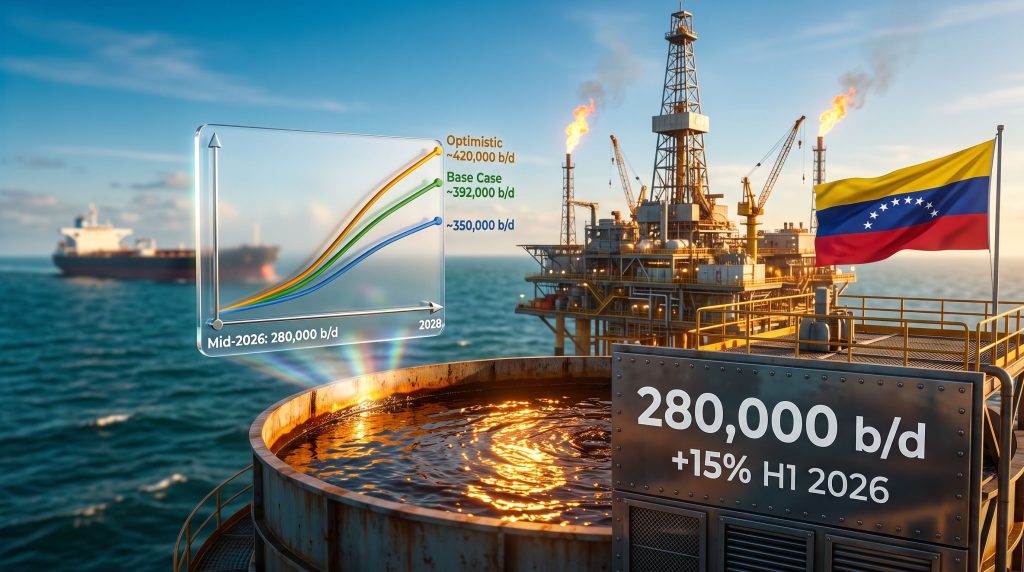
The gross figure of 280,000 b/d achieved in the first half of 2026 represents a 15% increase over the preceding six-month period and encompasses output from all three of Chevron's active partnerships with PDVSA. However, Chevron's direct financial exposure and earnings contribution is governed by its equity share, which is substantially lower. Investors modelling earnings impact should anchor to the equity-adjusted figure rather than the gross JV number when assessing balance sheet contribution.
The Three JV Structure and Venezuela's Acreage Profile
Chevron participates in three distinct joint ventures with PDVSA across approximately 74,000 oil and gas acres in Venezuela. This acreage concentration, combined with Venezuela's position as the holder of the world's largest proven reserves, gives Chevron a structurally unique upstream footprint. The bulk of Venezuela's reserves are classified as extra-heavy crude, predominantly concentrated in the Orinoco Belt, requiring either upgrading or blending before processing.
U.S. Gulf Coast refineries, particularly those configured for grades such as Venezuelan Merey crude, represent a natural demand destination for this material. This refining integration is a dimension that rarely features prominently in mainstream coverage but has significant strategic implications. The logistical and processing alignment between Venezuelan heavy crude supply and U.S. Gulf Coast refinery configuration creates netback advantages that improve the economics of Venezuelan production relative to other global heavy crude sources.
Benchmarking the H1 2026 Surge in Historical Context
To appreciate the significance of the current production trajectory, it is necessary to understand how far Venezuela's oil sector has fallen and how much ground has already been recovered. Venezuela's upstream industry experienced one of the most catastrophic collapses in OPEC market influence history between 2017 and 2020.
National output fell from above 2 million b/d to below 400,000 b/d within approximately three years, driven by mismanagement, underinvestment, skilled workforce emigration, and the escalating impact of U.S. sanctions on PDVSA's financing and operational capacity. Furthermore, the U.S. policy on PDVSA created additional constraints that compounded operational deterioration across the sector.
Chevron maintained its operational presence throughout this period through a series of U.S. Treasury Department general licences, positioning itself as the only Western major with an active upstream footprint in Venezuela when recovery conditions began to improve. That continuity has since translated into a first-mover production advantage that peers who exited the country cannot easily replicate.
- Pre-collapse peak: Venezuela producing over 2 million b/d nationally
- Trough (circa 2020): National output fell below 400,000 b/d
- 2022 recovery period: Chevron's JV equity contribution estimated at 45,000–50,000 b/d
- H1 2026: Gross JV output reaches 280,000 b/d, with Chevron's CEO-level commentary suggesting output has approximately doubled from the recovery baseline
This recovery trajectory is not simply a story of operational improvement. It reflects the compounding effect of sustained capital deployment, workforce stabilisation within the JVs, and the gradual rehabilitation of reservoir management practices that had deteriorated significantly during the crisis period.
The 50% Growth Target: Modelling the Path to 2028
Chevron's CFO communicated during the company's second-quarter 2026 results that the company anticipates growing its Venezuelan output by up to 50% between mid-2026 and the end of 2028. Stress-testing that target against different operational and geopolitical assumptions generates a range of plausible scenarios.
| Scenario | Base Output (Mid-2026) | Growth Rate | Projected 2028 Output |
|---|---|---|---|
| Conservative | 280,000 b/d | 25% | ~350,000 b/d |
| Base Case | 280,000 b/d | 40% | ~392,000 b/d |
| Optimistic (CFO guidance) | 280,000 b/d | 50% | ~420,000 b/d |
Achieving the upper end of this range is contingent on several simultaneous conditions being met:
- Sanctions continuity: U.S. Treasury licensing must remain active across a politically dynamic two-year horizon
- PDVSA operational capacity: The national oil company must sustain sufficient infrastructure, workforce capability, and reservoir management to support expanded JV activity
- Capital competition clearance: Venezuelan projects must demonstrate returns that are competitive within Chevron's global upstream portfolio
- Commercial negotiation outcomes: Any expansion into new project areas requires terms that satisfy Chevron's internal investment thresholds
The capital competition condition is particularly important and often underweighted in external analysis. Chevron operates across highly productive basins including the Permian (U.S.), the Gulf of Mexico, Kazakhstan's Tengiz field, and offshore Australia. Venezuelan assets carry a distinct risk premium that must be offset by sufficient return potential before they clear Chevron's internal allocation criteria.
How Middle East Conflict Is Reshaping Venezuelan Crude Economics
The ongoing conflict across the Middle East has generated a set of indirect tailwinds for Venezuelan crude that were not anticipated at the start of 2026. Understanding the mechanism requires tracing several interconnected dynamics, particularly as they relate to crude oil price geopolitics and crude oil price geopolitics in a shifting global order.
Strait of Hormuz transit volumes have fallen to approximately 9% of pre-war levels, with maritime security data indicating only 12 vessels transited the waterway on 24 July 2026. Vessel traffic has increasingly concentrated along the northern lanes controlled by Iran, which now handles between 88% and 100% of Hormuz transits according to maritime tracking data. Drone strikes have targeted energy infrastructure across Saudi Arabia, Egypt, and Yemen, while Iran-backed proxies have intensified attacks on regional shipping.
The practical consequence for Venezuelan crude is a structural improvement in its relative economics. As Middle East supply reliability deteriorates and buyers seek diversification across supply chains, Venezuelan heavy crude, which typically trades at a discount to benchmark grades, becomes more attractive to buyers with appropriate refinery configurations.
The elevated crude price environment generated by this supply disruption premium has also materially accelerated Chevron's sovereign debt recovery timeline. The Venezuelan government's outstanding debt obligations to Chevron are being repaid at a faster rate than previously modelled, with Chevron now expecting full debt recovery by early 2027. This compressed timeline reduces Chevron's sovereign credit risk exposure ahead of schedule.
Strait of Hormuz and the Limits of Military Solutions
A critical insight from maritime security analysis is that Iran's ability to disrupt commercial shipping through the Strait of Hormuz is structurally resistant to military degradation. The relatively small volume of firepower required to create commercial disruption, combined with Iran's asymmetric capabilities including fast attack craft, cruise missiles, and drone technology, makes it extremely difficult for any adversary to eliminate the threat without a negotiated diplomatic resolution.
This asymmetry has direct implications for Venezuelan crude. If the Hormuz disruption proves durable, as current analysis suggests, the structural premium supporting global crude prices may persist well into 2027, further accelerating Chevron's Venezuelan debt recovery and improving project economics across the JV portfolio.
Chevron's Contrarian Position Among Western Majors
The broader context of Western major capital allocation decisions in mid-2026 makes Chevron's Venezuelan expansion strategy even more distinctive. BP announced in late July 2026 that it was placing its entire UK North Sea business up for sale, including five production hubs and approximately 82,000 b/d of liquids production. This move reflects a broader trend of Western operators rationalising exposure to politically complex or fiscally challenged basins.
Chevron's retention and active expansion of Venezuelan operations represents a deliberately contrarian position. No other Western major currently maintains an equivalent operational footprint in Venezuela's upstream sector. The barriers to entry for any potential competitor are now substantially higher than they were in 2017, given the operational knowledge, PDVSA relationship depth, and infrastructure investment that Chevron has accumulated during its uninterrupted presence.
The next major ASX story will hit our subscribers first
Risk Landscape: What Could Derail the 2028 Target?
Any credible assessment of Chevron's Venezuelan growth ambitions must confront the risk framework honestly. Several variables sit outside Chevron's operational control and carry material probability of disrupting the production trajectory. In addition, the potential for oil market disruption from broader geopolitical developments adds further uncertainty to the outlook.
| Risk Factor | Probability | Potential Output Impact |
|---|---|---|
| U.S. sanctions non-renewal or reimposition | Medium | Severe, potentially halting operations |
| PDVSA infrastructure deterioration | High | Moderate, constraining JV capacity |
| Venezuelan political instability | Medium | Moderate, disrupting government negotiations |
| Global crude price decline | Low-Medium | Slows debt repayment but not operations |
| Middle East de-escalation reducing price support | Medium | Reduces economics, not operational viability |
The sanctions dependency is the most consequential single variable. Chevron's entire Venezuelan operation rests on U.S. Treasury Department licensing that can be modified, suspended, or revoked based on foreign policy conditions that are only partially connected to Chevron's own behaviour. Any shift in U.S. diplomatic positioning toward Venezuela could alter the operational framework with limited advance warning.
Investors should treat the 2028 production target as a best-case scenario under conditions of sanctions continuity, rather than as a baseline planning assumption.
FAQ: Chevron Venezuelan Output Explained
What is Chevron's current Venezuelan output level?
Chevron's joint ventures with PDVSA produced approximately 280,000 b/d on a gross basis in the first half of 2026, representing a 15% increase over the prior six-month period.
What growth target has Chevron set for Venezuelan operations by 2028?
Chevron's CFO has communicated an ambition to grow Chevron Venezuelan output by up to 50% between mid-2026 and the end of 2028, which would imply gross JV production approaching 400,000 to 420,000 b/d under optimistic modelling.
When does Chevron expect to recover its Venezuelan government debt?
The company expects full recovery of the debt owed by the Venezuelan government by early 2027, a timeline accelerated by elevated crude prices linked to Middle East conflict.
How many joint ventures does Chevron operate in Venezuela?
Chevron participates in three joint ventures with PDVSA, operating across approximately 74,000 oil and gas acres. According to analyst projections, these ventures are central to Chevron's longer-term heavy crude strategy.
What percentage of Venezuela's national output do Chevron's JVs represent?
Based on Venezuela's estimated national production of approximately 900,000 b/d, Chevron's JV network accounts for roughly 22% of total national output.
Is Chevron pursuing additional Venezuelan projects?
Chevron is engaged in active negotiations with the Venezuelan government regarding further project opportunities. However, any expansion must satisfy commercially competitive terms and clear Chevron's internal portfolio capital allocation criteria.
Strategic Scenarios: Three Pathways to 2028
Scenario A: Accelerated Expansion
Sanctions licensing remains intact, elevated crude prices persist due to continued Middle East supply disruption, and Venezuelan government debt is cleared ahead of the early 2027 target. Recovered capital flows back into JV expansion, and Chevron approaches its 50% growth ambition by late 2028. Venezuelan heavy crude supply to U.S. Gulf Coast refiners increases materially.
Scenario B: Constrained Growth
Partial Middle East de-escalation reduces the crude price support premium. Venezuelan debt recovery slows modestly. Chevron's Venezuelan assets face stiffer capital competition from higher-returning Permian Basin opportunities. Output growth consequently plateaus at 25 to 30% above mid-2026 levels rather than reaching the 50% upper target.
Scenario C: Sanctions Disruption
A realignment in U.S. foreign policy toward Venezuela, whether driven by domestic political dynamics or broader diplomatic negotiations, results in a change to the sanctions licensing framework. Chevron is forced to curtail or suspend Venezuelan operations, removing approximately 280,000 b/d of gross JV production from the market and compressing global heavy crude supply available to Gulf Coast refiners.
The range across these three scenarios is wide, and the variable with the greatest leverage over outcomes remains entirely outside Chevron's operational control. That asymmetry is the defining feature of Venezuela as an investment thesis and the reason why the 50% growth target, compelling as it appears, must always be contextualised within a disciplined risk framework.
This article is intended for informational purposes only and does not constitute financial or investment advice. Forecasts, production targets, and scenario projections referenced herein are subject to material uncertainty and should not be relied upon as predictions of future outcomes.
Want to Stay Ahead of the Next Major Resource Opportunity?
Discovery Alert's proprietary Discovery IQ model scans ASX announcements in real time, delivering instant alerts on significant mineral discoveries so investors can act before the broader market catches on — explore historic discoveries and their returns to see what's possible, then start your 14-day free trial at Discovery Alert.