
August 22, 2026
The Eastern Mediterranean's Fragile Energy Architecture and What One Drone Revealed
Energy infrastructure has always been the silent variable in geopolitical risk modelling. Markets price crude oil, natural gas futures, and shipping rates against a baseline assumption that the physical systems moving these commodities remain largely intact. That assumption is increasingly difficult to defend along the Eastern Mediterranean corridor, where a single drone strike on July 29, 2026 exposed the structural fragility sitting beneath Europe's post-Russia gas diversification strategy.
The drone strike on Egypt's Damietta port was not simply a regional security incident. It was a stress test applied to one of the most consequential energy chokepoints in the world at a moment when that chokepoint was already operating under historically elevated load.
When big ASX news breaks, our subscribers know first
Why Damietta Sits at the Centre of Europe's Energy Recalculation
Following Russia's invasion of Ukraine in 2022, European policymakers accelerated a structural pivot away from pipeline gas dependence toward diversified supply. The broader LNG supply outlook had already placed North African production, Eastern Mediterranean offshore discoveries, and Egyptian liquefaction infrastructure as central pillars of that strategy. Egypt emerged not merely as a producer but as a transit and liquefaction hub positioned to channel gas from Cypriot and Israeli offshore fields toward European import terminals.
Damietta port sits at the geographic and commercial intersection of this entire system. Its Mediterranean coastline positioning, direct proximity to the Suez Canal corridor, and its portfolio of floating storage and regasification units (FSRUs) and LNG loading berths made it an irreplaceable node in the supply chain. Critically, Damietta had been designated as the liquefaction gateway for the Cronos gas project, the offshore Cyprus development backed by Eni and TotalEnergies.
The significance of the timing cannot be overstated. Eni and TotalEnergies announced their final investment decision (FID) on the Cronos project on July 28, 2026. The drone strike targeting Damietta's infrastructure occurred the following day. Whether that timing was coincidental or deliberate, the message delivered to European energy planners was unmistakable: the infrastructure chain connecting Eastern Mediterranean gas reserves to European consumers contains a highly exposed link.
The proximity of the Cronos FID announcement and the Damietta attack within a 24-hour window raises legitimate questions about whether the strike was designed to signal vulnerability in the Eastern Mediterranean energy development pipeline, even if no group has claimed responsibility.
A Technical Breakdown of the July 29 Incident
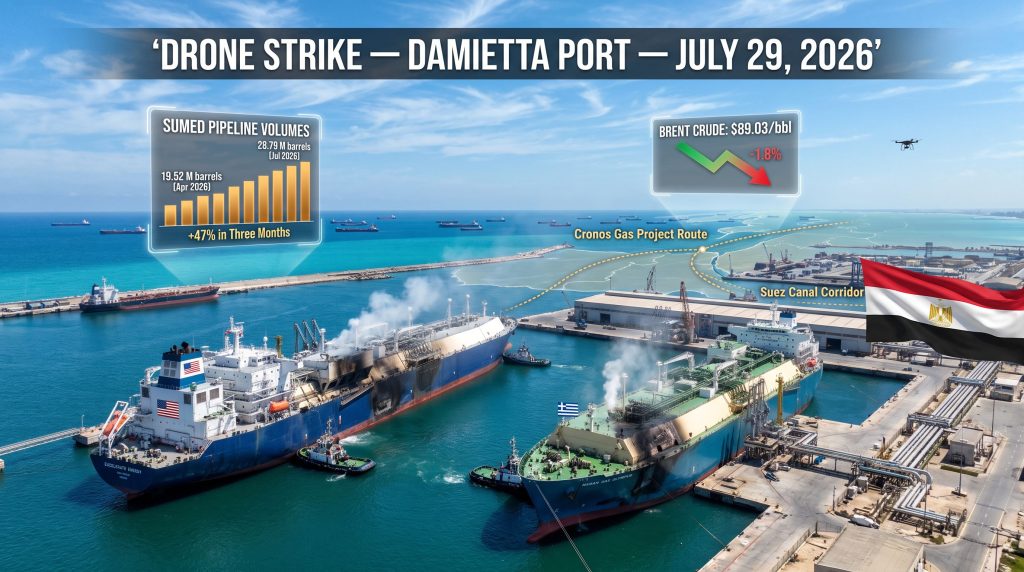
According to Reuters, two vessels were targeted in the attack. The Energos Winter, a U.S.-owned FSRU, and the GasLog Salem, a Greek-flagged LNG carrier, both sustained damage when fire broke out following the drone strike. Emergency response crews required between 12 and 14 hours to achieve full containment. Remarkably, no fatalities or injuries were recorded, and port operations continued during and after the incident, suggesting the physical damage, while significant, was contained.
Understanding what these two vessels represent within Egypt's energy system clarifies why the incident carries weight well beyond its immediate operational impact.
| Vessel | Type | Ownership | Strategic Function |
|---|---|---|---|
| Energos Winter | FSRU | U.S.-owned | ~7% of Egypt's daily gas consumption; ~16% of total regasification capacity |
| GasLog Salem | LNG Carrier | Greek-flagged | Active Mediterranean LNG transport vessel |
An FSRU is not a simple storage tank. These units are purpose-built vessels capable of receiving LNG from carriers, regasifying it, and injecting the resulting natural gas directly into onshore pipeline networks. They represent flexible, rapidly deployable infrastructure that many gas-importing nations rely on to supplement or replace fixed onshore terminals. When an FSRU of the Energos Winter's scale is taken offline, the downstream effects ripple through domestic gas distribution and power generation simultaneously.
Attribution: The Known, the Contested, and the Strategically Ambiguous
Egypt's government confirmed on July 30 that a preliminary investigation identified a drone as the cause of the fire, explicitly ruling out accidental ignition. This finding was independently corroborated by maritime security firm Ambrey, while port-services company Inchcape confirmed reports of an explosion and fire aboard both vessels.
Despite this technical clarity, political attribution remained unresolved at the time of reporting:
- No group claimed responsibility for the attack.
- Yemen's Houthi movement explicitly denied any involvement.
- Several international media outlets cited unnamed sources suggesting an Iran-linked drone, a claim Egyptian authorities did not officially confirm.
Unverified attribution claims carry significant geopolitical weight in this context. Analysts and readers should distinguish between officially confirmed technical findings and speculative sourcing from unnamed intelligence contacts before drawing escalation conclusions.
Regional Escalation: A Timeline of Deteriorating Security
The drone strike on Egypt's Damietta port did not occur in isolation. It sits within a sequence of escalating events along the Mediterranean-Red Sea energy arc that began months earlier. Furthermore, this pattern reflects a broader geopolitical risk landscape that has been intensifying across multiple commodity corridors simultaneously.
| Date | Event | Significance |
|---|---|---|
| February 28, 2026 | U.S.-Iran conflict begins | Opens new phase of energy infrastructure vulnerability |
| July 20, 2026 | Houthis threaten to block Saudi crude via Bab el-Mandeb | Triggers major rerouting of oil shipments northward |
| July 28, 2026 | Eni and TotalEnergies announce Cronos FID | Confirms Damietta as the liquefaction route for Cypriot gas |
| July 29, 2026 | Drone strike on Damietta port | First confirmed drone attack on Egyptian soil in this conflict cycle |
| July 30, 2026 | Egyptian government confirms drone cause, activates contingency infrastructure | Demonstrates available but reduced reserve capacity |
The SUMED Pipeline's Sudden Prominence
The Houthi threat against Bab el-Mandeb on July 20 triggered a rerouting of Saudi crude exports through the Suez Canal and the SUMED pipeline, the Suez-Mediterranean pipeline that connects the Red Sea to Mediterranean export points. This rerouting has materially increased the strategic load borne by Egyptian transit infrastructure.
According to Kpler data, volumes transported through the SUMED pipeline increased sharply over just three months:
| Month | Barrels Transported (millions) |
|---|---|
| April 2026 | 19.52 |
| July 2026 | 28.79 |
| Change | +47% in three months |
The U.S. Energy Information Administration estimates that roughly 10% to 12% of global maritime trade transits the Suez Canal annually. When SUMED pipeline volumes rise nearly 50% within a quarter, the corridor is no longer operating as a supplementary route. It has become the primary functioning alternative for a substantial portion of global oil trade.
Saud Bhutta of RBC Capital Markets assessed that the Mediterranean route is now handling a volume burden that was never intended to serve as a primary corridor, and that any disruption at this juncture compounds pressure that is already building across multiple chokepoints at the same time. The assessment reflects a structural reality that market pricing had not yet absorbed.
Egypt's Domestic Consequences and Emergency Response
For Egypt's energy system, the consequences were immediate and operationally significant. The Energos Winter accounted for approximately 7% of Egypt's daily natural gas consumption and 16% of its total regasification capacity, according to Egyptian energy consultancy ElAdl Studies. Losing that capacity at the height of summer electricity demand was a serious stress event, even if it stopped short of triggering a supply crisis.
Egypt's government responded with several contingency measures activated in parallel:
- Power generation facilities were switched from natural gas to fuel oil and diesel to maintain electricity supply during peak demand.
- A standby regasification vessel stationed at Jordan's Port of Aqaba was integrated into Egypt's national gas supply network.
- Four additional floating regasification units at other Egyptian ports remained operational and took on additional load.
Prime Minister Mostafa Madbouly publicly confirmed the activation of these protocols, and Petroleum and Mineral Resources Minister Karim Badawi affirmed the availability of the alternative infrastructure. The contingency response demonstrates that Egypt had anticipated some degree of infrastructure vulnerability and maintained redundancy accordingly. However, the system is now operating with materially reduced reserve margins, precisely the condition that makes a second incident significantly more dangerous than the first.
The more significant concern is not whether Egypt can absorb this specific incident, which the evidence suggests it can. The concern is what happens if a second or third infrastructure node is targeted while the system is already running without its normal reserve buffer.
How Energy Markets Responded, and Why the Gap Matters
Market reaction to the Damietta attack was notably subdued. Brent crude fell approximately 2% on July 31, 2026, closing at $89.03 per barrel. Traders were focused primarily on diplomatic signals emerging from Iranian-Omani discussions related to the Strait of Hormuz, rather than pricing in Mediterranean disruption risk. Consequently, this muted response mirrors patterns seen during earlier episodes of oil market volatility, where structural risks were priced in only after escalation became undeniable.
Aly Blakeway, Atlantic LNG lead at S&P Global Energy, noted that markets had not yet begun pricing in any disruption risk to the Suez Canal corridor. Meanwhile, Kpler analyst Matthew Wright assessed that a disruption to the Suez Canal would produce an almost immediate impact on global energy prices. The divergence between these two assessments and market pricing behaviour reflects a structural disconnect that investors should consider carefully.
Three factors appear to explain the market's muted response:
- Contingency infrastructure absorbed the immediate disruption, removing any actual supply shortfall from current pricing calculations.
- Attribution ambiguity left traders unable to model escalation probability with confidence, reducing panic-driven positioning.
- Hormuz diplomatic noise captured the majority of trader attention, effectively overshadowing Mediterranean risk signals that may ultimately prove more durable.
This pricing disconnect is not necessarily irrational in the short term. It becomes potentially dangerous if it persists while structural vulnerability continues to accumulate.
The next major ASX story will hit our subscribers first
The Cronos Project and the Route Security Question
The Cronos project FID, announced just one day before the Damietta attack, crystallises the route security dilemma for European energy planners. Gas from the offshore Cyprus development is designed to flow through subsea pipelines to Damietta, where it would be liquefied and loaded onto LNG carriers bound for European import terminals. That entire commercial logic depends on Damietta remaining a secure, functional hub.
The attack does not necessarily derail the project. A single incident, contained without casualties and absorbed by contingency infrastructure, does not constitute proof of systemic route failure. However, it does introduce a risk variable into the financing, insurance, and offtake negotiations that will determine whether the Cronos project proceeds on its intended timeline.
Scenario Analysis: Three Pathways for the Damietta-Europe LNG Route
Scenario 1: Contained Incident, Accelerated Security Investment
The Damietta attack remains isolated. Egypt and international partners invest in port hardening, drone detection systems, and maritime security protocols. Cronos proceeds on schedule, and European buyers accept modestly higher insurance premiums while maintaining confidence in the route.
Scenario 2: Sustained Targeting, Route Diversification Pressure
Further attacks on Egyptian or Eastern Mediterranean infrastructure force European buyers to accelerate alternative supply routes, including Iberian LNG terminals and Baltic interconnectors. The Cronos project faces financing review as offtake counterparties reassess route security. In addition, global trade disruption compounds pressure on LNG spot prices, which experience periodic spikes linked to Mediterranean security events.
Scenario 3: Chokepoint Cascade, Full Mediterranean Crisis
Simultaneous disruption across Bab el-Mandeb, the Suez Canal, and Damietta creates a cascading failure across the primary remaining alternative to the Strait of Hormuz. An estimated 5 million barrels per day of oil and significant LNG volumes lose viable routing options. Global energy prices face sharp upward pressure, and European gas storage targets for winter 2026/27 come under severe strain.
Strategic Risk Assessment Summary
| Risk Dimension | Current Status | Severity |
|---|---|---|
| Immediate supply disruption (Egypt) | Contained via contingency infrastructure | Moderate |
| Cronos project viability | Under review given route security concerns | Elevated |
| Mediterranean corridor capacity | Operating at historically high volumes (+47% SUMED) | High |
| Market pricing of disruption risk | Underpriced relative to structural vulnerability | High |
| Attribution clarity | Unconfirmed, no perpetrator identified | Uncertain |
| European winter gas supply risk | Manageable if no further escalation | Moderate-Elevated |
Frequently Asked Questions
What happened at Damietta port on July 29, 2026?
A drone struck two gas vessels, the Energos Winter FSRU and the GasLog Salem LNG carrier, triggering a fire that burned for between 12 and 14 hours before emergency crews achieved containment. No casualties were reported, and port operations continued throughout. Egyptian authorities confirmed a preliminary investigation identified a drone as the cause.
Who was responsible for the drone strike on Egypt's Damietta port?
No group claimed responsibility. Yemen's Houthi movement denied involvement. The BBC reported that some media outlets cited unnamed sources suggesting an Iran-linked drone, but Egyptian authorities had not officially confirmed any attribution at the time of reporting.
How significant is Damietta to Egypt's energy system?
The Energos Winter FSRU alone accounted for approximately 7% of Egypt's daily gas consumption and 16% of its total regasification capacity. Egypt has alternative facilities that prevented an immediate supply shortage, but the incident reduced the system's operational reserve margin at the peak of summer electricity demand.
What is the Cronos gas project and why is it directly relevant?
Cronos is an offshore gas development in Cyprus, with a final investment decision taken by Eni and TotalEnergies on July 28, 2026, one day before the attack. Gas from the project is intended to be liquefied at Damietta for export to European markets, making the port's security directly relevant to European energy supply planning over the medium term.
How did oil markets respond?
Brent crude fell approximately 2% on July 31, 2026, closing at $89.03 per barrel. Analysts noted that market attention was focused on Hormuz diplomatic developments rather than pricing in Mediterranean disruption risk, a divergence that several energy analysts flagged as potentially underestimating the structural exposure accumulating along this corridor. For context, this contrasts markedly with previous episodes of an oil price rally driven by geopolitical shock.
What alternative infrastructure does Egypt have available?
Egypt activated four additional floating regasification units at other ports, integrated a standby vessel from Jordan's Port of Aqaba into its national gas supply network, and switched power plants to fuel oil and diesel to maintain electricity generation. These measures were sufficient to absorb the immediate incident without triggering a supply shortage.
This article is intended for informational purposes only and does not constitute financial or investment advice. Scenario projections and analyst assessments involve inherent uncertainty. Readers should conduct independent research before making any investment decisions based on energy market or geopolitical analysis. Attribution claims regarding the Damietta attack remain unconfirmed by official sources as of the time of writing.
For ongoing coverage of African and Mediterranean energy developments, Ecofin Agency at ecofinagency.com provides sector-focused reporting across energy, mining, finance, and infrastructure.
Want to Stay Ahead of the Next Major Resource Discovery Before the Market Reacts?
The geopolitical disruptions reshaping global energy corridors are creating real-time ripple effects across commodity markets — and the investors best positioned to capitalise are those with the fastest access to actionable intelligence. Discovery Alert's proprietary Discovery IQ model delivers instant notifications on significant ASX mineral discoveries the moment they are announced, helping subscribers identify opportunities before the broader market catches on — explore historic examples of what early discovery positioning can deliver, then begin a 14-day free trial at Discovery Alert to secure your edge in an increasingly volatile resource landscape.