August 1, 2026
When Infrastructure Becomes a Target: The New Geography of Energy Risk
For decades, energy security planners treated the Mediterranean as a relatively stable transit zone, a buffer between the volatility of Gulf production and the demand centres of northern Europe. That assumption is now under serious pressure. The drone strike on Egypt's Damietta port on July 29, 2026 did not merely damage two vessels. It exposed a structural vulnerability that has been quietly building since Europe began redesigning its gas supply architecture after 2022.
Understanding why this incident matters requires stepping back from the immediate event and examining the layered geography of risk that now defines Mediterranean energy flows.
When big ASX news breaks, our subscribers know first
Why Damietta Sits at the Centre of Europe's Gas Diversification Strategy
Europe's pivot away from Russian pipeline gas created an urgent need for alternative supply routes. LNG emerged as the primary solution, and the eastern Mediterranean became a focal point. Cyprus, Israel, and Egypt sit atop significant offshore gas reserves, while Egypt uniquely possesses the liquefaction infrastructure needed to convert that gas into LNG for export. Shifts in global LNG supply dynamics have, furthermore, intensified the strategic importance of every processing node in this corridor.
Damietta port is not simply a regional logistics hub. It functions as a critical processing node connecting Levantine offshore fields to European import terminals. The port hosts floating storage and regasification units (FSRUs) capable of both receiving and processing gas, and its position on Egypt's northern Mediterranean coastline places it directly on the shipping lanes serving southern European LNG terminals.
The Dual Function That Makes Damietta Irreplaceable
Most energy ports perform a single function. Damietta, however, performs two. It handles regasification for domestic consumption and liquefaction for export-oriented LNG processing. This dual-use architecture makes it extraordinarily difficult to replace with a single alternative facility.
The port's geographic position compounds this value. Ships departing Damietta with LNG cargoes can reach Italian, Spanish, and Greek import terminals within days, making it one of the shortest supply chains in the European gas import network.
What Happened at Damietta Port on July 29, 2026
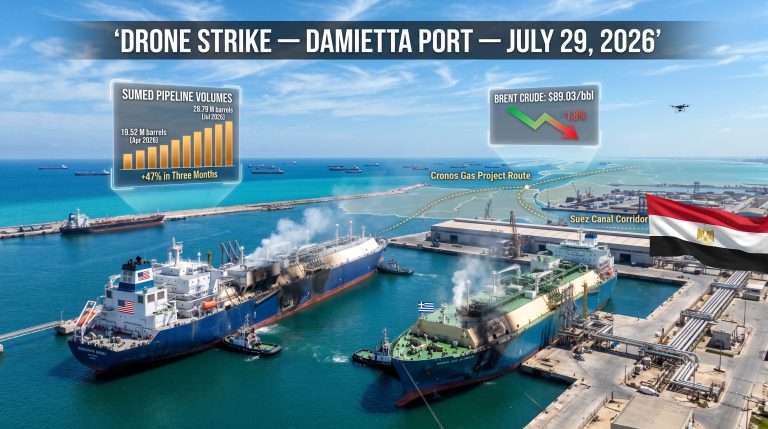
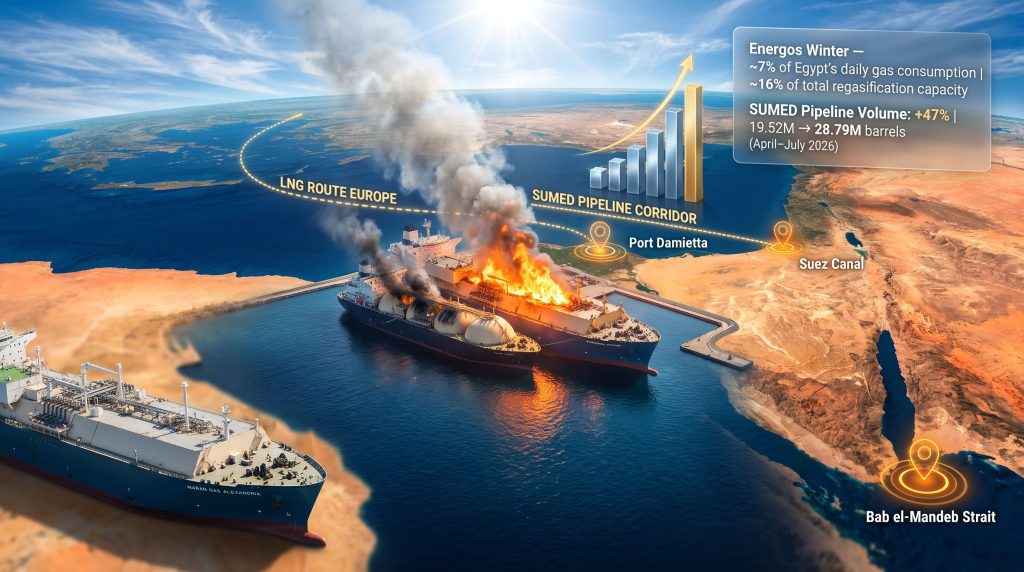
On July 29, 2026, according to Reuters, a drone strike ignited a fire aboard two gas vessels berthed at Damietta. The vessels involved were the Energos Winter, a U.S.-owned FSRU, and the GasLog Salem, a Greek-flagged LNG carrier. The fire, which originated on the Energos Winter before spreading to the adjacent carrier, required between 12 and 14 hours to fully contain. Emergency response crews evacuated all personnel without casualties.
Egyptian authorities confirmed on July 30 that a preliminary investigation attributed the incident to a drone strike. Maritime security firm Ambrey was among the first to identify the incident publicly. Notably, no group claimed responsibility. Yemen's Houthi movement, which had conducted sustained maritime targeting campaigns in the Red Sea, explicitly denied any involvement, leaving the question of attribution unresolved.
The absence of a claimed perpetrator creates a significant diplomatic and commercial complication. Without attribution, governments cannot calibrate a response, and insurance underwriters face acute difficulty pricing future risk for assets berthed at Egyptian ports.
This incident is significant in a way that goes beyond the physical damage. It represents the first confirmed drone strike on Egypt's Damietta port territory since the escalation of the broader U.S.-Iran conflict beginning February 28, 2026. That threshold matters because it signals a potential expansion of the targeting doctrine previously applied to vessels in open maritime corridors.
Egyptian Government's Immediate Contingency Response
Egyptian Prime Minister Mostafa Madbouly activated contingency protocols within hours of the attack. The response involved several coordinated measures:
- Power generation facilities across Egypt were switched to fuel oil and diesel as an interim energy source
- A standby regasification vessel stationed at Jordan's Port of Aqaba was integrated into Egypt's national gas distribution network
- Petroleum and Mineral Resources Minister Karim Badawi confirmed that four additional floating regasification units remained operational at other Egyptian ports
- Port authorities maintained that broader vessel traffic and cargo handling at Damietta continued without widespread disruption
The speed of this response reflects planning, but also reveals how dependent Egypt's contingency architecture is on regasification capacity rather than liquefaction capacity. This distinction becomes critical when assessing export risk. In addition, these energy export challenges mirror pressures that Australia and other export-dependent economies have also been grappling with across energy export challenges in the current environment.
Capacity Impact: What the Numbers Actually Tell Us
| Metric | Value |
|---|---|
| Energos Winter share of Egypt's daily gas consumption | ~7% |
| Energos Winter share of Egypt's total regasification capacity | ~16% |
| Fire containment duration | 12 to 14 hours |
| Remaining operational FSRUs at other Egyptian ports | 4 units |
| SUMED pipeline volumes in April 2026 | 19.52 million barrels |
| SUMED pipeline volumes in July 2026 | 28.79 million barrels |
| SUMED volume increase (April to July 2026) | +47% |
Source: Egyptian energy consultancy ElAdl Studies, cited by Reuters; Kpler commodity analytics
According to Egyptian energy consultancy ElAdl Studies, cited by Reuters, the Energos Winter accounted for approximately 7% of Egypt's daily natural gas consumption and 16% of its total regasification capacity. The consultancy indicated that an immediate domestic supply shortage is not anticipated, given the activation of alternative infrastructure.
However, a critical nuance exists here that market commentary tends to overlook. The four alternative FSRUs referenced by Minister Badawi are regasification assets, designed to convert imported LNG back into gas for domestic distribution. They do not perform liquefaction, which is the export-facing function that Damietta provides. Egypt can sustain its population's energy needs in the short term, but its ability to monetise offshore gas through export channels depends entirely on restoring Damietta's liquefaction capability.
The strategic risk is not scarcity today. It is fragility tomorrow, particularly at a moment when summer electricity demand is already stretching system capacity to its upper limits.
The Cronos Timing Problem: A One-Day Coincidence With Major Commercial Implications
On July 30, 2026, one day after the Damietta attack, Eni and TotalEnergies announced their final investment decision (FID) on the Cronos offshore gas project in Cypriot waters. Cronos gas is slated to be transported to Damietta for liquefaction before export to European markets.
The proximity of these two events creates a commercial dilemma that project developers must now address directly. The FID commits significant capital to a supply chain whose downstream processing hub has just been confirmed as a viable target for hostile action.
Three Scenarios for the Cronos-Damietta Supply Chain
Scenario A: Isolated Incident, No Structural Change
The attack is treated as a one-off event, security at Damietta is upgraded, and the Cronos project proceeds on its original schedule. European energy planners continue to rely on the Egypt liquefaction route. This outcome depends on successful attribution and no repeat incidents.
Scenario B: Sustained Targeting, Partial Rerouting
Repeated attacks on Egyptian energy infrastructure prompt project developers to explore alternative liquefaction arrangements, such as Israeli FLNG facilities or expanded onshore processing in Cyprus. Damietta retains a partial role but loses its status as the primary export node. This scenario becomes increasingly plausible if regional conflict escalation continues.
Scenario C: Full Corridor Disruption, European Supply Shock
Combined pressure on the Suez Canal, the SUMED pipeline, and Damietta infrastructure simultaneously restricts Mediterranean energy flows. Europe faces intensified competition for Atlantic Basin LNG cargoes, driving spot price volatility. This remains a lower-probability outcome but carries the highest systemic consequence.
Mapping the Full Pressure Corridor: From Bab el-Mandeb to Damietta
The Damietta attack does not exist in isolation. It represents a fourth pressure point added to an already stressed corridor:
- Bab el-Mandeb Strait: Houthi threats issued on July 20, 2026 to block Saudi crude exports through this chokepoint have already redirected significant oil volumes northward
- Suez Canal: Rerouted Saudi crude now transits the canal at elevated volumes, with the U.S. Energy Information Administration estimating that 10% to 12% of global maritime trade passes through this waterway
- SUMED Pipeline: Volumes surged 47% between April and July 2026, from 19.52 million to 28.79 million barrels, reflecting the growing strategic load being placed on the Egypt-Mediterranean transit system
- Damietta Port: Now confirmed as a direct strike target inside Egyptian sovereign territory, introducing a qualitatively new dimension to the security threat landscape
Why the Damietta Strike Is Qualitatively Different From Prior Maritime Attacks
Previous Houthi-attributed attacks focused on vessels transiting open maritime corridors, specifically in the Red Sea and Gulf of Aden. The Damietta strike hit fixed infrastructure inside a sovereign nation's territorial waters. This distinction matters for several reasons:
- Fixed port infrastructure cannot be rerouted the way a ship can
- Attacking inside Egyptian territory potentially draws Cairo into a conflict it had previously managed to stay peripheral to
- The U.S.-owned Energos Winter introduces a bilateral dimension that may attract Washington's attention in ways that foreign-flagged vessel strikes do not
- Insurance underwriters now face the prospect of pricing port-berthed asset risk in Egypt, not just transit risk in open water
The next major ASX story will hit our subscribers first
How Oil Markets Are Processing the Signal
Brent crude fell nearly 2% on July 31, 2026, closing at $89.03 per barrel, as traders prioritised diplomatic signals from Iranian-Omani discussions related to the Strait of Hormuz over the Damietta incident. This price response reveals a market psychology worth examining closely. Furthermore, broader oil price movements in the current geopolitical environment suggest that markets consistently underweight infrastructure risk until disruption becomes undeniable.
Kpler analyst Matthew Wright has stated that a disruption to the Suez Canal would have an almost immediate impact on prices. Yet S&P Global Energy's Atlantic LNG lead, Aly Blakeway, has noted that the market is not yet pricing in disruption to the canal. Saud Bhutta of RBC Capital Markets has identified the Mediterranean route as the last major alternative pathway for as many as 5 million barrels of oil per day currently bypassing the Strait of Hormuz.
The gap between what analysts identify as structural risk and what markets are currently pricing creates a potentially significant asymmetry. If a secondary incident occurs at another corridor pressure point, the repricing could be abrupt.
This kind of delayed market recognition is not unusual in geopolitical risk scenarios. Markets tend to discount tail risks until they materialise, at which point the adjustment can be disproportionately sharp relative to the underlying physical disruption.
Egypt's Export Ambitions and the Fiscal Stakes
For Egypt, the security of Damietta is not merely an infrastructure question. It is a fiscal one. Egypt has been navigating a significant foreign currency shortage, and LNG export revenues represent a critical hard currency inflow. The Cronos project, and the broader expansion of eastern Mediterranean gas through Damietta, is central to Cairo's medium-term economic recovery strategy.
Any sustained threat to Damietta's operational viability directly undermines these revenue projections and may complicate Egypt's ongoing engagement with international lenders and investors. Consequently, the intersection of energy infrastructure vulnerability and sovereign fiscal stress creates a compounding risk profile that goes well beyond the immediate physical damage to two vessels.
The trade war impacts already reshaping global commodity flows add yet another layer of complexity, as energy-dependent economies attempt to manage geopolitical exposure on multiple fronts simultaneously. Similarly, supply chain disruption caused by tariff regimes and rerouting pressures further reduces the margin for error when a critical infrastructure node like Damietta comes under attack.
Comparative Timeline: Regional Energy Infrastructure Attacks (2024 to 2026)
| Period | Target | Method | Outcome |
|---|---|---|---|
| 2024 onward | Red Sea commercial shipping | Houthi drone and missile strikes | Significant rerouting via Cape of Good Hope |
| July 20, 2026 | Saudi crude export routes via Bab el-Mandeb | Houthi threat declaration | Accelerated Suez Canal and SUMED rerouting |
| July 29, 2026 | Damietta port, Egypt | Drone strike on berthed vessels | Fire on two LNG assets; no casualties reported |
Frequently Asked Questions: Drone Strike on Egypt's Damietta Port
What vessels were involved in the Damietta port attack?
The two vessels directly affected were the Energos Winter, a U.S.-owned floating storage and regasification unit, and the GasLog Salem, a Greek-flagged LNG carrier. The fire started on the Energos Winter before extending to the adjacent vessel.
Has any group claimed responsibility?
As of the available reporting, no group has claimed the attack. Yemen's Houthi movement denied involvement, leaving attribution unresolved. The Wall Street Journal has reported on the wider implications of this ambiguity in the context of the Iran conflict.
Will Egypt face a domestic gas shortage?
Egyptian authorities have activated alternative infrastructure, including four additional FSRUs at other ports and a standby regasification vessel at Jordan's Port of Aqaba. No immediate domestic shortage is expected, though reserve capacity has been reduced during peak summer demand.
How does the attack affect European gas supply?
The Cronos project, which would route gas through Damietta for European export, has not yet entered production. The attack does not immediately halt European flows but introduces material security risk into the planned supply chain.
What percentage of Egypt's gas capacity was affected?
The Energos Winter accounted for approximately 7% of Egypt's daily natural gas consumption and 16% of its total regasification capacity, according to ElAdl Studies, as cited by Reuters.
Key Takeaways for Energy Security Analysts and Investors
- The Mediterranean energy corridor, previously treated as a stable fallback to Gulf and Red Sea routes, has now been directly tested by hostile action inside a sovereign state's territorial waters
- Egypt's contingency infrastructure protects domestic consumption but does not replace export liquefaction capacity, a distinction that matters enormously for European gas supply planning
- The one-day gap between the Cronos FID announcement and the Damietta attack creates reputational and commercial risk for the eastern Mediterranean gas development pipeline
- Energy markets appear to be underpricing corridor disruption risk; a secondary incident involving the Suez Canal or SUMED pipeline could trigger a rapid and significant repricing
- European energy security planners should treat the Damietta vulnerability as a structural scenario variable embedded in supply chain design, not as an isolated news event to be monitored and forgotten
Disclaimer: This article contains forward-looking analysis and scenario modelling based on publicly available information as of July 31, 2026. It does not constitute financial or investment advice. Market conditions, geopolitical developments, and infrastructure status may change rapidly. Readers should conduct independent analysis before making decisions based on information contained herein.
Want to Stay Ahead of Commodity Market Shifts Driven by Geopolitical Risk?
Discovery Alert's proprietary Discovery IQ model delivers real-time alerts on significant ASX mineral discoveries, transforming complex commodity and resource data into actionable investment insights — precisely when it matters most. Explore how historic mineral discoveries have generated substantial market returns, and begin your 14-day free trial today to position yourself ahead of the next major market move.