June 8, 2026
The Structural Weakness at the Heart of America's Battery Ambitions
The United States has spent decades building sophisticated downstream manufacturing capabilities while quietly offshoring the upstream chemical processing that makes those capabilities possible. Nowhere is this contradiction more visible than in the lithium supply chain, and the ABTC DoE grant for Tonopah lithium refinery represents one of the most direct attempts to address it. The country sits atop substantial lithium-bearing geology, yet the infrastructure required to convert raw material into battery-grade lithium hydroxide has remained almost entirely absent from domestic soil.
This is not simply a commercial gap. It represents a structural vulnerability in the industrial foundation of the electric vehicle transition. Battery-grade lithium hydroxide carries strict purity specifications, typically exceeding 56.5% LiOH content, with tightly controlled impurity thresholds for elements like calcium, sodium, and sulphate.
Achieving those specifications from unconventional feedstocks like lithium claystone, rather than the more commonly processed sources used in spodumene extraction or lithium brines, requires purpose-built processing infrastructure and proprietary chemical engineering that cannot be improvised at short notice.
China currently controls the overwhelming majority of global lithium chemical processing capacity. According to the International Energy Agency, China accounts for roughly 60% of global lithium processing and refining. That concentration gives Chinese industrial policy extraordinary leverage over the battery supply chains of every major EV-producing nation. The ABTC DoE grant for Tonopah lithium refinery sits directly within this geopolitical context, representing one of the more technically credible attempts to build a genuinely independent US domestic refining capability.
When big ASX news breaks, our subscribers know first
Understanding the Tonopah Flats Lithium Project
Project Fundamentals at a Glance
The Tonopah Flats Lithium Project is located in Nevada's Big Smoky Valley, near the town of Tonopah on land administered by the Bureau of Land Management. The following table summarises the project's core parameters:
| Parameter | Detail |
|---|---|
| Location | Big Smoky Valley, Nevada |
| Land Management | Bureau of Land Management (BLM) |
| Total Area | More than 10,340 acres |
| Mining Claims | 517 unpatented lode mining claims |
| Resource Type | Lithium claystone |
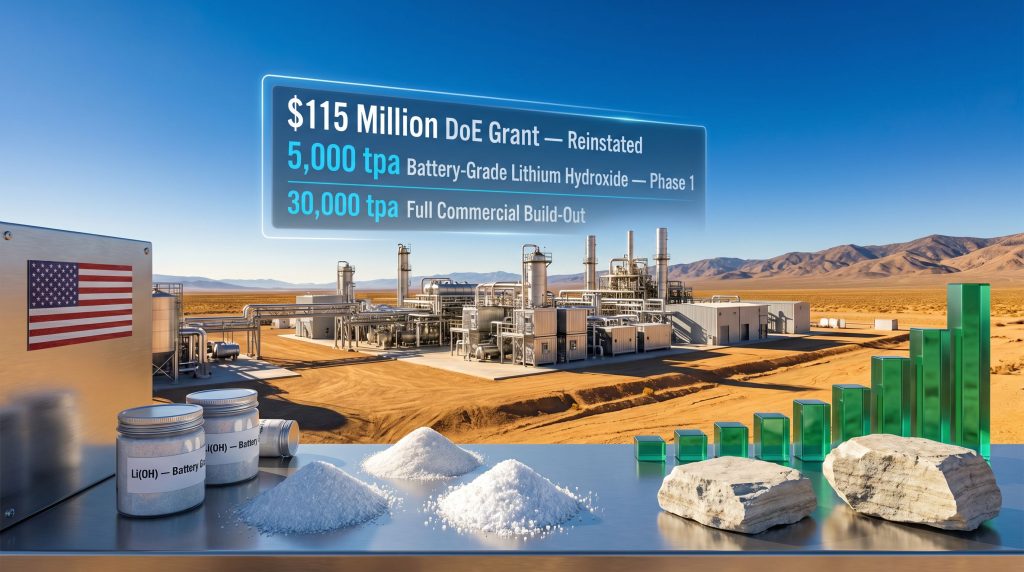
| Phase 1 Target Output | 5,000 tpa battery-grade lithium hydroxide |
| Full Commercial Scale | Up to 30,000 tpa lithium hydroxide |
| Total Project Capital Estimate | Approximately $115 million |
| DoE Grant Value | $115 million |
| Projected Employment | 150+ skilled positions |
The project is reported to host one of the largest lithium claystone resources in the United States across measured, indicated, and inferred resource categories. Projects that carry resource estimates across all three confidence classifications simultaneously demonstrate a level of geological definition that de-risks development planning and supports the engineering assumptions underpinning capital cost estimates.
Why Lithium Claystone Is a Technically Distinct Challenge
Most of the global lithium refining industry was built around two primary feedstock types: hard-rock spodumene concentrates sourced predominantly from Australia, and lithium-rich brines extracted from South American salt flats. Claystone-hosted lithium represents a fundamentally different geological and chemical context, and that distinction has significant processing implications.
In claystone deposits, lithium is typically bound within clay mineral structures, most commonly hectorite or smectite-group clays, rather than existing in discrete mineral grains that can be physically concentrated through conventional flotation or evaporation. This means that standard processing flowsheets cannot simply be transplanted to a claystone operation.
ABTC developed a proprietary extraction methodology specifically designed for the chemical characteristics of the Tonopah Flats claystone material. Furthermore, the company validated this approach at demonstration scale before the current commercial-stage grant was awarded, which is a critical technical distinction.
Demonstration-scale validation provides proof that the chemistry works at meaningful throughput before capital is committed to a full commercial facility. The DoE's decision to fund commercial-scale development only after successful demonstration reflects a rigorous due diligence framework that distinguishes between speculative processing concepts and genuinely validated technology.
Lithium claystone processing represents one of the least commercially proven segments of the lithium supply chain. Successful commercial-scale production from claystone feedstock would represent a genuine technology milestone, not merely an incremental improvement on existing methods.
The ABTC DoE Grant: From Award to Termination to Reinstatement
A Five-Year Programme With Bipartisan Roots
The ABTC DoE grant for Tonopah lithium refinery was first awarded in October 2022 as part of a competitive five-year programme administered through the Manufacturing Energy Supply Chain office under the Biden administration. However, the project's federal relationship predates that award. Earlier development and demonstration work was supported by a separate DoE grant awarded during the first Trump administration.
This sequential federal support across two different administrations and two different DoE programme offices is not a trivial detail. Federal grant programmes for critical mineral processing are subject to intense competition. The fact that Tonopah Flats secured funding through entirely separate competitive processes, under administrations with contrasting energy policy priorities, suggests the project's technical merits have been independently evaluated and validated on multiple occasions.
The October 2025 Termination and What It Represented
On 9 October 2025, ABTC was formally notified that its DoE grant had been terminated. This action was not project-specific. It occurred as part of a broader federal review affecting numerous DoE awards during a period of significant administrative transition. By that point, ABTC had already completed two full years of the five-year programme and had met all contracted technical and commercial milestones.
For critical mineral developers, mass grant terminations during federal transitions create a category of risk that is distinct from conventional project execution risk. A project can be performing perfectly on its own terms while still facing funding disruption driven by administrative factors entirely outside its control. This is particularly problematic for projects that have already committed capital, hired technical staff, and advanced permitting on the basis of confirmed federal co-funding.
The Dispute Resolution Process: Step by Step
ABTC's response to the termination was methodical and rapid. The formal dispute resolution sequence unfolded as follows:
- Appeal Filing (10 October 2025): ABTC formally contested the termination within 24 hours of receiving the notification, initiating the DoE's appeal process.
- Informal Dispute Resolution Entry: The company entered a structured review process with DoE staff, submitting comprehensive technical and commercial documentation covering milestone achievement records.
- Multi-Month Assessment Period: Several months of iterative review followed, encompassing engineering progress reports, financial accountability documentation, and strategic project value assessments.
- Final Review Meeting (December 2025): A concluding assessment session between ABTC representatives and DoE officials formally concluded the evidentiary review phase.
- Reinstatement Notification (2026): The DoE formally determined that reversing the termination and continuing the project was the appropriate outcome, restoring the full award and project schedule.
The successful reinstatement demonstrates that the DoE's dispute resolution framework can function as a genuine accountability mechanism, capable of distinguishing between administratively motivated terminations and projects with documented milestone compliance and verified strategic value.
The DoE's formal conclusion stated that after a thorough review of all materials submitted, the department determined that rescinding the termination notice and continuing the project was warranted. Critically, the review also confirmed that ABTC had achieved all contracted technical and commercial milestones to that point in the programme.
Federal Support Instruments and What Each Signals
A Multi-Layer Federal Profile
The Tonopah Flats project has accumulated a range of federal interactions beyond the core DoE grant. Understanding each instrument separately is important, because they differ substantially in structure, conditionality, and what they signal about project viability.
| Instrument | Administering Body | Nature | Repayment Required? |
|---|---|---|---|
| DoE Manufacturing Grant | Department of Energy | Non-dilutive grant funding | No |
| FAST-41 Designation | Federal Permitting Council | Coordinated permitting review | N/A |
| Priority Project Status | National Energy Dominance Council | White House-level classification | N/A |
| EXIM Letter of Interest | Export-Import Bank | Potential debt financing | Yes |
In June 2025, the project was designated a critical mineral Priority Project by the White House's National Energy Dominance Council and was simultaneously selected under the FAST-41 Permitting Council framework. US critical minerals policy has increasingly prioritised coordinated interagency scheduling and transparency requirements, which can reduce the duration and uncertainty of environmental review processes. It is worth noting that these designations reflect the project's classification within existing federal frameworks and do not constitute guaranteed funding or permitting outcomes.
The EXIM Bank Letter of Interest
Separately, the Export-Import Bank issued a letter of interest for up to $900 million in potential financing support. This figure is substantially larger than the DoE grant and pertains to the full commercial build-out scenario rather than Phase 1 alone. An EXIM letter of interest is not a binding commitment; it signals that a project meets the preliminary criteria for consideration under the bank's financing mandate.
The scale of the figure, however, provides an implicit valuation signal about how federal financing institutions perceive the project's commercial scalability at the 30,000 tpa full-production level. Unlike the DoE grant, EXIM financing would carry repayment obligations and would be structured as a debt instrument. This distinction matters for project economics at the full commercial stage, where the capital requirements extend far beyond what a single grant programme can cover.
Nevada's Role and the Domestic Supply Chain Equation
Why Nevada Makes Strategic Sense
Nevada's regulatory and geological environment for large-scale mineral extraction and processing is among the most developed in the United States. The state has established permitting pathways, an experienced mining workforce, existing infrastructure corridors, and a geographic position that places it within practical proximity of the emerging Western US battery manufacturing cluster.
These factors are not incidental to project selection; they are material inputs into the economic viability modelling that underpins both the DoE's grant evaluation and any future EXIM financing assessment. The Bureau of Land Management's administrative role over the 10,340-acre project footprint means federal land use processes are directly relevant to the permitting timeline.
The Phase 1 to Full-Scale Pathway
The gap between Phase 1 output of 5,000 tpa and the full commercial target of 30,000 tpa is not merely a matter of scaling up existing equipment. It represents a six-fold increase in production that would require additional capital deployment, expanded permitting scope, and secured offtake agreements at a volume that would make Tonopah Flats a genuinely significant contributor to domestic lithium hydroxide supply.
For context, the US currently has minimal domestic battery-grade lithium hydroxide production capacity relative to the volumes that domestic EV manufacturers have committed to sourcing. Shifting lithium market dynamics mean that even the full 30,000 tpa commercial build-out would represent a fraction of projected US demand by the early 2030s, which underscores both the opportunity and the scale of the challenge facing the domestic critical mineral processing sector.
The next major ASX story will hit our subscribers first
What the Reinstatement Reveals About US Critical Mineral Policy Continuity
A Milestone-Based Accountability Model
One underappreciated dimension of the DoE's grant reinstatement is what it reveals about the evidentiary standard required to reverse a federal termination decision. The multi-month review process, culminating in the DoE's confirmation that all contracted milestones had been achieved, establishes that the reinstatement was driven by documented project performance rather than political recalibration alone.
This matters for the broader critical mineral developer community because it establishes a precedent: projects that maintain rigorous milestone documentation and can demonstrate commercial and technical compliance have a viable pathway through the dispute resolution framework, even when initial terminations appear administratively driven. In addition, advances in direct lithium extraction technology are further expanding the range of feedstocks that domestic refiners can viably process, strengthening the long-term case for projects like Tonopah Flats.
Bipartisan Continuity as a Credibility Signal
The three-administration arc of federal support for Tonopah Flats, spanning first Trump administration demonstration funding, Biden administration commercial-scale grant award, and second Trump administration reinstatement, is unusual in the context of US energy policy, where funding priorities frequently shift with electoral cycles.
This continuity suggests that the ABTC DoE grant for Tonopah lithium refinery occupies a position of genuine strategic consensus, rather than partisan preference, within federal industrial policy. For private sector investors and project developers, this type of cross-administration durability represents a meaningful risk-reduction signal. It suggests that the underlying strategic rationale for supporting domestic critical mineral processing is sufficiently robust to survive significant changes in federal policy orientation, though investors should note that past policy continuity does not guarantee future funding or regulatory outcomes.
This article is intended for informational purposes only and does not constitute financial or investment advice. Statements regarding federal funding, permitting timelines, and production targets are based on publicly available information and company disclosures. Forecasts and projections involve inherent uncertainty and actual outcomes may differ materially from those described. Readers seeking additional context on US critical mineral supply chain policy may find relevant background in reporting published by Mining Technology at mining-technology.com.
Want To Stay Ahead of the Next Major Lithium Discovery on the ASX?
Discovery Alert's proprietary Discovery IQ model delivers real-time alerts on significant ASX mineral discoveries — including lithium — instantly cutting through complex data to surface actionable opportunities before the broader market reacts. Explore how historic mineral discoveries have generated substantial returns on Discovery Alert's dedicated discoveries page, and begin your 14-day free trial today to position yourself ahead of the market.