August 7, 2026
Global industrial markets are experiencing unprecedented volatility as supply chain constraints intersect with evolving geopolitical dynamics. The fertilizer sector, representing a critical component of agricultural production systems worldwide, has become increasingly sensitive to raw material price fluctuations that cascade through international trade corridors. The recent abu dhabi adnoc january sulphur price increase exemplifies how regional pricing decisions by major producers influence downstream manufacturing economics across multiple continents, particularly when considering broader oil price dynamics and commodity trading trends.
Understanding Abu Dhabi's Strategic Position in Global Sulphur Markets
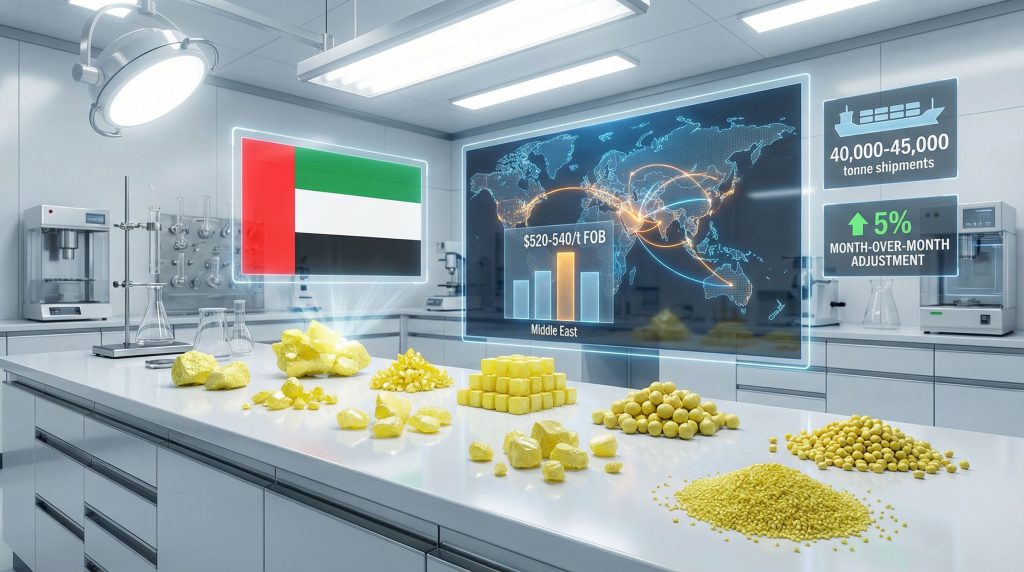
Abu Dhabi National Oil Company has established itself as a cornerstone supplier in international sulphur markets through strategic positioning at the intersection of Asian and European demand corridors. The company's January 2025 pricing action, setting the official selling price at $520 per tonne FOB Ruwais for Indian subcontinent deliveries, represents a $25 per tonne increase from December levels, demonstrating the producer's ability to influence regional market dynamics.
The 5% month-over-month adjustment reflects underlying supply tightness across global fertilizer value chains, with delivered pricing to India reaching $536-538 per tonne CFR. This pricing structure incorporates freight costs assessed at $16-18 per tonne for standard 40,000-45,000 tonne shipments to India's east coast ports, highlighting the integrated logistics considerations that determine final market pricing.
ADNOC's production infrastructure supports sustained market influence through its Ruwais facility, which processes petroleum byproducts into industrial feedstocks for regional and international markets. The company's pricing methodology establishes monthly benchmarks that influence contract negotiations across South Asian fertilizer manufacturing centres, creating ripple effects through downstream agricultural input markets.
Regional buyers utilise ADNOC's official selling prices as baseline references for contract negotiations, with typical adjustments ranging $2-5 per tonne above established OSP levels depending on delivery terms, payment conditions, and volume commitments. This pricing framework creates predictable cost structures for industrial buyers while maintaining flexibility for market-responsive adjustments.
When big ASX news breaks, our subscribers know first
What Drives Official Selling Price Adjustments in Energy Markets
Monthly OSP mechanisms function as sophisticated price discovery tools that balance production economics with demand conditions across multiple geographic markets. The abu dhabi adnoc january sulphur price increase from an implied December level of $495 per tonne to $520 per tonne demonstrates how integrated oil companies translate upstream cost pressures into downstream pricing adjustments, particularly when analysing tariff impact analysis and broader trade considerations.
Energy-intensive production processes create direct correlations between crude oil price movements and sulphur production economics. When refinery capacity utilisation fluctuates, sulphur byproduct volumes adjust accordingly, influencing supply availability for industrial applications. These operational dynamics drive monthly pricing reviews that incorporate changing energy costs, freight conditions, and competitive positioning relative to alternative suppliers.
The timing of OSP announcements follows predictable patterns, with major producers typically releasing monthly prices during the final week of each preceding month. This scheduling allows industrial buyers to incorporate pricing changes into their own commercial planning while maintaining operational continuity through established contract frameworks.
Cost pass-through mechanisms demonstrate the immediate impact of feedstock price changes on downstream production economics. According to Argus Media analysis, elevated input costs across fertilizer value chains are creating sustained upward pressure on pricing, with sulphur cost increases translating directly into higher production costs for ammonium sulphate manufacturers.
Industry analysis indicates that sulphur feedstock represents approximately 29% of ammonium sulphate production costs, meaning price increases create significant margin compression for downstream producers. When major suppliers like International Oils Corporation temporarily shut down operations due to rising feedstock costs before restarting in December 2024, it demonstrates the operational challenges created by volatile input pricing.
Regional Supply Chain Economics: Middle East to South Asia Corridor
The 14-18 day transit time between Ruwais and Indian east coast ports represents one of the most actively traded regional supply routes in global sulphur markets. Current freight assessments of $16-18 per tonne for December 2024 reflect post-monsoon seasonal advantages, with shipping rates typically increasing during the June-September period when Bay of Bengal weather conditions create navigation risks.
Vessel economics for 40,000-45,000 tonne shipments optimise cost efficiency through Supramax and Ultramax bulk carriers, which provide ideal capacity matching with minimal empty space. These vessels, typically ranging 52,000-65,000 deadweight tonnes, track broader Capesize and Panamax freight indices while incorporating route-specific premiums during challenging seasonal periods.
Port infrastructure considerations significantly influence delivered costs and operational efficiency. Ruwais terminal maintains specialised solid bulk handling capabilities designed for petroleum byproducts, while Indian destinations including Paradip, Visakhapatnam, and Chennai ports feature equipment capable of 500-1,000 tonnes per day discharge rates depending on facility specifications and vessel queuing conditions.
Inventory management strategies require sophisticated coordination between production scheduling, vessel booking, and destination storage capacity. Indian fertilizer manufacturers typically arrange vessel bookings 20-30 days in advance while managing inventory during transit periods and coordinating 5-7 day unload windows at destination ports.
Furthermore, the 3.0-3.4% freight component of delivered pricing demonstrates the efficiency of established Middle East to South Asia trade corridors, with logistics costs representing a relatively modest portion of total landed expenses. This cost structure supports sustained trade flows while maintaining competitive pricing relative to alternative supply sources.
Market Structure Analysis: Sulphur as Industrial Feedstock
Primary demand drivers centre on ammonium sulphate production, where sulphur serves as a critical chemical input with specific purity and consistency requirements. Projected first-quarter 2026 Tampa sulphur contracts indicate pricing between $475-520 per long tonne delivered, representing increases of 53-68% compared to previous contract levels of $310 per long tonne.
These cost escalations translate into production increases of $40-50 per short ton for ammonium sulphate manufacturing, creating significant margin pressure for producers across global markets. The stoichiometric relationship requiring approximately 1 tonne of sulphur per 3.5 tonnes of final ammonium sulphate output means feedstock price volatility directly impacts manufacturing profitability.
Secondary applications encompass chemical processing industries including sulphuric acid production, petroleum refining catalysts, and specialised industrial compounds. These diverse end-use sectors create multiple demand streams that contribute to market stability while generating distinct pricing dynamics based on product specifications and delivery requirements.
Price elasticity considerations vary significantly across different applications, with fertilizer manufacturing typically demonstrating lower elasticity due to agricultural timing requirements and limited substitute availability. Chemical processing applications often exhibit greater price sensitivity, with producers adjusting operating rates based on input cost economics and margin preservation strategies.
US market dynamics illustrate global interconnectedness, with 1.2 million tonnes of ammonium sulphate imports during the 2024-25 fertilizer year including 48% from European Union sources (approximately 576,000 tonnes). November 2024 US tariff exemptions on ammonium sulphate demonstrate policy impacts on international trade flows and competitive positioning.
Comparative Pricing Dynamics Across Major Producing Regions
| Region | Price Range ($/t FOB) | Key Advantages | Market Constraints |
|---|---|---|---|
| Middle East | 520-540 | Strategic location, integrated production | Geopolitical considerations |
| North America | 480-520 | Stable logistics, established infrastructure | Higher operational costs |
| Eastern Europe | 500-530 | Established trade relationships | Supply disruption risks |
| North Africa | 510-535 | Mediterranean access, proximity to EU | Infrastructure limitations |
Regional cost structures reflect underlying production economics, transportation infrastructure, and competitive positioning within specific market corridors. Middle Eastern producers benefit from integrated petroleum processing operations that generate sulphur as a byproduct, creating favourable cost structures compared to standalone production facilities.
Transportation cost differentials significantly influence competitive positioning across regional markets. Middle East to Asia routes typically demonstrate cost advantages compared to longer-haul Atlantic or Pacific crossings, while European producers benefit from proximity to high-demand industrial centres despite potentially higher production costs.
Contract structures vary by region, with Middle Eastern producers typically utilising monthly OSP mechanisms while North American suppliers often employ quarterly or longer-term pricing agreements. These differences reflect regional market practices, customer preferences, and competitive dynamics specific to each geographic area.
How Sulphur Price Volatility Affects Downstream Industries
Margin compression effects create cascading impacts through fertilizer supply chains, with producers facing difficult decisions regarding production rates, pricing adjustments, and capacity utilisation. When the abu dhabi adnoc january sulphur price increase reaches $25 per tonne, ammonium sulphate manufacturers experience approximately $7.14 per tonne production cost increases, representing 14-24% margin compression at typical industry margins of $30-50 per tonne.
Operational adjustments demonstrate industry responses to volatile input costs. Major producers like IOC temporarily shut down ammonium sulphate production due to surging feedstock costs before restarting operations in December 2024, illustrating the operational flexibility required to navigate volatile market conditions.
Agricultural sector implications extend beyond immediate fertilizer costs to influence crop input economics and planting decisions. Higher fertilizer costs create affordability challenges for agricultural producers, potentially affecting application rates, crop selection, and overall agricultural productivity in price-sensitive markets.
Ripple effects through global supply chains create interconnected impacts across multiple industries. Moreover, sulphuric acid production for various industrial applications experiences similar cost pressures, while caprolactam producers in the nylon value chain face margin compression from elevated sulphur-derived feedstock costs.
The pass-through timeline typically ranges 1-2 weeks from initial feedstock price changes to downstream product pricing adjustments, creating temporary margin pressure during transition periods while enabling eventual cost recovery through adjusted selling prices.
The next major ASX story will hit our subscribers first
Investment Implications for Resource Sector Stakeholders
Revenue optimisation strategies for integrated oil companies involve balancing sulphur pricing with broader petroleum product margins and market positioning objectives. ADNOC's ability to implement 5% month-over-month price increases demonstrates the company's market influence while supporting enhanced profitability from byproduct operations.
Supply security considerations drive fertilizer manufacturers toward diversified sourcing strategies that balance cost optimisation with operational reliability. Companies typically maintain relationships with multiple suppliers across different geographic regions to mitigate supply disruption risks while maintaining competitive input costs.
Portfolio diversification opportunities emerge from sulphur market dynamics, with investors examining integrated production capabilities, transportation infrastructure investments, and downstream manufacturing operations that benefit from stable feedstock access or processing cost advantages. Furthermore, understanding mining industry trends provides additional context for resource sector positioning.
Capital allocation decisions reflect the importance of sulphur-dependent industries within broader industrial portfolios. Companies with integrated sulphur production capabilities often demonstrate enhanced earnings stability compared to enterprises dependent on external feedstock procurement at volatile market prices.
Risk management frameworks incorporate sulphur price volatility through hedging strategies, contract structuring, and operational flexibility that enables production adjustments based on changing market conditions and margin preservation objectives.
Forward Market Indicators and Price Discovery Mechanisms
Quarterly contract negotiations establish longer-term pricing frameworks that provide greater predictability for industrial buyers while incorporating market conditions and competitive dynamics. Tampa sulphur contract projections indicating $475-520 per long tonne for first-quarter 2026 represent significant increases from previous levels and demonstrate sustained cost pressure across global markets.
Spot market dynamics create short-term pricing flexibility while reflecting immediate supply and demand conditions. Monthly OSP adjustments by major producers like ADNOC influence spot market assessments while providing benchmark references for contract negotiations across regional markets.
Seasonal demand patterns drive predictable market cycles, with spring fertilizer application seasons creating increased demand periods that typically support higher pricing levels. Winter shipping advantages in routes like Middle East to India create seasonal freight cost variations that influence delivered pricing structures.
Inventory management considerations affect pricing dynamics as buyers balance storage costs, working capital requirements, and supply security objectives. Large-scale storage facilities at major ports enable strategic inventory positioning that can moderate short-term price volatility while supporting sustained operations during supply disruptions.
Benchmark correlation analysis demonstrates relationships between sulphur pricing and broader commodity indices, energy costs, and agricultural demand cycles. These correlations support forecasting methodologies and risk management strategies for market participants across the value chain.
Regulatory and Trade Policy Considerations
Export licensing requirements in major producing countries create administrative frameworks that can influence supply availability and trade flows. Middle Eastern producers typically operate under established export frameworks that support sustained international trade while maintaining domestic supply priorities when required.
Import tariff structures significantly affect delivered costs and competitive positioning across different markets. The November 2024 removal of US import tariffs on fertilizers, including ammonium sulphate, demonstrates how policy changes can rapidly alter trade economics and competitive dynamics, particularly when considering geopolitical market impact on global supply chains.
Environmental regulations increasingly influence production capacity and operational costs across major producing regions. European carbon border adjustment mechanisms (CBAM) create additional cost considerations for international trade flows while encouraging lower-carbon production technologies and processes.
Trade agreement impacts affect regional competitive positioning and market access conditions. Established trade relationships between Middle Eastern producers and South Asian markets support sustained commercial frameworks while newer trade arrangements can create opportunities for market share adjustments.
Currency considerations add complexity to international pricing mechanisms, with USD-denominated contracts providing stability while local currency fluctuations affect relative competitiveness and buyer economics in different regional markets.
Strategic Outlook: Sulphur Market Evolution Through 2026
Projected demand growth in emerging agricultural markets supports sustained sulphur consumption increases, with developing economies expanding fertilizer usage to support agricultural productivity improvements and food security objectives. South Asian and Latin American markets demonstrate particularly strong growth trajectories that support sustained import demand.
Capacity expansion plans across major producing regions indicate potential supply additions that could moderate price volatility while supporting increased global demand. However, integrated petroleum processing operations that generate sulphur as byproducts create complex capacity planning considerations tied to broader energy market dynamics.
Technology developments affecting production efficiency include improved byproduct recovery systems, enhanced purification processes, and integrated logistics solutions that can reduce overall production and delivery costs while maintaining product quality standards required for industrial applications.
In addition, the abu dhabi adnoc january sulphur price increase exemplifies how market fundamentals continue to drive pricing decisions across global commodity markets. According to S&P Global Energy analysis, market participants project sustained volatility through the first half of 2026, with supply constraints and elevated input costs creating upward pressure on pricing that is unlikely to ease significantly without substantial capacity additions or demand moderation.
Competitive positioning changes may emerge as new suppliers develop production capabilities or existing producers expand capacity to serve growing markets. However, the capital-intensive nature of integrated petroleum processing creates barriers to entry that support sustained market concentration among established producers.
Long-term structural trends include increasing agricultural intensity in developing markets, evolving environmental regulations affecting production processes, and technological innovations that may alter production economics or create alternative supply sources for industrial sulphur applications.
Risk Management Strategies for Market Participants
Hedging mechanisms available for price volatility include forward contracts, futures instruments, and pricing formulas that provide predictable cost structures while maintaining operational flexibility. Many large-scale buyers utilise combination strategies that balance fixed-price security with market participation benefits.
Supply diversification approaches for industrial buyers involve developing relationships with multiple suppliers across different geographic regions while maintaining sufficient storage capacity to manage delivery timing variations and potential supply disruptions from individual sources.
Contract structuring options for long-term price stability include quarterly pricing agreements, annual supply contracts with monthly pricing adjustments, and volume-based pricing tiers that provide cost advantages for sustained offtake commitments while maintaining flexibility for operational adjustments.
Operational flexibility strategies enable production adjustments based on changing input costs and market conditions. Companies with multiple production lines or alternative feedstock capabilities can optimise operations based on relative cost advantages while maintaining competitive positioning in target markets.
Financial risk management incorporates currency hedging for international transactions, credit risk assessment for counterparty relationships, and working capital optimisation that balances inventory carrying costs with supply security objectives and operational requirements.
Disclaimer: This analysis is based on publicly available market information and industry data. Commodity prices are subject to significant volatility, and past performance does not guarantee future results. Market participants should conduct independent analysis and seek professional advice before making investment or commercial decisions based on the information provided.
Want to Capitalise on Emerging Commodity Market Opportunities?
Discovery Alert's proprietary Discovery IQ model delivers real-time alerts on significant ASX mineral discoveries, instantly empowering subscribers to identify actionable opportunities ahead of the broader market amidst the current volatility across industrial commodity sectors. Understanding why major mineral discoveries can lead to substantial market returns by exploring Discovery Alert's dedicated discoveries page, which showcases historic examples of exceptional outcomes, while beginning your 30-day free trial today to position yourself ahead of evolving market dynamics.