June 4, 2026
ABX Group rare earth extraction has emerged as a critical focus area amid Western nations' urgent quest to diversify their supply chains away from Chinese dominance. The global rare earth market faces unprecedented pressures as over 80% of processing remains controlled by China, making critical minerals energy security a strategic imperative for allied nations. This geopolitical landscape creates opportunities for projects that can deliver both technical excellence and supply chain diversification.
Among Australian rare earth developments, extraction efficiency remains the primary technical barrier to commercial viability. Traditional processing methods for clay-hosted deposits have struggled to achieve economically viable recovery rates. Furthermore, these challenges are particularly pronounced for heavy rare earth elements that command premium pricing in defence and renewable energy applications.
Understanding ABx Group's Breakthrough in Australian Rare Earth Processing
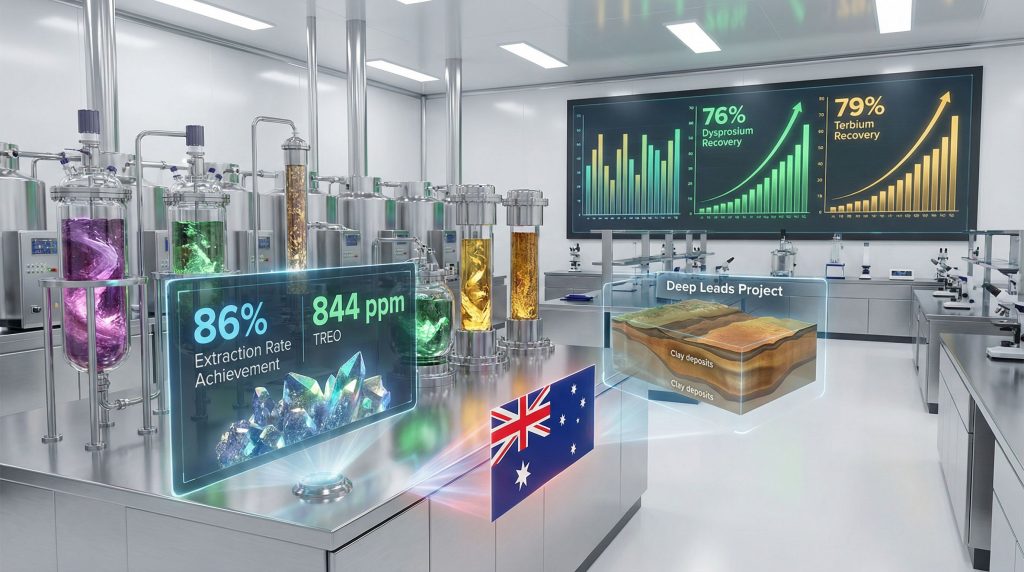
The recent achievements at ABx Group's Deep Leads project represent a significant advancement in ionic clay processing technology. The company's column leach testing methodology, conducted through ANSTO facilities, has delivered extraction rates that exceed both company benchmarks and industry standards for similar deposit types. Consequently, this development positions ABx Group among Australia's leading rare earth extraction companies.
What Makes Clay-Hosted Rare Earth Extraction Challenging?
Clay-hosted rare earth deposits present unique metallurgical challenges that differentiate them from conventional hard rock operations. The ionic nature of rare earth elements in clay formations requires specialised leaching techniques to achieve economic extraction rates. Moreover, these deposits demand careful management of reagent consumption and environmental impact.
Traditional heap leaching approaches have historically struggled with clay deposits due to:
• Permeability issues that restrict solution flow through fine-grained clay materials
• Clay swelling when exposed to aqueous solutions, reducing porosity
• Ion exchange complexities requiring precise pH and reagent management
• Variable mineralogy across deposit zones affecting extraction consistency
Australian clay deposits face additional challenges compared to their Chinese counterparts. Higher silica content and different clay mineral compositions require modified processing approaches. However, previous extraction attempts on Australian ionic clays typically achieved 60-70% recovery rates, limiting commercial viability given current rare earth pricing structures.
ABx Group's Deep Leads Project Technical Specifications
The Deep Leads resource in northern Tasmania represents one of Australia's most significant heavy rare earth concentrations. In addition, the deposit's technical characteristics provide several processing advantages over comparable global projects.
Resource Quality Metrics:
• Total resource: 89 million tonnes
• Average grade: 844 parts per million total rare earth oxides (TREO)
• Heavy rare earth concentration: 36 ppm combined dysprosium and terbium
• Deposit depth: Near-surface accessibility reducing mining costs
• Clay mineralogy: Favourable for leaching applications
The combined dysprosium and terbium grades of 36 ppm represent the highest concentration among Australian ionic clay deposits. These heavy rare earth elements command prices exceeding $400 per kilogram for dysprosium and $1,200 per kilogram for terbium. Consequently, this significantly exceeds light rare earth pricing.
Geographic positioning in Tasmania provides infrastructure advantages including reliable power supply. Furthermore, it offers established transport networks and proximity to processing facilities. The stable regulatory environment and skilled mining workforce further enhance the project's development prospects.
When big ASX news breaks, our subscribers know first
How Did ABx Group Achieve Record 86% Extraction Rates?
The breakthrough results from ABx Group's testing programme demonstrate that Australian clay deposits can achieve extraction rates comparable to global best practices. However, this success requires appropriate methodologies to be applied systematically.
ANSTO Column Leach Testing Methodology
The Australian Nuclear Science and Technology Organisation (ANSTO) testing utilised advanced column leaching techniques designed specifically for ionic clay applications. The methodology involved processing 26-kilogram bulk samples from trial pit DLP002. This represents a significant scale-up from previous laboratory testing.
Testing Protocol Elements:
• Multi-stage extraction using optimised reagent concentrations
• Variable flow rate testing to determine optimal leaching parameters
• Real-time monitoring of solution chemistry and extraction kinetics
• Quality control measures ensuring reproducible results across sample batches
The bulk sample approach provides greater confidence in results compared to smaller laboratory samples. Furthermore, it better represents the heterogeneity and processing characteristics of the actual ore body.
Critical Performance Metrics Breakdown
ABX Group rare earth extraction achievements represent a substantial improvement over previous benchmarks. Consequently, this positions the company among global leaders in ionic clay processing efficiency.
| Element Type | ABx Achievement | Previous Company Benchmark | Industry Average |
|---|---|---|---|
| Total REE | 86% (81% average) | 65-75% | 60-70% |
| Dysprosium | 76% | 55-65% | 50-60% |
| Terbium | 79% | 55-65% | 50-60% |
| Light REE | 88% | 70-80% | 65-75% |
The 81% benchmark average across bulk samples provides a conservative planning basis for commercial operations. This level represents a 15-20 percentage point improvement over the company's previous extraction rates. Moreover, it establishes a foundation for economic feasibility studies.
Heavy Rare Earth Recovery Significance
The superior extraction rates for dysprosium (76%) and terbium (79%) carry particular strategic importance. This is due to their critical role in defence applications and renewable energy technologies.
Strategic Applications Include:
• Permanent magnets for wind turbines and electric vehicle motors
• Military guidance systems requiring precise magnetic properties
• Laser technologies for defence and industrial applications
• Phosphor materials for specialised lighting systems
Current global supply of heavy rare earths remains concentrated in southern China. This creates supply security concerns for Western manufacturers. Furthermore, ABx Group's demonstrated ability to efficiently extract these elements from Australian resources addresses a critical supply chain vulnerability.
What Processing Technology Enables These Superior Results?
The validation of heap leaching as a viable processing route for Deep Leads represents a significant development in rare earth extraction technology. This approach offers several advantages over conventional tank leaching methods. In addition, this aligns with broader mining industry innovation trends toward more cost-effective processing solutions.
Heap Leaching vs Tank Leaching Comparative Analysis
The distinction between heap leaching and tank leaching carries major implications for capital requirements and operational flexibility. ABx Group's results suggest heap leaching could provide superior economics for their specific deposit characteristics.
Capital Expenditure Comparison:
• Heap leaching: Lower fixed infrastructure requirements, reduced construction timeline
• Tank leaching: Higher capital intensity, complex agitation and residence time systems
• Infrastructure differences: Heap operations require larger land area but simpler processing circuits
Heap leaching operations typically require 30-50% lower initial capital investment compared to tank leaching facilities of equivalent capacity. This reduction comes from simpler process equipment and reduced concrete and steel requirements. Furthermore, it involves shorter construction schedules.
Mixed Rare Earth Carbonate (MREC) Product Quality
ABx Group's maiden MREC product demonstrates exceptional heavy rare earth content. This translates directly into premium pricing opportunities within the global market.
Product Composition Achievements:
• Dysprosium content: 4% (double industry standard)
• Terbium concentration: 0.7% (above peer products)
• Basket pricing advantage: 17-51% premium over competitor products
• Purity levels: Meeting downstream processing specifications
The premium composition results from the inherent characteristics of the Deep Leads deposit. Furthermore, it stems from optimised extraction processes that preferentially recover valuable heavy rare earth elements.
Infrastructure Requirements for Commercial Scale-Up
Transitioning from successful test work to commercial production requires substantial infrastructure development. However, heap leaching reduces these requirements compared to alternative processing methods.
Key Infrastructure Elements:
• Heap leach pads with engineered liner systems and solution collection
• Solution processing circuits for purification and precipitation
• Reagent storage and handling facilities for acids and other chemicals
• Product storage and shipping infrastructure for MREC transport
The modular nature of heap leaching allows for staged development. This enables ABx Group to commence production at smaller scales and expand capacity as markets and financing permit.
How Does ABx Group's Resource Quality Compare Globally?
When evaluated against international ionic clay deposits, Deep Leads ranks among the highest quality undeveloped resources outside China. This positioning provides significant competitive advantages in terms of processing economics and product quality. Moreover, these factors align with emerging geopolitical minerals trends favouring Western supply chains.
Ionic Clay Deposit Ranking Analysis
Global ionic clay deposits vary significantly in grade, heavy rare earth content, and processing characteristics. The following comparison illustrates Deep Leads' competitive positioning:
| Deposit | Location | TREO Grade (ppm) | Heavy REE % | Development Stage |
|---|---|---|---|---|
| Deep Leads | Australia | 844 | 4.3% | Pre-production |
| Longnan | China | 500-800 | 3.5% | Production |
| Zudong | China | 600-900 | 4.0% | Production |
| Adamas Clay | Myanmar | 400-600 | 2.8% | Exploration |
| Weathered Granite | Madagascar | 300-500 | 2.2% | Exploration |
Deep Leads' combination of high total grade (844 ppm TREO) and exceptional heavy rare earth percentage (4.3%) positions it favourably. This is particularly evident when compared to producing operations in China and other development projects globally.
Metallurgical Advantages of Australian Clay Deposits
Beyond grade considerations, Australian ionic clay deposits offer several processing advantages. These enhance extraction efficiency and product quality significantly.
Processing Benefits Include:
• Lower radioactivity levels reducing handling and disposal complexities
• Favourable clay mineralogy enhancing leaching kinetics
• Reduced impurity content minimising downstream purification requirements
• Consistent deposit geology supporting predictable processing conditions
The absence of significant radioactive elements (thorium and uranium) in Australian deposits eliminates major environmental and regulatory hurdles. This characteristic affects other rare earth projects globally. Furthermore, this significantly reduces processing complexity and associated costs.
What Are the Commercial Production Pathway Scenarios?
ABX Group rare earth extraction success creates multiple pathways to commercial production. Each pathway presents distinct risk-reward profiles and capital requirements for potential investors.
Phase 1 Development Timeline and Milestones
The progression from successful test work to commercial production involves several critical development phases. Each phase requires specific achievements and approvals to proceed successfully.
Development Sequence:
- Engineering studies completion (6-12 months)
- Environmental impact assessment (12-18 months)
- Mining approvals and permits (6-12 months)
- Construction financing (3-6 months)
- Facility construction (18-24 months)
The company's November 2025 capital raising of A$6.05 million provides funding to advance engineering studies. In addition, it supports exploration drilling programmes. These activities will refine processing parameters and expand resource confidence to support commercial development decisions.
Capital Investment Requirements Analysis
Commercial production at Deep Leads requires substantial capital investment. However, the validated heap leaching approach reduces these requirements compared to tank leaching alternatives.
Estimated Capital Requirements:
• Initial heap leach facility: A$50-80 million
• Processing infrastructure: A$30-50 million
• Mining and site preparation: A$15-25 million
• Working capital: A$10-15 million
• Total estimated requirement: A$105-170 million
These estimates reflect current construction costs and include contingencies for project execution risks. The modular nature of heap leaching allows for staged development. Consequently, this could potentially reduce initial capital requirements.
Production Scale-Up Scenarios
Resource size and demonstrated extraction rates support multiple production scenarios. These range from modest initial operations to substantial commercial scale facilities.
Based on the 89 million tonne resource and 81% average extraction rates, Deep Leads could potentially support 2,000-3,000 tonnes annual TREO production over a 20+ year mine life, positioning it among the top 10 non-Chinese rare earth operations globally.
Production scenarios must balance capital efficiency with market positioning. Smaller initial operations could establish market presence and generate cash flow to fund expansion. However, larger scale development would capture greater market share but require substantial upfront investment.
How Significant Is the Ucore Partnership for Market Access?
The strategic relationship with Ucore Rare Metals provides ABx Group with direct access to Western supply chains. These chains are actively seeking secure, non-Chinese rare earth sources. This relationship reflects broader critical minerals policy order initiatives prioritising supply chain security.
Western Supply Chain Integration Strategy
Ucore's backing from the US Department of Defense and Canadian government creates unique market access opportunities. This is particularly valuable for Australian rare earth production seeking Western market penetration.
Strategic Partnership Benefits:
• Government backing providing supply security assurance
• Established processing capability eliminating downstream development requirements
• Defence contractor relationships accessing premium pricing markets
• Allied nation procurement preferences supporting demand security
The first right of refusal structure covering 50% of production over five years provides ABx Group with guaranteed market access. Furthermore, it retains flexibility for additional offtake arrangements.
Offtake Agreement Structure and Pricing
The memorandum of understanding with Ucore establishes framework terms for commercial supply arrangements. However, final pricing and volume commitments require completion of definitive agreements.
Agreement Structure Elements:
• Volume allocation: 50% of production over five years
• Pricing methodology: Market-based with potential premiums
• Quality specifications: Based on MREC product characteristics
• Delivery terms: Ex-works from processing facility
The premium composition of ABx Group's MREC product contains 4% dysprosium and 0.7% terbium. This commands significant pricing advantages over standard rare earth concentrates. Consequently, this quality differential could support pricing premiums of 17-51% above peer products.
Geopolitical Risk Mitigation Benefits
Western supply chain diversification has become a critical policy objective following supply disruptions. Export restrictions have significantly affected rare earth markets. ABx Group's Australian location provides substantial geopolitical advantages.
Risk Mitigation Elements:
• Allied nation source eliminating export restriction risks
• Stable regulatory environment supporting long-term supply security
• English-speaking jurisdiction facilitating business relationships
• Established mining sector providing operational expertise and infrastructure
These characteristics position ABx Group to capture premium pricing associated with supply security. This is particularly relevant for defence and critical infrastructure applications requiring assured materials access.
The next major ASX story will hit our subscribers first
What Are the Technical Risks and Mitigation Strategies?
While test results demonstrate exceptional extraction performance, scaling from laboratory success to commercial operations involves inherent technical and operational risks. Furthermore, modern data-driven mining operations approaches can help mitigate many of these scaling challenges.
Scale-Up Challenges from Laboratory to Commercial
The transition from 26-kilogram bulk samples to commercial-scale processing presents multiple technical challenges. These could affect extraction rates and operational efficiency.
Primary Scale-Up Risks:
• Sample representativeness variations across the broader ore body
• Process optimisation at industrial scale with different kinetics
• Equipment performance differences between laboratory and commercial systems
• Quality consistency maintenance across varying feed characteristics
Mitigation approaches include pilot plant testing at intermediate scales. Additionally, comprehensive resource drilling confirms deposit consistency. Furthermore, staged production ramp-up allows process optimisation before full capacity operation.
Environmental and Regulatory Compliance Requirements
Commercial rare earth processing in Tasmania requires comprehensive environmental approvals. Moreover, ongoing compliance with stringent regulatory standards remains essential.
Key Regulatory Requirements:
• Environmental impact assessment covering water, air, and soil impacts
• Water management systems for process solution containment and treatment
• Waste disposal approvals for process residues and tailings
• Community consultation and social licence maintenance
The absence of radioactive elements in Deep Leads ore significantly reduces regulatory complexity. This compares favourably to other rare earth projects. However, comprehensive environmental management systems remain essential for approval and operation.
Operational Risk Management Framework
Successful commercial operation requires robust risk management across multiple operational areas. This spans from supply security to workforce development requirements.
Critical Risk Management Areas:
• Reagent supply security for processing chemicals and consumables
• Skilled workforce development for specialised rare earth processing
• Technology transfer and operational knowledge retention
• Market price volatility affecting revenue and project economics
The company's relationship with ANSTO provides ongoing technical support and knowledge transfer opportunities. Furthermore, Tasmania's established mining sector offers workforce development infrastructure and operational expertise.
How Does ABx Group's Valuation Compare to Rare Earth Peers?
At current trading levels, ABx Group's valuation metrics reflect its pre-production status. However, they are beginning to incorporate the potential value from demonstrated extraction success.
Market Capitalisation Analysis
Comparing ABx Group to established rare earth producers and development companies reveals significant valuation disparities. These could present opportunity or reflect development risks.
| Company | Market Cap (A$M) | Resource (Mt) | TREO Grade | EV/Resource |
|---|---|---|---|---|
| ABx Group | 34 | 89 | 844 ppm | 0.38 |
| Lynas Rare Earths | 4,200 | 21 | 7.4% | 200 |
| Arafura Resources | 850 | 56 | 2.6% | 15.2 |
| Iluka Resources | 2,100 | 35 | 3.2% | 60 |
| Northern Minerals | 45 | 27 | 0.8% | 1.7 |
ABx Group's enterprise value per tonne of resource (A$0.38) reflects its early development stage. However, successful execution could support substantial valuation re-rating toward peer levels.
Investment Risk-Reward Profile Assessment
The investment proposition combines exceptional technical results with significant execution risks. These risks are typical of pre-production mining developments.
Risk Factors:
• Development execution from successful testing to commercial production
• Capital raising requirements estimated at A$105-170 million
• Commodity price exposure to rare earth market volatility
• Regulatory approval processes and timeline uncertainties
Reward Potential:
• Premium product quality supporting higher pricing than peers
• Secure market access through Ucore partnership
• Supply chain positioning benefiting from Western diversification trends
• Valuation re-rating potential upon development milestones
The risk-reward profile suggests suitability for growth-oriented investors. Furthermore, these investors must have appropriate risk tolerance for speculative mining investments.
What Catalysts Could Drive Future Share Price Performance?
Multiple near-term and medium-term catalysts could influence investor sentiment and share price performance. These catalysts emerge as the project advances toward commercial development.
Near-Term Technical Milestones
Completion of ongoing technical programmes could provide further validation of extraction performance and resource characteristics. Moreover, these results would strengthen the case for ABX Group rare earth extraction commercialisation.
Upcoming Technical Catalysts:
• Additional bulk sample results from different deposit areas
• Pilot plant feasibility assessment for heap leaching optimisation
• Resource expansion drilling increasing confidence and potentially size
• Metallurgical test work on downstream processing and product upgrading
These technical milestones would provide additional data supporting commercial development decisions. Furthermore, they could potentially attract strategic investor interest.
Commercial Development Triggers
Progression toward commercial production involves several significant milestones. These typically generate investor interest and potential valuation re-rating.
Key Commercial Catalysts:
• Binding offtake agreements converting memorandums of understanding to firm commitments
• Development financing completion providing construction funding certainty
• Construction commencement marking transition to development phase
• Government support announcements for critical minerals development
Each milestone reduces project risk and could support higher valuation multiples. Consequently, development certainty increases with each achievement.
Market Sentiment Factors
Broader market dynamics affecting rare earth valuations could significantly influence ABx Group's share price performance. These effects occur independent of company-specific developments.
Market Influence Factors:
• Global supply-demand dynamics affecting rare earth pricing
• Geopolitical developments impacting supply security concerns
• Critical minerals policy announcements from Western governments
• Peer company performance and sector rotation effects
The company's exposure to heavy rare earth markets provides leverage to supply security themes. However, it also creates volatility from commodity price fluctuations.
Should Investors Consider ABx Group at Current Levels?
The investment decision requires weighing exceptional technical achievements against typical pre-production mining risks. Furthermore, substantial capital requirements must be considered carefully.
Bull Case Investment Thesis
Several compelling factors support a positive investment outlook for risk-appropriate portfolios. These factors strengthen the overall case for ABX Group rare earth extraction potential.
Investment Strengths:
• Record extraction rates validating commercial viability potential
• Premium heavy rare earth content supporting higher pricing than peers
• Strategic partnership providing Western market access and government backing
• Supply security positioning benefiting from diversification trends away from Chinese sources
• Modest valuation relative to resource size and technical achievements
The combination of technical success and strategic positioning creates potential for significant value creation. However, this requires successful development execution.
Bear Case Risk Considerations
Investment risks reflect the inherent challenges of transitioning from successful laboratory results to commercial rare earth production. For more detailed analysis, investors can review ABx Group's recent heavy rare earth results.
Primary Risk Factors:
• Early development stage with unproven commercial scalability
• Substantial capital requirements estimated at A$105-170 million for development
• Execution uncertainty from technical success to operational production
• Commodity price volatility potentially affecting project economics
• Competition from established producers with operating cost advantages
These risks require careful consideration within individual portfolio risk tolerances and investment objectives. Furthermore, they must align with overall investment strategies.
Portfolio Positioning Recommendations
ABx Group's risk-reward profile suggests specific positioning considerations for different investor types. Each approach requires careful evaluation of risk tolerance.
Conservative Investors: May prefer waiting for further development milestone achievement and risk reduction before establishing positions.
Growth-Oriented Investors: Could consider modest position sizing appropriate to speculative investment allocation. This recognises both upside potential and loss risks.
Strategic Investors: May find value in the supply security and Western supply chain positioning themes. This is particularly relevant for thematic or ESG-focused portfolios.
Position Sizing Guidance: Given pre-production risks, position sizes should remain within speculative investment limits. This typically means 1-3% of total portfolio value for most investors.
Investment decisions should always consider individual financial circumstances, risk tolerance, and investment objectives. This analysis does not constitute personalised investment advice and readers should consult qualified financial advisors before making investment decisions.
Looking for the Next Major Rare Earth Discovery?
Discovery Alert instantly alerts investors to significant ASX mineral discoveries using its proprietary Discovery IQ model, transforming complex mineral data into actionable insights within minutes of announcements. Understand why major mineral discoveries can generate exceptional returns and begin your 30-day free trial today to position yourself ahead of the market when the next breakthrough emerges.