August 25, 2026
When the Ground Speaks, Can a Machine Listen? The Science Behind Acoustic Rock-Sounding in Deep Mining
Every underground mining operation rests on an invisible contract between geology and engineering. At shallow depths, that contract is relatively straightforward to manage. But as mines descend further into the earth, the terms become far more demanding, and the consequences of misreading them more severe. At depths exceeding three kilometres, rock behaves in ways that surface-level intuition cannot anticipate. Stress fields intensify, seismic events become routine occurrences, and the margin for error in ground condition assessment narrows dramatically.
It is within this geotechnical reality that CSIR digital rock-sounding technology at Harmony Gold's Mponeng Mine takes on its full significance. This is not simply a technology story. It is a story about one of the most persistent, dangerous, and difficult-to-solve problems in underground mining, and a methodical attempt to bring data-driven mining operations rigour to a practice that has historically depended entirely on human sensory interpretation.
When big ASX news breaks, our subscribers know first
Understanding the Fall-of-Ground Problem at Extreme Depths
Fall-of-ground events, commonly abbreviated as FoG incidents, represent one of the most severe occupational hazards in deep-level underground mining globally. They occur when rock displaces uncontrollably from the walls, hanging wall, or face of an underground excavation, sometimes without warning. In South Africa's gold mining sector, FoG incidents have historically been among the leading causes of fatality and serious injury, a pattern that has driven decades of research, regulation, and engineering innovation without ever producing a complete solution.
The challenge is compounded by the physical environment at extreme depths. Mining at levels beyond 3,000 metres below surface introduces geomechanical conditions that have no real analogue in shallower operations:
- Rock stress values at these depths can reach levels that cause spontaneous fracturing of intact rock mass
- Seismic activity, including rockbursts triggered by stress redistribution during blasting or ore extraction, adds a dynamic and unpredictable element to ground behaviour
- The rock mass at such depths has typically been subjected to complex geological deformation over millions of years, creating discontinuities, faults, and zones of altered material that behave very differently from the surrounding competent rock
- Temperature and humidity conditions are extreme, affecting both human performance and the physical properties of support systems
Against this backdrop, systematic workplace examination, including the practice of barring and sounding exposed rock surfaces before any person enters a working area, remains one of the most critical safety protocols in the industry.
Mponeng: Why the World's Deepest Mine Is the Right Place to Test This Technology
Mponeng Gold Mine, operated by Harmony Gold in South Africa's North West Province, holds the distinction of being the deepest operational gold mine on earth, with working levels extending beyond 3.5 kilometres below surface. The mine extracts gold from the Ventersdorp Contact Reef and Carbon Leader Reef, both of which are narrow tabular ore bodies that require highly selective, labour-intensive mining methods.
The geotechnical environment at Mponeng is, by any measure, extreme. The virgin rock temperature at depth exceeds 60 degrees Celsius before refrigeration systems intervene. Seismic events are a routine part of the operational landscape. The rock stress conditions require sophisticated support systems and constant monitoring. It is precisely because of these characteristics that Mponeng represents the most demanding possible test environment for any new underground safety technology.
If an acoustic rock-sounding application can function reliably at Mponeng, there is a strong technical argument that it can function reliably anywhere. The proof-of-concept field trial conducted there by the Council for Scientific and Industrial Research, in collaboration with Harmony Gold's rock engineering team, was therefore a deliberate choice to validate performance against the hardest available benchmark.
The Traditional Practice: What Barring and Sounding Actually Involves
To understand what the digital application adds, it is essential to first understand what experienced underground workers already do, and how well they do it.
Barring involves systematically striking exposed rock surfaces with a steel bar to dislodge any loose material before personnel enter a working area. Rock sounding accompanies this process: as the bar strikes the rock, the acoustic response tells a trained worker whether the ground is solid or potentially hazardous. Solid rock produces a sharp, resonant ring. Rock that is cracked, delaminated, or otherwise compromised tends to produce a dull, hollow thud.
The tonal distinction between a sound "ring" and a hollow "thud" is not merely empirical folklore. It reflects genuine acoustic physics: solid rock transmits and reflects sound waves differently from fractured or void-bearing material, producing measurable differences in frequency content, amplitude decay, and resonance characteristics.
Experienced rock engineering personnel develop extraordinary sensitivity to these acoustic cues over years of underground work. The limitation, however, is not one of skill but of consistency and documentation. Furthermore, several systemic gaps persist:
- Inter-individual variability: Two equally experienced workers may interpret the same acoustic response differently, particularly under conditions of fatigue or elevated ambient noise
- Shift-to-shift continuity: When personnel rotate between shifts, the interpretive context built up during one inspection is rarely transferred to the next team in any structured way
- No audit trail: Traditional sounding leaves no permanent record of where examination was conducted, what responses were encountered, or what decisions were made as a result
- Environmental interference: Underground noise from ventilation systems, machinery, and nearby blasting can mask acoustic cues or alter their perceived character
These limitations do not undermine the value of skilled sounding practice. They do, however, create a systemic gap between ideal ground control outcomes and what is consistently achievable across large, complex underground workplaces operating around the clock.
How the CSIR Acoustic Application Works: Signal Processing Meets Machine Learning
The application developed through the collaboration between the CSIR and Peralex Electronics addresses this gap by introducing a consistent, algorithm-driven layer of acoustic analysis that runs alongside, not instead of, the judgement of trained underground personnel. In addition, underground ore sensing advances in recent years have demonstrated that sophisticated signal capture is increasingly viable even in the most challenging subsurface environments.
The technical architecture of the system centres on three core processes:
1. Acoustic Capture
Underground audio recording hardware captures the acoustic response generated when rock is struck during standard sounding activities. The system is designed to operate in the demanding physical conditions of a deep underground mine, where dust, humidity, vibration, and ambient noise present significant engineering challenges.
2. Signal Processing and Feature Extraction
Acoustic signal processing algorithms isolate the specific frequency and amplitude characteristics of each rock strike response, separating the signal of interest from background noise. The system analyses properties including frequency distribution, amplitude envelope, and decay characteristics to extract features that are diagnostically meaningful for ground condition assessment.
3. Machine Learning Classification
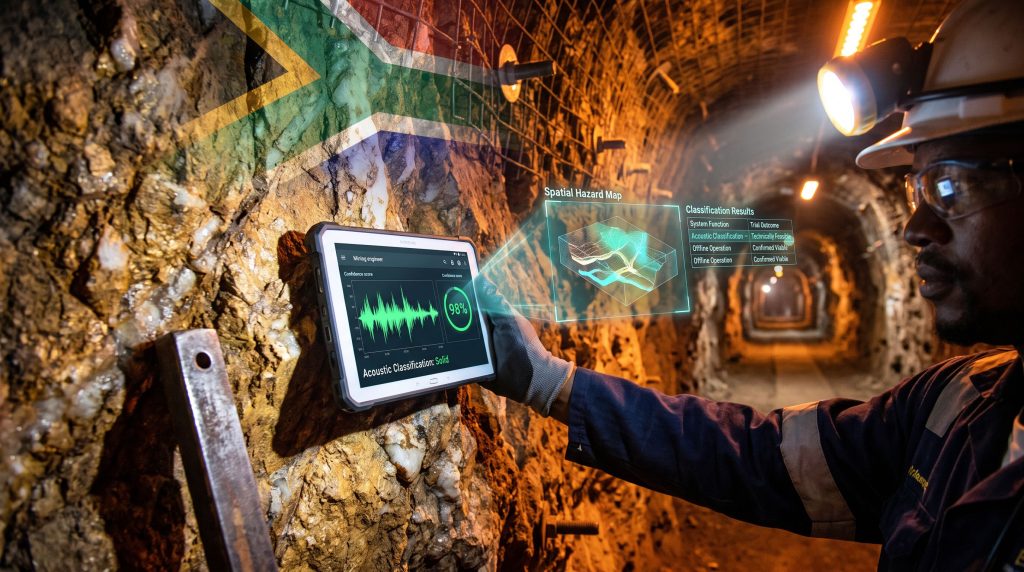
Classification models trained on labelled acoustic datasets assign each strike response to one of two categories: acoustic signatures consistent with solid ground conditions, or signatures associated with potentially loose or hazardous rock. Critically, the system also generates a confidence score for each classification, indicating the probability weighting assigned to the result. This is an important design feature: it means the system communicates not just a binary outcome but a measure of its own certainty, allowing underground personnel to weight the result appropriately in their decision-making.
Two additional capabilities proved particularly significant during the Mponeng field trial:
- Offline operation: The system functions without continuous network connectivity, a non-negotiable requirement in deep underground environments where communication infrastructure is often limited or intermittent
- Event logging and data export: Every sounding event is recorded with a timestamp and classification result, creating a structured, exportable dataset for post-shift engineering review and trend analysis
What the Mponeng Field Trial Confirmed
The underground proof-of-concept evaluation successfully demonstrated the technical feasibility of the acoustic rock-sounding application under authentic deep-level mining conditions. The following table summarises the core functions evaluated and their outcomes:
| System Function | What Was Tested | Trial Outcome |
|---|---|---|
| Underground Audio Recording | Acoustic capture in live mining environment | Successfully demonstrated |
| Acoustic Classification | ML-based ground condition categorisation | Technically feasible under field conditions |
| Confidence Scoring | Probability weighting per classification | Operational in underground environment |
| Event Logging | Timestamped recording of all sounding events | Successfully evaluated |
| Offline Operation | Full function without network connectivity | Confirmed viable |
| Data Export | Dataset transfer for post-shift engineering review | Successfully completed |
The trial also identified specific practical refinements required before operational deployment, including adjustments to hardware configuration and classification model optimisation for the particular acoustic characteristics of Mponeng's geological environment. This is a normal and expected outcome of proof-of-concept validation at an authentic field site, where variables that cannot be replicated in controlled settings inevitably surface.
It is important to be precise about what the trial did and did not prove. Technical feasibility under field conditions is a meaningful milestone, but it is distinct from operational readiness. The classification models will require further training on larger labelled datasets before their accuracy across diverse geological conditions can be fully characterised. Hardware configurations will need optimisation. Integration with existing mine communication and data systems remains a future development challenge.
The next major ASX story will hit our subscribers first
The Long-Term Vision: From Individual Classifications to Spatially Referenced Hazard Intelligence
The immediate value of the acoustic rock-sounding application lies in its ability to provide consistent, documented acoustic assessments during workplace examination. Its longer-term strategic value, however, is considerably more significant.
By capturing and storing acoustic strike data as a structured digital dataset, the system establishes the foundation for a fundamentally different approach to ground control intelligence. As data accumulates across multiple shifts, working areas, and geological zones, several new analytical capabilities become possible:
- Temporal trend analysis: Identifying locations where acoustic responses deteriorate over time, potentially indicating progressive ground instability before it reaches a critical state
- Spatial hazard mapping: When integrated with 3D geological modelling and underground positioning systems, acoustic classification data can be linked to precise underground coordinates, generating location-specific ground condition maps that persist across shift changes
- Shift handover documentation: Digital sounding records create a structured, reviewable basis for communicating hazard intelligence between incoming and outgoing shift teams
- Model improvement feedback loops: Accumulating labelled acoustic datasets progressively improves the classification models' accuracy, particularly for geological conditions that were underrepresented in the initial training data
The trajectory from individual acoustic classifications toward spatially referenced hazard intelligence represents a qualitative shift in what ground control decision-making can look like. Rather than relying on the memory and judgement of whoever conducted the most recent inspection, rock engineering teams would have access to a continuously updated, location-specific picture of ground condition trends across the entire workplace.
The Collaborative Framework: CSIR, Peralex Electronics, and Harmony Gold
The acoustic rock-sounding application was developed within the Mandela Mining Precinct's Advanced Orebody Knowledge Programme, a structured research stream that coordinates industry-relevant applied research for South Africa's mining sector. The CSIR, as South Africa's leading applied science and technology research organisation, led the geotechnical research and system development work.
Peralex Electronics contributed the hardware engineering and acoustic signal processing architecture that transformed the research concept into a field-deployable proof-of-concept system. Harmony Gold's rock engineering team participated as active collaborators in the design and execution of the Mponeng field trial, not merely as hosts. This distinction matters: industry participation at the trial design stage ensures that the technology is tested against operationally realistic scenarios and that practical usability considerations are embedded in the evaluation from the outset.
The collaboration model demonstrated here reflects a broader principle that has gained traction across high-risk industrial sectors: safety-critical technology development benefits from tight integration between research institutions, engineering partners, and operational end-users throughout the development process, not just at the point of deployment.
What Comes Next: The Pathway to Operational Piloting
The next development phase will focus on four interconnected objectives:
- Structured underground validation trials at scale, generating the larger labelled acoustic datasets required to improve classification model performance across diverse geological conditions
- Classification model refinement, incorporating geological variability data from the Mponeng trial and any subsequent validation sites
- Hardware configuration optimisation, addressing the specific environmental challenges identified during the proof-of-concept evaluation
- Preparation for a controlled operational pilot, which will require integration with underground communication infrastructure, development of a user interface optimised for underground conditions, and establishment of data governance protocols
The transition from proof-of-concept to controlled operational pilot represents the most demanding phase of any industrial technology development programme. It requires sustained commitment from all stakeholder groups, including mining companies willing to integrate experimental systems into live operational workflows.
Broader Implications: Digital Sounding Beyond Gold Mining
Could This Technology Apply Across Other Underground Sectors?
While the Mponeng trial was conducted in the specific context of deep-level gold mining, the underlying technology has potential applicability across a wider range of underground environments. Platinum group metal mining in South Africa's Bushveld Complex involves similar tabular ore body geometries and comparable ground control challenges. Underground civil infrastructure projects, including tunnelling and cavern construction, involve systematic rock condition assessment that could benefit from the same acoustic classification approach.
Furthermore, the mining automation trends shaping the broader industry suggest that acoustic classification tools like this are well-positioned to integrate with automated inspection workflows as they mature. Similarly, AI in mining continues to demonstrate that machine learning models can meaningfully augment, rather than replace, the expertise of experienced underground personnel.
Perhaps less obviously, the accumulated acoustic datasets generated by widespread deployment of this technology could eventually support objective competency assessment for rock engineering personnel, providing a data-driven benchmark against which the interpretive accuracy of individual workers can be evaluated and training needs identified.
CSIR digital rock-sounding technology at Harmony Gold's Mponeng Mine field trial is, in the immediate sense, a proof-of-concept validation. In a broader sense, it represents an early and carefully constructed step toward a future where the safety-critical knowledge embedded in experienced underground workers can be documented, analysed, and progressively augmented by machine intelligence without ever being diminished or replaced by it. Detailed technical findings from the trial are available for those wishing to explore the underlying research in greater depth.
This article is intended for informational purposes only and does not constitute financial, investment, or professional advice. Readers seeking additional context on South Africa's mining technology innovation landscape may find value in exploring coverage published by Mining Weekly at miningweekly.com.
Want to Stay Ahead of the Next Major ASX Mineral Discovery?
Discovery Alert's proprietary Discovery IQ model scans ASX announcements in real time, instantly identifying significant mineral discoveries and turning complex data into actionable investment insights — start your 14-day free trial today, or explore how historic discoveries have delivered extraordinary returns to early-positioned investors.