August 24, 2026
The Exploration Technology Gap Slowing America's Critical Mineral Ambitions
The mining industry has a timing problem that no amount of capital alone can solve. From the moment a geologist identifies a promising mineral target to the point where engineers can confidently declare economically mineable reserves, the conventional exploration workflow unfolds across a timeline measured not in months but in years — often stretching well beyond a decade. For a nation attempting to reduce its dependence on foreign sources of the minerals underpinning electric vehicles, defense systems, and clean energy infrastructure, that pace is structurally misaligned with the urgency of the challenge. Furthermore, the critical minerals demand surge makes this timing problem increasingly acute.
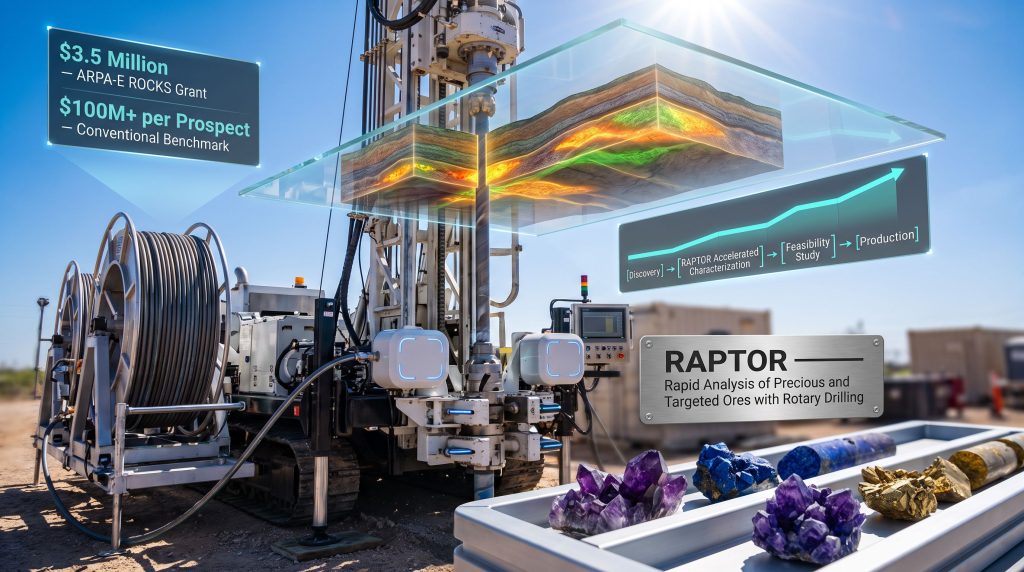
This is the context in which Texas A&M RAPTOR critical mineral drilling technology is emerging as one of the more consequential exploration innovations to receive federal attention in recent years. Developed by a research team at Texas A&M University and funded through the U.S. Department of Energy's Advanced Research Projects Agency-Energy (ARPA-E), RAPTOR represents a fundamental rethinking of how mineral deposits are identified, characterised, and evaluated — not through incremental refinement of existing methods, but through the integration of technologies that attack multiple bottlenecks simultaneously.
When big ASX news breaks, our subscribers know first
Why Conventional Critical Mineral Exploration Is Structurally Broken
To understand what RAPTOR is solving, it helps to understand precisely where conventional exploration loses time. The workflow follows a recognisable pattern across virtually every hard rock mineral project: drill a hole, collect samples, ship those samples to a laboratory, wait weeks or months for assay results, interpret the data, plan the next round of drilling, and repeat — progressively tightening the drill spacing until enough geological confidence exists to support a formal resource estimate.
Each iteration of this cycle introduces delay. Laboratory turnaround times create information gaps between drill campaigns. The deposit model only takes shape gradually, meaning each new drill hole is planned with incomplete knowledge of the subsurface. By the time a project team has sufficient data to commission definitive feasibility studies — the documents required to define economically mineable reserves — years have elapsed and capital expenditure has accumulated substantially.
ARPA-E has quantified this challenge in concrete terms: orebody characterisation required to transform a mineral prospect into an economically evaluated deposit can currently take more than a decade and cost more than $100 million per prospect. These are not worst-case figures; they reflect the structural reality of conventional exploration economics across the industry.
The implications extend beyond project timelines. When exploration capital is tied up for a decade per prospect, the number of deposits that can realistically be advanced simultaneously is severely constrained. Investors face extended periods of uncertainty. The gap between domestic critical mineral demand and domestic supply widens, reinforcing import dependency precisely when geopolitical risk is rising.
What Is RAPTOR and How Does It Work?
RAPTOR, an acronym for Rapid Analysis of Precious and Targeted Ores with Rotary Drilling, is an integrated drilling and mineral characterisation platform developed by researchers in the Harold Vance Department of Petroleum Engineering at Texas A&M University. The project is led by Dr. Roman Shor, an Associate Professor whose team is collaborating with researchers at the University of Texas at Austin and drawing on expertise from drilling and mineral industry partners.
The platform has received $3.5 million in federal funding from ARPA-E through its ROCKS programme — Reliable Ore Characterisation with Keystone Sensing — which targets order-of-magnitude improvements in the speed and cost of critical mineral deposit characterisation. A prototype is scheduled for testing at the National Oilwell Varco Springett Technology Center in Texas, a facility specifically designed for evaluating advanced drilling technologies under real operating conditions.
The platform integrates four distinct technical capabilities, each addressing a separate constraint in the conventional exploration workflow:
Coiled Tubing Drilling
Conventional drill rigs advance into the ground using individual sections of rigid pipe that must be connected as the bit descends and disconnected as it is retrieved. This pipe-handling process consumes significant rig time. Coiled tubing replaces this segmented approach with a continuous, flexible length of tubing that spools in and out of the hole without requiring repeated make-and-break connections. The method is well-established in petroleum sector operations and is being adapted here for hard rock mineral exploration applications.
Rotary-Percussive Drilling
Critical mineral deposits frequently occur in geologically complex, hard rock environments where standard rotary drilling struggles to achieve efficient penetration rates. RAPTOR couples the coiled tubing system with a rotary-percussive mechanism that combines conventional rotation with a hammering action, enabling faster penetration through the tough formations where many economically significant mineral deposits are hosted. Prior research has demonstrated meaningful drilling speed improvements from this combined approach relative to rotary-only methods.
Continuous Real-Time Sample Analysis
This is arguably the most transformative element of the Texas A&M RAPTOR critical mineral drilling technology. Rather than collecting samples for external laboratory analysis, RAPTOR is engineered to analyse rock cuttings and other sample material continuously as they emerge from the borehole. Advanced sensing technologies identify the minerals and elemental composition present in the material in real time, generating a mineralogical data stream that exploration teams can act on immediately.
The practical implication is significant: instead of waiting weeks or months for laboratory assays before deciding where to drill next, geologists receive mineralogical intelligence while the rig is still turning. This does not eliminate the need for formal laboratory assays — certified resource and reserve declarations under established reporting standards still require validated laboratory analysis. What it does provide is earlier indication of mineralisation and geological trends while those definitive results are pending, enabling faster and better-informed decisions about drill programme direction. In addition, interpreting drill results becomes significantly more efficient when real-time data is available to contextualise findings.
Machine Learning and Real-Time Digital Twinning
The sensing data stream generated by RAPTOR feeds into machine learning algorithms that identify mineralogical patterns and geological structures as drilling progresses. Simultaneously, this information continuously updates a digital twin — a live computational model of the subsurface geology and mineralisation. Consequently, AI in mineral exploration is becoming an indispensable component of next-generation discovery platforms such as this.
In conventional exploration, deposit models are assembled largely after a drill programme concludes, drawing on the accumulated data from dozens or hundreds of holes. With a live digital twin, that model evolves dynamically during drilling, enabling geologists to refine subsequent drill targets while the rig remains operational. The result is a fundamentally different decision-making cycle: adaptive, data-driven, and responsive to emerging geological evidence rather than dependent on retrospective analysis.
RAPTOR vs. Conventional Drilling: A Comparative Overview
| Exploration Attribute | Conventional Approach | RAPTOR Platform |
|---|---|---|
| Drill pipe method | Segmented sections, repeated connections | Continuous coiled tubing |
| Rock penetration | Rotary only | Rotary-percussive combined |
| Sample analysis | Weeks to months, external laboratory | Real-time at drill site |
| Deposit modelling | Assembled post-programme | Live digital twin updated during drilling |
| Decision cycle | Delayed until lab results return | Near-immediate, based on live data |
| Timeline benchmark | 10+ years per prospect | Targeted order-of-magnitude compression |
| Cost benchmark | $100 million+ per prospect | Targeted significant reduction |
The Hard Rock Problem: Why Critical Minerals Demand Specialised Drilling
One detail that often escapes general coverage of critical mineral exploration is the specific geological challenge posed by the host environments where many high-value deposits occur. Rare earth elements, lithium-bearing pegmatites, cobalt-rich formations, and other strategically critical mineral systems frequently reside in geologically ancient, structurally complex hard rock settings that bear little resemblance to the sedimentary environments where much conventional petroleum-derived drilling technology was optimised.
Drilling through granites, gneisses, and other metamorphic or igneous rock types at the penetration rates required for commercial exploration economics demands equipment that standard rotary techniques cannot always deliver efficiently. The rotary-percussive approach embedded in RAPTOR addresses this mismatch directly, and its combination with coiled tubing creates a system architecture better suited to the physical demands of hard rock critical mineral exploration than either technology would be individually.
This cross-sector technology transfer — adapting petroleum engineering tools and methods for hard rock mineral applications — represents one of the more intellectually interesting aspects of the RAPTOR project. The petroleum industry has invested heavily in drilling efficiency over decades of offshore and unconventional resource development. Much of that accumulated engineering knowledge has remained largely siloed from the hard rock mining sector, and RAPTOR represents a deliberate effort to bridge that gap. Texas as a strategic hub for critical materials further underscores why this research is particularly well-placed to influence national supply chain strategy.
Understanding the Digital Twin in a Mineral Exploration Context
The concept of digital twinning is increasingly familiar in manufacturing and infrastructure management, but its application to mineral exploration deserves specific explanation. In a mining exploration context, a digital twin is a continuously updated computational model of subsurface geology and mineralisation. It incorporates drilling data, geophysical measurements, geochemical results, and structural geological interpretations into a dynamic three-dimensional representation of what lies below ground.
A real-time digital twin evolves with each new data point rather than representing a static snapshot assembled after the fact — a distinction that fundamentally changes how exploration programmes can be managed.
The economic logic of continuous subsurface modelling is compelling:
- Improving drill target accuracy before each new hole reduces the proportion of unproductive drilling
- Earlier identification of mineralised zones concentrates resources on higher-probability targets
- Adaptive planning mid-programme shortens the overall number of drill campaigns needed to achieve sufficient geological confidence
- Reduced unproductive drilling also carries environmental benefits, lowering the surface disturbance and waste rock generation per unit of geological information obtained
The next major ASX story will hit our subscribers first
The ROCKS Programme and What It Signals About Federal Exploration Investment
ARPA-E's ROCKS programme is worth understanding beyond its role as a funding mechanism for RAPTOR. The programme's design criteria reveal something important about how federal research investment is being directed toward the exploration technology layer of the critical mineral supply chain — specifically, the front-end characterisation phase that has historically received less technological attention than processing and refining.
The ROCKS programme explicitly targets not incremental improvements but order-of-magnitude gains in characterisation speed and cost. This framing is significant. An order-of-magnitude compression in a decade-long timeline could theoretically reduce the characterisation phase to roughly one year. Applied to a $100 million per-prospect cost structure, the same scaling logic points toward potential savings of tens of millions of dollars per deposit evaluated. Moreover, the broader US critical minerals strategy provides important policy context for understanding why this level of federal investment is being directed here now.
| ROCKS Programme Metric | Current Benchmark | Programme Target |
|---|---|---|
| Characterisation timeline | 10+ years per prospect | Order-of-magnitude reduction |
| Cost per prospect | $100 million+ | Significant compression |
| Data resolution | Periodic, sample-dependent | Continuous, high-resolution |
| Decision cycle | Weeks to months between drill decisions | Near real-time adaptive planning |
Target Commodities and the Strategic Mineral Landscape
RAPTOR's design is applicable across a range of critical mineral deposit types, with particular relevance to:
- Rare earth elements (REEs): Essential for the permanent magnets used in electric vehicle motors, wind turbines, and precision-guided defence systems, rare earths present particularly complex mineralogical characterisation challenges given the close similarity between individual REE minerals
- Lithium: Increasingly in demand for battery storage applications across the energy transition, with significant domestic hard rock lithium resources in pegmatite formations requiring efficient drilling and characterisation
- Cobalt and nickel: Critical battery cathode materials with complex mineralogical associations in their primary deposit types
- Strategic technology metals: Including the broader suite of minerals identified as critical to semiconductor, aerospace, and clean energy supply chains
The common thread across these commodity types is that their deposit geometries and mineralogical complexity make rapid, accurate characterisation particularly valuable — and particularly difficult with conventional methods.
Limitations, Open Questions, and Realistic Expectations
Intellectual honesty requires acknowledging where RAPTOR stands in its development trajectory and what remains unproven. Several important caveats apply:
Technology readiness: RAPTOR is currently at the prototype development and testing stage. The transition from a controlled testing environment at the National Oilwell Varco Springett Technology Center to diverse, remote field conditions introduces engineering challenges that prototype performance cannot fully predict.
Integration complexity: Combining coiled tubing mechanics, percussive drilling, real-time sensing, and machine learning processing into a single operationally reliable platform is a substantially more demanding engineering task than optimising any one of those components individually. System reliability under sustained field conditions will be a critical validation threshold.
Assay replacement limitations: Real-time sensing data generated during Texas A&M RAPTOR critical mineral drilling technology operations is designed to provide early mineralogical intelligence, not to replace the certified laboratory assays required for resource and reserve declarations under JORC, NI 43-101, or equivalent reporting codes. Investors and industry observers should understand this distinction clearly.
Geological variability: Performance validated in one geological setting does not automatically translate to equivalent performance across the full diversity of hard rock critical mineral deposit types. Extensive field testing across varied geological environments will be necessary before broad commercial applicability can be assessed.
This article contains forward-looking assessments of an early-stage research platform. Outcomes will depend on prototype testing results, engineering development progress, and field validation across diverse geological environments. Nothing in this article should be construed as investment advice.
What Success Could Mean for U.S. Critical Mineral Supply Chains
If RAPTOR achieves its design objectives at prototype scale and subsequently advances toward field deployment, the implications for domestic critical mineral development extend beyond any single project or company. Furthermore, Texas A&M researchers have outlined the broader national significance of achieving a step-change in exploration efficiency.
| Scenario | Potential Implication |
|---|---|
| 50% timeline compression | Feasibility assessments achievable in 5 years rather than 10+ |
| Significant cost reduction per prospect | Exploration capital freed to evaluate additional deposits simultaneously |
| Higher drill target accuracy | Fewer unproductive holes, reduced environmental footprint per deposit |
| Earlier mineralisation detection | Faster decisions to advance or abandon individual targets |
| Faster reserve definition | Reduced structural import dependency for technology-critical minerals |
Beyond the direct economics, RAPTOR's development model carries broader significance. The deliberate transfer of petroleum engineering expertise into hard rock mineral exploration, executed through an academic-industry-government collaboration and validated at a commercial drilling technology test facility, establishes a template that could be replicated across other exploration technology challenges. If the approach proves successful, the U.S. would possess not only a more capable domestic exploration toolkit but potentially exportable technology with applications across allied nations facing similar critical mineral supply challenges.
Key Milestones Worth Monitoring
- Results from prototype testing at the National Oilwell Varco Springett Technology Center
- ARPA-E's evaluation of outcomes across the broader ROCKS programme portfolio
- Engineering progress toward a field-deployable system configuration
- Industry partnership announcements indicating commercial sector interest in adoption
- Performance data from initial field deployments in diverse geological settings
The gap between what the domestic critical mineral sector needs and what conventional exploration technology can deliver has been widening for years. Texas A&M RAPTOR critical mineral drilling technology represents a serious, federally backed attempt to engineer a narrower runway between discovery and reserves — and the technical logic underpinning it is considerably more sophisticated than most exploration technology announcements suggest.
Want to Track the Next Major Mineral Discovery Before the Market Does?
Discovery Alert's proprietary Discovery IQ model delivers real-time alerts the moment significant ASX mineral discoveries are announced, transforming complex geological data into actionable investment insights for traders and long-term investors alike — explore historic discoveries and their extraordinary returns to understand the opportunity, then begin your 14-day free trial to position yourself ahead of the broader market.