August 22, 2026
The Geological Architecture That Makes Narrow-Vein Gold-Antimony Systems So Difficult to Fully Explore
Underground mining operations built on narrow, high-grade vein systems present a paradox that challenges even the most experienced exploration geologists. The same structural complexity that concentrates exceptional metal grades into discrete, centimetre-scale pods also creates a geological environment where cross-cutting faults can obscure, displace, or entirely mask high-grade mineralisation from conventional drilling programs. Zones that appear barren or economically marginal under one structural interpretation can transform into genuine ore discoveries when the geological model is revised. This is the essential story behind the Alkane Resources Costerfield gold antimony discovery that has reshaped how the operation's Cuffley domain is understood.
What Mesothermal Vein Systems Actually Produce, and Why
Mesothermal, or orogenic, gold-antimony lode systems form when hydrothermal fluids migrate along crustal-scale shear zones under elevated pressure and temperature conditions. At specific points along these structures, changes in pressure, temperature, or fluid chemistry cause gold and stibnite (antimony sulphide, Sb₂S₃) to co-precipitate within the vein system. The result is not a uniform, disseminated deposit but rather a series of high-grade pods distributed along structurally favourable sites within a broader mineralised corridor.
This deposit geometry is fundamentally different from the bulk-tonnage profiles of porphyry copper-gold or epithermal gold systems. Where a porphyry deposit might carry 0.3 to 0.5 g/t gold across hundreds of millions of tonnes, a mesothermal narrow-vein system like Costerfield can deliver grades exceeding 500 g/t gold over sub-metre true widths. The economic model is entirely different: revenue is generated from very high value per tonne of ore extracted, with mine economics being highly sensitive to dilution management during underground extraction.
Victoria's Lachlan Fold Belt, which hosts the Costerfield tenement, is one of the world's premier settings for this deposit style. The belt's complex structural history has created multiple generations of shear-hosted vein systems, some of which have been mined intermittently since the 1860s without being fully delineated.
When big ASX news breaks, our subscribers know first
The Costerfield System: 160 Years of Mineralisation History and What It Implies
The Costerfield goldfield was first worked in 1861, making it one of Victoria's earliest recorded gold discoveries. The significance of this longevity for modern exploration is frequently underappreciated. When a mineralised corridor has been productive across more than a century of intermittent activity under vastly different technical conditions, it typically signals a geological system of genuine scale rather than an isolated pocket.
Modern mechanised underground operations commenced at Costerfield in 2006, applying contemporary diamond drilling, grade control, and geotechnical methods to a field that had previously been worked by shallow surface and near-surface techniques. This transition left significant portions of the structural corridor inadequately tested by systematic drilling, creating a substantial inventory of potential near-mine discovery targets.
The principal mineralised domains currently being actively explored across the Costerfield operation include:
- Kendal – an expanding vein system immediately adjacent to the Youle deposit
- Brunswick South – a high-grade corridor extending south of the historically mined Brunswick vein
- True Blue – an active extension and infill drilling target
- Cuffley – the site of the most recently identified high-grade pod discovery
- Sub-KC – a deeper domain positioned below the Augusta mine workings
The spatial distribution of these zones across the tenement corridor is itself geologically informative. Rather than representing isolated pods, their distribution pattern is consistent with a district-scale gold-antimony system operating along a persistent structural architecture.
Decoding the Cuffley Lode Discovery: What the Drill Data Actually Reveals
The 23-hole diamond drilling program at Cuffley, totalling 3,255 metres of core, was designed to test a structurally complex area that prior interpretations had assigned low economic priority. Cross-cutting fault interference had been interpreted as causing grade dilution within this corridor, discouraging systematic testing. Revised structural modelling challenged this interpretation, leading to a drilling program that ultimately identified a newly defined high-grade pod.
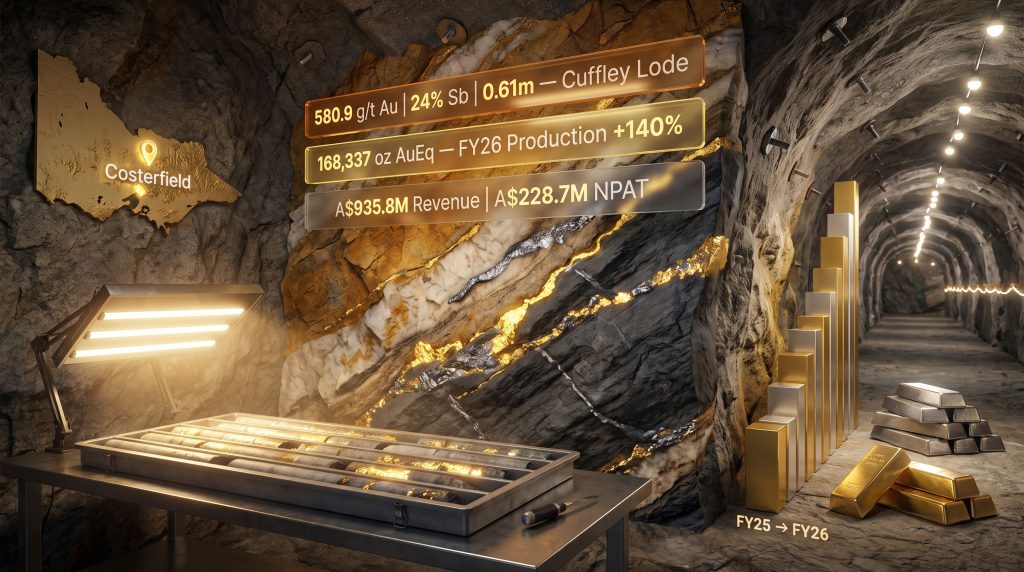
The results from the program warrant careful technical reading. The standout intercept from hole AD270 returned 580.9 g/t gold and 24% antimony over 0.61 metres, with a sub-interval of 1,360 g/t gold and 19.7% antimony over 0.25 metres. These figures represent exceptionally concentrated mineralisation within a narrow true-width vein, not bulk tonnage ore.
| Drill Hole | Gold Grade (g/t) | Antimony (%) | Interval (m) | Classification |
|---|---|---|---|---|
| AD270 | 580.9 | 24.0 | 0.61 | New Cuffley Pod |
| AD270 (sub-interval) | 1,360 | 19.7 | 0.25 | Peak Grade |
| AD275 | 124.0 | 48.6 | 0.23 | >10 g/t AuEq over mining width |
| Cuffley (additional) | 168.9 | 33.5 | 0.90 | High-grade intercept |
| Cuffley (additional) | 60.1 | 15.2 | 1.26 | Broad high-grade |
Across the full Cuffley program, four holes intersected mineralisation above 10 g/t gold equivalent over mining width, and a further four returned above 2 g/t gold equivalent over mining width. In the context of a narrow-vein system, a statistically clustered result set of this density across 23 holes is geologically meaningful. It suggests a spatially coherent pod rather than a series of disconnected high-grade flickers. Furthermore, interpreting drill results correctly is essential for investors seeking to evaluate whether intercepts like these represent genuine resource potential or isolated anomalies.
Technical Note: Investors interpreting narrow-vein drill results should focus on the grade-thickness product (g/t multiplied by true width in metres) rather than headline grades alone. A result of 1,360 g/t over 0.25 metres true width represents a grade-thickness product of 340 g/t-m, which by industry benchmarks for narrow-vein underground mining is extremely high. However, mineralisation continuity across strike and down-dip must be demonstrated before resource classification can proceed.
A geologically significant detail that elevates the practical value of the Cuffley pod is its spatial position. The pod occupies an unmined gap sitting between the historically worked Cuffley North and Cuffley South panels. This geometry implies that the structural controls that generated those earlier mining targets also generated the newly identified pod, strengthening the geological model for continuity between the three zones.
Critically, the Cuffley pod's accessibility from existing underground infrastructure means it does not require substantial new capital development before extraction. Its incorporation into the active Costerfield mine schedule distinguishes this discovery as a near-term production contributor rather than a longer-dated exploration asset.
Sub-KC: The Deeper Frontier Below Augusta Mine
While the Cuffley discovery commands immediate attention, the Sub-KC domain represents a different and potentially larger category of geological opportunity. Positioned below the Augusta mine workings, Sub-KC has been tested by a combined program of four target-testing holes and twelve growth and infill holes.
| Drill Hole | Gold Grade (g/t) | Antimony (%) | Interval (m) |
|---|---|---|---|
| CSK044 | 28.2 | – | 0.99 |
| CSK043 | 73.2 | 18.8 | 0.19 |
| CSK043 (sub-interval) | 192.0 | – | 0.17 |
| CSK048 | 16.1 | 12.7 | 0.37 |
The structural information gathered from north and south target-testing holes has provided new constraints on the geometry of the Sub-KC domain. A critical operational implication emerging from this data is that achieving optimal intersection angles in portions of Sub-KC may require either surface drilling or new underground development. This represents a capital planning consideration for future programs, but it also reinforces the exploration upside case: the domain has not yet been tested from the most geometrically favourable angles, meaning current results may understate the true grade and width characteristics of the mineralisation.
Multi-Zone Drilling Strategy: Reducing Single-Point Risk Across the Operation
One of the less widely appreciated aspects of Costerfield's exploration approach is the simultaneous prosecution of multiple discovery zones within the same campaign. This methodology distributes exploration risk across independent geological targets, meaning that a disappointing result in one zone does not invalidate the broader program.
| Zone | Notable Intercept | Antimony (%) | Key Characteristic |
|---|---|---|---|
| Kendal | 132.2 g/t Au over 1.94m | 19.8 | Expanding system adjacent to Youle |
| Kendal (additional) | 25.3 g/t Au over 1.71m | 42.8 | High antimony concentration |
| Brunswick South | 50.1 g/t Au over 2.17m | 26.2 | Continuous high-grade corridor |
| Brunswick South | 50.2 g/t Au over 0.86m | 33.3 | Consistent corridor extension |
| True Blue | 57.6 g/t Au over 0.25m | 25.4 | Extension and infill active |
| Cuffley Lode | 580.9 g/t Au over 0.61m | 24.0 | Newly identified high-grade pod |
| Sub-KC | 192.0 g/t Au over 0.17m | – | Deeper domain below Augusta mine |
The consistency of elevated antimony grades across every active zone reinforces the interpretation of a district-scale gold-antimony system rather than a series of independent deposits. When multiple structurally separate lodes within the same tenement corridor all carry meaningful antimony concentrations, this points to a shared fluid source and a pervasive hydrothermal system capable of generating further discoveries beyond the zones currently being drilled.
Why Antimony Changes the Economics of Every Costerfield Ore Tonne
Antimony is a commodity most investors encounter only as a footnote in mining reports, but its role in the Costerfield economic model is far more consequential than that framing suggests. Unlike a conventional gold operation where a single commodity drives all revenue, Costerfield generates independently priced income streams from gold and antimony simultaneously. This dual-revenue structure creates a natural economic hedge.
When antimony prices rise relative to gold, the effective gold equivalent grade of physically identical ore increases, improving mine-level margins without any change to the ore itself. The inverse also applies, but the uncorrelated price dynamics of gold and antimony mean the two commodities rarely fall simultaneously, providing partial insulation against single-commodity price weakness. In addition, the antimony price surge observed in recent years has amplified the revenue contribution of this co-product, further strengthening the Costerfield economic profile.
The strategic dimension of antimony supply has intensified markedly in recent years. China has historically dominated global refined antimony output, accounting for the substantial majority of world production. This concentration creates supply chain vulnerability for industrial consumers in Western markets, particularly across:
- Flame retardant manufacturing, where antimony trioxide is a critical additive
- Lead-acid battery grid alloys used in conventional automotive and industrial applications
- Military and defence sectors, where antimony is used in ammunition primers and other ordnance components
- Emerging antimony-based grid-scale energy storage technologies, which represent a growing demand vector
Australia, the United States, and European Union jurisdictions have each classified antimony as a critical mineral, a designation that reflects supply security concerns rather than conferring any specific project-level benefits. For domestic producers like the Alkane Resources Costerfield gold antimony operation, this classification context elevates the commodity's strategic visibility within the investment community and among industrial buyers seeking supply chain diversification. Furthermore, antimony shortage risks in 2025 have sharpened focus on Western producers capable of delivering reliable supply outside of Chinese-controlled channels.
Analytical Note: An intercept such as AD275, returning 48.6% antimony over 0.23 metres, carries economic significance that extends well beyond its physical width. At prevailing antimony prices, the metal value contained in a single high-antimony vein interval can rival or exceed that of many broader low-grade gold intercepts reported across the broader industry. The grade-value density of co-mineralised gold-antimony ore is one of the most underappreciated aspects of the Costerfield production profile.
The next major ASX story will hit our subscribers first
From Drill Intercept to Mine Schedule: The Technical Conversion Process
The pathway from a reported drill result to ore extraction in a narrow-vein underground mine involves multiple technical steps that are rarely explained in market-facing communications. Understanding this process helps investors contextualise the significance of different stages of discovery.
-
Core logging and sampling: Diamond drill core is geologically described, sampled at defined intervals (typically 0.1 to 0.5 metres in high-grade zones), and submitted for fire assay (gold) and multi-element analysis (antimony, arsenic, sulphur, and other pathfinder elements).
-
True width correction: Apparent downhole widths are geometrically corrected for the angle between the drill hole trajectory and the vein plane to derive true mineralised thickness. Understanding true versus apparent widths is critical because reporting apparent widths in steeply dipping narrow veins can dramatically overstate the mining width.
-
Grade-thickness assessment: Mine planners apply minimum grade-thickness thresholds to identify which intervals meet the economic cut-off for narrow-vein extraction. Below these thresholds, waste dilution in the stoping process erodes any economic benefit.
-
3D wireframe modelling: Individual intercepts are projected onto longitudinal sections and integrated into three-dimensional geological wireframes. These models define pod geometry, strike length, and down-plunge continuity.
-
JORC 2012 resource classification: Intercepts within defined search ellipses are assigned confidence classifications: Inferred (least continuity), Indicated, or Measured (highest). The search ellipse dimensions reflect demonstrated geological continuity and drilling density.
-
Stope design and scheduling: Resource-classified pods are engineered into individual stope designs, incorporating access development requirements, ventilation routing, and ore pass connectivity.
-
Infrastructure proximity assessment: The capital cost and time required to access a new pod from existing underground workings is the final determinant of how quickly a discovery transitions from the resource inventory into the mine schedule.
Alkane's Financial Transformation: The Scale of the FY26 Result
The Costerfield exploration news arrives in the context of a business that has undergone a structural transformation following the Alkane-Mandalay merger, completed in August 2025. The financial metrics for FY26 reflect a company operating at a fundamentally different scale to its pre-merger predecessor.
| Metric | FY25 | FY26 | Change |
|---|---|---|---|
| Gold Equivalent Production (oz) | 70,120 | 168,337 | +140% |
| Revenue (A$) | ~A$261M | A$935.8M | +257% |
| Net Profit After Tax (A$) | ~A$33M | A$228.7M | +592% |
| Basic EPS (cents) | ~5.46 | 17.69 | +224% |
| Avg. Realised Gold Price (A$/oz) | A$3,770 | A$5,664 | +50% |
| Cash, Bullion & Investments (A$) | – | A$454M | Record |
The merger added the Björkdal mine in Sweden and the Costerfield operation to the existing Tomingley Gold Operations asset base in New South Wales, creating a three-jurisdiction production platform. The geographic and geological diversification of this portfolio distributes operational risk across independent mining environments.
Costerfield's combined mineral resources stood at 450,000 oz contained gold and 39,900 tonnes contained antimony as of 31 December 2024, against FY24 production of 43,346 oz gold and 1,282 tonnes antimony. The resource-to-annual-production ratio implies meaningful remaining mine life, currently reported to 2031, with ongoing multi-zone drilling programs designed to extend that horizon through new resource additions.
The Storheden resource upgrade at Björkdal to 212,000 oz adds further depth to the group's combined inventory, supporting a production growth narrative that extends across all three operating jurisdictions.
Key Risks Investors Must Understand Before Interpreting Narrow-Vein Results
Transparency around the limitations of narrow-vein drill data is essential for informed analysis. Several technical caveats apply specifically to the Costerfield discovery results:
- Narrow true widths: The majority of Costerfield intercepts fall below one metre true width. Exceptional grades across sub-metre intervals confirm mineralisation intensity but do not translate directly into large-tonnage resource estimates.
- Pod discontinuity risk: High-grade pods within lode systems can be spatially limited along strike and down-plunge. A positive result from one hole does not guarantee continuity to adjacent drill positions.
- Intersection angle dependency: Where drill holes intersect a vein at sub-optimal angles, apparent widths overstate true mining widths. Readers should verify that reported intervals reflect true-width corrected data wherever possible.
- AuEq conversion assumptions: Gold equivalent grades incorporate assumed antimony prices that may differ from prevailing spot levels. Changes in the antimony-to-gold price ratio directly alter the reported equivalent grade without any change to the physical ore.
- JORC compliance context: All exploration results and resource estimates should be assessed alongside full JORC 2012 Table 1 disclosures, which provide the qualified person's assessment of data quality, sample methodology, and estimation parameters.
This article is intended for informational purposes only and does not constitute financial advice. Readers should conduct their own due diligence and consult a licensed financial adviser before making any investment decisions. Forward-looking statements, production targets, and resource estimates are subject to material risks and uncertainties.
Victorian Gold-Antimony Systems: What Costerfield's Ongoing Discovery Rate Suggests About District Scale
Perhaps the most strategically significant aspect of the Alkane Resources Costerfield gold antimony discovery story is not any single intercept result but rather the sustained discovery rate across multiple independent zones within the same tenement corridor. Each successive drilling program across Kendal, Brunswick South, True Blue, Cuffley, and Sub-KC has returned economically meaningful intercepts, suggesting that the level of geological understanding of this system is still maturing. The latest Costerfield exploration update confirms this momentum continues to build with each new campaign.
The economic logic of near-mine exploration in established underground operations is well supported by industry evidence. New discoveries within an existing underground footprint can be accessed using existing infrastructure, meaning the capital intensity of converting an Inferred resource to a producing stope is far lower than developing a comparable discovery at a greenfields site. This cost advantage compounds the value of each new pod identified within the Costerfield corridor.
Looking ahead, the exploration priorities emerging from current programs include:
- Converting Inferred resources across Kendal, Brunswick South, True Blue, and Cuffley to Indicated classification through systematic infill drilling
- Designing surface or new underground development drilling to achieve improved intersection angles within the Sub-KC domain
- Integrating revised structural data from the target-testing holes into updated three-dimensional geological models
- Continued systematic testing of the broader Costerfield tenement corridor for additional high-grade pod discoveries within the proven district-scale gold-antimony system
The combination of a demonstrated multi-zone discovery record, a dual-commodity revenue model, and an established production and processing infrastructure positions Costerfield as one of Australia's more technically interesting high-grade underground operations, with a geological story that, after more than 160 years, continues to add new chapters.
Want to Stay Ahead of the Next Major ASX Mineral Discovery?
Discovery Alert's proprietary Discovery IQ model scans ASX announcements in real time, instantly translating complex geological data — like the high-grade gold-antimony intercepts reshaping operations such as Costerfield — into actionable investment insights for both short-term traders and long-term investors. Explore historic discoveries and the substantial returns they have generated, then begin your 14-day free trial at Discovery Alert to position yourself ahead of the broader market.