
June 19, 2026
The Engineering Realities Behind Grid-Scale Battery Storage in a Renewable-Dominant World
The transition to renewable energy presents a paradox that grid engineers have grappled with for years. The more solar panels and wind turbines a country installs, the more it exposes the fundamental weakness of modern electricity grids: they were designed around predictable, controllable generation sources, not the variable output profiles of weather-dependent assets. At a certain penetration threshold, renewables stop being a simple addition to the grid and start becoming a structural challenge to it. India crossed that threshold some time ago, and the Adani Green Khavda battery storage project is one of the most significant infrastructure responses to that challenge anywhere in the world.
When big ASX news breaks, our subscribers know first
Why Intermittency Is India's Renewable Energy Bottleneck
India's renewable capacity expansion has been rapid by any international measure, yet capacity alone does not guarantee reliability. Solar generation follows a predictable bell curve across daylight hours, peaking around midday and dropping to zero after sunset. Wind generation is even less predictable, varying by season, geography, and weather patterns. The result is a structural mismatch between when electricity is produced and when it is needed most.
Grid operators managing India's high-voltage transmission network face a compounding set of challenges as renewable penetration rises:
- Frequency instability: As thermal baseload plants are displaced, the grid loses the rotational inertia that traditionally buffers sudden generation-demand imbalances.
- Evening demand ramps: Post-sunset demand spikes occur precisely when solar output collapses, creating a steep supply gap that dispatchable resources must fill instantly.
- Curtailment losses: When solar and wind generation exceeds transmission capacity or real-time demand, operators are forced to curtail output, wasting both energy and capital investment.
- Monsoon volatility: Seasonal cloud cover and variable wind speeds during India's monsoon period introduce generation unpredictability that is difficult to hedge without storage.
Without large-scale storage infrastructure capable of absorbing surplus generation and releasing it on demand, renewable-heavy grids remain fundamentally dependent on fossil fuel backup. Battery Energy Storage Systems are the primary mechanism by which this dependency can be reduced. Furthermore, the growing critical minerals demand associated with this storage buildout is reshaping global supply chains at pace.
What Battery Energy Storage Systems Actually Do
A Battery Energy Storage System captures electrical energy during periods of surplus or low-cost generation and releases it during high-demand windows, effectively transforming variable renewable output into a controllable, dispatchable power source. The operational value of a utility-scale BESS extends well beyond simple charge-and-discharge cycles.
The core grid services that large-scale storage assets provide include:
- Energy time-shifting: Charging during midday solar peaks and discharging during morning and evening demand ramps.
- Frequency regulation: Responding within milliseconds to grid frequency deviations, a function that previously required spinning reserves from thermal plants.
- Peak shaving: Reducing instantaneous demand on transmission infrastructure during high-stress periods.
- Voltage support: Injecting or absorbing reactive power to maintain voltage stability across transmission corridors.
- Curtailment recovery: Absorbing excess renewable output that would otherwise be wasted due to transmission constraints.
Lithium-ion chemistry currently dominates utility-scale deployments globally due to declining cost trajectories, high energy density, and proven performance over thousands of charge-discharge cycles. Global lithium-ion battery pack costs have fallen by approximately 90% over the past decade, according to BloombergNEF data, making utility-scale deployments economically viable in a way they were not five years ago. The broader battery raw materials market has evolved considerably in response to this demand surge.
The Adani Green Khavda Battery Storage Project: Scale, Speed, and Significance
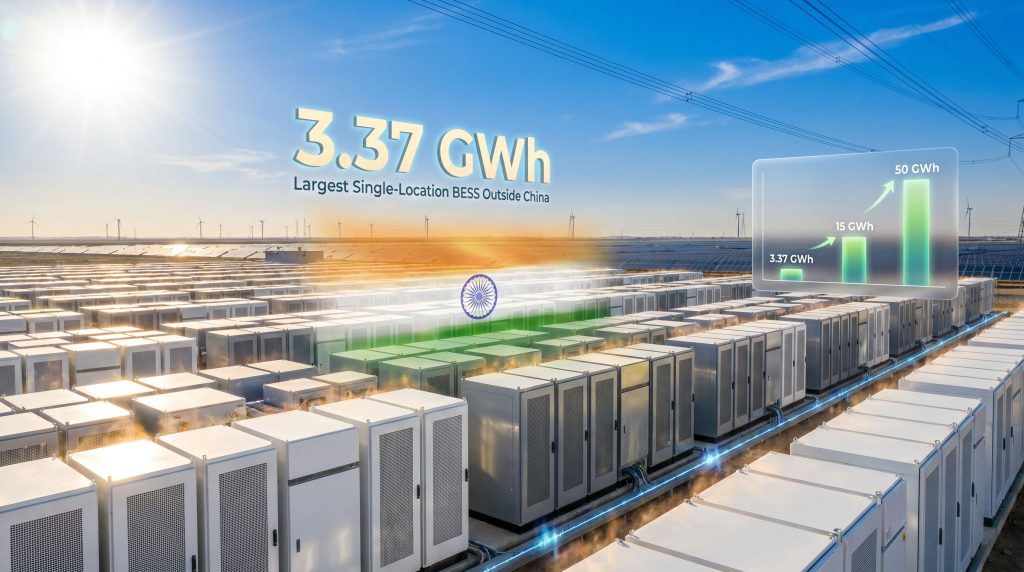
The Adani Green Khavda battery storage project represents the most consequential single-site battery storage commissioning outside China to date. Located in the Rann of Kutch region of Gujarat, the facility reached a total operational capacity of 3.37 GWh as of May 2026, with the most recent tranche of 1.37 GWh completed in March 2026. Adani's strategic entry into battery storage has been widely noted across the global energy sector as a landmark development.
Key Operational Metrics at a Glance
| Metric | Detail |
|---|---|
| Total commissioned BESS capacity | 3.37 GWh |
| March 2026 tranche | 1.37 GWh |
| Construction-to-commissioning timeline | ~10 months |
| Household energy equivalence | ~1 million homes for one full day |
| City-scale equivalence | Full peak demand of Indore, Chandigarh, or the state of Goa |
| Global positioning | Largest single-location BESS outside China |
| Co-located generation capacity (operational) | ~9.9 GW |
| Long-term park generation target | 30 GW by 2029 |
The 10-month construction-to-commissioning timeline is particularly notable. Most comparable utility-scale battery storage projects globally have required 18 to 36 months from financial close to commercial operation. Achieving 3.37 GWh of operational capacity within approximately 10 months of breaking ground establishes a new execution benchmark for the sector.
Understanding What 3.37 GWh Actually Means
Energy capacity figures in the gigawatt-hour range are often cited without adequate translation into meaningful real-world terms. Breaking down the numbers provides important context:
- At an average Indian household consumption of roughly 3 to 4 kWh per day, 3.37 GWh can supply between 840,000 and 1.12 million homes for a full 24-hour period.
- At a city scale, this stored energy volume is sufficient to meet the full daily peak electricity demand of mid-tier Indian cities.
- The distinction between energy capacity (GWh, measuring total stored volume) and power capacity (MW, measuring discharge rate) is critical for understanding operational design. The initial phase configuration, reportedly at approximately 1,126 MW of power capacity, suggests a discharge duration of roughly 3 to 3.5 hours, optimised for peak-hour shifting rather than overnight long-duration storage.
Technical Note: A 3 to 3.5 hour discharge window aligns with India's steepest evening demand ramp periods, where storage can replace the most expensive and emissions-intensive peaking generation. This duration optimisation is a deliberate engineering choice, not a limitation, reflecting where storage delivers maximum grid value in the Indian context.
The Technology Architecture Underpinning Khavda's BESS
The Adani Green Khavda battery storage project integrates advanced lithium-ion battery modules with sophisticated Energy Management Systems that govern how, when, and at what rate the system charges and discharges. In Gujarat's extreme climate, where summer temperatures regularly exceed 45 degrees Celsius, thermal management is not a secondary engineering concern but a primary determinant of battery longevity and safety.
Key technical components of the Khavda BESS architecture include:
- Battery module arrays: Thousands of individual lithium-ion cells grouped into modules, racks, and containerised units, each monitored for state of charge, temperature, and health.
- Power Conversion Systems (PCS): Inverters and transformers that translate the DC output of battery arrays into AC power compatible with the high-voltage grid.
- Energy Management Systems (EMS): Software-driven control platforms that receive real-time grid frequency and pricing signals and execute automated charge-discharge decisions within milliseconds.
- Thermal management infrastructure: Active cooling systems designed to maintain optimal cell operating temperatures in Gujarat's harsh climate, which materially differs from the temperate conditions where many global BESS benchmarks were established.
- Bidirectional grid interconnection: The system must absorb renewable generation flowing in one direction and inject power back into the grid in the other, requiring sophisticated protection and switching infrastructure.
An underappreciated aspect of deploying utility-scale BESS in extreme heat environments is its effect on cycle life. Elevated operating temperatures accelerate battery degradation, meaning that projects in Gujarat face a more demanding engineering brief than equivalent projects in California, South Australia, or northern Europe.
Co-Location Strategy: Why Khavda's Integrated Model Is Operationally Superior
The Adani Green Khavda battery storage project does not exist as a standalone storage facility. It is physically embedded within a renewable energy park targeting 30 GW of total generation capacity, of which approximately 9.9 GW is already operational. This co-location creates operational advantages that standalone storage projects cannot replicate. The broader battery storage expansion driving investments like this is reshaping how grids are designed globally.
Why Physical Integration With Generation Assets Matters
- Transmission congestion avoidance: Energy stored on-site avoids adding load to long-distance transmission corridors during peak solar generation windows, when those corridors are often already operating near capacity.
- Curtailment elimination: Rather than clipping solar output due to transmission constraints, the co-located BESS absorbs surplus generation directly, improving overall system efficiency and the economics of the solar assets themselves.
- Round-the-clock contract fulfilment: The combination of large-scale solar, wind, and co-located storage at a single site creates the technical foundation for round-the-clock renewable power purchase agreements, a premium contract structure that commands higher offtake prices.
- Response latency reduction: Co-located storage can respond to local grid events without the delay inherent in dispatching energy from a remotely located asset.
Market Context: Round-the-clock renewable power contracts are increasingly being sought by large industrial and commercial consumers in India who require 24/7 clean energy supply to meet scope emissions targets. Storage-backed developers who can fulfil these contracts using purely renewable sources gain a structural competitive advantage over those relying on thermal backup blending.
The next major ASX story will hit our subscribers first
Phased Expansion Roadmap: From 3.37 GWh to 50 GWh
The commissioning of 3.37 GWh is explicitly framed as a first phase within a substantially larger expansion trajectory. According to Adani Green's targets for 10 GWh battery storage by FY2027, the roadmap involves significant scaling of battery storage capacity over the next several years.
| Phase | Capacity Target | Timeframe | Indicative Investment |
|---|---|---|---|
| Phase 1 (Commissioned) | 3.37 GWh | By May 2026 | Not disclosed |
| Near-term expansion | More than 10 GWh additional | FY2027 | ~Rs 15,000 crore |
| Medium-term target | 15 GWh | By March 2027 | Not separately disclosed |
| Long-term vision | 50 GWh | Within 5 years (~2030-31) | ~Rs 40,000 crore (broader Khavda capex) |
The progression from 3.37 GWh to 50 GWh represents approximately a 15-fold capacity multiplication within five years. At 50 GWh, the Khavda storage complex alone would exceed the total utility-scale battery storage capacity of most developed nations outside the United States and China.
Capital Expenditure Considerations
Battery storage capital costs have declined dramatically over the past decade, but projects at this magnitude still represent some of the largest single-site energy infrastructure investments in Asia. A rough cost breakdown for utility-scale BESS projects at this scale typically reflects:
- Battery modules: 50 to 60% of total project cost
- Power conversion systems: 15 to 20%
- Civil and structural works: 10 to 15%
- Energy management systems and grid interconnection: 5 to 10%
India's Production Linked Incentive scheme targeting 50 GWh of domestic Advanced Chemistry Cell battery manufacturing capacity has the potential to progressively reduce per-unit storage costs for future phases. Innovations in direct lithium extraction technology could, furthermore, reduce upstream input costs and improve supply security for large-scale deployments of this nature.
Global Benchmarking: How Khavda Compares Internationally
| Project | Location | Capacity | Status |
|---|---|---|---|
| Khavda BESS (Adani Green) | Gujarat, India | 3.37 GWh operational; 50 GWh target | Phase 1 operational |
| Moss Landing (Vistra Energy) | California, USA | ~3.0 GWh | Operational prior to 2025 fire incident |
| Waratah Super Battery (AGL) | New South Wales, Australia | 850 MWh | Operational |
| Hornsdale Power Reserve (Neoen/Tesla) | South Australia | ~194 MWh (expanded) | Operational |
| Various state-backed deployments | Multiple Chinese provinces | Multi-GWh each | Operational |
China leads globally in aggregate utility-scale battery storage deployment, with multiple GWh-scale projects across its provincial grid networks. Outside China, the Khavda facility's 3.37 GWh positions it at the top of the global single-site BESS leaderboard. This distinction carries commercial significance, establishing India as the leading non-Chinese market for grid-scale storage execution capability.
Grid Reliability Applications: What Problems Khavda Directly Solves
The grid reliability value of the Adani Green Khavda battery storage project operates across several simultaneous dimensions that are worth examining individually.
Morning and evening demand ramps are among the most stressful events that any grid operator manages. India's grid experiences steep demand increases in early morning hours before solar generation fully activates, and again in the post-sunset period. A co-located BESS charged during the midday solar peak can discharge precisely during these critical windows, reducing reliance on fast-start gas turbines or coal-fired plants operating at inefficient part-load.
Seasonal generation variability during India's monsoon period creates conditions where cloud cover can reduce solar output significantly for days at a stretch. While storage cannot fully compensate for multi-day generation shortfalls, it can smooth intra-day variability and reduce the frequency of emergency grid interventions.
Frequency regulation represents a less visible but operationally critical function. As India's grid operates with a decreasing share of synchronous thermal generation, the inertia that previously stabilised frequency following sudden load changes is diminishing. Modern battery inverters can respond to frequency deviations within tens of milliseconds, far faster than any thermal plant, providing synthetic inertia that partially compensates for the loss of physical inertia.
India's National Storage Policy Context
India's National Electricity Plan has increasingly emphasised the importance of gigawatt-scale storage deployment as a prerequisite for achieving the country's 500 GW renewable capacity target by 2030. The Ministry of Power has introduced frameworks for storage procurement and ancillary services markets, though the regulatory architecture for grid-scale BESS remains in active development.
What the Khavda project demonstrates at a technical and commercial level is that large-scale storage deployment in Indian conditions is feasible within standard project timelines. This proof-of-execution is likely to inform regulatory development, tariff structures for storage services, and procurement frameworks for future state and central government storage tenders. The growing Indian lithium market adds a further dimension to this, as domestic demand anchors increasingly attract upstream investment.
The domestic manufacturing dimension adds another layer of strategic importance. India's ACC PLI scheme targets 50 GWh of domestic cell production capacity, a figure that is not coincidentally similar to the long-term Khavda storage target. Large-scale domestic demand for battery cells provides the volume justification for capital-intensive manufacturing investments, potentially setting up a virtuous cycle where deployment drives manufacturing scale, which in turn reduces deployment costs for subsequent projects.
FAQ: Adani Green Khavda Battery Storage Project
What is the total commissioned capacity of the Khavda BESS?
As of May 2026, the facility has reached a total operational capacity of 3.37 GWh, following the commissioning of a 1.37 GWh tranche in March 2026.
How does 3.37 GWh translate into practical energy terms?
The facility can store sufficient electricity to supply approximately one million Indian households with power for a full day, or meet the peak electricity demand of cities comparable in size to Indore or Chandigarh, or the entire state of Goa.
What battery technology is deployed at Khavda?
The project uses lithium-ion battery technology integrated with advanced Energy Management Systems that enable automated grid dispatch, real-time cell-level monitoring, and thermal management suited to Gujarat's extreme climate.
How quickly was the Khavda BESS constructed?
The facility reached commercial operation within approximately 10 months of on-site construction commencement, placing it among the fastest executed utility-scale battery storage projects globally at this capacity scale.
What are the long-term expansion targets?
The roadmap includes adding more than 10 GWh of additional capacity in FY2027, reaching 15 GWh by March 2027, and scaling total battery storage capacity to 50 GWh within five years.
What is the broader Khavda Renewable Energy Park?
The Khavda park is being developed toward a total renewable generation capacity of 30 GW by 2029, with approximately 9.9 GW already operational as of mid-2026. The BESS infrastructure is co-located with these solar and wind generation assets.
Why does battery storage matter for renewable-heavy grids?
Storage allows solar and wind generation, which cannot be controlled to match demand patterns, to behave like dispatchable power sources. By charging during surplus generation periods and discharging during peak demand windows, BESS assets make renewable power reliable and predictable, consequently reducing the grid's dependence on fossil fuel backup.
Structural Implications: Khavda as a Replicable Infrastructure Model
The broader significance of the Adani Green Khavda battery storage project extends beyond its own operational metrics. What it demonstrates is a replicable infrastructure model: co-located renewable generation and storage, executed at speed, in extreme climate conditions, within an emerging market supply chain environment.
If the 10-month execution timeline can be replicated across other high-renewable zones in India, such as Rajasthan, Tamil Nadu, and Andhra Pradesh, the pace at which India can build dispatchable renewable capacity would accelerate substantially. The transmission bottlenecks that currently prevent renewable-rich western and southern states from efficiently supplying load centres in the north and east could, furthermore, be partially addressed by co-locating storage at the generation source rather than building additional long-distance transmission capacity.
Forward-Looking Consideration: The transition from 3.37 GWh to 50 GWh will not be determined by capital availability alone. Supply chain localisation, grid interconnection standards for large storage assets, and the development of long-duration storage technology beyond the current 3 to 4 hour discharge window will all be critical determinants of whether Khavda becomes a global infrastructure template or remains a singular achievement. How India's regulatory and manufacturing ecosystem evolves over the next five years will answer that question.
Readers seeking additional context on India's grid-scale battery storage sector and renewable energy infrastructure development can explore related reporting at energy.economictimes.indiatimes.com.
This article contains forward-looking statements and projections based on publicly available information and announced plans. Actual outcomes may differ materially from those described. Nothing in this article constitutes financial or investment advice.
Want to Identify ASX Opportunities in the Battery Storage and Critical Minerals Boom?
As India's grid-scale storage buildout drives unprecedented critical minerals demand across lithium, nickel, and associated battery materials, Discovery Alert's proprietary Discovery IQ model delivers real-time alerts the moment significant ASX mineral discoveries are announced, transforming complex geological data into actionable investment insights — start your 14-day free trial at Discovery Alert and position yourself ahead of the broader market.