June 19, 2026
The Capital Architecture Behind Large-Scale Lithium Development
Few industries demand capital commitment at the scale of tier-one lithium brine development. Unlike hard-rock mining, where phased underground expansion can be calibrated against cash flow, large-scale salar operations require substantial upfront infrastructure before a single tonne of lithium carbonate equivalent reaches the market. Processing facilities, evaporation pond networks, water management systems, and remote camp infrastructure all carry costs that compound quickly when multiplied across multi-phase production targets measured in the tens of thousands of tonnes annually.
This structural reality is precisely why the search for a Ganfeng Lithium Argentina third investor for the Pozuelos-Pastos Grandes lithium project carries significance well beyond a routine capital-raising exercise. It reflects an industry-wide shift toward syndicated equity structures for projects whose capital requirements exceed what even well-capitalised majors choose to absorb on a bilateral basis.
When big ASX news breaks, our subscribers know first
What the Pozuelos-Pastos Grandes Project Actually Represents
Situated in Salta Province in northern Argentina, the Pozuelos-Pastos Grandes (PPG) project is one of the most ambitious lithium brine development programmes currently active in South America. Its scale is notable even within an industry accustomed to large numbers.
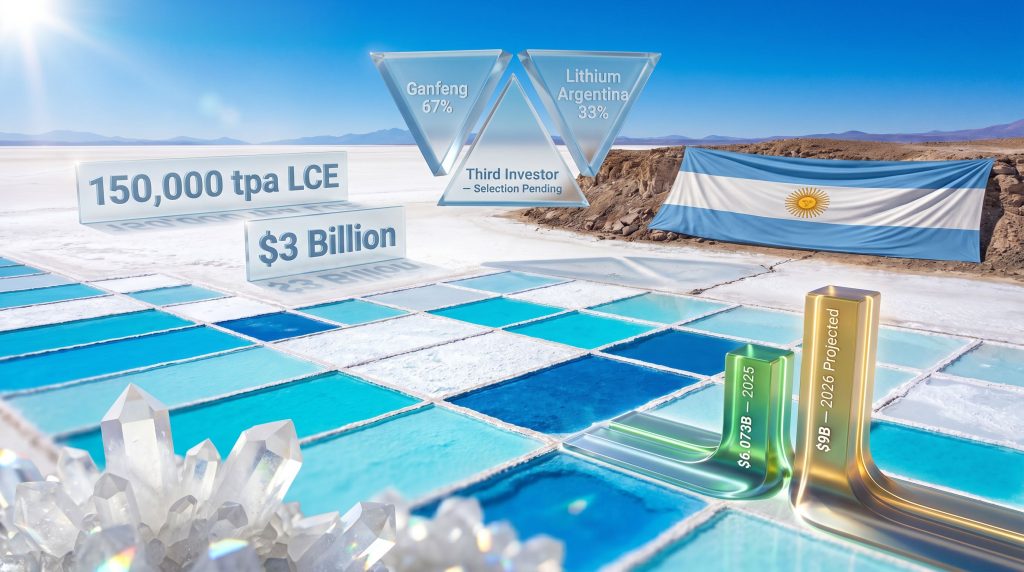
The venture brings together two previously separate asset clusters into a single unified development vehicle. Ganfeng Lithium, holding a 67% majority stake, contributed its wholly owned Pozuelos-Pastos Grandes asset, which the Chinese lithium major acquired in 2022 and subsequently invested in through infrastructure buildout including a construction camp. Lithium Argentina, holding the remaining 33%, contributed its Pastos Grandes and Sal de la Puna projects, consolidating adjacent brine concessions under one operational structure.
The combined result is a project with a production ambition that places it among the largest lithium development commitments globally.
| Metric | Detail |
|---|---|
| Project Name | Pozuelos-Pastos Grandes (PPG) |
| Location | Salta Province, northern Argentina |
| Target Production Capacity | Up to 150,000 tpa LCE |
| Total Projected Investment | Over $3 billion (three phases) |
| Joint Venture Structure | Ganfeng 67% / Lithium Argentina 33% |
| Debt Facility (Ganfeng to Lithium Argentina) | $130 million over six years |
The PPG project is not simply a lithium mine. It is an integrated brine development system targeting sequential capacity expansion across three distinct phases, each requiring its own capital mobilisation, permitting, and operational ramp-up. The $3 billion total investment figure reflects this complexity.
Understanding Brine-Based Lithium Production
For investors or observers less familiar with the technical mechanics of salar-based lithium extraction, it is worth understanding how these projects differ fundamentally from hard-rock spodumene mining. Furthermore, the methods underpinning lithium brine extraction are distinct in both their timelines and infrastructure demands.
Lithium brines are subsurface saline solutions trapped beneath salt flats. Extraction involves pumping brine to the surface and concentrating it through solar evaporation ponds, a process that can take anywhere from 12 to 24 months depending on evaporation rates, climate, and brine chemistry. The resulting concentrated lithium solution is then processed into either lithium carbonate or lithium hydroxide.
Key geological variables that determine a brine project's quality and economics include:
- Lithium concentration in the brine (measured in milligrams per litre)
- The ratio of magnesium to lithium, which affects processing costs and complexity
- Potassium and sulphate concentrations, which influence evaporation efficiency
- Aquifer depth and porosity, which determine pumping requirements and brine recovery rates
Argentine Lithium Triangle salars are generally characterised by lower magnesium-to-lithium ratios than Chilean brines, which translates to lower processing costs and improved lithium recovery. This geological advantage is one of the reasons the Argentina lithium brine market has attracted sustained interest from Chinese, Korean, and Western capital alike.
Why a Third Investor Makes Strategic Sense at This Scale
The decision to seek a third equity partner in the PPG joint venture is not a signal of financial distress. It is, however, a deliberate capital structure optimisation, and understanding the distinction matters for investors watching this sector.
When a project carries a $3 billion-plus capital requirement spread across three sequential development phases, even a majority shareholder like Ganfeng Lithium faces meaningful balance sheet considerations. Ganfeng operates a global lithium portfolio that includes processing facilities, battery materials operations, and other upstream mining projects. Concentrating an outsized proportion of development capital into a single project, regardless of its quality, constrains optionality elsewhere in the portfolio.
Bringing in a third equity partner achieves several objectives simultaneously:
- It reduces each existing partner's proportional capital exposure without diluting the project's development timeline.
- It introduces a new source of capital that may carry downstream strategic value, such as offtake commitments or supply chain integration.
- It creates a broader ownership consortium that can potentially access diversified financing channels, including project finance debt facilities linked to specific development phases.
- It establishes a more resilient governance structure for a multi-decade asset with exposure to commodity price cycles.
The $130 million debt facility that Ganfeng has extended to Lithium Argentina over six years adds another layer to the capital architecture. This facility effectively backstops Lithium Argentina's near-term funding obligations within the JV, while the third-investor search addresses the longer-term equity gap associated with Phases 2 and 3 of production expansion.
Argentina's RIGI Regime and Its Role in De-Risking Investment
One of the most consequential developments for the PPG project's investment thesis in 2026 has been Argentina's Large Investment Incentive Regime, known by its Spanish acronym RIGI. Ganfeng applied to register the PPG project under RIGI in March 2026, and the outcome of that application will materially influence the terms on which a third investor can engage.
The RIGI framework provides qualifying projects with a package of fiscal protections that specifically target the concerns most frequently cited by large-scale foreign investors in emerging-market resource projects:
- Long-term tax stability agreements that lock in rates for the duration of the project
- Exemptions or reductions on export duties for qualifying production volumes
- Regulatory certainty provisions that protect against retroactive policy changes
- Applicability threshold of investments exceeding $200 million USD, ensuring only genuinely large-scale projects qualify
The adjacent Cauchari-Olaroz project, co-owned by Ganfeng, Lithium Argentina, and provincial entity JEMSE, received RIGI approval in May 2026 for a $1.2 billion expansion. This precedent is important because it demonstrates that the Argentine regulatory framework has moved from policy announcement to active project approval, at least for Jujuy-based operations. PPG's application, covering a Salta Province project of significantly larger ambition, remains under review.
| Feature | Pozuelos-Pastos Grandes | Cauchari-Olaroz |
|---|---|---|
| Province | Salta | Jujuy |
| RIGI Status | Application submitted (March 2026) | Approved (May 2026) |
| Projected Investment | $3B+ across three phases | $1.2B expansion |
| JV Partners | Ganfeng + Lithium Argentina | Ganfeng + Lithium Argentina + JEMSE |
| Production Target | Up to 150,000 tpa LCE | Existing + expanded capacity |
For a prospective third investor, RIGI approval transforms the PPG project's risk profile by replacing open-ended regulatory uncertainty with a defined, contractualised set of fiscal parameters. The difference between investing before and after RIGI approval can be material in terms of internal rate of return modelling and board-level approval thresholds.
Who Might the Third Investor Be?
As of June 2026, no specific candidate has been publicly identified. Lithium Argentina's leadership has confirmed that a selection is expected within the coming months, but the criteria for evaluation remain undisclosed beyond what can be inferred from the project's strategic context.
Speculation within industry circles centres on several broad candidate profiles:
Asian battery manufacturers or cathode producers seeking to secure upstream lithium supply ahead of anticipated demand growth in the second half of this decade. South Korean conglomerates, Japanese trading houses, and Chinese battery cell manufacturers all have demonstrated precedent for direct equity participation in South American lithium projects.
Western resource majors or mid-tier miners looking to establish a foothold in the Lithium Triangle without the complexity of greenfield project development. A stake in a Ganfeng-anchored JV with existing infrastructure and an established regulatory pathway offers a faster route to production exposure than building from scratch.
Sovereign wealth funds or infrastructure-oriented capital from the Middle East or Asia Pacific, which have shown increasing appetite for long-duration resource assets that generate stable cash flows across commodity cycles.
The geopolitical dimension of the third-investor identity should not be underestimated. If the incoming partner represents Western capital, it would introduce a different offtake routing dynamic into a project currently dominated by a Chinese majority shareholder. If it represents additional Asian capital, it consequently reinforces the trajectory of Chinese-led lithium supply chain consolidation in South America.
Argentina's Position in the Global Lithium Supply Chain
The PPG project does not exist in isolation. It sits within a broader Argentine mining sector undergoing a significant structural expansion that extends well beyond lithium. Indeed, shifts in the global lithium market continue to shape how projects of this scale attract and retain capital.
Argentina is currently the world's fourth-largest lithium exporter, operating six producing lithium projects with a growing pipeline of development-stage assets awaiting capital mobilisation. The country's position within the Lithium Triangle, sharing geological endowment with Chile and Bolivia, provides it with a resource base that is increasingly critical to global battery supply chains.
What makes Argentina's competitive position distinct from Chile's is a combination of factors that are not always well understood by generalist investors:
- Argentina operates a multi-province federal system, meaning lithium royalty regimes and permitting frameworks vary between Salta, Jujuy, and Catamarca, the three primary lithium-producing provinces. This creates project-level regulatory variability that sophisticated investors must navigate on an asset-by-asset basis.
- Argentina's brine chemistry profiles are generally more amenable to conventional evaporation pond processing than some Chilean salars, which carry higher impurity loads requiring additional processing steps.
- Unlike Bolivia, which has historically pursued state-led lithium development with limited foreign equity participation, Argentina actively courts foreign direct investment, and the RIGI framework represents the most formalised expression of that orientation to date.
The macroeconomic stakes are considerable. Total Argentine mining exports reached $6.07 billion in 2025, with projections from the Argentine Chamber of Mining Companies (CAEM) pointing to $9 billion in 2026, an increase driven largely by lithium production ramp-ups and gold and silver export growth. Copper projects under development are expected to contribute meaningfully to this trajectory from approximately 2030 onward.
The next major ASX story will hit our subscribers first
Syndicated Capital Structures as the New Normal in Lithium Project Finance
The PPG third-investor search is best understood not as an isolated transaction but as a manifestation of a structural shift in how large-scale lithium projects are financed globally. Furthermore, the recent lithium market downturn has, in many respects, accelerated the move toward shared risk structures among project partners.
Through the 2010s, lithium project development was largely the domain of junior and mid-tier miners backed by institutional equity. The entry of Chinese strategic capital through the 2018 to 2022 period consolidated many of the best assets under majority Chinese ownership. The current phase, roughly 2024 onwards, is characterised by a different model: multi-party consortium structures in which Chinese majors, Western capital, and sovereign entities co-own assets that would be too capital-intensive for any single party to develop optimally.
This model distributes execution risk across a broader ownership base while preserving the operational control that majority shareholders like Ganfeng require to integrate project output into their downstream processing and battery materials businesses. In addition, innovations such as direct lithium extraction are beginning to reshape how investors evaluate long-term production efficiency across consortium-owned brine projects.
For investors evaluating the risk-return profile of a potential third equity stake in PPG, the key considerations stack as follows:
- Upside exposure to a 150,000 tpa LCE-capable asset in one of the world's most lithium-endowed geological settings
- Structural protection through Ganfeng's 67% majority stake, existing debt facility, and prior infrastructure investment
- Regulatory de-risking contingent on RIGI approval, which could follow the Cauchari-Olaroz precedent
- Execution risk across a multi-phase, multi-decade development timeline subject to lithium price cycle volatility, water management complexity, and operational ramp-up challenges
- Geopolitical considerations specific to Argentina's macroeconomic stability and the track record of successive Argentine governments in honouring large-scale foreign investment frameworks
Frequently Asked Questions
Is Ganfeng Lithium a New Investor in the PPG Project?
No. Ganfeng Lithium is the majority owner and project originator, having acquired the Pozuelos-Pastos Grandes asset in 2022 and subsequently invested in on-site infrastructure. The current JV structure with Lithium Argentina consolidates adjacent brine concessions rather than introducing new external capital at the majority level.
What Is the Total Capital Requirement for the PPG Project?
Total projected investment across three sequential development phases exceeds $3 billion, targeting a peak production capacity of up to 150,000 tonnes per annum of lithium carbonate equivalent. The Ganfeng Lithium Argentina third investor for the Pozuelos-Pastos Grandes lithium project is expected to help bridge the equity requirements across these later phases.
What Is the RIGI and Why Does It Matter Here?
The RIGI is Argentina's Large Investment Incentive Regime, designed to attract large-scale foreign capital by providing fiscal stability, tax concessions, and regulatory certainty for qualifying investments above $200 million. Ganfeng applied to register the PPG project under RIGI in March 2026. Approval would significantly strengthen the investment case for any incoming third equity partner.
When Will a Third Investor Be Announced?
Lithium Argentina's leadership has stated publicly that a selection decision is expected within the coming months as of June 2026. No specific candidate or timeline has been formally disclosed.
How Does PPG Compare to Cauchari-Olaroz?
Both projects are co-owned by Ganfeng and Lithium Argentina and located in Argentina's northern Lithium Triangle. Cauchari-Olaroz, which additionally includes provincial entity JEMSE as a partner and operates in Jujuy Province, received RIGI approval in May 2026 for a $1.2 billion expansion. PPG is larger in projected production scale and total capital commitment, with its RIGI application still under review. The Ganfeng Lithium Argentina third investor for the Pozuelos-Pastos Grandes lithium project, once identified, will therefore be entering a development programme of considerably greater scope than the Cauchari-Olaroz precedent suggests.
This article contains forward-looking statements and projections sourced from publicly available reporting and industry data. Capital cost estimates, production targets, and regulatory timelines are subject to change. Nothing in this article constitutes financial or investment advice. Readers should conduct independent due diligence before making any investment decisions related to companies or projects discussed herein.
Want to Stay Ahead of the Next Major Mineral Discovery on the ASX?
Discovery Alert's proprietary Discovery IQ model scans ASX announcements in real time, transforming complex mineral data into actionable investment insights across lithium and over 30 other commodities — explore historic discoveries and their returns to understand what early positioning can mean, then begin your 14-day free trial at Discovery Alert to secure your market-leading edge.