June 19, 2026
The Ancient Mountains Hiding America's Lithium Future
Beneath the rolling ridgelines of the southern Appalachians lies a geological story that began more than 250 million years ago, when three continents collided to form the supercontinent Pangea. That cataclysmic convergence generated heat and pressure so extreme that deep crustal rocks melted, and within those magmas, lithium concentrated into formations that geologists now recognise as some of the most significant hard-rock lithium deposits in the Western Hemisphere. The irony is considerable: the United States, which once led global lithium production, allowed these formations to sit idle for decades while its import dependency quietly deepened. A landmark assessment by the U.S. Geological Survey now reframes the strategic calculus entirely, finding that lithium in the Carolinas could replace imports for a century or more based on current consumption volumes.
When big ASX news breaks, our subscribers know first
America's Two-Layer Lithium Problem
The scale of U.S. lithium vulnerability is frequently underestimated because most public discussion focuses only on raw material sourcing. The reality is structurally more complex. The United States currently imports more than half of its annual lithium consumption in raw form, and it operates just one active domestic lithium producer, a fragility the USGS formally acknowledged by listing lithium on its 2025 Critical Minerals List. But the second layer is less visible: substantial volumes of lithium enter the country embedded within finished lithium-ion batteries inside consumer electronics, electric vehicles, and industrial equipment.
This means domestic raw material production, while necessary, is insufficient on its own to close the vulnerability gap without parallel investment in refining and battery manufacturing capacity.
China sits at the centre of this two-layer problem. While Australia holds the title of the world's largest raw lithium producer, China is the dominant force in refining and accounts for the majority of global lithium processing capacity. Any disruption to Chinese refining output cascades through supply chains in ways that raw Australian production cannot compensate for independently. The United States is therefore exposed not at one chokepoint but at two: upstream raw material supply and downstream processing capability.
Global lithium production has expanded more than 40-fold over the past 30 years, driven by the electrification of transport and the proliferation of battery-dependent devices. The USGS projects that world production capacity will double again by 2029, and lithium supply security has increasingly become a declared strategic priority for major technology companies and governments simultaneously. Demand is no longer cyclical or discretionary. It is structurally irreversible.
What the USGS Found Beneath the Southern Appalachians
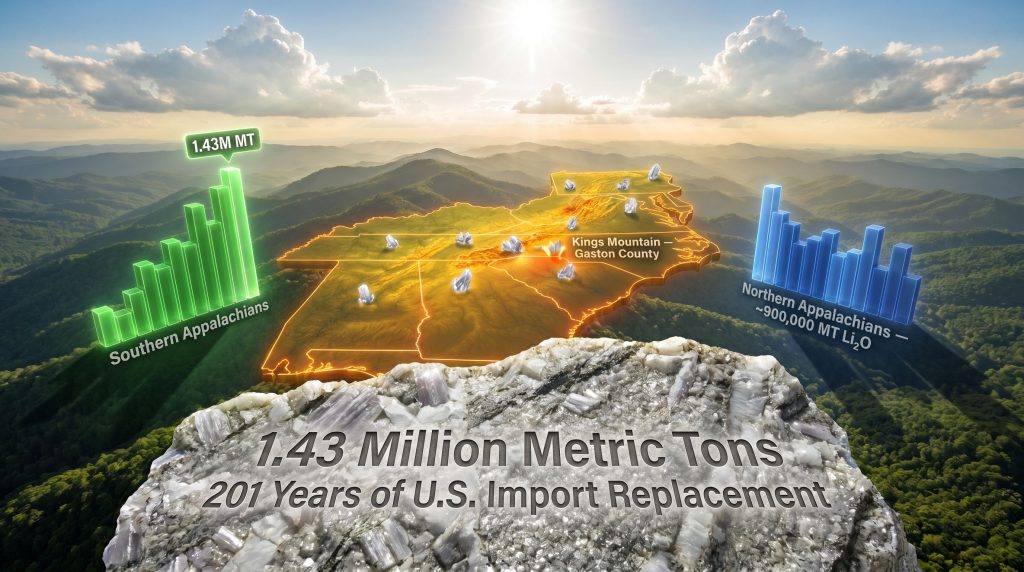
The USGS assessment, published in the peer-reviewed journal Natural Resources Research, estimates 1.43 million metric tons of undiscovered, economically recoverable lithium oxide within the southern Appalachian region. The study area spans seven southeastern states: Maryland, Virginia, North Carolina, South Carolina, Tennessee, Georgia, and Alabama, covering the geographic band between latitudes 31°N and 40°N and longitudes 75°W and 89°W.
This southern assessment is the companion piece to an earlier USGS study of the northern Appalachians, which estimated approximately 900,000 metric tons of lithium oxide. Combined, the two assessments place the total Appalachian resource at roughly 2.3 million metric tons of undiscovered, economically recoverable lithium oxide, a figure that positions the eastern United States as one of the most consequential hard-rock lithium provinces on the planet. For broader context, countries holding the largest lithium reserves globally are now facing competition from this emerging domestic U.S. source.
Understanding the Probability Range
The 1.43 million metric ton headline figure represents the 50% confidence level, meaning there is an equal probability the actual resource is higher or lower. The full probability distribution is considerably wider:
| Confidence Level | Estimated Lithium Oxide (Southern Appalachians) |
|---|---|
| 90% probability (minimum floor) | At least 60,000 metric tons |
| 50% probability (median estimate) | 1.43 million metric tons (economically recoverable) |
| Median in-place resource (pre-screening) | ~2.2 million metric tons |
| 10% probability (upside scenario) | Up to 6.9 million metric tons |
The methodology behind the 1.43 million metric ton figure involved screening the median in-place estimate of 2.2 million metric tons for economic recoverability using global lithium mining benchmarks and prevailing lithium prices. The upside case of 6.9 million metric tons at the 10% probability threshold is not a working estimate but a probabilistic boundary, illustrating the genuine geological uncertainty that remains before systematic drilling and feasibility work is completed.
The USGS assessment approach relied on Monte Carlo-style probabilistic simulations applied against a global dataset of lithium pegmatite deposits, not just local sampling. This methodology produces statistically defensible range estimates rather than point estimates, which is why investors and policymakers should engage with the full confidence interval rather than anchoring solely on the median.
The Carolinas as the Epicentre: Why This Region Specifically
While the assessment covers seven states, lithium concentrations are highest in North Carolina and South Carolina, making the Carolinas the geographic core of the southern Appalachian lithium story. Two geological features define this concentration.
The Carolina Tin-Spodumene Belt, running through the Kings Mountain and Gaston County corridor near Charlotte, is one of North America's most historically significant lithium corridors. Spodumene extraction methods within these pegmatites have evolved considerably since the belt's operational era, and the commercial grades and thicknesses found here remain highly relevant for modern battery-grade lithium production. The belt earned its name partly from its tin co-occurrence, though lithium has always been the primary economic driver in the modern context.
The Kings Mountain pegmatite belt carries additional historical weight: it was the site of the first large-scale lithium pegmatite mining operations in the United States. One U.S. government dataset indicates the Kings Mountain belt may contain ore bodies with up to 5 million metric tons of contained lithium metal in total resource terms, though this figure encompasses the broader resource in place rather than near-term economically recoverable volumes specifically.
A Region That Once Supplied the World
North Carolina's lithium history is largely absent from modern energy discussions, yet it is remarkable. In the mid-20th century, the Kings Mountain and Hallman-Beam operations in North Carolina supplied a dominant share of global lithium production. For an extended period, the region is described in historical sources as having provided the majority of the world's lithium supply.
These operations closed in the 1990s as production economics shifted decisively in favour of brine extraction from the Atacama and Salar de Uyuni in South America, and hard-rock spodumene mining in Western Australia. At that time, lithium's primary markets were ceramics, glass manufacturing, and lubricating grease, none of which commanded prices sufficient to sustain high-cost underground Appalachian mining. The battery revolution had not yet arrived, and when it did, the mines were already gone.
The economic calculus has now inverted. Battery-grade lithium hydroxide and carbonate command price premiums that would have been unimaginable to the operators of the 1980s Kings Mountain mines. The question is no longer whether Appalachian lithium can compete economically in principle, but how quickly the development pathway can be navigated.
How Big Is 1.43 Million Metric Tons? Real-World Scale
Abstract tonnage figures lose meaning without reference points. The USGS translated its estimated recoverable southern Appalachian resource into applied terms that clarify the magnitude:
- 1 million grid-scale batteries large enough to stabilise an entire electric grid
- 80 million electric vehicles
- 110 billion laptops, equivalent to a 600-year global supply at 2025 consumption rates
- 300 billion mobile phones, approximately 36 devices for every person currently alive on Earth
In import-replacement terms, the southern Appalachian resource alone represents the equivalent of 201 years of U.S. lithium imports at last year's volumes. The broader Appalachian region, north and south combined, extends that figure to approximately 328 years at static import rates. Indeed, according to the USGS, the eastern states' lithium endowment represents one of the most significant domestic mineral discoveries in recent history.
Critical Caveat: These calculations assume static import volumes. Real-world lithium demand is growing rapidly under EV adoption, grid storage buildout, and defence applications. Under accelerating demand scenarios, the effective import-replacement period would be materially shorter. These figures are best understood as illustrative scale indicators rather than operational forecasts.
The Geology That Made It Possible
Pangea, Plate Tectonics, and the Lithium Crystallisation Event
Understanding why the Carolinas are lithium-rich requires tracing the process back to a geological event that predates the Atlantic Ocean's existence. When Africa, Europe, and North America converged to form Pangea more than 250 million years ago, the collision generated pressures deep within the crust sufficient to partially melt rock at depths where temperatures and confining pressures are extreme. Magmas produced under these conditions can become significantly enriched in incompatible elements, including lithium, which is excluded from common silicate mineral structures and therefore concentrates progressively in the residual melt as crystallisation proceeds.
As these lithium-enriched magmas cooled slowly at depth, they crystallised into pegmatites: exceptionally coarse-grained rocks characterised by crystals that can reach metres in length. Within these pegmatites, the mineral spodumene (LiAlSi₂O₆) serves as the primary lithium repository. Spodumene crystals in Appalachian pegmatites can reach considerable size, and their lithium content, typically measured as lithium oxide (Li₂O) percentage, determines the commercial grade of the deposit.
A geologically compelling footnote: corresponding pegmatite belts exist in Ireland and Portugal, which were once geographically adjacent to the Appalachians before Pangea fragmented and the Atlantic Ocean opened between them. The same tectonic event that created North Carolina's lithium endowment created lithium provinces on the other side of what would become the Atlantic, suggesting a transoceanic mineral corridor defined by a single ancient geological episode.
The Six-Step USGS Assessment Methodology
The USGS team employed a rigorous, multi-dataset approach to generate its probabilistic estimates:
- Regional geologic mapping integrating existing Appalachian orogen maps at multiple scales
- Tectonic history reconstruction to identify crustal conditions favourable for pegmatite formation
- Geochemical sampling analysis targeting lithium-enriched soil and rock chemistry anomalies
- Geophysical survey interpretation using subsurface imaging to identify structural features associated with pegmatite bodies
- Mineral occurrence database compilation drawing on historical mine records, prospect reports, and academic studies across all seven study states
- Probabilistic simulation modelling using Monte Carlo methods applied against a global lithium pegmatite deposit database to estimate undiscovered deposit counts and contained lithium volumes
This systematic, evidence-layered approach distinguishes the assessment from earlier historical estimates and provides the statistical framework that underpins the confidence interval table above.
The next major ASX story will hit our subscribers first
The Broader U.S. Domestic Lithium Picture
The Appalachian assessments are significant in isolation, but they form part of a larger national critical minerals mapping effort. The USGS is actively assessing multiple domestic lithium source types simultaneously. Furthermore, lithium brines represent a parallel extraction pathway that could complement hard-rock production across several of these resource areas.
| Resource Area | Estimated Scale | Development Status |
|---|---|---|
| Southern Appalachians (Carolinas focus) | 1.43M metric tons Li₂O (economically recoverable) | Assessment complete |
| Northern Appalachians (Maine focus) | ~900,000 metric tons Li₂O | Assessment complete |
| Smackover Formation, SW Arkansas (brines) | 5 to 19 million metric tons Li in brines | Assessed 2024; recoverability not yet determined |
| California lakebeds | Under assessment | Ongoing |
| Nevada volcanic deposits | Under assessment | Ongoing |
| Gulf Coast energy production wastes | Under assessment | Ongoing |
The Smackover Formation brine resource in southwest Arkansas is particularly noteworthy in raw scale terms. At 5 to 19 million metric tons of lithium present in brines, it dwarfs the Appalachian pegmatite estimates. However, the USGS explicitly did not assess what portion of that brine resource would be economically recoverable, a critical distinction. Brine extraction economics depend heavily on lithium concentration grades within the brine, evaporation pond feasibility, and processing technology.
In addition, direct lithium extraction technologies are increasingly viewed as a potential game-changer for brine resources like the Smackover, as they can dramatically improve recovery rates compared with traditional evaporation methods. The Appalachian pegmatite assessments, having already been screened for economic recoverability, are therefore more immediately actionable from a policy and investment planning perspective.
From Geological Assessment to Operating Mine: The Gap That Matters
What Development Actually Requires
A USGS resource assessment establishes geological potential. It does not initiate or authorise mining, and it does not compress permitting timelines or guarantee project economics. The pathway from assessment to production involves multiple sequential and parallel processes:
- Federal and state environmental impact assessments and permitting approvals
- Water management planning, particularly significant given the Carolinas' proximity to population centres near Charlotte
- Processing infrastructure construction, including crushing circuits, flotation plants, and spodumene conversion facilities
- Capital investment at a scale typically measured in hundreds of millions to billions of dollars for commercial-scale operations
- Workforce development, which USGS leadership has explicitly identified as a parallel requirement alongside permitting reform
- Community engagement frameworks addressing land use, rehabilitation obligations, and local benefit sharing
Hard-rock spodumene processing is capital-intensive and technically distinct from brine-based lithium production. The process involves mining and crushing the pegmatite ore, flotation to concentrate the spodumene mineral, followed by a high-temperature calcination step that converts alpha-spodumene to the more chemically reactive beta-spodumene form, enabling subsequent acid leaching to produce lithium sulphate and ultimately battery-grade lithium hydroxide or carbonate. Each step requires specialised equipment, reagents, and trained operators.
Individual mine projects in the Kings Mountain district are typically modelled with operating lives of 20 to 30 years, meaning that multiple sequential or parallel projects would be required to sustain the century-scale supply narrative implied by the USGS aggregate figures. The "201 years of import replacement" framing applies to the entire southern Appalachian region as a collective, not to any single mine or even to the Carolinas in isolation.
The most defensible reading of the USGS data is that the Carolinas anchor a multi-state lithium system that, if developed systematically over decades, could materially reduce U.S. import dependency across generations. That is a genuinely significant finding. But it requires a portfolio of projects, sustained capital, and long-duration institutional commitment, not a single transformative mine.
The Policy Architecture Supporting Assessment Work
The USGS has held a mineral resource assessment mandate since its founding in 1879. The Energy Act of 2020 formally directed the agency to assess all critical minerals across the United States. Executive Orders 14154 (Unleashing American Energy) and 14241 (Immediate Measures to Increase American Mineral Production) have reinforced federal emphasis on domestic mineral mapping.
A coherent critical minerals strategy developed by allied nations such as Australia offers a comparative policy framework worth examining, as it demonstrates how government-led mapping and permitting reform can accelerate domestic production. USGS Director Ned Mamula has described the science underpinning these assessments as foundational to any broader effort to restore domestic mineral independence, emphasising that permitting reform, responsible mining standards, and workforce training must follow the science rather than precede it.
Moreover, analysts at Tomorrow's World Today have noted that the combined 2.3 million metric ton Appalachian estimate represents a structural shift in how the United States must now think about its domestic mineral endowment and long-term supply chain architecture.
Frequently Asked Questions
How much lithium is estimated in the southern Appalachian region?
The USGS estimates 1.43 million metric tons of undiscovered, economically recoverable lithium oxide at the 50% confidence level. The upside scenario reaches 6.9 million metric tons at the 10% probability threshold.
Is the lithium only in North Carolina and South Carolina?
The study area spans seven states, but concentrations are highest in North Carolina and South Carolina, which anchor the assessed resource geographically. Consequently, these two states are central to any near-term development planning.
Why did the Carolinas' mines close in the 1990s?
Production economics shifted toward lower-cost brine extraction in South America and hard-rock mining in Australia. Battery demand had not yet emerged to support premium pricing for Appalachian production.
What is spodumene and why does it matter?
Spodumene (LiAlSi₂O₆) is the primary lithium-bearing mineral within hard-rock pegmatite deposits. Its lithium oxide content, typically expressed as a percentage of the ore, determines commercial grade. Battery-grade processing requires converting spodumene through a calcination and leaching process to produce lithium hydroxide or carbonate.
Does the USGS assessment mean mining will start soon?
No. The assessment establishes geological potential only. Development requires separate permitting, environmental review, infrastructure investment, and community engagement processes that operate on independent timelines.
How does the Carolinas resource compare globally?
If developed, the southern Appalachian resource would represent a material addition to global hard-rock lithium supply. Australia currently dominates raw production. China dominates refining. Domestic U.S. production at Appalachian scale would reduce raw material import exposure but would require parallel domestic refining investment to address the full supply chain vulnerability. The finding that lithium in the Carolinas could replace imports for a century or more underscores the transformative potential of systematic domestic development.
This article contains forward-looking analysis based on publicly available USGS research. Resource estimates represent geological probability ranges, not confirmed reserves. Actual development timelines, economic outcomes, and supply impacts will depend on permitting, investment, market conditions, and demand trajectories that cannot be predicted with certainty. Nothing in this article constitutes financial or investment advice.
Want to Know Which ASX Mineral Discoveries Could Rival the Next Big Resource Find?
Discovery Alert's proprietary Discovery IQ model delivers real-time alerts on significant ASX mineral discoveries — turning complex geological data into actionable investment insights the moment announcements hit the exchange, much like the transformative resource finds reshaping critical mineral supply chains globally. Start your 14-day free trial today and explore historic discovery returns on Discovery Alert's dedicated discoveries page to understand just how significant being early to a major find can be.