June 18, 2026
The Infrastructure Gap at the Heart of Zimbabwe's Lithium Ambitions
When resource-rich nations attempt to climb the value chain by restricting raw material exports, the outcome is rarely determined by the policy itself. It is determined by whether the physical infrastructure required to comply with that policy actually exists when the deadline arrives. This is the fundamental tension currently playing out inside Zimbabwe's lithium sector, where an ambitious beneficiation mandate is colliding with the practical realities of building industrial processing plants in a landlocked African nation under compressed timelines and volatile commodity prices.
Understanding the Zimbabwe lithium export ban extension debate requires more than a review of regulatory announcements. It demands an honest assessment of where processing capacity actually stands, why the gap between policy ambition and operational reality opened up, and what the consequences of misaligned enforcement timelines could mean for global battery supply chains.
When big ASX news breaks, our subscribers know first
Zimbabwe's Structural Position in the Global Lithium Market
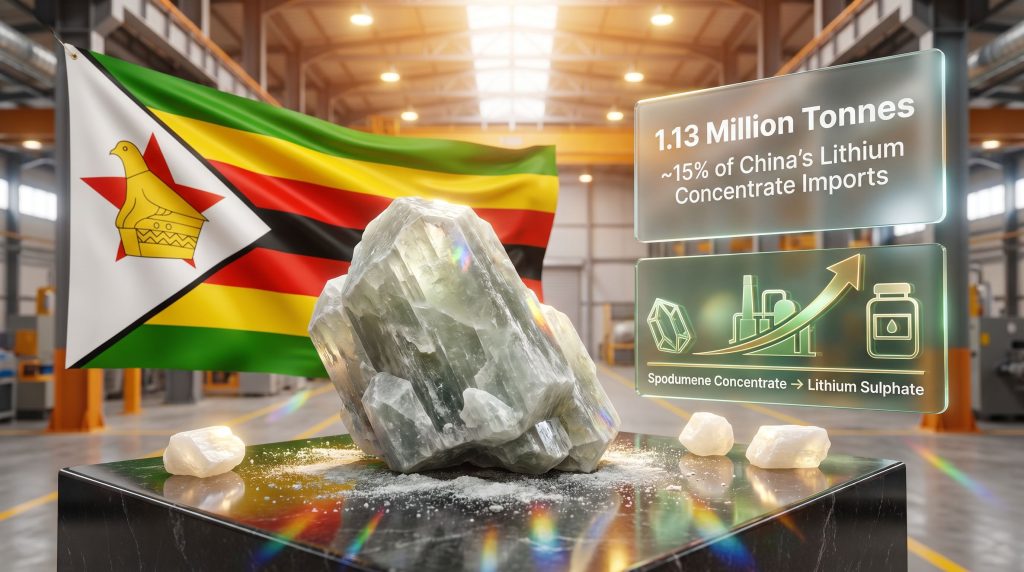
Africa's largest lithium-producing nation is not a marginal player in the global battery metals conversation. Zimbabwe exported 1.13 million tonnes of lithium-bearing spodumene concentrate in 2025, a volume that represented approximately 15% of China's total lithium concentrate imports for the year. That single statistic reframes what might otherwise look like a regional policy story into something with genuine global supply chain significance.
Zimbabwe's lithium endowment is predominantly hard-rock in nature, hosted in pegmatite formations that have proven geological continuity and significant remaining reserve life. Unlike brine-hosted lithium deposits in South America's Lithium Triangle, hard-rock spodumene extraction operations deliver a more consistent product grade and can be brought into production faster, though they carry higher processing energy costs. Zimbabwe's deposits have attracted sustained capital precisely because of this geological reliability.
The country's shift from passive raw material exporter to active policy architect reflects a trajectory that has been building for years. The regulatory posture that produced the Zimbabwe lithium export ban extension debate did not emerge overnight. It is the product of a deliberate industrialisation strategy modelled, at least in part, on resource nationalism experiments in other mineral-rich nations.
How the Policy Framework Actually Evolved
The timeline of Zimbabwe's export restrictions reveals a pattern of escalating interventions that caught some operators mid-construction and reshaped the commercial calculus for the entire sector.
| Date | Policy Action | Key Detail |
|---|---|---|
| Pre-2026 | January 2027 ban announced | Planned prohibition on raw lithium concentrate exports to incentivise local processing |
| February 2026 | Immediate export suspension | All raw minerals and lithium concentrates banned with immediate effect, including shipments already in transit |
| Mid-2026 | Quota and tax framework introduced | Export quotas reinstated under conditions; 16% tax on lithium concentrate exports applied |
| June 2026 | Industry appeals for deadline extension | Zimbabwe's Lithium Producers' Association formally requests extension to June 2027 |
The February 2026 acceleration is particularly significant from an investor risk perspective. According to Al Jazeera, the government cited mineral leakages and alleged malpractice within the export pipeline as justification for the immediate suspension, applying the measure retroactively to minerals already in transit. This kind of enforcement action, targeting goods already physically moving through the logistics chain, represents an unusually aggressive regulatory posture that elevated sovereign risk perceptions across the sector.
The subsequent introduction of a quota system paired with a 16% export tax created a hybrid regime: not a hard ban, but not open trade either. Producers could export, but under constrained volumes and with meaningful fiscal penalties applied to every tonne of concentrate shipped.
The Processing Infrastructure Reality
The core argument behind the formal request for a Zimbabwe lithium export ban extension rests on a straightforward operational reality. Building a lithium sulphate processing plant is not a six-month undertaking. It requires capital commitment, engineering design, equipment procurement, civil construction, commissioning, and operational ramp-up — a sequence that routinely takes two to four years even under favourable conditions.
Furthermore, the government's beneficiation mandate requires miners to convert raw spodumene ore into lithium sulphate before export. Lithium sulphate is an intermediate processed chemical, not a finished battery-grade product. Further refining into lithium hydroxide or a product traded on the lithium carbonate market remains necessary before the material enters cathode manufacturing. The policy therefore adds one processing step to the chain, not the entire downstream value chain.
The current operational status of processing facilities across Zimbabwe's major lithium operations illustrates the beneficiation gap precisely:
- Zhejiang Huayou Cobalt: The only operator with a fully commissioned lithium sulphate plant, already exporting processed chemicals. This represents the benchmark outcome the policy is designed to replicate across the sector.
- Sinomine's Bikita Minerals: Lithium sulphate plant under active construction. Not yet operational as of mid-2026.
- Sichuan Yahua's Kamativi Mine: Processing plant construction underway following a confirmed build announcement. Not yet commissioned.
- Sandawana Mine (State-owned): Still at feasibility study stage, representing the furthest operational lag from compliance requirements.
The disparity between these four operators is meaningful. Huayou Cobalt's early compliance reflects both its larger capital base and a strategic decision to move quickly on processing infrastructure before the regulatory environment hardened. The remaining operators are not refusing to comply; they are physically unable to comply by January 2027 because their facilities are still being built.
Why the Six-Month Extension Request Is Commercially Credible
The Zimbabwe Lithium Producers' Association has formally requested that the beneficiation deadline shift from January 2027 to June 2027. The association's chairman, who also leads the state-owned Mutapa Energy Resources, presented this appeal at a mining conference in Victoria Falls in June 2026, framing it not as resistance to the policy but as a request for an operational runway calibrated to construction reality.
The commercial logic supporting the extension request involves several interconnected pressures:
- Construction timelines are fixed by physics, not preference. Major processing plant construction cannot be accelerated beyond certain physical limits regardless of regulatory urgency.
- Revenue continuity funds construction. Export revenues from concentrate shipments are, in many cases, partially funding the construction of the processing plants themselves. A hard ban before plants are commissioned creates a revenue vacuum that could paradoxically slow, not accelerate, beneficiation.
- The government has fiscal skin in the game. If major operators halt exports abruptly, Zimbabwe loses both the 16% export tax revenue and the future royalty and tax base that compliant processing operations would generate.
- The state-owned operator is the furthest behind. Sandawana Mine's feasibility study status is particularly relevant because it is a government-owned asset. Enforcing a hard ban that the government's own miner cannot comply with creates an obvious credibility problem.
Enforcing a deadline before the infrastructure required to meet it exists does not accelerate industrialisation. It creates a production halt that damages both mining revenues and government fiscal receipts, while doing nothing to fast-track plant commissioning.
Zimbabwe's 2030 Lithium Sulphate Production Target
The Zimbabwe Lithium Producers' Association has projected 344,000 metric tonnes of annual lithium sulphate output by 2030. This figure represents aggregate designed capacity across all planned processing facilities, not current or near-term production.
Achieving this target requires:
- Bikita Minerals completing and commissioning its sulphate plant within the next one to two years
- Kamativi's plant reaching full operational capacity on schedule
- Sandawana completing its feasibility study and then executing a full capital build
- Huayou Cobalt maintaining and potentially expanding its existing processing output
If realised, 344,000 tonnes of annual lithium sulphate production would meaningfully reposition Zimbabwe in the global battery supply chain. The country would shift from being a raw material supplier to a mid-tier processor, potentially attracting downstream cathode precursor investment and reducing the margin available to offshore processors who currently add value to Zimbabwean spodumene before it reaches battery manufacturers.
The next major ASX story will hit our subscribers first
The Chinese Capital Dimension
Understanding Zimbabwe's lithium sector requires confronting the scale of Chinese financial and operational dominance within it. Chinese firms have invested approximately $2 billion in Zimbabwe's lithium mining sector since 2021, and three of the four major operating mines are owned or controlled by Chinese companies.
| Factor | Zimbabwe's Perspective | China's Perspective |
|---|---|---|
| Raw concentrate exports | Revenue source under threat from ban | Preferred low-cost feedstock for Chinese refineries |
| Local processing mandate | Value-add industrialisation goal | Adds cost and complexity to supply chain |
| Export ban enforcement | Sovereignty and policy credibility | Supply chain disruption risk |
| Processing plant investment | Domestic job creation and tax base expansion | Sunk capital that must be protected and operationalised |
The interesting dynamic here is that Chinese operators completing processing plants — as Huayou Cobalt has already done — effectively adapt to the new policy framework while maintaining their grip on Zimbabwe's lithium output. The transition from exporting raw spodumene to exporting lithium sulphate does not fundamentally reduce Chinese influence over Zimbabwe's mineral resources. It relocates that influence one step further down the processing chain, with the added complication that processing assets now sit inside Zimbabwe rather than in China.
This creates a subtly different risk profile for Chinese investors. Fixed processing infrastructure is harder to relocate than mining equipment, consequently increasing the sunk capital exposure to Zimbabwe's sovereign risk environment.
The Indonesia Precedent and What It Teaches
Zimbabwe's beneficiation strategy bears a clear structural resemblance to Indonesia's nickel model, implemented in 2020. Indonesia prohibited the export of unprocessed nickel ore to force domestic smelting investment, a move that was initially resisted by global markets, challenged at the World Trade Organization by the European Union, and broadly criticised as disruptive.
The outcome, however, validated the core strategy. Indonesia successfully attracted over $15 billion in foreign direct investment into domestic nickel processing infrastructure, transforming the country from a raw ore exporter into a significant producer of nickel pig iron and nickel matte for battery supply chains.
| Country | Restriction Type | Processing Mandate | Outcome |
|---|---|---|---|
| Zimbabwe | Export ban + quota + tax | Lithium sulphate production required | In transition; deadline under negotiation |
| Indonesia | Nickel ore export ban (2020) | Domestic smelting required | Successfully shifted; attracted $15B+ in FDI |
| Chile | Nationalisation framework | State participation mandated | Ongoing; mixed investor reception |
| DRC | Cobalt export levies | Partial processing incentives | Limited processing capacity built to date |
The critical variable in Indonesia's success was that enforcement timelines were ultimately calibrated — through a combination of phased implementation and practical tolerance — to match the pace at which smelting infrastructure could be built. Zimbabwe faces the same calibration challenge. The policy architecture is sound. The question is whether the January 2027 deadline reflects operational reality or aspirational ambition.
Supply Chain Implications for Battery Manufacturers
For battery manufacturers and EV supply chain planners, the Zimbabwe lithium export ban extension debate has both short-term and structural implications. In addition, the distinction between hard-rock vs brine lithium sources matters here, as Zimbabwe's pegmatite-hosted deposits behave differently in supply disruption scenarios compared to South American brine operations.
Near-term considerations:
- Zimbabwe contributed approximately 15% of China's lithium concentrate imports in 2025. Any disruption to that flow has a measurable, if not decisive, impact on global spodumene supply
- Fitch's BMI has characterised the export ban as a temporary supply dent rather than a structural shortage, suggesting that market analysts view the disruption as manageable within existing supply buffers
- The transition from concentrate to sulphate exports changes the product form available on global markets but does not alter the underlying resource volume
Longer-term strategic considerations:
- A Zimbabwe producing 344,000 tonnes of lithium sulphate annually by 2030 would represent a genuinely different participant in the battery supply chain, one selling an intermediate chemical rather than a raw feedstock
- European and North American battery manufacturers seeking supply chain diversification away from Chinese-processed lithium may find partially processed Zimbabwean lithium sulphate a more accessible option in the medium term, depending on trade framework developments
- Technologies such as direct lithium extraction may also reshape processing economics over time, however the shift in product form does not eliminate further processing requirements. Lithium sulphate still requires conversion into hydroxide or carbonate before cathode manufacturing, meaning downstream processing concentration risks are not eliminated, merely redistributed
Three Scenarios for the January 2027 Deadline
The resolution of the Zimbabwe lithium export ban extension request will likely follow one of three paths, each carrying distinct consequences:
Scenario 1: Extension to June 2027 Granted
An orderly transition period allows Bikita Minerals and Kamativi to complete commissioning while export revenues continue funding construction. Policy credibility is preserved through negotiated compliance rather than forced confrontation.
Scenario 2: January 2027 Deadline Enforced Without Extension
Non-compliant operators face an immediate halt to concentrate exports. A revenue gap opens for both miners and the government. According to Fast Markets, legal uncertainty may follow, and investor sentiment toward Zimbabwe's mining sector could deteriorate. Short-term reduction in global spodumene availability may create upward price pressure, though this would likely be modest given current lithium market conditions.
Scenario 3: Indefinite Deferral or Policy Reversal
If the government repeatedly delays or retreats from enforcement, Zimbabwe's resource nationalism credibility erodes. Future processing infrastructure investment weakens as investors conclude that beneficiation mandates are negotiable rather than binding. This scenario potentially locks Zimbabwe into raw material exporter status for another decade.
Frequently Asked Questions: Zimbabwe Lithium Export Ban
What is the Zimbabwe lithium export ban?
Zimbabwe has implemented a policy prohibiting the export of unprocessed lithium concentrate (spodumene), requiring miners to build domestic processing facilities that convert raw ore into lithium sulphate before export. The ban was originally scheduled to take full effect in January 2027 but was preceded by an immediate export suspension in February 2026, followed by a quota and tax framework.
Why is Zimbabwe pursuing this export restriction policy?
The government's stated objective is to capture greater economic value from domestic lithium resources by mandating in-country processing. Rather than exporting low-margin raw material, Zimbabwe aims to export higher-value processed lithium chemicals, generating additional tax revenue, employment, and industrial development capacity.
Has the export ban deadline been extended?
As of June 2026, Zimbabwe's Lithium Producers' Association has formally requested an extension from January 2027 to June 2027. The government had not confirmed a response to this request at the time of the appeal.
Which companies are affected?
The primary operators affected are Chinese-controlled mining companies including Sinomine's Bikita Minerals, Sichuan Yahua's Kamativi mine, and the state-owned Sandawana operation. Zhejiang Huayou Cobalt has already completed its processing plant and is exporting lithium sulphate in compliance with the new framework.
What is Zimbabwe's projected lithium sulphate output?
The Zimbabwe Lithium Producers' Association forecasts 344,000 metric tonnes of annual lithium sulphate production by 2030, contingent on all planned processing facilities being completed and commissioned across the sector.
Disclaimer: This article contains forward-looking statements, production forecasts, and scenario analyses that are subject to material uncertainty. Regulatory outcomes, construction timelines, commodity prices, and geopolitical developments may differ significantly from projections discussed. Nothing in this article constitutes financial or investment advice.
Ready to Identify the Next Major Mineral Discovery Before the Market Does?
Discovery Alert's proprietary Discovery IQ model delivers real-time alerts on significant ASX mineral discoveries — transforming complex data across more than 30 commodities into clear, actionable insights for both short-term traders and long-term investors. Explore Discovery Alert's dedicated discoveries page to see how historic finds have generated substantial returns, and begin your 14-day free trial today to position yourself ahead of the market.