June 18, 2026
Brazil's Lithium Valley: Why the World's Next Critical Minerals Frontier Is Already Being Claimed
The global race to secure battery-grade lithium, rare earth elements, and semiconductor-critical gallium has quietly shifted its centre of gravity away from established mining jurisdictions. Across the highlands of Minas Gerais, Brazil, a geological endowment that took billions of years to form is now attracting serious exploration capital from some of the most resource-savvy jurisdictions on earth. Canadian junior miners, long regarded as the world's most experienced exploration-stage operators, are among the first to stake meaningful positions in what geologists have begun calling Brazil's Lithium Valley.
The Spark critical minerals project in Brazil represents one of the most substantive early-stage commitments to emerge from this district, with Canadian explorer Spark Energy Minerals outlining a planned capital expenditure of US$30 million across its Arapaima Lithium and REE Project in Minas Gerais. Understanding what this capital is targeting, what it can realistically achieve, and what risks accompany it requires a deeper look at the geology, geopolitics, and investment mechanics underpinning this emerging district.
When big ASX news breaks, our subscribers know first
The Geological Case for Minas Gerais: Pegmatites, REEs, and Gallium
Not all lithium districts are created equal. The lithium mineralisation found within Minas Gerais is hosted predominantly within granitic pegmatite systems, which are large-crystalled igneous intrusions that concentrate incompatible elements, including lithium, rubidium, cesium, and critically, rare earth elements, as molten rock cools slowly at depth. The Jequitinhonha Valley within Minas Gerais has been prospected for gemstones for centuries, meaning historical artisanal workings have inadvertently mapped surface pegmatite exposure for modern explorers.
What distinguishes Lithium Valley from many competing districts globally is the combination of:
- Surface accessibility: Pegmatite dykes outcrop or sit at shallow depth across large portions of the district, reducing early-stage drilling costs.
- Proven mineralisation nearby: Sigma Lithium's Grota do Cirilo deposit, now in production, has validated that high-grade spodumene-bearing pegmatites exist at commercial scale in the same geological terrane.
- Multi-commodity endowment: The same geological processes that concentrate lithium in pegmatites can simultaneously generate REE anomalies in associated granitic bodies, creating exploration optionality that single-mineral districts cannot match.
- Infrastructure proximity: Roads, power corridors, and port access through Salvador and Vitória are already established for Minas Gerais' iron ore and gold industries.
A critical technical distinction that many non-specialist investors overlook is the difference between spodumene and lepidolite as lithium-bearing minerals. Spodumene extraction typically yields higher lithium grades and responds well to established flotation processing, while lepidolite requires more complex and expensive hydrometallurgical treatment. Identifying which mineralogy dominates a given pegmatite target is therefore a key de-risking milestone before any resource estimate carries meaningful economic weight.
Arapaima Project Profile: Land Package, Targets, and Commodity Scope
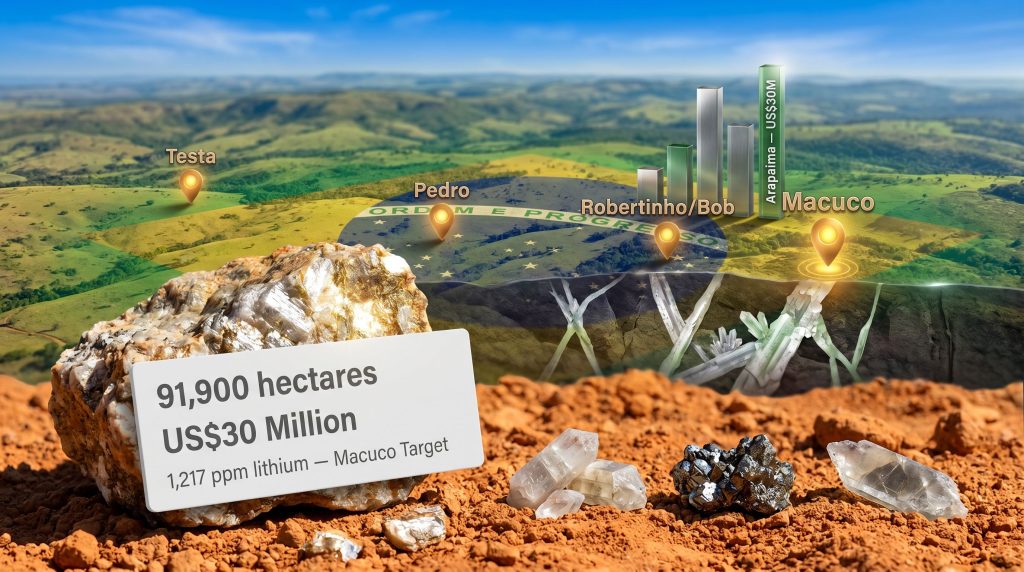
Spark's Arapaima project covers a substantial 91,900-hectare land package within the Lithium Valley district. The scale of this tenure is important context: at the exploration stage, larger land packages increase the statistical probability of intersecting economically significant mineralised systems, while also providing optionality to pivot focus as geochemical data accumulates.
| Project Attribute | Detail |
|---|---|
| Project Name | Arapaima Lithium and REE Project |
| Location | Minas Gerais, Brazil (Lithium Valley) |
| Land Package | 91,900 hectares |
| Primary Commodities | Lithium, Rare Earth Elements, Gallium |
| Project Stage | Exploration (drill-ready targets identified) |
| Planned Capital Expenditure | US$30 million |
| Operating Company | Spark Energy Minerals (Canada) |
Four high-priority lithium drill targets have been defined across the tenure through systematic rock chip and soil geochemical sampling programs:
- Testa – A pegmatite trend with structural and geochemical characteristics consistent with lithium-bearing mineralisation at depth.
- Pedro – Displays anomalous lithium values aligned along identifiable pegmatite strike trends, warranting drill testing to assess continuity.
- Robertinho/Bob – Structurally positioned within the broader land package where cross-cutting pegmatite dyke systems suggest potential for stacked mineralised zones.
- Macuco – The highest-priority target to date, returning a peak geochemical sample of 1,217 ppm lithium from combined rock and soil sampling, representing the strongest surface anomaly documented across the project area.
Technical Context: A reading of 1,217 ppm lithium in surface geochemistry is a prospectivity indicator rather than a grade figure. Lithium grades in ore are typically expressed as Li₂O percentage (for example, Sigma Lithium's Grota do Cirilo averages around 1.4% Li₂O). The conversion from ppm lithium in soils to drill-intercept grades requires confirmation through systematic core drilling and assaying at depth.
The Caladão Granite: REEs and Gallium as Complementary Vectors
Beyond the lithium targets, Spark has identified a separate exploration vector within the Arapaima land package centred on the Caladão Granite. Stream-sediment and soil sampling programs have outlined geochemical anomalies suggestive of rare earth element and gallium mineralisation associated with this granitic body.
This matters for several reasons that go beyond conventional lithium exploration logic. Gallium, a byproduct mineral typically recovered from bauxite processing and certain zinc smelting operations, has become one of the most strategically contested materials in global supply chains. Furthermore, the role of gallium in semiconductors, 5G infrastructure components, and military-grade electronics has been underscored by China's export controls introduced in 2023, with restrictions tightened further in 2024, effectively weaponising its near-monopoly position (U.S. Geological Survey, 2024).
The presence of gallium anomalies at Caladão Granite therefore elevates the Arapaima project's strategic profile considerably beyond a conventional lithium play. It introduces a third commodity vector that aligns directly with Western industrial and defence procurement priorities, offering potential co-production economics if mineralisation can be confirmed through systematic follow-up work.
Benchmarking the US$30 Million Capital Commitment
Understanding what US$30 million represents at the exploration stage requires contextual benchmarking against both the project's specific needs and broader district activity.
| Company | Project | Stage | Approximate Capital Commitment |
|---|---|---|---|
| Spark Energy Minerals | Arapaima | Exploration | US$30 million |
| Sigma Lithium | Grota do Cirilo | Production | Multi-hundred million |
| Latin Resources | Salinas | Resource Definition | Advancing |
| Atlas Lithium | Neves | Exploration to Development | Active |
At the exploration stage, US$30 million is a meaningful but targeted allocation. A rough breakdown of how such capital is typically deployed in a Brazilian pegmatite exploration program:
- Geophysics and geological mapping: Ground-penetrating surveys, magnetics, and structural interpretation to refine drill targets.
- Drilling programs: Reverse circulation (RC) or diamond core drilling across four to six targets at approximate costs of AUD$150–$250 per metre depending on depth and access.
- Assaying and metallurgical testwork: Laboratory analysis of core samples, plus initial mineralogical characterisation to identify spodumene versus lepidolite mineralogy.
- Environmental baseline studies: Required ahead of any formal permitting application under Brazilian environmental law.
- Resource estimation: If drilling returns sufficient positive results, engagement of a qualified person under NI 43-101 or JORC standards to compile an initial mineral resource estimate.
Investor Awareness: Exploration-stage capital commitments should be evaluated against the probability of resource conversion, not against production-stage benchmarks. US$30 million at drill-ready stage is meaningful but represents only the first phase of what could be a multi-stage capital journey spanning five to ten years before production economics are established.
The Multi-Commodity Thesis: Why Lithium Alone Is No Longer the Whole Story
Lithium's Demand Trajectory Through 2035
Battery-grade lithium demand is forecast to grow at a compound annual growth rate exceeding 20% through to 2030, driven by electric vehicle adoption across Europe, North America, and Southeast Asia (International Energy Agency, World Energy Outlook 2024). The strategic concern for Western governments is not whether demand will materialise, but whether supply chains will remain accessible. Currently, approximately 60% of global lithium refining capacity sits in China, creating downstream vulnerability even for jurisdictions that mine the raw material elsewhere.
How lithium mining works within Brazilian spodumene deposits differs meaningfully from brine-based operations, and concentrates produced at commercial scale would feed into cathode active material manufacturing chains that Western governments are actively trying to diversify away from Chinese control. This supply-chain logic, rather than spot lithium price alone, underpins much of the foreign direct investment flowing into Minas Gerais from Canadian, Australian, and European exploration groups.
Rare Earth Elements: The High-Value Layer Most Analysts Underweight
The REE suite associated with Brazilian granitic and pegmatitic systems encompasses both light rare earths (LREEs) such as neodymium and praseodymium, and heavy rare earths (HREEs) including dysprosium and terbium. The latter are disproportionately critical for permanent magnet manufacturing used in EV motors and wind turbine generators.
A less commonly understood dynamic in the REE space is that co-production economics within a lithium pegmatite setting can materially alter project economics. Much like rare earth supply chains globally, if REE mineralisation at Caladão proves amenable to recovery alongside a lithium circuit, the marginal cost of REE production could be substantially lower than for standalone REE projects, improving the overall project economics of Arapaima even at lower individual commodity prices.
Exploration Risk Framework: What Investors Need to Understand
The staged pathway from geochemical work to commercial production involves multiple decision gates, each carrying distinct risk profiles:
- Geochemical sampling identifies surface anomalies and ranks targets by priority.
- Drill programs test whether surface anomalies reflect mineralisation at economic depth and width.
- Resource estimation (under JORC or NI 43-101) quantifies the mineralisation into inferred, indicated, or measured categories.
- Scoping and feasibility studies assess technical and economic viability of extraction.
- Permitting through IBAMA and state-level environmental agencies in Brazil, which can add 12 to 36 months to timelines.
- Construction and commissioning represent the largest single capital requirement, typically an order of magnitude larger than exploration spend.
Key risks specific to Brazilian lithium exploration that investors should actively interrogate include:
- Geological discontinuity: Pegmatite dykes can pinch and swell unpredictably, meaning surface anomalies do not always translate to economically continuous mineralised bodies at depth.
- Metallurgical uncertainty: Until core samples are tested in a laboratory setting, the lithium mineralogy (and therefore processing pathway and cost) remains unconfirmed.
- Regulatory timeline: Brazil's environmental licensing framework, while functional, is complex, and permit delays have historically affected exploration and development timelines across Minas Gerais.
- Dilution risk: Exploration-stage companies typically fund multi-phase drill programs through equity raises, which can dilute existing shareholders at each funding cycle.
- Lithium price volatility: Lithium carbonate spot prices fell from record highs above US$80,000 per tonne in late 2022 to below US$15,000 per tonne by mid-2024, demonstrating the commodity's price cycle risk and the importance of not anchoring project valuations to peak-cycle assumptions.
The next major ASX story will hit our subscribers first
Brazil's Critical Minerals Policy Landscape: Context Without Overstatement
Brazil has formally designated lithium, rare earth elements, and gallium as strategic minerals within its national resource framework. The country has also engaged in bilateral investment discussions with Canada, the European Union, and Indo-Pacific partners as part of broader efforts to position its mineral endowment within Western-aligned supply chains. Brazil's potential role in diversifying US critical mineral supply is increasingly recognised at the policy level, with the EU Critical Raw Materials Act and the US Inflation Reduction Act both creating demand-pull incentives for qualifying critical mineral sources.
What is important to distinguish, however, is that these policy environments represent macro-level tailwinds for the sector broadly, not project-specific endorsements or accelerated permitting commitments for any individual explorer. The pathway from policy framework to offtake agreement for a specific exploration-stage project involves commercial negotiations, resource confirmation, and regulatory compliance that unfold independently of national strategy declarations.
Frequently Asked Questions: Spark Critical Minerals Project in Brazil
What is the Spark critical minerals project in Brazil?
Spark Energy Minerals, a Canadian exploration company, is advancing the Arapaima Lithium and REE Project in Minas Gerais, Brazil, covering 91,900 hectares and targeting lithium, rare earth elements, and gallium within Brazil's Lithium Valley district. Furthermore, direct lithium extraction technologies may play a role in processing decisions as the project advances towards resource definition.
How much is Spark investing in its Brazil critical minerals project?
Spark has outlined a planned capital expenditure of approximately US$30 million for exploration drilling, geochemical programs, and early-stage project development at Arapaima.
What lithium results has Spark reported at Arapaima?
The project's highest-priority target, Macuco, has returned a peak geochemical sample of 1,217 ppm lithium from rock and soil sampling. Additional anomalous lithium values have been recorded across the Testa, Pedro, and Robertinho/Bob targets.
What stage is the Arapaima project at?
Arapaima is at the exploration stage. Four drill-ready lithium targets have been identified, and geochemical work on the Caladão Granite for REE and gallium potential is ongoing. No JORC or NI 43-101 mineral resource has been defined. Consequently, Spark's maiden drill campaign represents a pivotal next step in converting these surface anomalies into drill-tested data.
Why is gallium significant at the Arapaima project?
Gallium is a critical semiconductor material subject to Chinese export restrictions since 2023. Its presence within the Caladão Granite adds multi-commodity optionality and potential strategic value to Western supply chain initiatives that extends well beyond the lithium thesis.
Key Takeaways for Investors and Industry Observers
The Spark critical minerals project in Brazil sits at the intersection of several powerful structural forces: a geologically prospective district with proven nearby mineralisation, a multi-commodity thesis spanning lithium, REEs, and gallium, and a macro environment in which Western capital is actively seeking to diversify critical mineral supply chains away from single-jurisdiction concentration risk.
What the project represents at this stage, however, is prospectivity rather than confirmed value. The milestones that would represent genuine de-risking include:
- First drill results from Macuco and the other high-priority lithium targets.
- Mineralogical confirmation of spodumene-dominant lithium bearing, which would support conventional processing economics.
- REE and gallium assay results from the Caladão Granite that define a definable anomaly footprint.
- An initial NI 43-101 or JORC inferred resource estimate, which would allow institutional capital to begin formal project valuation.
- Environmental baseline studies filed with Brazilian regulatory authorities as a precursor to permitting.
The broader signal that the Spark Arapaima project sends to the market is this: Canadian exploration capital, which has historically been the most sophisticated early-stage mining capital in the world, is placing serious bets on Brazil's Lithium Valley at scale. That conviction, backed by a US$30 million planned expenditure on a drill-ready land package, reflects an informed assessment of the district's potential that observers across the critical minerals sector would do well to monitor closely.
This article is for informational purposes only and does not constitute financial or investment advice. Exploration-stage projects carry significant risk, and outcomes described as prospective or potential are not guaranteed. Readers should conduct independent due diligence before making any investment decisions. Commodity price forecasts referenced are drawn from publicly available sources including the International Energy Agency and U.S. Geological Survey and are subject to revision.
Want to Stay Ahead of the Next Major Critical Minerals Discovery on the ASX?
Discovery Alert's proprietary Discovery IQ model delivers real-time alerts the moment significant mineral discoveries — spanning lithium, rare earth elements, gallium, and over 30 other commodities — are announced on the ASX, converting complex geological data into clear, actionable insights for investors at every experience level. Explore historic discoveries and their market returns to understand the scale of opportunity, then begin your 14-day free trial at Discovery Alert to position yourself ahead of the broader market.