June 18, 2026
The Chemistry Shift Quietly Reshaping Europe's Battery Manufacturing Ambitions
For decades, the dominant narrative in energy storage has centred on lithium. Lithium-ion chemistry powered the consumer electronics revolution, then migrated into electric vehicles, and eventually anchored the utility-scale battery storage market. Yet the deeper the world's dependence on lithium grew, the more exposed its structural vulnerabilities became. Concentrated mining operations, geopolitically sensitive refining chokepoints, and a supply chain dominated by a handful of Asian manufacturers have collectively forced European policymakers and industrialists to confront an uncomfortable reality: sovereign battery manufacturing capability cannot be built on a foundation of imported critical minerals.
That pressure is now catalysing a new wave of battery chemistry exploration across Europe, and sodium-ion technology sits near the top of the agenda. Within this emerging landscape, a Basque Country startup is pursuing one of the continent's more technically distinctive approaches, with a three-stage industrial roadmap that targets a Bihar Batteries sodium-ion pilot cell line by 2027.
When big ASX news breaks, our subscribers know first
Why Europe's Lithium Dependency Has Become an Industrial Liability
The structural fragility of lithium-ion supply chains has been visible for years, but the speed at which European policymakers have moved to address it accelerated sharply following a sequence of global disruptions. Lithium carbonate prices swung dramatically between 2021 and 2024, exposing how price volatility in a single upstream material could destabilise downstream battery economics across an entire continent.
Beyond price risk, the geographic concentration of lithium processing capacity presents a strategic problem that no amount of hedging fully resolves. Approximately 60% of the world's lithium refining capacity is located in China, and the cathode materials used in conventional lithium iron phosphate (LFP) batteries rely on supply chains that remain deeply integrated with Chinese industrial infrastructure.
Sodium-ion chemistry disrupts this dependency at the materials level. Sodium is among the most abundant elements on Earth, found in vast quantities in seawater and mineral deposits on every continent. It requires no cobalt, no nickel, and no lithium, making it structurally immune to the supply chain vulnerabilities that have plagued lithium-ion battery manufacturing. For European battery developers seeking genuine materials sovereignty, this is not a minor advantage; it is a foundational strategic differentiator. Furthermore, the global lithium market continues to face concentration risks that reinforce the case for alternative chemistries.
What Bihar Batteries Is Building and Why the Basque Country Matters
Bihar Batteries, headquartered in San Sebastián, developed its core sodium-ion cell technology through a collaborative research programme with CIC energiGUNE, the Basque Country's internationally recognised electrochemical energy storage technology centre. This institutional partnership provided Bihar with access to advanced materials characterisation capabilities and electrochemical testing infrastructure that would be prohibitively expensive for an early-stage startup to replicate independently.
The collaboration produced Bihar's first pouch-cell demonstrators, a cell format chosen specifically for its ability to optimise energy density and preserve capacity retention under thermally demanding operating conditions. Pouch cells also offer greater design flexibility during the pre-commercial phase, allowing engineers to iterate on electrode architecture and electrolyte formulation without the constraints imposed by cylindrical or prismatic cell housings.
What makes Bihar's materials strategy particularly notable is its sourcing logic. The company derives its sodium from seawater and produces its hard carbon anode material from timber, two inputs that are regionally abundant across the Iberian Peninsula and the broader European continent. Hard carbon is the preferred anode material for sodium-ion batteries because sodium ions are too large to intercalate efficiently into graphite, the standard anode material used in lithium-ion cells. Biomass-derived hard carbons, produced through controlled pyrolysis of organic precursors, offer tunable porosity structures that can be optimised for sodium storage capacity and cycling stability. Research into upscaling sodium-ion battery cells from aqueous processing confirms that hard carbon and Prussian white pouch cell architectures are among the most promising pathways for pre-commercial scale-up.
The decision to source hard carbon from timber rather than synthetic precursors reflects a broader strategy of building a vertically integrated materials supply chain that is both cost-competitive and geopolitically resilient.
Sodium-Ion vs. LFP: Where the Performance Trade-offs Actually Matter
For potential adopters evaluating sodium-ion technology against established lithium alternatives, the performance comparison requires nuance. Sodium-ion cells currently trail lithium iron phosphate on energy density, a metric that matters enormously in electric vehicles but carries less weight in stationary storage applications where physical footprint is a secondary concern.
The comparison looks considerably different when thermal performance becomes the primary variable.
| Attribute | Sodium-Ion (Bihar) | LFP (Conventional) |
|---|---|---|
| Operating Temperature Range | -20°C to +60°C | -10°C to +45°C (typical) |
| Depth of Discharge | 100% | 80-90% (recommended) |
| Thermal Stability | Higher (reduced cooling dependency) | Moderate |
| Critical Mineral Dependency | Low (no lithium, cobalt, or nickel) | Lithium-dependent |
| Maturity Level | Pilot/Pre-commercial | Commercially mature |
| Primary Use Case | C&I stationary, outdoor | Grid-scale, C&I, residential |
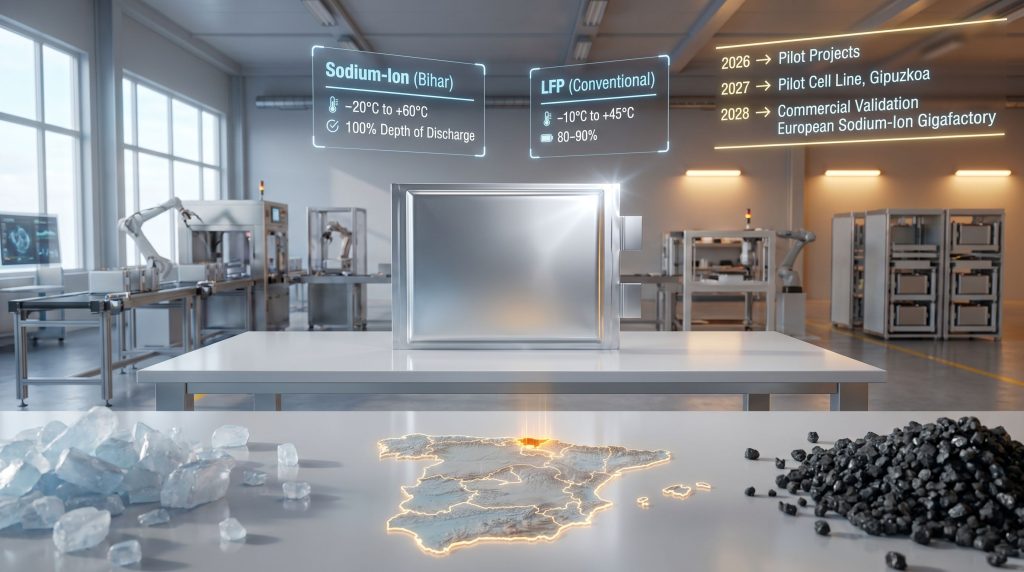
Bihar's cells are engineered to operate across a temperature range of -20°C to +60°C while supporting 100% depth of discharge, two characteristics that directly address the thermal management challenges endemic to outdoor commercial and industrial deployments. By contrast, conventional LFP systems typically require active liquid cooling infrastructure when ambient temperatures regularly exceed 40°C, adding capital expenditure and ongoing maintenance overhead that compounds across a 10 to 15 year asset life.
The Hidden Cost of Thermal Management in Outdoor Storage
The economic case for sodium-ion in outdoor commercial and industrial applications becomes clearest when thermal management costs are fully accounted for in project economics. In environments where summer temperatures routinely exceed 40°C, as is common across southern Spain, Portugal, and much of the Mediterranean basin, LFP battery systems require active cooling architectures that can represent a significant share of total installed system cost.
Consider an industrial facility in southern Spain requiring a 500 kWh outdoor battery installation. An LFP-based system would typically require liquid cooling loops, heat exchangers, and climate control infrastructure to maintain cells within their recommended operating window. A sodium-ion system capable of operating comfortably at ambient temperatures up to +60°C could eliminate or substantially reduce that cooling requirement, improving the project's levelised cost of storage (LCOS) materially over its operational lifetime.
This is not merely a theoretical advantage. Thermal management infrastructure adds both capital cost at installation and recurring energy consumption throughout the system's life, since cooling systems themselves consume electricity to operate. For commercial and industrial customers seeking to optimise storage economics, the total cost of ownership implications are meaningful. In addition, the broader battery raw materials landscape increasingly favours chemistries that reduce dependency on thermally sensitive and geopolitically concentrated inputs.
The Three-Stage Industrial Roadmap: From Prototype to Pilot Line
Bihar's transition from laboratory demonstrator to industrial manufacturer follows a structured three-stage progression, with each phase designed to de-risk the subsequent step before major capital is committed.
-
Stage One (2026): Launch of real-world pilot projects for both sodium-ion cells and complete storage systems, targeted for the second half of 2026. These deployments are intended to validate cell performance under genuine field conditions and generate the operational data needed to support industrial scale-up decisions.
-
Stage Two (2027): Establishment of a pilot cell manufacturing line in Spain's Gipuzkoa province. This facility will serve as the physical foundation for validating industrial production processes and demonstrating that the Bihar Batteries sodium-ion pilot cell line chemistry can be manufactured consistently at scale.
-
Stage Three (2028): Commencement of operations at the pilot line, with the facility functioning as the precursor infrastructure for a potential large-scale sodium-ion manufacturing plant that Bihar has described as a candidate for becoming one of Europe's first sodium-ion battery gigafactories.
The 2027 pilot cell line in Gipuzkoa is strategically positioned not merely as a manufacturing test bed, but as the foundational infrastructure for what Bihar envisions as a European-scale sodium-ion production capability, placing Spain at the forefront of a continent-wide effort to build sovereign battery manufacturing capacity.
Why Gipuzkoa Provides an Unusually Favourable Manufacturing Environment
The choice of Gipuzkoa province as the location for Bihar's pilot cell line reflects a deliberate positioning within one of Europe's most concentrated advanced manufacturing ecosystems. The Basque Country has cultivated an industrial base combining precision engineering, advanced materials science, and applied research institutions over several decades, creating a talent pool and supply chain infrastructure that is genuinely difficult to replicate in other European regions.
Bihar has received institutional backing from the Provincial Council of Gipuzkoa and the Basque Government through its SPRI development agency. This regional support architecture reduces early-stage manufacturing risk by providing access to industrial land, infrastructure connectivity, and technology transfer networks that would otherwise require years to develop independently.
How Bihar's Financial Architecture Is Structured
Funding a pre-commercial battery cell venture through to pilot manufacturing requires a capital structure that blends patient private investment with public programme support, and Bihar's financial architecture reflects this reality precisely.
| PERTE Funding Round | Award Year | Budget | Focus Area |
|---|---|---|---|
| Round 1 | 2025 | €2 million | Battery materials manufacturing and pack assembly |
| Round 2 | 2026 | €8 million | Sodium-ion cell manufacturing and assembly |
| Total Public Programme Support | €10 million | Full cell-to-pack value chain |
On the private side, Bihar completed a €2 million capital increase backed by international investors, a raise that signals external validation of the technology and the commercial strategy from parties operating outside the Spanish domestic ecosystem. Participation by international investors in a pre-commercial stage battery startup carries informational value beyond the capital amount itself; it suggests the technology has been evaluated against a global competitive benchmark.
The combined €10 million secured through two rounds of Spain's PERTE renewable energy value chain programme represents a meaningful vote of confidence in Bihar's industrial roadmap. The first PERTE award, worth €2 million, focused on battery materials manufacturing and pack assembly. The second, recently awarded at €8 million, specifically targets the manufacturing and assembly of sodium-ion cells, directly funding the 2027 pilot cell line ambition.
It is important to note that PERTE programme funding represents participation in a competitive public industrial programme, not a guarantee of project success or a commitment of ongoing government support beyond the awarded amounts.
The next major ASX story will hit our subscribers first
Strategic Partnerships Accelerating Commercialisation
Bihar's commercialisation strategy extends beyond cell development to encompass the system-level architecture needed to bring sodium-ion storage products to market. Agreements with Battera and NX Technologies are central to this approach.
The NX Technologies partnership is particularly significant from a technical standpoint. Bihar's prototype storage systems integrate NX's battery management system (BMS), which incorporates advanced sensor arrays alongside pyrotechnic fuse mechanisms. This safety architecture is designed to enable faster fault isolation in the event of an electrical incident, reducing the risk profile of sodium-ion systems deployed in commercial outdoor environments. Consequently, the Bihar Batteries and NX Technologies sodium-ion BMS collaboration represents one of the more technically differentiated system integration partnerships to emerge from Europe's sodium-ion ecosystem in recent years.
Why Battery Management System Architecture Matters More Than Most Buyers Realise
The BMS is frequently underestimated as a commercial differentiator, treated as a commodity component rather than a critical system. In reality, the BMS governs nearly every aspect of battery performance that end users actually experience: state of charge accuracy, charge rate management, thermal monitoring, cell balancing, and fault detection. A BMS optimised specifically for sodium-ion cell characteristics, rather than adapted from a lithium-ion architecture, can meaningfully improve both performance consistency and cycle life in commercial deployments.
The incorporation of pyrotechnic fuse technology represents a relatively advanced approach to fault isolation that is more commonly found in aerospace and high-value industrial applications than in commercial energy storage. Its inclusion in Bihar's prototype architecture suggests a design philosophy oriented toward premium commercial and industrial customers for whom system reliability and safety certification are non-negotiable procurement criteria.
Where Bihar Fits Within Europe's Broader Sodium-Ion Race
Bihar Batteries is not operating in isolation. The global sodium-ion competitive landscape includes Chinese manufacturers such as CATL and HiNa Battery, which have already commercialised sodium-ion products at scale, alongside a growing cohort of European and North American startups pursuing proprietary cell chemistries. In June 2026, General Motors announced plans to develop sodium-ion batteries for grid-scale storage applications, a signal that the technology is attracting serious industrial interest well beyond the startup ecosystem.
What distinguishes Bihar's position within this landscape is its commitment to proprietary cell chemistry development rather than licensing existing technology. Most European battery startups attempting to enter the sodium-ion market are working from licensed IP foundations developed in academic or large corporate research environments. Bihar's CIC energiGUNE collaboration produced internally developed cell architecture, giving the company greater flexibility to optimise its technology for specific application requirements and to capture the full value of any intellectual property generated through the development process. Furthermore, applying direct lithium extraction lessons to sodium recovery processing is an area that several European researchers believe could further reduce Bihar's upstream materials cost base over time.
The 2026 to 2028 period represents a critical validation window for European sodium-ion manufacturing ambitions broadly. Several European startups and established manufacturers are simultaneously working to demonstrate that cells developed in European laboratories can be manufactured economically at European industrial facilities. The Bihar Batteries sodium-ion pilot cell line outcomes will carry implications well beyond a single company's commercial prospects.
Five Strategic Implications for European Energy Storage
-
Sovereign cell chemistry development is emerging as a viable industrial strategy for European battery startups, reducing dependency on Asian intellectual property licensing and creating defensible competitive positions.
-
Regional industrial policy ecosystems exemplified by the Basque Country model demonstrate that concentrated institutional, financial, and technical support can meaningfully accelerate the transition from laboratory prototype to pilot manufacturing.
-
Sodium-ion's thermal advantages are increasingly recognised as a commercial differentiator for outdoor commercial and industrial storage, moving from academic curiosity to genuine procurement consideration.
-
Blended public-private capital structures are the dominant funding model for pre-gigafactory battery ventures in Europe, with national industrial programme funding playing a catalytic role in de-risking private investment.
-
The 2027 to 2028 validation window carries continent-wide significance for sodium-ion manufacturing; the outcomes of pilot lines established during this period will determine whether European sodium-ion ambitions translate into industrial reality or remain at the demonstration stage. These outcomes will also have significant implications for the broader critical raw materials transition that European policymakers are actively pursuing.
This article contains forward-looking statements based on publicly available information and announced company plans. Battery technology development timelines, funding outcomes, and commercial deployment milestones are subject to technical, regulatory, and market risks. Nothing in this article constitutes financial or investment advice.
Want To Identify the Next Major Battery Minerals Discovery Before the Market Does?
Discovery Alert's proprietary Discovery IQ model scans ASX announcements in real time, instantly identifying significant mineral discoveries across the commodities driving Europe's battery manufacturing revolution — from sodium and hard carbon precursors to the critical minerals underpinning the energy storage transition. Begin your 14-day free trial at Discovery Alert today, or explore historic discovery returns to understand the scale of opportunity that early-stage mineral discoveries can generate.