August 24, 2026
The Race to Control How the World Prices Lithium
For most of modern commodity market history, the metals that powered industrial civilisation were priced in London or New York. The London Metal Exchange set copper, aluminium, and nickel benchmarks that governed contracts from Santiago to Shanghai. That architecture is now under sustained pressure — not through sudden disruption, but through a methodical, multi-year campaign by Chinese exchanges to position themselves as the pricing authority for the minerals that will define the next energy era.
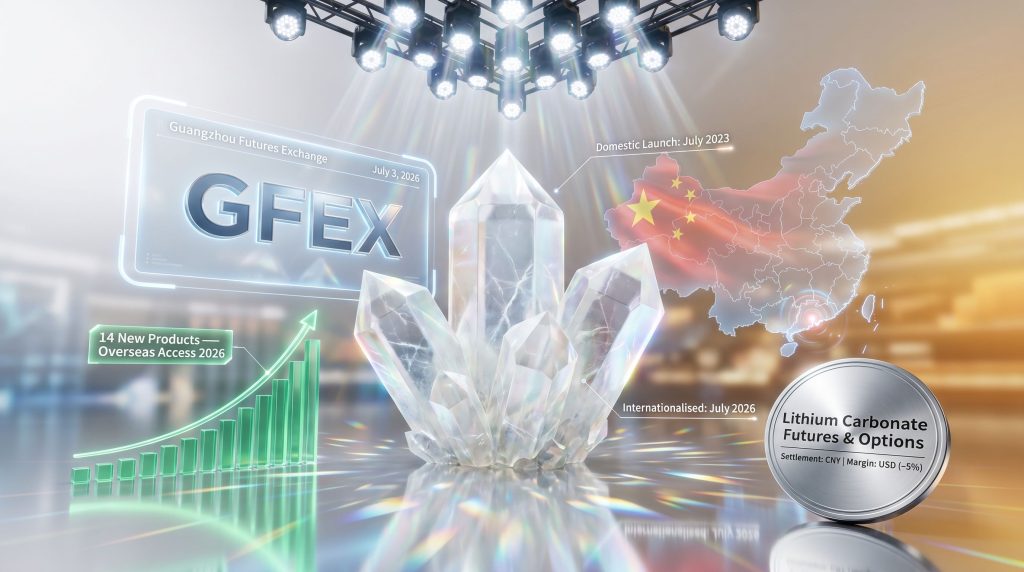
Lithium sits at the centre of this contest. As the foundational input for lithium-ion battery chemistry, its price signals ripple through electric vehicle manufacturing, grid storage investment, and mining project economics across every continent. Whoever anchors the global lithium price benchmark holds significant structural leverage over the entire battery supply chain. That is precisely the context in which China's Guangzhou Futures Exchange announced it would open lithium carbonate futures and options to overseas traders — a move reshaping the global lithium market — beginning July 3, 2026, marking a pivotal moment for China exchange to open lithium futures to overseas traders.
When big ASX news breaks, our subscribers know first
Understanding the GFEX Contract and What Is Actually Being Opened
The Guangzhou Futures Exchange is a relatively young institution, but it has moved quickly to establish itself as the home of China's battery metals derivatives market. Its lithium carbonate futures contract launched domestically in July 2023, making the push toward full internationalisation just three years later a notably compressed timeline by any historical standard.
The specific product being opened is the lithium carbonate futures and options contract, not a lithium hydroxide or lithium metal derivative. This distinction matters significantly for anyone seeking to understand which part of the battery ecosystem is most affected. Furthermore, understanding the underlying lithium carbonate supply-demand dynamics is essential context for any overseas participant evaluating this contract.
- Lithium carbonate is the dominant feedstock for lithium iron phosphate (LFP) battery chemistry, which has become the preferred technology for mass-market EVs and grid-scale storage in China and increasingly in global markets.
- Lithium hydroxide, by contrast, is primarily used in higher-energy-density nickel-manganese-cobalt (NMC) cathode formulations favoured in premium EV segments.
- The GFEX contract therefore has its most direct pricing relevance for LFP battery supply chains, which represent the fastest-growing segment of global battery deployment.
The key structural parameters of the contract are as follows:
| Contract Detail | Specification |
|---|---|
| Exchange | Guangzhou Futures Exchange (GFEX) |
| Contract Type | Lithium Carbonate Futures and Options |
| Domestic Launch Date | July 2023 |
| International Access Date | July 3, 2026 |
| Eligible Contracts | Monthly delivery contracts from July onward |
| Margin Currency | USD accepted (subject to 5% haircut) |
| Settlement Currency | Chinese Yuan (CNY) |
The USD Margin Mechanism: Accessibility With an Embedded Cost
Overseas traders may post US dollar funds as margin collateral, but a 5% haircut is applied to those positions. In practical terms, this means that for every $100 of USD margin posted, only $95 of effective collateral is recognised by the exchange. This is not a trivial consideration.
The haircut introduces a cost-of-carry differential that does not exist for domestic yuan-funded participants, creating a structural asymmetry between local and foreign traders from the outset.
Overseas participants must factor the 5% USD margin haircut into their basis risk calculations. At scale, this differential affects the economics of hedging strategies and carries implications for how tightly foreign positions can track the underlying physical market.
All contracts remain yuan-denominated at settlement, meaning overseas participants carry embedded currency exposure regardless of how margin is posted. Traders with no existing yuan framework will need to either hedge the CNY/USD exposure separately or accept it as part of the overall position. China's official announcement confirms the regulatory intent behind this framework.
The 14-Product Mandate: Situating Lithium Within a Broader Strategy
The opening of GFEX lithium contracts to overseas traders is not a standalone decision. At the start of 2026, China's securities regulator, the China Securities Regulatory Commission (CSRC), identified 14 futures and options products across multiple exchanges for internationalisation. This was a coordinated regulatory programme, not an ad hoc exchange-level initiative.
The lithium carbonate contract follows the April 2026 internationalisation of nickel futures on the Shanghai Futures Exchange (SHFE), which established both the operational template and the political precedent. Nickel's internationalisation provides the most instructive recent case study: it demonstrated that the CSRC's January 2026 mandate was operationally serious, not merely aspirational.
The pattern that emerges across these decisions points to three consistent strategic rationales:
- Benchmark anchoring: By attracting overseas participants to yuan-denominated contracts, China seeks to make its domestic price discovery the de facto global reference for these materials.
- Yuan internationalisation: Each overseas trader who enters a yuan-settled contract is, in effect, expanding the practical use of the renminbi in international trade finance and commodity settlement.
- Competitive response: Western exchanges including the London Metal Exchange and CME Group have both attempted to develop lithium derivatives with limited success in building liquidity. China is moving aggressively while its competitors remain fragmented.
How Competing Global Benchmarks Have Reshaped Commodity Pricing
Historical precedent from China's prior internationalisation efforts provides useful framing for what may follow in lithium markets.
| Commodity | Exchange | Year Internationalised | Impact on Global Pricing |
|---|---|---|---|
| Crude Oil (SC) | Shanghai International Energy Exchange | 2018 | Created a significant Asia-Pacific pricing reference, though WTI and Brent retain dominance |
| Iron Ore | Dalian Commodity Exchange | 2018 | Increased Chinese influence over seaborne spot pricing dynamics |
| Nickel | Shanghai Futures Exchange | April 2026 | Benchmark still in early development phase |
| Lithium Carbonate | Guangzhou Futures Exchange | July 2026 | Impact to be determined by participation and liquidity depth |
The crude oil case is particularly instructive. Despite significant Chinese promotional effort, the Shanghai crude contract has not displaced Brent or WTI as global benchmarks. However, it has created a meaningful Asia-centric pricing reference that influences regional differentials and contract structures.
A similar outcome for lithium — where the GFEX becomes the dominant pricing reference for Asian physical trade even without supplanting every Western mechanism — would still represent a substantial shift in global price formation. Bloomberg's coverage of China's broader commodity futures opening reinforces how significant this shift may prove to be.
Why China's Dominance in Processing Makes This Contract Matter
Unlike crude oil, where pricing power is spread across multiple major producers and consumer blocs, lithium carbonate's supply chain is characterised by extraordinary geographic concentration at the processing stage. While lithium is mined in Australia, Chile, Argentina, and increasingly other jurisdictions, the overwhelming majority of lithium chemical conversion capacity sits inside China.
This processing chokepoint gives the GFEX contract a structural advantage that the Shanghai crude contract never had. Any producer or buyer seeking physical delivery or hedging exposure to refined lithium carbonate must ultimately engage with Chinese processing economics. A futures contract that reflects those economics accurately — and that achieves sufficient liquidity — will have a compelling case to become the global reference price simply because that is where the physical product is actually made.
For Australian spodumene producers, the path from spodumene to lithium salts runs directly through Chinese refiners, making the GFEX contract especially relevant to their hedging frameworks. Similarly, South American brine operators engaged in lithium brine production will need to determine whether yuan-denominated hedging makes operational sense within their cost structures.
The Competitive Landscape: LME, CME, and the Liquidity Problem
Both the London Metal Exchange and CME Group have made attempts to develop credible lithium derivatives products, but neither has yet achieved the liquidity depth needed to serve as a reliable hedging instrument for large-scale market participants.
- The LME introduced lithium hydroxide contracts, targeting the NMC battery segment, but volumes have remained modest and bid-ask spreads wide.
- CME Group's lithium hydroxide swaps offer a dollar-denominated alternative but similarly suffer from thin participation, limiting their utility for anything beyond small speculative positions.
- Neither Western product covers lithium carbonate specifically, leaving the LFP battery chemistry supply chain without a deep Western hedging instrument.
This gap is precisely where the GFEX contract has the most significant opportunity. If overseas participation grows meaningfully after July 3, 2026, the GFEX could achieve a liquidity advantage over Western alternatives within a relatively short timeframe — simply by being the only game in town for LFP-relevant hedging at scale. Innovations in direct lithium extraction could further shift supply-side economics, adding further complexity to how prices are formed globally.
The fragmentation risk is real: multiple competing benchmarks with insufficient liquidity can amplify rather than reduce price volatility by creating basis risk between instruments that are supposed to track the same underlying asset.
The next major ASX story will hit our subscribers first
Regulatory and Compliance Considerations for Foreign Participants
Overseas traders seeking access to GFEX lithium contracts will need to navigate a compliance framework that differs materially from Western exchange participation. Several practical considerations apply:
- Approved intermediary access: Foreign traders will likely require engagement with a CSRC-approved intermediary or broker with cross-border connectivity to the GFEX infrastructure.
- KYC and reporting requirements: Chinese regulatory frameworks impose their own documentation and reporting standards that may differ from those familiar to European or American institutional participants.
- Geopolitical and sanctions risk: Institutional investors subject to compliance frameworks in the US, UK, or EU will need their legal teams to assess whether participation in yuan-denominated Chinese commodity contracts creates any exposure under their operating guidelines.
- Exchange readiness timelines: The July 3 date represents official opening, but practical access for international participants may roll out incrementally as brokers establish connectivity and compliance workflows are validated.
What This Means for Battery Supply Chain Participants
For producers, refiners, battery manufacturers, and EV companies, the internationalisation of the GFEX lithium carbonate contract introduces both opportunity and complexity. On the opportunity side, a liquid futures market for lithium carbonate would allow physical market participants to hedge price exposure in ways that were previously unavailable or deeply impractical.
Long-term offtake contracts could potentially be structured with reference to a transparent exchange price rather than opaque bilateral negotiations, consequently reducing information asymmetry for smaller producers.
On the complexity side, the currency dynamics of yuan-denominated settlement introduce an additional variable into what is already a multi-currency supply chain. A South American miner receiving USD from an Asian buyer — whose customer is hedging on a CNY-settled futures contract — faces a layered currency risk structure that requires careful modelling. In this context, the decision by China exchange to open lithium futures to overseas traders introduces both new tools and new layers of exposure for every participant along the chain.
Disclaimer: This article is intended for informational purposes only and does not constitute financial or investment advice. Commodity futures markets involve significant risk of loss. Past performance of comparable internationalisation efforts does not guarantee similar outcomes for the GFEX lithium carbonate contract. Readers should conduct independent due diligence and consult qualified financial advisers before making any investment or trading decisions.
Frequently Asked Questions
What is the Guangzhou Futures Exchange?
The GFEX is a Chinese commodity exchange that launched lithium carbonate futures domestically in July 2023. From July 3, 2026, it is extending participation rights to overseas traders, making it the first significant internationalised lithium futures venue operating within China's regulated exchange framework.
Can overseas traders use US dollars to trade GFEX lithium futures?
Yes. Foreign participants may post USD as margin collateral, but a 5% haircut reduces the effective collateral value recognised by the exchange. All contracts are denominated and settled in Chinese yuan, creating embedded currency exposure for non-yuan holders.
What is the difference between lithium carbonate and lithium hydroxide in battery applications?
Lithium carbonate is the primary input for LFP battery chemistry, widely used in mass-market EVs and grid storage. Lithium hydroxide is more commonly used in high-nickel NMC batteries found in premium EV applications. The GFEX contract covers lithium carbonate specifically.
How many products did China open to overseas investors in 2026?
China's securities regulator announced 14 futures and options products for overseas investor access at the start of 2026, spanning multiple exchanges and commodity categories including both nickel and lithium carbonate.
Could multiple competing lithium benchmarks fragment global pricing?
This is a credible risk. If the GFEX, LME, and CME products all operate with insufficient liquidity, basis risk between instruments could amplify rather than reduce price volatility across the lithium supply chain. Indeed, the decision by China exchange to open lithium futures to overseas traders makes resolving this fragmentation question more urgent than ever.
Want to Stay Ahead of the Next Major Lithium Discovery on the ASX?
As the global lithium pricing landscape shifts with China's GFEX internationalisation, identifying high-potential ASX lithium opportunities early has never been more critical — Discovery Alert's proprietary Discovery IQ model delivers real-time alerts the moment significant mineral discoveries hit the ASX, transforming complex data across 30+ commodities into clear, actionable insights. Explore how historic discoveries have generated substantial returns on Discovery Alert's dedicated discoveries page, and begin your 14-day free trial today to position yourself ahead of the market.