June 27, 2026
The Hidden Economics of Mineral Wealth: Why Asia-Pacific Needs More Than a Mining Boom
For decades, the global energy transition has been framed primarily as a technology challenge. Yet the deeper structural problem facing Asia-Pacific economies is not a shortage of raw materials but rather a systematic failure to capture the economic value embedded within them. The region sits atop some of the world's most significant deposits of lithium, nickel, cobalt, copper, and rare earth elements, yet the finished batteries, motors, and electronic components manufactured from these materials are largely produced elsewhere, generating employment, industrial capability, and tax revenues in other economies.
This dynamic represents one of the most consequential economic inefficiencies of the clean energy era, and it is precisely this gap that the ADB critical mineral supply chain finance scheme is designed to address. Furthermore, the scheme arrives at a moment when critical minerals and energy security have become central to the strategic agenda of governments across the region.
When big ASX news breaks, our subscribers know first
What the ADB Critical Mineral Supply Chain Finance Scheme Actually Does
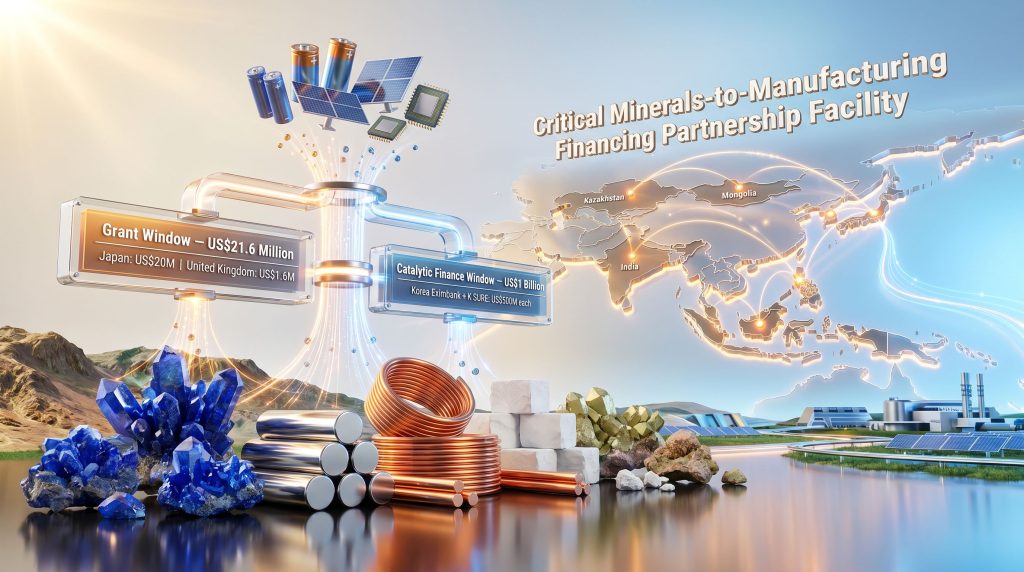
Launched on 4 May 2026 at the ADB's annual meeting in Samarkand, the Critical Minerals-to-Manufacturing Financing Partnership Facility is a multilateral financing mechanism designed to fund the entire development arc of critical mineral supply chains, from early-stage project preparation through to processing, manufacturing, and recycling infrastructure across Asia and the Pacific.
ADB President Masato Kanda framed the initiative in explicitly economic justice terms at the Samarkand meeting. He stated that Asia and the Pacific should be positioned as more than a supplier of unprocessed resources, and that the region deserves to retain the jobs, technology transfer, and economic value that its mineral endowments can generate. He further described the facility as a response to both urgency and fairness, with the goal of enabling developing member countries to participate in advanced manufacturing and build domestic economic opportunity.
This framing reflects a maturation in development finance thinking. Traditional multilateral lending to extractive industries focused predominantly on mine development and export infrastructure. The new facility deliberately extends its mandate to the downstream phases where the majority of economic value is actually created.
The Raw Materials Trap: Understanding Value Leakage in Mineral Supply Chains
To understand why this facility matters, it is necessary to understand how economic value is distributed across a typical critical mineral supply chain. The progression from mined ore to finished product involves multiple stages of transformation, each adding progressively more value per tonne of material processed.
- Extraction and ore processing typically generates the lowest economic return per tonne, while being the most capital-intensive phase for host nations to finance independently.
- Refining and chemical processing (such as converting nickel laterite ore into battery-grade nickel sulphate) captures significantly more economic value and requires more sophisticated industrial infrastructure.
- Component manufacturing (such as cathode active materials, battery cells, and modules) generates substantially higher margins and supports skilled employment ecosystems.
- End-product assembly (electric vehicles, consumer electronics, grid storage systems) delivers the highest value-add per unit of mineral input.
For resource-rich developing economies across Asia-Pacific that currently export raw or minimally processed ore, the economic opportunity cost of this value gap is substantial. Nations including Indonesia, the Philippines, Mongolia, Kazakhstan, and Papua New Guinea possess significant mineral endowments yet have historically lacked the financing mechanisms, technical infrastructure, and regulatory frameworks needed to develop downstream processing capabilities at scale.
The clean energy transition is intensifying this dynamic. The International Energy Agency has consistently noted in its commodity market analyses that global demand growth is concentrated in processed and refined mineral forms, not raw ore, meaning the economic premium for downstream capabilities is increasing over time. According to IEA projections, demand for battery-grade lithium, nickel, and cobalt is expected to grow at multiples of historical extraction rates through 2040, driven by electric vehicle adoption and grid-scale energy storage deployment. Consequently, the battery raw materials market is evolving rapidly in ways that reward nations capable of delivering processed inputs rather than simply mined ore.
Key Minerals and Their Strategic Roles
| Mineral | Primary Application | Notable Asia-Pacific Producers |
|---|---|---|
| Nickel | Battery anodes, stainless steel | Indonesia, Philippines |
| Cobalt | Cathode active materials | Indonesia, Philippines |
| Lithium | EV batteries, grid storage | Mongolia, Philippines, Kazakhstan |
| Rare Earths | EV motors, digital electronics | China, India, Myanmar |
| Copper | Electrical infrastructure, wiring | Mongolia, Philippines, Papua New Guinea |
Note: Production volumes and country rankings are subject to change and should be verified against current USGS Mineral Commodity Summaries for investment decision-making purposes.
A Two-Window Architecture: How the Facility Is Structured
The ADB critical mineral supply chain finance scheme operates through a dual-window model that addresses two fundamentally different financing problems simultaneously.
Window One: Grant Funding for Pre-Commercial Development
The first window provides grant capital to fund the preparatory work that must occur before commercial investment can enter a project. This phase, sometimes described in development finance literature as the project preparation gap, is where many mineral supply chain initiatives stall indefinitely. Without funded feasibility studies, environmental and social impact assessments, technical assistance, and regulatory navigation support, projects cannot achieve the bankability required to attract institutional capital.
Two founding contributors have committed to this window:
- Japan: US$20 million committed to grant-stage project preparation support
- United Kingdom: US$1.6 million committed to grant-stage activities
- Combined grant commitments: US$21.6 million
The grant window addresses what development economists call the pre-investment valley of death, where project risk is highest but the returns are too distant and uncertain for commercial lenders to engage. Public grant capital at this stage does not crowd out private investment; it creates the conditions under which private investment becomes possible.
Window Two: Catalytic Co-Finance for Capital-Intensive Infrastructure
The second window functions as a risk-sharing mechanism to mobilise institutional and private capital for the more capital-intensive phases of processing and manufacturing infrastructure development.
Two founding partners have committed to this window through signed Memoranda of Understanding:
- Korea Eximbank: US$500 million MoU as a founding partner
- Korea Trade Insurance Corporation (K-SURE): US$500 million MoU as a founding partner
- Combined catalytic window MoU commitments: US$1 billion
The participation of both Korea Eximbank and K-SURE within the same facility is structurally significant. Korea Eximbank operates as a development finance institution that can provide direct export credit financing and concessional loans. K-SURE functions as a trade credit insurer, providing political risk coverage and commercial risk guarantees that materially lower the perceived risk profile of projects for co-investors. The combination of direct financing capacity and insurance coverage within a single facility creates a more comprehensive de-risking toolkit than either institution could provide independently.
Important disclaimer: MoU commitments represent expressions of intent and are not necessarily legally binding deployment commitments. The translation of MoU figures into deployed project capital depends on deal origination, due diligence outcomes, and project-level commercial viability assessments.
Financing Architecture Summary
| Window | Function | Lead Contributors | Capital Committed |
|---|---|---|---|
| Grant Window | Pre-commercial project preparation | Japan, United Kingdom | US$21.6 million |
| Catalytic Finance Window | Co-financing and risk mitigation | Korea Eximbank, K-SURE | US$1 billion (MoU basis) |
| Combined Initial Commitments | US$1.021 billion |
The Economic Case for Downstream Investment in Mineral Supply Chains
The economic rationale for multilateral intervention at the processing and manufacturing stage is grounded in several reinforcing arguments that go beyond simple value-addition arithmetic.
Employment generation: Downstream mineral processing and battery manufacturing create significantly more jobs per unit of mineral output than extraction operations. A nickel smelter or lithium refinery requires not only operational labour but supporting ecosystems of engineers, logistics specialists, quality technicians, and maintenance personnel. Battery cell manufacturing facilities are even more labour-intensive and require higher-skilled workforces, generating broader wage premiums across local economies.
Technology transfer and industrial capability: Foreign investment in processing and manufacturing operations brings with it proprietary process technologies, quality management systems, and operational knowledge that gradually diffuses into domestic industrial capacity. Indonesia's experience with nickel laterite processing expansion, while not without controversy regarding environmental and labour standards, illustrates how downstream investment can accelerate the development of a domestic industrial base that would otherwise take generations to build organically.
Supply chain resilience for importing economies: Geopolitical concentration of critical mineral processing in a small number of nations creates systemic vulnerability for economies dependent on those supply chains. The diversification of processing capacity across a broader range of Asia-Pacific nations reduces single-point failure risk and creates more competitive, transparent markets for processed mineral products.
Alignment With Existing ADB Programs
The facility builds upon an existing portfolio of ADB-supported initiatives across the region:
- Battery production development programs in India
- Geological mapping and resource assessment initiatives in Mongolia
- Policy and regulatory reform support in Kazakhstan and the Philippines
These existing programs create project pipelines that the new facility can accelerate, rather than requiring entirely new origination activity from a standing start. In addition, the battery metals investment landscape in these nations is increasingly well-suited to absorb catalytic financing of the kind the facility provides.
Environmental Safeguards and Supply Chain Transparency
One of the facility's structurally important features is the explicit integration of environmental and social safeguards within the grant window itself. By funding environmental and social impact assessments as part of the pre-commercial preparation phase, the facility ensures that projects meeting ADB safeguard standards are identified and developed before they enter the catalytic finance pipeline.
This approach reflects a lesson learned from earlier generations of resource development finance: projects that lack rigorous environmental and social frameworks at inception create reputational and commercial liabilities for all co-investors, regardless of their entry point. By embedding safeguard funding at the earliest stage, the facility creates a quality filter that reduces downstream commercial risk as well as social and environmental harm.
The ADB's Critical Minerals Database, referenced within the facility's design, also serves a transparency function that benefits institutional investors. Supply chain visibility reduces due diligence costs, enables investors to assess exposure to specific geographies and mineral types, and builds the long-term investor confidence necessary to sustain capital flows to the sector over multiple market cycles.
The next major ASX story will hit our subscribers first
How the ADB Facility Compares to Other Global Critical Minerals Finance Initiatives
The facility occupies a distinct position within an increasingly crowded landscape of multilateral and bilateral critical minerals financing programmes. However, understanding where the ADB scheme sits relative to comparable initiatives helps clarify its unique structural contribution to the critical minerals demand challenge.
| Initiative | Lead Institution | Geographic Focus | Primary Mechanism | Approximate Scale |
|---|---|---|---|---|
| ADB Critical Minerals Facility | Asian Development Bank | Asia-Pacific | Grant + catalytic co-finance | US$1B+ (initial) |
| Minerals Security Partnership | US-led multilateral coalition | Global | Government co-investment | Multi-billion (unspecified) |
| EU Critical Raw Materials Act | European Commission | EU + partner nations | Regulatory + strategic reserves | Regulatory framework |
| IFC Mining Finance | World Bank Group | Global emerging markets | Direct equity and debt | Project-by-project |
The ADB facility's structural advantage lies in its dual-window design, its deep member country relationships across Asia-Pacific, and its integration of grant-stage preparation with catalytic commercial co-financing. Unlike purely regulatory frameworks or standalone government co-investment programmes, it addresses the full financing lifecycle of supply chain development within a single institutional mechanism. The critical raw materials facility operating under the EU framework offers a useful point of comparison, though its primary orientation toward European supply security differs meaningfully from the ADB's development mandate.
Risks and Limitations Investors and Policymakers Should Monitor
No multilateral financing initiative operates without execution risk, and the ADB's new scheme carries several structural vulnerabilities worth tracking:
- MoU-to-deployment conversion: The gap between signed MoUs and actual capital deployment is a known challenge in development finance. The US$1 billion in Korean institutional commitments represents intent, not guaranteed deployment, and project-level commercial viability must still be established.
- Permitting and infrastructure bottlenecks: Processing and manufacturing facilities in developing economies often face significant permitting delays, infrastructure gaps (power, water, transport), and workforce skill shortages that extend project timelines and increase capital costs beyond initial estimates.
- Commodity price volatility: The commercial viability of mineral processing investments is sensitive to spot and forward prices for both input commodities and processed products. A sustained downturn in battery metal prices can undermine the investment case for facilities that appeared commercially robust at appraisal.
- Governance quality in recipient nations: The effectiveness of the facility in generating genuine economic development outcomes depends substantially on the quality of governance, rule of law, and anti-corruption frameworks in recipient countries. Facility participation does not automatically address pre-existing governance deficiencies.
- Environmental and social execution risk: Even with funded impact assessments, implementation of environmental and social management plans during construction and operations remains a challenge that requires sustained monitoring and enforcement capacity.
This article contains forward-looking analysis based on publicly available information. It does not constitute financial or investment advice. Readers should conduct their own due diligence and seek professional advice before making investment decisions related to critical mineral supply chains or associated securities.
Frequently Asked Questions: ADB Critical Mineral Supply Chain Finance Scheme
What is the ADB Critical Minerals-to-Manufacturing Financing Partnership Facility?
It is a multilateral financing mechanism launched by the Asian Development Bank on 4 May 2026, at the annual meeting in Samarkand, designed to fund critical mineral supply chain development across Asia and the Pacific, from project preparation through to processing, manufacturing, and recycling infrastructure.
How much funding has been committed to the facility so far?
Initial commitments total approximately US$1.021 billion, comprising US$500 million MoUs from Korea Eximbank and K-SURE respectively, plus US$20 million in grants from Japan and US$1.6 million from the United Kingdom.
Which minerals does the facility target?
The facility focuses on minerals critical to clean energy, electric vehicles, and digital technology supply chains, including nickel, cobalt, lithium, rare earth elements, and copper.
Who announced the facility and where?
ADB President Masato Kanda announced the facility at the ADB's annual meeting held in Samarkand.
What is the difference between the two financing windows?
The grant window funds pre-commercial activities including feasibility studies and environmental assessments to prepare projects for commercial investment. The catalytic finance window mobilises co-investment and risk-sharing from institutional and private sector partners to fund capital-intensive infrastructure.
Which countries have existing ADB mineral sector programmes that align with the new facility?
India, Mongolia, Kazakhstan, and the Philippines each have active ADB-supported projects in areas including battery production development, geological mapping, and policy reform that align with the new facility's objectives.
Want to Know Which ASX Mineral Discoveries Could Benefit From the Critical Minerals Boom?
As demand for battery metals and critical minerals accelerates across Asia-Pacific, Discovery Alert's proprietary Discovery IQ model delivers real-time alerts on significant ASX mineral discoveries — instantly translating complex geological data into actionable investment insights. Explore historic discovery returns on Discovery Alert's dedicated discoveries page and begin your 14-day free trial today to position yourself ahead of the next major find.